
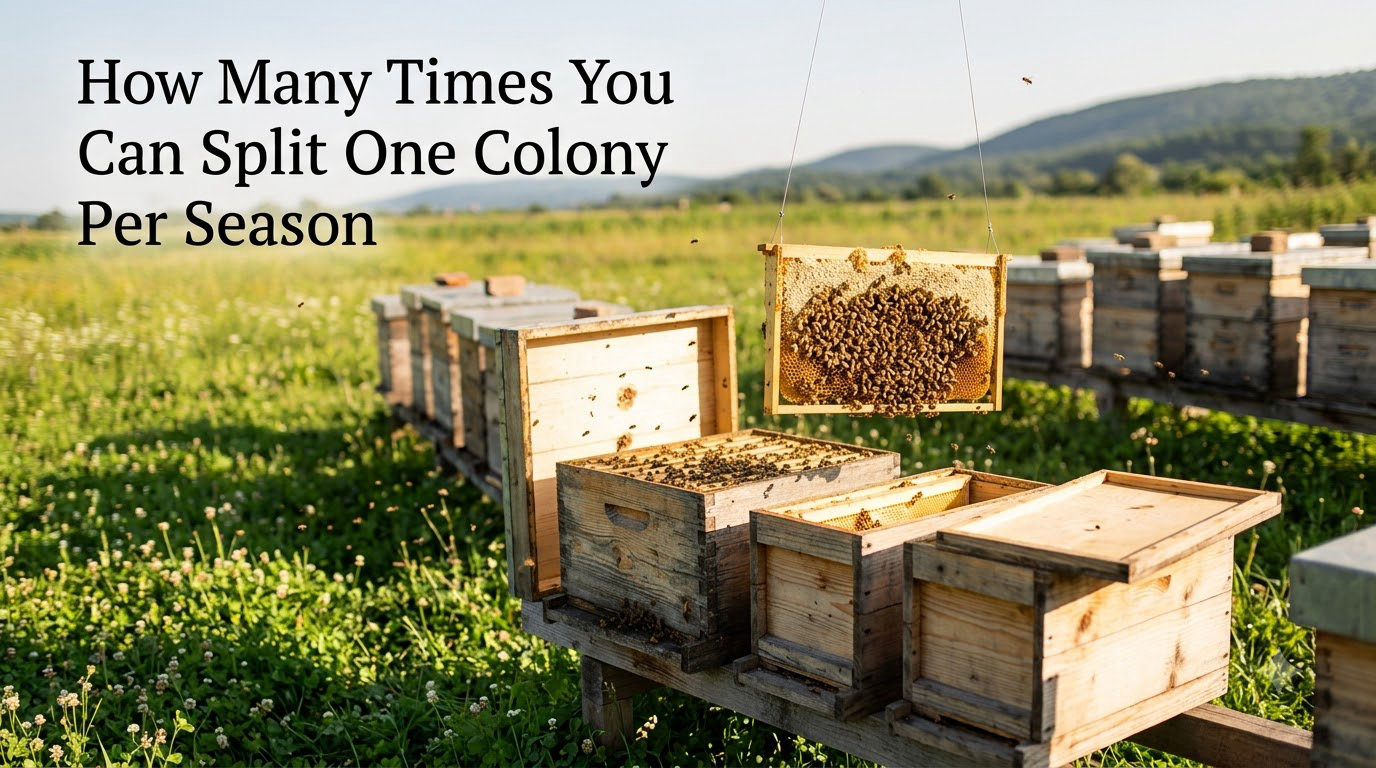
If you have ever stood in front of an overwintered colony in early spring and wondered how many splits you can realistically pull from it, you are not alone. After running a small operation for nearly a decade and talking with dozens of beekeepers across climate zones, I have found one number keeps coming up as the practical answer: 3 to 5 splits per strong colony per season. That range works for both hobbyists expanding their apiary and sideliners selling nucleus colonies.
But that single number leaves out a lot of detail. The truth is that the answer depends on colony strength, your climate, the timing of your local nectar flow, and whether you are willing to buy mated queens or raise your own. In this guide I will break down exactly how many times you can split one colony per season, what factors change that count, and how to manage the process without weakening your original hive.
By the end of this article, you will have a clear target range, a Day 1 to Day 45+ split timeline, three proven splitting methods, and answers to the most common questions beekeepers ask about colony increase.
Table of Contents
How Many Times Can You Split One Colony Per Season?
The short answer is 3 to 5 splits per strong, overwintered colony in a typical beekeeping season. Beginners should aim for 2 to 3 splits from each hive, while experienced beekeepers with strong genetics and good timing can push toward 5. The theoretical upper limit is closer to 10 splits from a single double-brood colony, but achieving that requires perfect conditions and considerable labor.
Here is how the ranges break down in practice:
- Beginner range: 2 to 3 splits per strong colony. This keeps the original hive healthy and lets you learn the process without overextending.
- Experienced range: 3 to 5 splits per strong colony. This is the most common target for sideliners and small commercial operations.
- Maximum theoretical: Up to 10 splits from a single double-brood hive. I have read forum reports of 80 nucs pulled from one massive colony in a single season, but those cases require extensive resources and near-perfect conditions.
- Minimum practical: At least 1 split per strong colony. If your hive is healthy and you do not split at all, you risk losing bees to swarming anyway.
Three things determine where you fall within these ranges: how many brood frames your colony has, how strong your local nectar flow is, and how quickly you can requeen splits that fail to raise their own queen. Our team has found that most backyard beekeepers land between 3 and 4 splits when conditions are average.
What Factors Affect How Many Splits You Can Make?
Several variables push the number up or down. Understanding each one helps you set a realistic split count before you open the hive.
Colony strength and population. A hive coming out of winter with 8 to 10 frames of bees can support more splits than one with only 4 to 5 frames. I always count frame coverage before I plan my splits, because underpopulated colonies cannot keep brood warm enough to recover.
Brood frame availability. Every split needs at least 2 frames of capped brood, 1 frame of eggs and young larvae, and 1 frame of honey and pollen. If your donor colony only has 6 brood frames total, your practical maximum is 2 splits, not 5.
Drone population. New queens need to mate with 10 to 20 drones during their mating flights. If your area has low drone numbers, your splits may fail to produce viable queens, which caps your realistic split count.
Nectar flow timing. Splits made right before a strong nectar flow recover faster. Splits made during a dearth need constant feeding and often lag behind. Plan your splits 4 to 6 weeks before your main flow for best results.
Climate and length of season. Beekeepers in the southern United States can sometimes squeeze in 4 to 5 splits because their season runs 8 to 9 months. Northern beekeepers often cap out at 2 to 3 splits before fall preparation begins.
7 Signs Your Colony Is Ready to Be Split
I watch for these seven signals every spring before I make my first cut. If your hive shows 5 or more, it is ready.
- Eight or more frames covered with bees. This is the minimum population for a safe split.
- Queen cells present on the comb. Swarming instinct is already engaged, and the colony wants to divide.
- Drones flying and visible in the hive. Drones appear about 4 weeks before peak mating conditions.
- Crowded brood nest with backfilled cells. Bees packed shoulder-to-shoulder on every frame signal congestion.
- Bearding at the hive entrance on cool evenings. Workers cannot fit inside the box, even at night.
- Strong orientation flights at midday. Indicates a healthy, expanding population.
- Three or more frames of capped brood. Gives the split enough emerging bees to sustain itself.
If your colony only shows 2 or 3 of these signs, wait another 2 to 3 weeks. Forcing a split on a borderline hive usually produces a weak split and weakens the donor colony too.
When Is the Best Time to Split a Colony?
Timing matters more than most beekeepers realize. Split too early and the colony cannot keep new brood warm. Split too late and the new queen has no time to mate and lay before fall.
The ideal window is 4 to 6 weeks before your main nectar flow. For most of the northern United States and Canada, that means late April through mid-May. For southern climates, late February through March works well.
I learned the hard way that splitting right at the start of the nectar flow is a mistake. The foragers return to the original hive, leaving your split with too few field bees. Aim to finish your splits at least 2 weeks before the main flow so populations have time to rebalance.
It is also too late to split when fewer than 8 to 10 weeks remain before your first frost. A new queen needs about 4 weeks to mate and start laying, and her offspring need another 4 to 6 weeks to build up winter population.
Day 1 to Day 45+ Split Timeline: What to Expect
This is the timeline I follow for both walk-away splits and queen-right splits. I have built this table based on Utah State University Extension guidance and my own split logs over the past 6 years.
| Day | Walk-Away Split (no queen) | Queen-Right Split (queen added) |
|---|---|---|
| Day 1 | Place 2-3 frames of brood and bees into nuc box; queenless split raises emergency cells | Place mated queen in cage; release after 3-4 days |
| Day 4 | Inspect for emergency queen cells on brood; remove all but 1-2 best cells | Queen released from cage; begin laying within days |
| Day 8 | Queen cells capped; colony continues to raise queen | Confirm queen is laying; check for eggs in worker cells |
| Day 16 | Virgin queen emerges from cell | Brood pattern should be visible and expanding |
| Day 20-28 | Mating flights begin (weather permitting) | Brood frames increasing steadily |
| Day 28-35 | Queen should be mated and returning to hive | Strong worker population building |
| Day 35-42 | First eggs visible in worker cells | Split approaching self-sufficiency |
| Day 45+ | Capped brood from new queen visible | Ready to be evaluated for honey production or further splits |
If your walk-away split has no eggs by Day 42, the queen likely failed to mate. Combine that split back with a stronger hive or give it a frame of eggs to try again. I keep mated queens on hand every spring for exactly this situation.
How to Split a Bee Colony: 3 Proven Methods
There are three splitting methods I use regularly. Each works for a different situation, and most beekeepers end up using a mix depending on the colony.
Method 1: Walk-Away Split
The walk-away split is the simplest method and a good starting point for beginners. Move 2 to 3 frames of brood, 1 frame of honey and pollen, and the adhering bees into a new nuc box. The original hive keeps the queen. The split has no queen and must raise one from emergency cells on the brood frames.
This method works best on strong hives with plenty of eggs and young larvae. The downside is the 4 to 6 week delay before the new queen starts laying, and the risk of queen failure.
Method 2: Swarm-Control Split
The swarm-control split doubles as swarm prevention. When you see queen cells on the bottom of frames, remove 2 to 3 frames with cells attached and place them in a nuc box along with supporting frames of brood and resources.
The original colony, now without swarm cells, usually settles down and continues building. The split gets a head start because the queen cells are already mature. This is my preferred method in late spring.
Method 3: Sister Split or Double Split
For experienced beekeepers pushing toward 4 or 5 splits per colony, the sister split works well. Divide one strong colony into two equal halves, each with 4 to 5 frames of brood and bees. Give one half a purchased mated queen and let the other half raise its own.
This method requires buying queens or having a queen-rearing operation. It is the fastest way to multiply your colonies, but the upfront cost is higher.
Regional Timing: Climate Zone Adjustments
Where you live changes everything about split timing. A beekeeper in Florida and a beekeeper in Minnesota both want 3 to 5 splits per colony, but they hit that target on very different calendars.
Northern climates (USDA zones 3-5): Split between late April and mid-May. You will likely get 2 to 3 splits per colony before mid-July, when fall prep begins.
Mid-Atlantic and Midwest (zones 5-7): Split from late March through April. Most beekeepers in these zones hit 3 to 4 splits per colony.
Southern climates (zones 7-9): Split from late February through March. Some beekeepers in the deep south pull 4 to 5 splits per colony and still have time for a fall nectar flow.
Coastal and Pacific Northwest: Timing depends heavily on your local bloom calendar. Watch blackberry bloom and adjust accordingly.
Should You Split a First-Year Colony?
Most experienced beekeepers agree: do not split a first-year colony. A package or nuc installed in spring needs the entire season to draw comb, build population, and store enough honey to survive winter.
Splitting a first-year hive almost always results in two weak colonies that both struggle to overwinter. I made this mistake in my second year and lost both halves. Wait until the colony has successfully overwintered once before splitting.
The exception is a swarm cell split taken in late spring from a package that exploded in growth. Even then, I would only take one split and only if the original colony has 8 or more frames of bees.
Feeding and Managing Splits After Creation
New splits cannot feed themselves. Until the new queen is laying and the population is climbing, you need to provide supplemental food.
Syrup feeding: Feed a 1:1 sugar-to-water syrup continuously for the first 3 to 4 weeks. Place a boardman feeder or top feeder on the nuc and refill every 3 to 5 days.
Pollen patties: If your local pollen is scarce, add a pollen substitute patty directly on top of the brood frames. This supports nurse bee development and brood production.
When to stop feeding: Once the split has 4 to 5 frames of brood and a steady nectar flow is underway, you can taper off. Continuing to feed indefinitely can cause the split to backfill the brood nest with syrup, which limits the queen’s laying space.
Watch: Splitting a Bee Colony Step-by-Step
Reading about splits is one thing. Seeing the process in action is another. This video from the University of Guelph Honey Bee Research Centre walks through the walk-away split method with clear visuals and timing notes.
Pause at the 4:30 mark to see how to identify emergency queen cells, and again at 11:15 for the inspection schedule through Day 30. The video shows the same timeline I use in my own apiary.
Frequently Asked Questions About Colony Splitting
How many times can I split a hive?
You can split a strong, overwintered colony 3 to 5 times in a single season. Beginners should aim for 2 to 3 splits, while experienced beekeepers can push toward 5 with good timing and resources. The theoretical maximum is closer to 10 splits, but that requires perfect conditions and significant labor.
What is the 3 3 3 rule for bees?
The 3-3-3 rule is a beginner-friendly guideline that suggests waiting until you have 3 pounds of bees, 3 frames of brood, and 3 frames of honey before adding a third deep box. It applies more to hive expansion than splitting, but it reflects the same population thresholds needed for a healthy split.
Does splitting a hive prevent swarming?
Yes, splitting is one of the most effective swarm prevention techniques. By removing queen cells and dividing the population before congestion peaks, you address the two main triggers for swarming: crowding and the swarming instinct. Many beekeepers split specifically to control swarms rather than to increase hive numbers.
When is it too late to split a hive in spring?
It is too late to split when fewer than 8 to 10 weeks remain before your first frost. A new queen needs about 4 weeks to mate and start laying, and her offspring need another 4 to 6 weeks to build a winter-ready population. Splitting later than this usually produces a colony too weak to overwinter.
Can you split a hive twice in one year?
Yes, you can split a hive twice or more in one year. A strong overwintered colony commonly supports 3 to 5 splits in a single season, and experienced beekeepers sometimes push higher. The exact number depends on colony strength, nectar flow timing, and your climate zone.
Should I split before or after the nectar flow?
Split 4 to 6 weeks before your main nectar flow for best results. Splits made too early struggle to keep brood warm. Splits made during the flow lose foragers back to the parent hive. The 4 to 6 week window gives the split time to rebalance population and the new queen time to start laying before the flow peaks.
Final Thoughts on Colony Splitting Frequency
If you remember nothing else from this guide, remember this: the realistic answer to how many times you can split one colony per season is 3 to 5 splits per strong, overwintered colony. Beginners should stay closer to 2 or 3, and experienced beekeepers with good resources can push toward 5. The theoretical ceiling of 10 splits exists, but it is rarely worth the extra labor and risk.
Plan your splits 4 to 6 weeks before your main nectar flow, confirm the colony shows 5 or more readiness signs, and keep mated queens on hand for failed walk-away splits. Use the Day 1 to Day 45+ timeline to track progress, and feed your splits until they reach self-sufficiency.
Colony splitting is one of the most rewarding skills in beekeeping. Done well, it lets you expand your apiary, prevent swarms, and even generate income from selling nucs. Start with one strong colony this season, pull 3 splits, and see how your numbers grow by fall. You will be surprised how quickly a single healthy hive can multiply into a thriving operation when you give it the right support.