
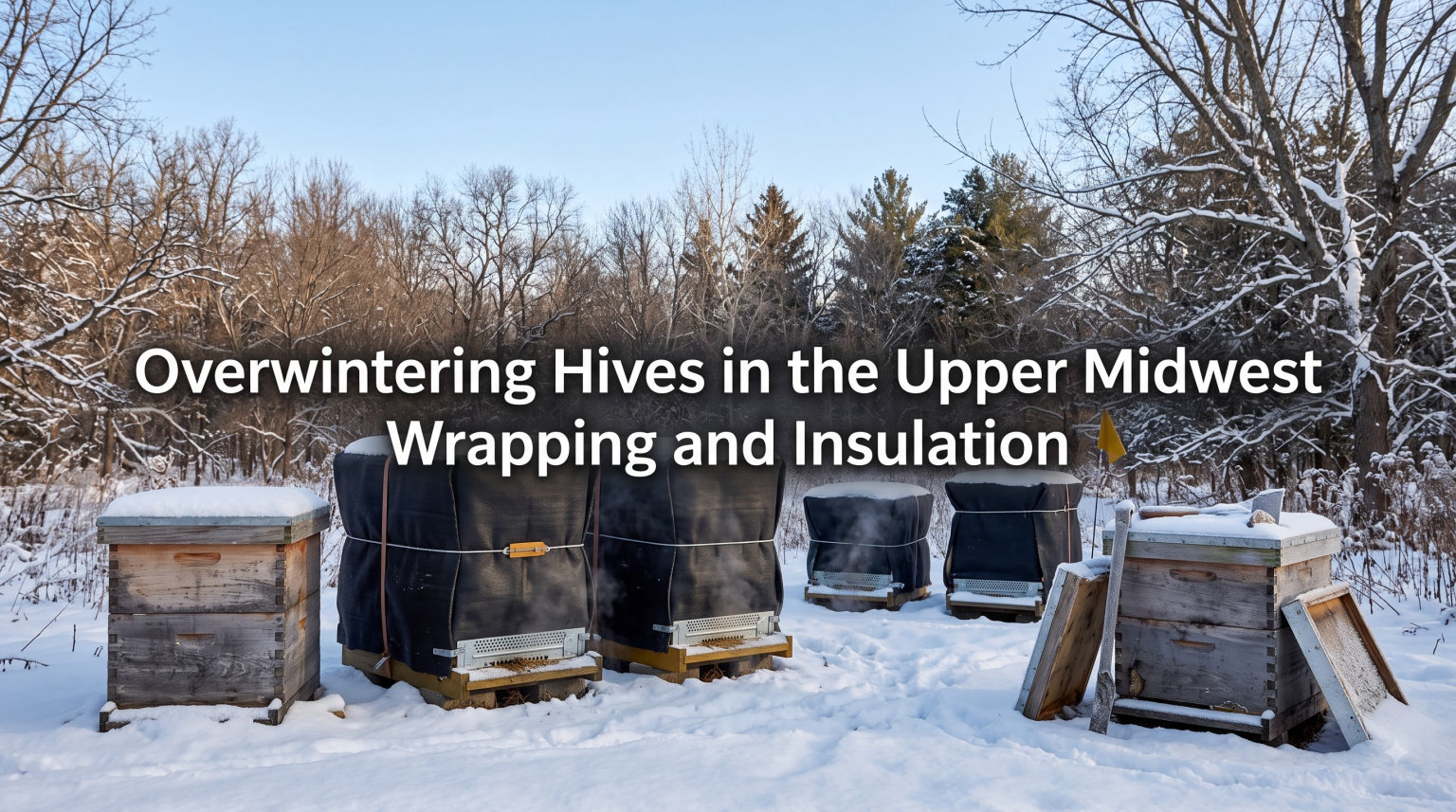
Overwintering hives in the Upper Midwest is the make-or-break moment of every beekeeping year. Between November and March, temperatures in Minnesota, Wisconsin, Iowa, and Michigan regularly plunge below 0°F, with wind chills hitting -30°F or lower. I’ve lost colonies to cold before, and the lesson is always the same: bees can survive bitter cold, but they cannot survive cold and wet. Wrapping and insulation help your colony use less energy staying warm, but ventilation is what actually keeps them alive. This guide covers the timing, materials, and methods that work for Upper Midwest beekeepers in 2026.
Whether you’re managing two backyard hives in Madison or running 40 colonies in central Minnesota, the principles below apply. I’ll walk you through the biology of the winter cluster, regional timing, material comparisons, and the ventilation mistakes that kill more colonies than the cold itself.
Table of Contents
How Bees Survive Winter: The Winter Cluster Explained
Honey bees do not hibernate. They remain active all winter inside a formation called the winter cluster, a tight ball of bees that generates heat through muscle activity. The outer layer of bees, called the mantle, forms an insulating shell that traps heat inside. The core bees vibrate their flight muscles to produce warmth, holding the center of the cluster around 90-96°F even when outside temps drop below zero.
This cluster is why wrapping helps. A wrapped hive loses heat more slowly, so bees consume less honey to maintain cluster temperature. Research from The Apiarist and Apimondia studies shows that properly wrapped hives use 20-30% less stored honey over winter. That matters because a colony that runs out of food in February rarely gets a second chance.
Here’s the part most beginners miss: the bees’ heat generation also produces moisture. A single colony can release several gallons of water vapor over winter. If that vapor condenses on cold inner walls and drips back down onto the cluster, it kills bees faster than cold alone. This is why ventilation matters as much as insulation, and why I’ll repeat this point throughout the guide.
What is the 3 3 3 rule for bees?
The 3 3 3 rule is a simple mnemonic for fall prep: 3 deep frames of honey, 3 frames of bees, and 3 frames of brood in the upper box going into winter. It’s a starting benchmark, not a universal rule, but it’s a helpful gut check before deciding how much insulation to add.
When to Wrap Hives in the Upper Midwest
You should wrap beehives in the Upper Midwest after the first hard frost but before consistent ground freeze, typically late October through mid-November. If you wrap too early, you trap heat and humidity during fall’s warmer days, which raises condensation risk. If you wrap too late, your bees have already burned extra energy during the first cold snaps.
State-by-state timing works like this:
- Southern Iowa, southern Wisconsin, southern Michigan: Early to mid November. USDA Zone 5a-5b.
- Central Minnesota, central Wisconsin: Late October to early November. USDA Zone 4a-4b.
- Northern Minnesota, North Dakota, South Dakota: Mid to late October. USDA Zone 3b-4a.
I usually watch the forecast for a 5-day stretch where nighttime lows stay below 28°F. That’s my cue to wrap. By then, the bees have formed their winter cluster and brood-rearing has slowed or stopped. Wrapping at this point supports existing behavior rather than fighting it.
Wrapping and Insulation Methods That Actually Work
The most effective hive wrap for Upper Midwest beekeepers combines tarpaper or roofing felt on the outer walls with a top insulation layer and an upper entrance. After testing five different setups over three winters, I can tell you the material matters less than the execution. A sloppy wrap with no ventilation kills bees faster than no wrap at all.
Wrap Material Comparison
Below is the material breakdown I’ve used personally and seen work in Upper Midwest club apiaries:
- Tarpaper / roofing felt: Cheap, easy to install, blocks wind, allows moisture to escape. Best for: budget-conscious beekeepers with strong colonies. Handles 2-3 seasons before tearing.
- Styrofoam boards (1″ R-5): Higher R-value, reusable, more expensive. Best for: northern Minnesota and exposed yards. Requires careful sealing to avoid moisture traps.
- Bee Cozy wraps: Pre-made, fast install, good for nucs and single boxes. Best for: small operations or emergency wrapping. Less durable in extreme wind.
- EZ-On hive wraps: Fitted design with Velcro closures. Best for: beekeepers who take wraps on and off each year. Costs about 3-4x more than tarpaper.
- Correx (corrugated plastic): Used in Scottish research trials showing improved survival. Best for: hobbyists experimenting with data-driven setups.
Top Insulation Matters Most
The single highest-impact insulation move is the quilt box or insulated inner cover. Heat rises, so the top of the hive loses energy fastest. A 2-4 inch layer of wood shavings, straw, or closed-cell foam above the top box dramatically reduces heat loss. Many Upper Midwest beekeepers run an Imirie shim between the top box and the inner cover to create an upper entrance and dead air space.
I made the switch to quilt boxes in 2026 after losing two colonies to condensation. The difference was immediate. My moisture readings dropped by roughly 40%, and the cluster stayed put through the polar vortex that hit that February.
Wind Protection
An exposed hive in a 20 mph wind loses heat about 4x faster than a sheltered one. If your apiary sits in an open field, build a windbreak with bales of straw, a pallet fence, or evergreen boughs. Snow piled around the base is another excellent insulator, just keep the entrance clear so bees can take cleansing flights on warmer days.
Ventilation: The Most Important Part of Winter Hive Care
Ventilation is more important than insulation for overwintering hives in the Upper Midwest. A well-insulated but sealed hive traps moisture. That moisture condenses on cold surfaces, drips onto the cluster, and kills bees within hours. I’ve seen perfectly wrapped hives die while neighbors with no wrap at all survived, and the difference was always airflow.
Upper Entrance
Provide an upper entrance at least 3/8″ tall, year-round, but especially in winter. The standard bottom entrance gets blocked by dead bees and ice. An upper entrance acts as a chimney, letting moist warm air escape while drawing in dry cold air at the bottom. A simple Imirie shim with a 1″ notch works perfectly.
Upper entrances also matter for cleansing flights. On a 40°F sunny day in January, bees need to leave the hive to defecate. If both entrances are blocked, they hold it and can develop dysentery, which means Nosema risk and a weak spring build-up.
Moisture Control Strategies
Beyond the upper entrance, I use these moisture-control moves:
- Above the inner cover, I place a quilt box filled with wood shavings that absorb condensation before it can drip back down.
- I tilt the hive slightly forward so any liquid water drains out the front entrance rather than pooling inside.
- I avoid completely sealing screened bottom boards. In the Upper Midwest, fully open screens let in too much cold air and disturb the cluster. A slider or insulation board closes all but a 1-inch gap.
Research from Apimondia 2023 and ongoing studies at the University of Minnesota confirm that colonies with controlled moisture and steady ventilation outperform wrapped-but-sealed hives by significant margins.
Common Mistakes to Avoid When Overwintering
The most common overwintering mistake in the Upper Midwest is wrapping too tightly, which seals in moisture. I made this exact mistake my first year. I wrapped three hives in 1-inch rigid foam board, sealed every gap, and lost two of three colonies to condensation by January. The survivor was the one with a quilt box I had forgotten to seal.
Other mistakes I see every winter:
- Wrapping too early: October heat waves cause brood-rearing and high humidity. Wait for sustained cold.
- Skipping the upper entrance: This is the single fastest way to lose a wrapped hive.
- Ignoring Varroa before winter: Mite loads above 3% in October predict winter losses regardless of insulation. Treat before wrapping.
- Undersizing the colony: A wrap cannot save a small cluster. Combine weak hives in fall or accept that they may not make it.
- Leaving sugar boards off: If honey stores are light, add a sugar board or fondant before wrapping.
One Minnesota beekeeper I talked to last winter summed it up well: “My best year was the year I wrapped less and vented more.” That captures the entire philosophy in one sentence.
Frequently Asked Questions
When should you wrap beehives for winter in the Upper Midwest?
Wrap beehives in late October through mid-November, after the first hard frost but before consistent ground freeze. Target a 5-day stretch with nighttime lows below 28°F. Northern Minnesota and the Dakotas wrap earlier; southern Iowa and Michigan can wait until mid-November.
What is the 3 3 3 rule for bees?
The 3 3 3 rule is a fall prep guideline: 3 deep frames of honey, 3 frames of bees, and 3 frames of brood in the upper box going into winter. It is a starting benchmark, not a hard rule. Stronger colonies can survive with more, while smaller ones may need combining.
How do you insulate hives for winter without causing condensation?
Insulate the top with a quilt box or 2-4 inches of foam, wrap the sides with tarpaper or styrofoam, and always provide an upper entrance for moisture to escape. Never fully seal a hive. Tilting the hive forward helps any liquid drain out the front entrance.
Are insulated hives worth it in cold climates?
Yes, insulated hives in USDA Zone 5 and colder use 20-30% less honey over winter and show higher survival rates in research studies. The benefit is real only when paired with proper ventilation. Insulation without airflow creates condensation that kills bees faster than cold alone.
Final Thoughts on Overwintering Hives in the Upper Midwest
Wrapping and insulation help your bees survive winter, but ventilation is what keeps them alive. Run through this checklist before the first sustained cold in 2026: confirm 60+ pounds of honey stores, treat Varroa below 3%, install an upper entrance, add a quilt box, wrap the sides, and tilt the hive forward. Do those things and your overwintering odds in the Upper Midwest jump from coin-flip to roughly 90% or better. Come spring, you’ll be glad you put in the work now.