
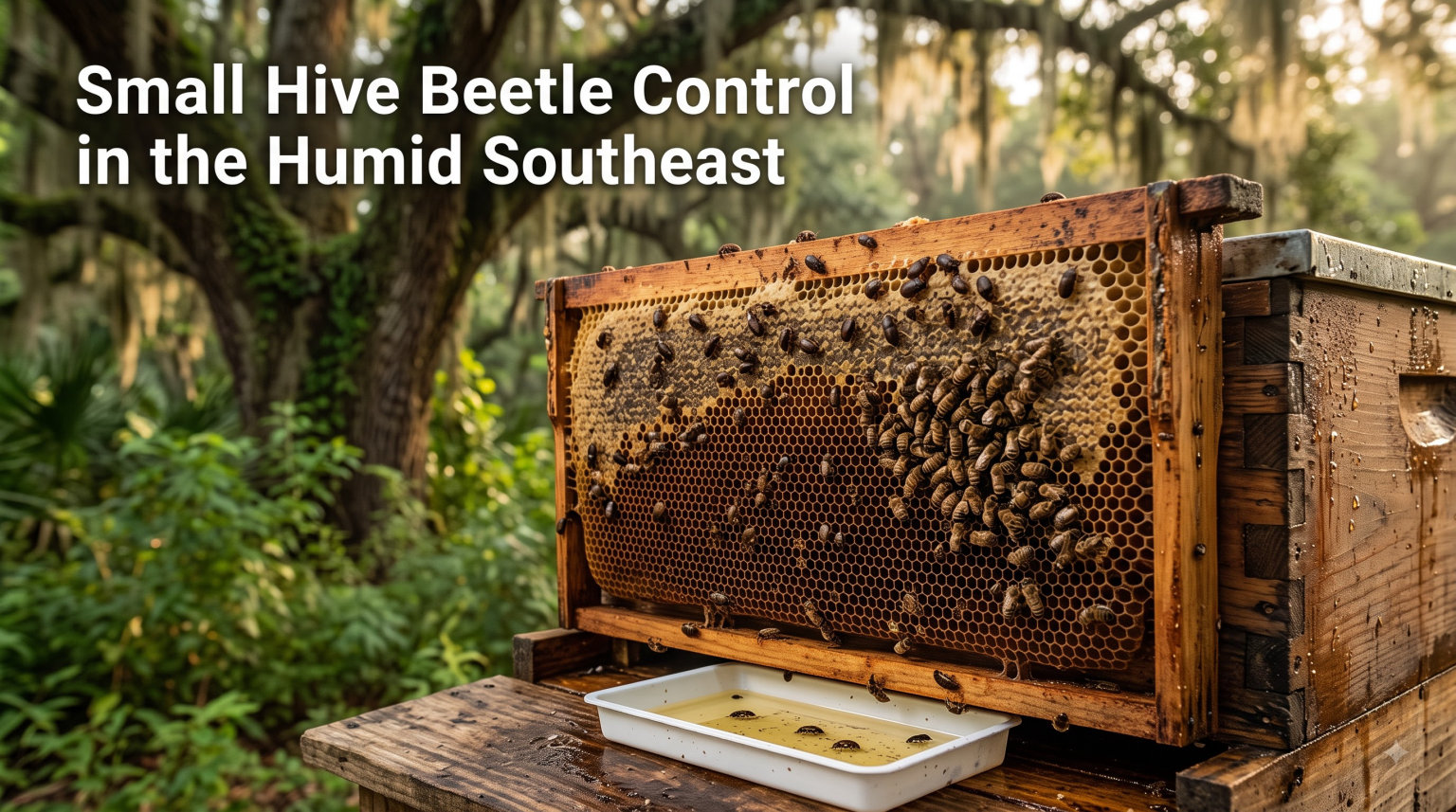
If you keep bees anywhere from Virginia down through Florida and across to Louisiana, the small hive beetle (Aethina tumida) is probably the pest you think about most. Our long warm season and constant humidity create the exact conditions this invasive beetle loves. Small hive beetle control in the humid Southeast is not a one-time fix but a year-round management commitment.
I have talked with dozens of beekeepers across Georgia, Florida, and the Carolinas, and the story is always the same. A colony looks fine on a Tuesday inspection, and by the following weekend the comb is slimy, the honey is fermenting, and the larvae are pouring out the entrance. Weak colonies can collapse in under 10 days once beetles get the upper hand.
This guide walks through everything you need to know: how to identify the beetle at every life stage, why humidity is the core problem, and which prevention and control methods actually work in our climate. I will also share a Southeast-specific management calendar so you know when to act and what to watch for each season.
Table of Contents
What Is the Small Hive Beetle?
The small hive beetle, or SHB, is a member of the sap beetle family (Nitidulidae) and is native to sub-Saharan Africa. It was first detected in the United States in the late 1990s and has since spread aggressively through the southeastern states. The beetle thrives here because our climate mirrors the warm, moist conditions of its native range.
Learning to recognize the beetle at each life stage is the first step in any effective control program. Adults, larvae, and eggs all look different and require different responses.
Adult Beetles
Adult small hive beetles are roughly one-third of an inch long, oval-shaped, and dark brown to nearly black. Their most identifying feature is the pair of clubbed antennae and the short wing covers (elytra) that leave the tip of the abdomen exposed. When you open a hive, you will see adults scurry for cover, darting into corners, under the inner cover, and into crevices between frames. They move fast and prefer dark, tight spaces.
Larvae
SHB larvae are the destructive stage. They are cream-colored, legless grubs that grow to about half an inch long. The body has a distinct ridged back with rows of small brown spines running across each segment. These spines are the key feature that distinguishes SHB larvae from wax moth larvae, which are smooth-bodied. SHB larvae also have three pairs of small legs near the head, while wax moth larvae have true prolegs along the body.
Another lookalike to watch for is the dusky sap beetle, which is similar in size but feeds on overripe fruit rather than bee colonies. If you are uncertain, the setting matters: if the beetle is inside your hive, treat it as a small hive beetle.
Eggs
Female beetles lay tiny, pearly-white eggs in clusters inside crevices, behind the hive wall, or directly in comb that bees cannot reach. The eggs are similar in size to honey bee eggs but are laid in irregular masses rather than individually. You will rarely see them without close inspection of hidden areas.
Small Hive Beetle Life Cycle in Humid Climates
The SHB life cycle has four stages: egg, larva, pupa, and adult. In the warm, humid Southeast, this cycle can complete in as little as three weeks during peak summer heat. That speed is why populations seem to explode overnight.
Adult females can lay up to a thousand eggs over their lifespan. They prefer to lay eggs in protected spots where worker bees cannot police them. Once the eggs hatch, larvae begin tunneling through comb, feeding on pollen, honey, and brood. After feeding for 10 to 14 days, mature larvae leave the hive through the entrance and burrow into the soil to pupate.
Pupation happens in the top few inches of soil around the hive. This is where humidity plays an enormous role. The soil needs adequate moisture for pupae to develop. In the Southeast, where ground moisture stays high much of the year, pupation success rates are elevated. New adults emerge from the soil in one to three weeks, fly back to the hive, and the cycle repeats.
Here is the principle that matters most for control: SHB eggs are extremely susceptible to desiccation. When relative humidity drops below 50% with good airflow, eggs dry out and fail to hatch. This is exactly why ventilation and hive placement matter so much in our region.
How to Identify Small Hive Beetle Damage
By the time you see obvious damage, the infestation is already advanced. Knowing the early warning signs lets you intervene before a colony is lost.
The signature symptom is sliming. As larvae feed, they defecate in the honey, introducing a yeast that causes fermentation. The honey takes on a wet, glistening sheen and starts to bubble and ooze out of cells. This slimy mess has a sharp, rotten-fruit odor that you will recognize immediately once you have smelled it once.
You may also see larvae congregating in large masses on the bottom board or streaming out the front entrance in a process called mass exodus. This happens when larvae have finished feeding and are leaving to pupate in the soil. It is a sure sign that the colony has been overwhelmed.
Severe infestations produce fermented honey that drips from the hive and a smell that lingers on equipment. Once comb reaches this stage, it generally needs to be discarded or frozen and cleaned. Frames with slimed comb are very difficult to salvage.
Why the Humid Southeast Is Ground Zero for SHB
Relative humidity below 50% combined with good airflow causes small hive beetle eggs to desiccate and fail to hatch. In the humid Southeast, we rarely sustain those conditions naturally, which is why the beetle reproduces so aggressively here compared to drier regions.
Three factors converge in our region. First, the warm season stretches from March through November in many states, allowing multiple overlapping beetle generations per year. Second, ambient humidity regularly exceeds 70% during summer, which protects eggs from desiccation. Third, soil around hives stays moist enough for pupation almost continuously during the growing season.
Forum discussions among experienced beekeepers reinforce this reality. Many note that wet, humid weather creates ideal breeding conditions for SHB, and that populations can build fast during stretches of rainy weather. One beekeeper from coastal South Carolina described watching beetle counts double within a week of sustained humidity.
The practical takeaway is that you cannot rely on natural desiccation to control SHB in our climate. You have to actively create dry, ventilated conditions and keep colonies strong enough to police beetles themselves.
Small Hive Beetle Control in the Humid Southeast: Prevention Strategies
Small hive beetle control in the humid Southeast starts with prevention. Once you understand that humidity is the engine driving beetle reproduction, every management decision becomes about reducing moisture and keeping colonies strong enough to fight back.
1. Place Hives in Full Sun
Sun is your cheapest and most effective tool. Hives in dappled shade or full shade stay cooler and damper inside, which beetles love. Place colonies in full sun, ideally with the entrance facing south or southeast. The added heat helps bees maintain hive temperature and discourages beetles from settling in.
2. Keep Colonies Strong
Strong colonies with healthy populations can corral beetles into confinement zones. Worker bees chase adult beetles into corners and guard them, limiting their ability to feed and reproduce. When a colony weakens, beetles break free and reproduce rapidly. Requeening with hygienic stock gives your bees a genetic advantage in beetle resistance.
3. Reduce Entrance Size
A smaller entrance makes it easier for bees to defend the hive and limits the number of beetles that can slip in. Use entrance reducers during dearths and whenever beetle pressure is high. This is especially important in late summer and fall when robbing pressure compounds the problem.
4. Avoid Over-Supering
Adding too many supers gives beetles more space to hide and reduces the bees’ ability to patrol every frame. Only add supers when a colony can fully occupy and defend them. Empty comb sitting in supers is a beetle magnet.
5. Practice Honey House Sanitation
Do not leave filled supers standing before extraction, and never leave cappings exposed for long periods. These are prime breeding sites for SHB. Extract honey promptly, freeze comb if you need to store it, and clean up the honey house after every session. Freezing honeycomb at zero degrees Fahrenheit (minus 18 degrees Celsius) for at least 12 hours kills all beetle life stages.
6. Avoid Protein Patties During Beetle Season
Protein patties are a known attractant for small hive beetles. Beekeepers on forums consistently report that patties draw beetles and accelerate infestations. If you must feed protein, do it in small amounts the bees consume quickly, and remove leftovers immediately.
7. Leverage Fire Ants
Imported fire ants, often considered a nuisance, prey on SHB pupae in the soil. Hives placed on stands over fire ant activity may see reduced beetle emergence. This is not a reason to encourage fire ants near your home, but it is a natural control worth knowing about in the Southeast.
Detection Methods: Catching Infestations Early
Catching a beetle problem early is the difference between a quick fix and a lost colony. Make detection part of every hive inspection.
During inspections, check the corners of the hive, under the inner cover, and along the bottom board where adults hide. Beetles avoid light, so moving quickly and looking in dark crevices gives you the best chance of spotting them. Even a few adults per inspection warrants attention during peak season.
Corrugated cardboard inserts are a simple detection tool. Place a small piece of corrugated cardboard on the bottom board. Beetles hide inside the corrugated channels during the day. Pull the cardboard out, shake it over a white surface, and count the beetles that fall. This gives you a rough sense of population pressure.
Traps serve double duty as both detection and control tools. If you are catching beetles in a trap, you know the colony is under pressure even if you do not see adults during a quick inspection.
Trap Options, Biological Control, and Chemical Approaches
When prevention is not enough, you need active control methods. Experienced beekeepers in the Southeast overwhelmingly favor mechanical traps over chemical treatments. Here is a breakdown of the main options and how they fit into a humid-climate program.
In-Hive Oil Traps
The Beetle Blaster is a disposable plastic tray filled with food-grade oil that sits between the top bars of two frames. Beetles fall in and drown. It is inexpensive, easy to install, and requires refilling or replacement every one to two weeks depending on humidity and beetle pressure. The main drawback is that it reduces usable comb space in the brood chamber.
The Hood Trap is a reusable design that fits into a frame slot and uses a shallow oil reservoir. It catches beetles efficiently but needs regular cleaning. Some beekeepers find maintenance tedious during peak season.
The Swiffer sheet method is a popular budget alternative. Cut pieces of unscented Swiffer-like cleaning cloth and lay them on the top bars. Beetles get tangled in the fibers, and you remove and replace the sheets during inspections. It costs almost nothing and works surprisingly well as a supplemental method.
The Freeman Beetle Trap
The Freeman Beetle Trap is widely regarded as the most effective mechanical control by experienced beekeepers. It replaces the bottom board with a tray filled with oil positioned below a screened floor. Beetles fall or are chased through the screen by bees and drown in the oil. Because it sits below the cluster, it does not interfere with brood comb space.
The tradeoff is cost and maintenance. You need to check and refill the oil tray regularly, and the initial investment is higher than simple in-hive traps. But for operations in high-pressure Southeast locations, beekeepers on forums consistently say the Freeman trap outperforms everything else.
Biological Control: Entomopathogenic Nematodes
Nematodes attack SHB where chemical treatments cannot reach: in the soil during pupation. Steinernema carpocapsae and Steinernema riobrave are two species that have shown effectiveness against SHB pupae. You apply them as a soil drench around hive stands when larvae are actively entering the ground to pupate.
In the Southeast, timing the application is critical. Apply nematodes in late spring through summer when soil temperatures are warm enough for nematode activity. Moisture is required for nematodes to move through soil, so our humid climate is actually an advantage here. Water the area lightly before and after application to keep the soil hospitable.
Nematodes are living organisms, so buy them fresh, store them properly, and apply them quickly. They are a good fit for organic beekeepers and those who want to avoid chemicals entirely.
Chemical Control Considerations
Chemical options exist but should be a last resort, used only when mechanical and biological methods have failed. CheckMite+ strips contain coumaphos and can be used inside the hive for beetle control, placed under corrugated cardboard on the bottom board. Follow label instructions precisely, observe treatment limits, and never use coumaphos during a honey flow on comb intended for human consumption.
Gard Star is a permethrin-based product applied as a soil drench around hive stands to kill pupating larvae. It targets the ground stage rather than the interior of the hive. Use it carefully because permethrin is highly toxic to bees if it drifts into the hive or onto blooming plants nearby. Apply only to bare soil and avoid contact with the hive itself.
Always rotate chemical modes of action and combine them with mechanical traps to reduce the risk of resistance. In the Southeast, where beetle pressure is relentless, chemical dependence is a losing strategy long-term. Integrated pest management that prioritizes prevention and mechanical control is the sustainable path.
Southeast SHB Management Calendar
No competitor provides a clear seasonal calendar for our region, so here is one built from forum wisdom, extension guidance, and field experience.
Spring (March through May)
Start monitoring early. As temperatures rise, overwintered adults become active and begin laying eggs. Install traps before beetle populations build. Spring is the time to assess colony strength, requeen with hygienic stock, and ensure hives are in full sun before the heat arrives.
Summer (June through August)
This is peak beetle season in the Southeast. Heat and humidity are at their highest, and beetle populations explode. Check traps every one to two weeks, keep entrances reduced, and avoid leaving excess comb or protein patties in hives. Consider nematode applications during periods of high larval activity. Watch weak colonies closely because they can collapse in days.
Fall (September through November)
Fall is a critical window. Beetles are still active while bees are reducing cluster size for winter. This mismatch makes colonies vulnerable. Reduce entrances, remove unnecessary supers, and ensure hives are well-ventilated to reduce internal humidity. Continue monitoring through the first hard frosts.
Winter (December through February)
Beetle activity drops in winter, but some adults survive inside the cluster. Use this time to clean and repair equipment, freeze comb to kill any lingering life stages, and plan your prevention strategy for spring. Do not assume winter kills all beetles in the Southeast, because our mild winters often allow survival.
FAQs
What repels small hive beetles?
The most effective repellents are environmental, not chemical. Full sun exposure, strong ventilation that keeps relative humidity below 50%, and keeping colonies strong enough to confine beetles all discourage SHB. Diatomaceous earth around hive stands can also reduce crawling adults. Some beekeepers report that certain essential oil blends have a mild deterrent effect, but these are not reliable substitutes for proper hive management.
What temperature kills hive beetles?
Freezing honeycomb at zero degrees Fahrenheit (minus 18 degrees Celsius) for at least 12 hours kills all small hive beetle life stages including eggs, larvae, pupae, and adults. High heat above 120 degrees Fahrenheit sustained for several hours is also lethal. In the Southeast, freezing is the more practical method for treating infested comb and equipment.
How to get rid of small hive beetle infestation?
Act fast because weak colonies can collapse in under 10 days. First, install mechanical traps such as a Freeman trap or Beetle Blaster to kill adults. Second, reduce the entrance to help bees defend the hive. Third, remove any slimed comb and freeze it or discard it. Fourth, apply nematodes to the soil around the hive to kill pupating larvae. Finally, strengthen the colony by feeding and requeening with hygienic stock if needed.
Does apple cider vinegar attract small hive beetles?
Yes, fermented odors including apple cider vinegar can attract small hive beetles. Some beekeepers use a small amount of apple cider vinegar mixed with oil in DIY traps as a bait lure. However, never leave open containers of vinegar or fermenting material near hives outside of a sealed trap, because it can draw beetles from surrounding areas and worsen your problem.
Conclusion
Small hive beetle control in the humid Southeast comes down to one principle: manage moisture and keep colonies strong. Our climate gives the beetle every advantage, which means we have to work harder than beekeepers in drier regions. The good news is that the same tools work everywhere: full sun, good ventilation, strong colonies, mechanical traps, and prompt action when you see the first signs of trouble.
Start with prevention, monitor consistently, and escalate to traps, nematodes, or chemicals only when needed. Use the seasonal calendar to stay ahead of beetle populations before they peak. Your bees are capable of defending themselves when you give them the right conditions. Take the next step by walking your apiary this week and evaluating sun exposure, ventilation, and colony strength before beetle season intensifies.