
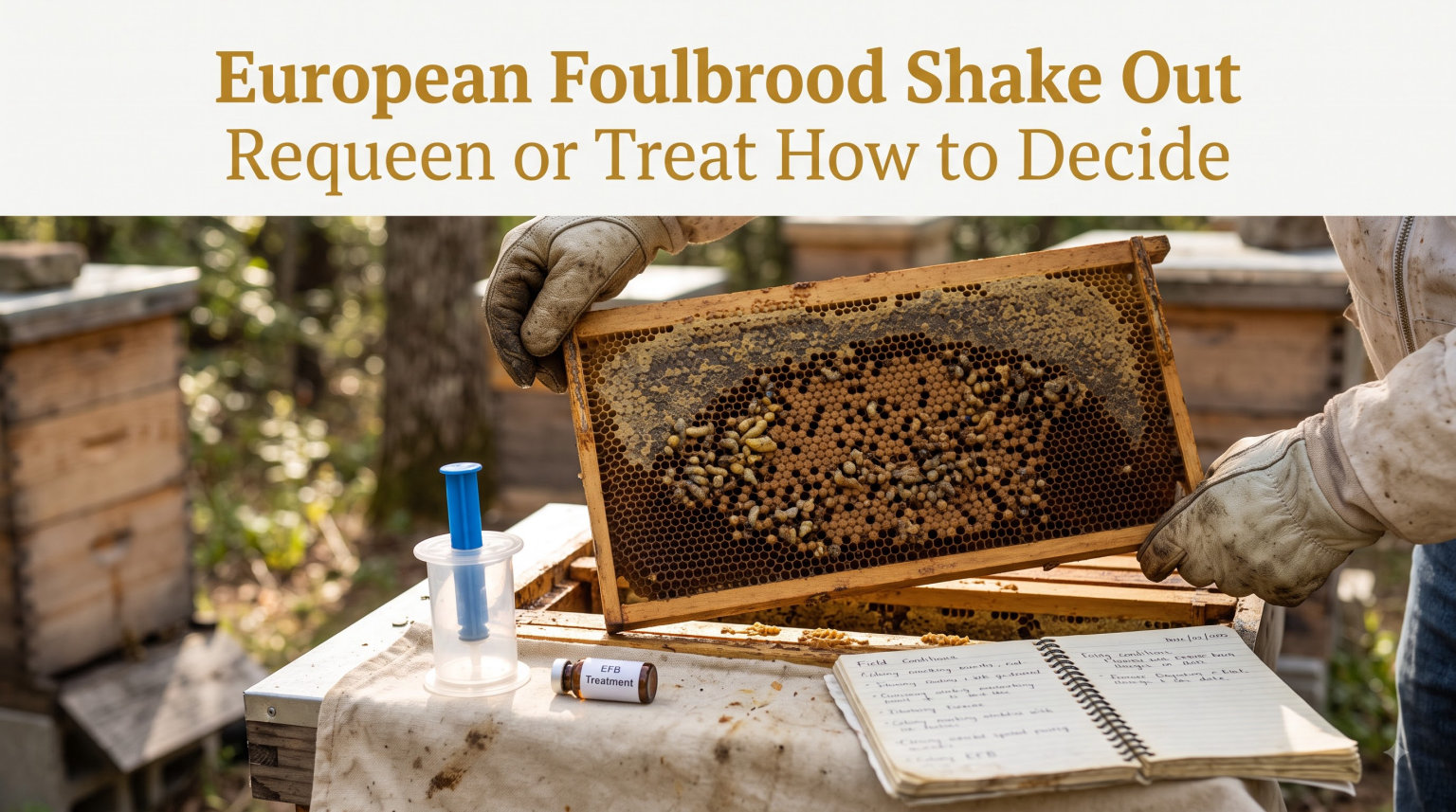
Walking up to a hive and spotting a scattered, yellowish brood pattern can stop a beekeeper cold. European foulbrood requeen or treat is the question that follows, and it is the right one to ask.
I have helped inspect colonies where a single yellow larva was the first warning of a bigger problem. Over the past decade working with both hobby and sideliner beekeepers, I have watched this disease show up in spring, vanish during a strong nectar flow, and roar back when colonies are stressed. The good news: EFB is manageable. The trick is matching the response to what the colony is actually showing you.
This guide gives you the framework I use. We will cover what EFB is, how to tell it from American foulbrood, what causes outbreaks, and how to choose between requeening, antibiotics, and the shook swarm method. By the end, you will know which path fits your hive.
Table of Contents
What Is European Foulbrood and Why the Decision Matters
European foulbrood is a bacterial brood disease caused by Melissococcus plutonius. The bacterium infects young larvae through contaminated brood food and multiplies in their gut, competing for nutrients and starving them before they are capped.
Unlike American foulbrood, EFB does not produce the long-lived spores that make AFB nearly impossible to eradicate from equipment. That single difference is why you have a real choice between requeen and treat rather than being forced to burn contaminated comb.
EFB typically appears in spring and early summer when colonies are building up fast. The disease can resolve on its own during a strong nectar flow, which is part of why beekeepers disagree about how aggressive to be. Knowing the cause and timing helps you pick the right response instead of guessing.
The Bacteria Behind EFB
Melissococcus plutonius lives in the midgut of infected larvae and dies when the larva dies, unlike AFB spores that linger for decades. Dead larvae can also support secondary bacteria that produce the sour or rotten smell many beekeepers associate with the disease.
The bacterium spreads when nurse bees clean infected cells and then feed healthy larvae. House bees, robbers from weak colonies, and drifting bees all carry the pathogen between hives. This is why a single sick colony can quickly become an apiary-wide problem.
How to Identify European Foulbrood in Your Hive
You can identify European foulbrood by looking for a scattered brood pattern with curled, yellowish-brown larvae in open cells, often accompanied by a sour or rotten smell and larvae that do not rope out when tested with a toothpick.
Most cases show up on the third or fourth day of larval life, before cells are capped. Workers often uncap and remove dead larvae, leaving empty cells mixed with healthy brood in what beekeepers call a “shotgun” pattern.
EFB vs AFB: A Quick Visual Comparison
EFB and AFB look different if you know what to look for. Use this comparison to tell them apart in the field:
Cell capping: EFB larvae die before capping; AFB larvae die after capping and caps often appear sunken, perforated, or greasy.
Larva position: EFB larvae twist into a C-shape at the bottom of the cell; AFB larvae melt into a brown, gluey scale stuck to the cell wall.
Toothpick test: EFB larva does not rope out; AFB larva ropes out about 1 cm of brownish mucus.
Smell: EFB smells sour or rotten; AFB smells like rotting meat or glue.
Spore persistence: EFB does not form resistant spores; AFB spores survive decades in equipment.
When in doubt, contact your state apiary inspector. Most jurisdictions require or strongly encourage reporting suspected AFB because of the spore risk. EFB reporting rules vary by region.
Signs That Confirm EFB
A positive identification usually combines several visible signs. Look for larvae that:
Are twisted, yellow-brown, or melted in open cells
Appear in a patchy, scattered pattern with empty cells mixed in
Have a translucent tracheal system once removed
Sit in a watery, slightly milky puddle that does not rope when lifted
Emit a sour or rotten dairy smell when several cells are affected
What Causes EFB Outbreaks and Why Stress Matters
EFB outbreaks are caused when stressed colonies cannot produce enough nurse bee secretions to feed large numbers of larvae, allowing Melissococcus plutonius to outcompete healthy gut bacteria in starving larvae.
The pathogen is often present at low levels in healthy colonies. Trouble starts when conditions tip in favor of the bacteria. The most common triggers I see in the field are poor nutrition, weak nectar flows, varroa mite damage, and sudden spring expansion when the nurse bee population cannot keep up.
The Nurse Bee to Larvae Ratio Connection
Spring is the highest-risk window because queens ramp up egg laying before the nurse bee force fully expands. When there are too many larvae for the available nurse bees, individual larvae receive less brood food and royal jelly.
That shortage gives M. plutonius the edge it needs. Beekeepers who manage colonies to maintain a strong nurse force through buildup have far fewer EFB cases, even when the bacterium is present.
Environmental Stressors That Trigger EFB
Five stressors show up again and again in outbreaks I have investigated:
Poor nutrition: Pollen shortage or low-quality forage weakens nurse bee development.
Weak nectar flow: Reduced incoming food lowers the energy budget for brood feeding.
High varroa loads: Mite feeding damages developing bees and shortens nurse bee lifespan.
Poor ventilation: Damp, poorly ventilated hives favor bacterial growth in cells.
Drifting and robbing: Weak colonies get robbed, spreading the pathogen across the apiary.
The Three Treatment Paths: Requeen, Antibiotics, or Shook Swarm
You have three main options for managing European foulbrood: requeening to introduce hygienic genetics and create a brood break, treating with antibiotics like oxytetracycline, or performing a shook swarm to remove all contaminated brood at once.
Each approach has a place. The right choice depends on the severity of the outbreak, the strength of the colony, your local regulations on antibiotic use, and how quickly you need results.
Option 1: Requeening
Requeening introduces a new queen whose daughter workers carry hygienic behavior traits, while the brood break during queen replacement interrupts the disease cycle.
When you remove the old queen, the existing brood continues to emerge for about three weeks. Once the new queen lays eggs, the cycle restarts with workers that detect and remove infected larvae faster.
Requeening works best on moderately strong colonies with a laying queen and enough bees to maintain temperature during the brood break. It is the option I reach for when the outbreak is mild to moderate and I can source a hygienic stock queen.
Pros: no antibiotic residues in honey, addresses the underlying genetics, sustainable long-term solution. Cons: requires sourcing a quality queen, takes 4 to 6 weeks to show results, less effective on severe outbreaks.
Option 2: Antibiotic Treatment (Terramycin / Oxytetracycline)
Antibiotic treatment with oxytetracycline (sold as Terramycin) suppresses the bacteria long enough for healthy larvae to develop, but it does not eliminate M. plutonius from the hive.
Antibiotics work by stopping bacterial multiplication. They do not replace good management. In the United States, oxytetracycline is the only FDA-approved antibiotic for EFB, and it must be applied according to label instructions, typically mixed with powdered sugar and dusted on the cluster.
Antibiotics fit colonies that need fast intervention and have a strong enough population to recover once the bacterial load drops. Always check your state’s rules, because some jurisdictions restrict antibiotic use in honey-producing colonies.
Pros: fast results, widely available, label-supported. Cons: does not cure the disease, residues can end up in honey, requires multiple applications, masks underlying stress issues.
Option 3: The Shook Swarm Method
The shook swarm method removes all brood from the hive, shakes every bee onto fresh foundation, and forces the colony to rebuild, eliminating the bacterial reservoir.
You brush every bee off every frame, remove all old comb, and install the colony on fresh foundation with a new queen or a caged one to release. The bees draw new comb, raise new brood from clean cells, and the disease cycle is broken because the contaminated larvae are gone.
This method works best in early spring or early fall when the colony is strong enough to draw comb quickly and the weather supports rapid buildup. It is also the most stressful option for the colony.
Pros: removes the bacterial reservoir completely, no chemicals needed, excellent long-term results. Cons: very labor intensive, requires good weather, kills all existing brood including healthy larvae, requires fresh foundation or drawn comb.
The Decision Framework: How to Choose Between Requeen and Treat
Choose requeening for mild to moderate EFB in strong colonies with good genetics, choose antibiotics for severe outbreaks that need fast suppression, and choose shook swarm for stubborn cases or when you want to eliminate contaminated comb without chemicals.
I use a simple decision tree when I walk up to a sick hive. Here is the version I share with newer beekeepers in my local association:
Mild outbreak (under 10% of brood affected): Requeen with hygienic stock. Add a pollen patty and feed 1:1 syrup to support nurse bee recovery.
Moderate outbreak (10 to 30% affected): Requeen and treat with oxytetracycline if your state allows. Boost the colony with a frame of capped brood from a healthy hive.
Severe outbreak (over 30% affected): Combine requeening with a shook swarm on fresh foundation, or treat aggressively with antibiotics and plan to requeen after the colony recovers.
Colony too weak to recover: If the colony has fewer than 4 frames of bees, combine it with a healthy hive or euthanize and burn the equipment.
Forum beekeepers often add a fifth step: wait for a strong nectar flow. Several experienced beekeepers in our regional association report that EFB cleared on its own once blackberry and tulip poplar started blooming. The added nutrition helped nurse bees outfeed the bacteria.
Preventing EFB Before It Starts
Prevent EFB by maintaining strong colonies with adequate nutrition, controlling varroa mites below 2 per 100 bees in spring, requeening every one to two years with hygienic stock, and keeping equipment clean and well ventilated.
Prevention is cheaper and easier than treatment. Here are the practices that consistently keep EFB out of healthy apiaries.
Hive Management Practices
Healthy management is your first line of defense. I run these practices year-round:
Requeen every 1 to 2 years, ideally with VSH or hygienic stock
Monitor varroa monthly with alcohol washes or sugar rolls, treating at 3 mites per 100 bees in spring
Provide protein patties during late winter pollen dearths
Keep hive entrances small and well ventilated to reduce dampness
Replace old comb on a 3-year rotation to remove pathogen buildup
Nutrition and Stress Reduction
Strong colonies resist EFB better than weak ones. Feed 1:1 syrup during spring buildup if the flow is light, plant early-blooming forage like willow and crocus, and avoid inspections during cold snaps that chill brood.
Avoid moving frames between hives without checking for signs of disease. Drift and robbing are the two fastest ways to spread EFB across an apiary, so keep colonies of similar strength next to each other.
FAQs
Can you treat European foulbrood?
Yes. European foulbrood can be treated with antibiotics like oxytetracycline, managed with a brood break through requeening, or eliminated with the shook swarm method. Unlike American foulbrood, EFB does not form resistant spores, so colonies can recover with proper management.
How do I know when to requeen a hive with EFB?
Requeen when the outbreak is mild to moderate, the colony has at least 4 frames of bees, and you can source a hygienic queen. Requeening introduces clean genetics and creates a brood break that interrupts the disease cycle.
How can I tell European foulbrood from American foulbrood?
EFB kills larvae before capping, producing yellow-brown twisted larvae in open cells with a sour smell. AFB kills larvae after capping, producing sunken or perforated caps, brown gluey scales stuck to cell walls, and a ropy test of about 1 cm when lifted with a toothpick.
What causes European foulbrood outbreaks?
EFB outbreaks are triggered when stressed colonies cannot produce enough nurse bees to feed expanding brood. Common triggers include poor nutrition, weak nectar flow, high varroa mite loads, poor ventilation, and drifting or robbing between colonies.
How long does a hive take to recover from European foulbrood?
Recovery time depends on the treatment path. Antibiotics show improvement within 2 to 3 weeks. Requeening takes 4 to 6 weeks for new brood to emerge cleanly. Shook swarm colonies rebuild in 3 to 4 weeks during good spring or fall weather.
Final Thoughts on Deciding Between Requeening and Treating
The European foulbrood requeen or treat decision comes down to matching the response to the colony in front of you. Mild cases on strong colonies respond well to requeening alone. Severe cases need antibiotics or shook swarm in addition to requeening to get back on track.
Whichever path you choose, address the underlying stressors. A strong nectar flow, good nutrition, controlled varroa, and hygienic queen stock will do more for your colony than any single treatment. Inspect every hive in the apiary once you find EFB, because the disease rarely stays in one box.
Your next step: walk your hives this week, take notes on brood pattern, and decide which colonies need intervention before the spring flow peaks. Reach out to your state apiary inspector if you see signs of AFB, and connect with a local beekeeping association for queen sources and hands-on help.