
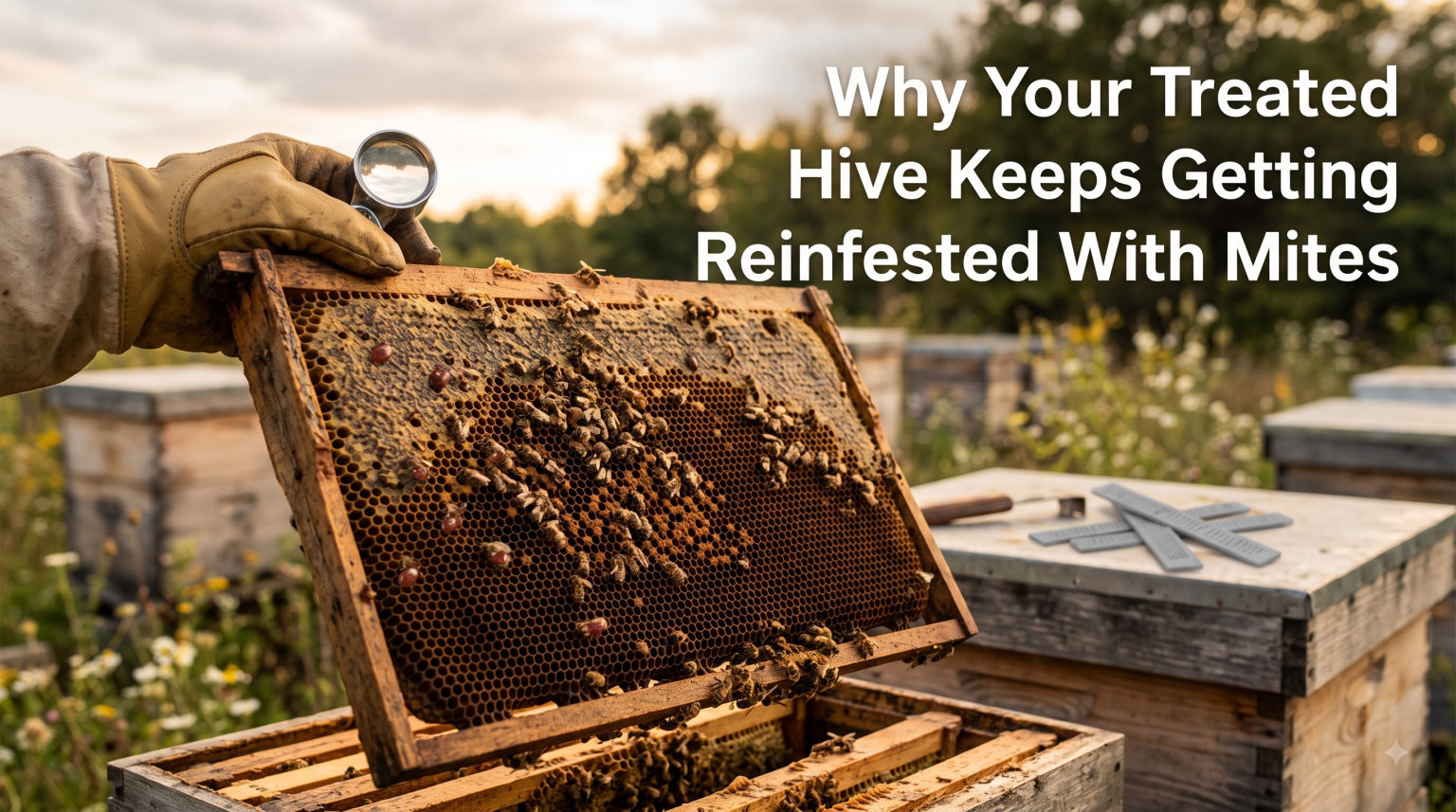
You did everything right. You bought the right treatment, followed the label instructions, waited the full duration, and pulled the strips on schedule. Then two weeks later, your alcohol wash shows mites climbing right back up.
If you are reading this, you have probably experienced that exact moment of frustration. You are not alone in this.
Varroa mite reinfestation is the single most common reason beekeepers lose treated colonies. The mites come back because most treatments only kill phoretic mites riding on adult bees. They do not reach the mites reproducing safely inside capped brood cells.
Those hidden mites emerge days or weeks after treatment, repopulating the colony from within while new mites arrive from outside sources.
In our experience talking with hundreds of beekeepers across forums and local clubs, the frustration runs deep. You followed the protocol and still lost ground.
The truth is that treating for varroa is not a one-and-done event. It is an ongoing battle against a parasite that has spent millions of years perfecting its survival strategy.
This guide breaks down exactly why varroa mite reinfestation happens, the specific mechanisms behind it, and what you can do differently. We will cover the mite lifecycle, how mites travel between hives, treatment timing errors, resistance issues, and practical prevention strategies you can start using this season.
Table of Contents
What Is Varroa Mite Reinfestation?
Varroa mite reinfestation happens when mite populations rebound in a colony after a treatment that initially appeared successful. This is different from treatment failure, where the product itself does not work as intended. Reinfestation means the treatment worked fine, but the colony got mites back anyway.
Here is the critical distinction. Treatment failure means the chemical never killed the mites it was supposed to. Reinfestation means the chemical did its job, but mites survived through gaps in coverage or arrived from external sources after treatment ended.
Most beekeepers assume they have treatment failure when they actually have reinfestation. Understanding this difference changes your entire approach. If your treatment genuinely failed, you need a different product. If you have reinfestation, you need a different strategy.
That strategy involves timing, monitoring, environmental management, and treating the right way at the right moment. We will cover all of these in detail below.
The economic threshold for varroa mites is roughly 3 mites per 100 bees in an alcohol wash during the active season. Once you exceed that level, the viral load your colony carries becomes dangerous. Reinfestation pushes colonies past this threshold even after you brought the count down to zero or near zero.
Why Treatment Alone Is Never Enough
Treatment alone fails because of one fundamental gap in how most varroa products work. The majority of registered treatments kill phoretic mites, meaning mites currently riding on the bodies of adult bees. They do not penetrate the wax cappings of brood cells where the real damage is happening.
Think of a treated hive as a house where you fumigated every room. The adult mites on the bees die.
But inside the capped brood cells, female mites are reproducing in sealed chambers that the treatment vapors or contact strips cannot fully penetrate. Those mites are safe inside their wax-walled nurseries.
A single female mite entering a brood cell just before capping can produce 2 to 3 daughter mites during the 12 days that cell stays capped in worker brood. In drone brood, which stays capped for 14 days, she can produce even more. When that bee emerges, out come 3 to 5 mites ready to find new hosts.
This means even a 95 percent effective treatment leaves behind the entire brood-protected population. If your colony has 20,000 cells of capped brood and even a small percentage contain reproducing mites, you have hundreds of mites waiting to emerge after treatment.
This is why beekeepers who use oxalic acid vaporization during active brood seasons see great initial knockdown followed by a bounce-back within weeks. Oxalic acid is extremely effective against phoretic mites but does nothing to mites under cappings.
The brood is doing exactly what nature designed it to do. It is protecting its occupants, including the parasites.
The Mite Lifecycle: Why Brood Is the Real Problem
Understanding the varroa mite life cycle is the foundation of every effective reinfestation prevention strategy. The mite has two distinct phases in its life, and treatments can only hit one of them.
The Phoretic Phase
Phoretic mites are adult female mites riding on the bodies of adult bees, usually wedged between the abdominal segments where they feed on fat body tissue. This phase lasts anywhere from a few days to several months depending on the season. During summer, phoretic mites move between bees and seek out brood cells to reproduce in.
This is the phase that treatments can actually reach. Any mite sitting on an adult bee is exposed to oxalic acid, formic acid, thymol, or amitraz depending on what you apply. If your treatment is working, these are the mites that die.
The Reproductive Phase Under Cappings
When a female mite is ready to reproduce, she enters a brood cell just before worker bees cap it. Once sealed inside, she feeds on the developing bee larva and lays eggs.
The first egg becomes a male, and subsequent eggs become females. In the confined space of the capped cell, these mites mate and develop.
Worker brood stays capped for about 12 days. Drone brood stays capped for about 14 days. A female mite in worker brood typically produces 1 to 2 mature daughters. In drone brood, she can produce 2 to 3 because of the longer development time.
When the young bee chews through its capping and emerges, the mother mite and her daughters ride out on the new bee. They immediately re-enter the phoretic phase, ready to either repeat the cycle or get picked up by treatments.
Why Broodless Windows Are Gold
This is why beekeepers chase broodless treatment windows. When a colony has no capped brood, every mite in the hive is phoretic. There is nowhere to hide.
A single oxalic acid treatment during a broodless period can achieve 90 to 97 percent efficacy because it hits the entire population. This is the closest thing to a silver bullet that exists in varroa management.
Natural broodless periods occur in late fall when colonies contract for winter, and during swarming preparation when the queen stops laying. Beekeepers can also create artificial brood breaks by caging the queen for a period.
The problem is that most beekeepers do not time their treatments to these windows. They treat when it is convenient or when they notice a problem, which usually means brood is active and a significant portion of the mite population is untouchable.
How Mites Re-enter Your Treated Hive
Even if you treat perfectly and knock down every mite in your colony, new mites can arrive from outside sources within days. Three primary vectors drive this external reinfestation. Most beekeepers only think about one of them.
Drifting: The Silent Mite Highway
Bees drift between hives constantly, especially in apiaries where colonies are arranged in straight rows with identical appearances. Foraging bees returning from the field sometimes enter the wrong hive. When they do, they carry their mite passengers with them.
Research shows that in apiaries with 20 or more hives arranged in rows, 10 to 15 percent of foragers may enter the wrong colony on any given day. Each drifting bee can carry one or more phoretic mites.
Over weeks, this creates a constant trickle of mites moving between colonies. You can reduce drifting by painting your hive entrances different colors, arranging hives in circles or U-shapes rather than straight lines, and placing landmarks like bushes or rocks near entrances.
Robbing: When Your Strong Hive Raids a Dying One
Robbing behavior is one of the fastest reinfestation pathways. When a nearby colony is weak and dying from varroa overload, strong hives send foragers to steal its honey. Those robber bees enter the dying colony, fight with guard bees, and pick up mites from the infested bees and comb.
This is especially dangerous because the dying colony is usually packed with mites. A hive collapsing from varroa can have mite loads of 50 to 100 mites per 100 bees. Every robber bee that enters that hive has a high probability of picking up multiple mites.
Forum discussions on Beesource and Reddit repeatedly highlight this pathway. Experienced beekeepers report watching their clean, treated hives get overrun with mites within a week of a neighboring colony collapsing.
The lesson is clear. A dying hive in your apiary is a mite bomb that will infect everything around it.
You can prevent robbing-related reinfestation by reducing entrances on weak colonies, combining struggling hives before they collapse, and removing dead-out equipment promptly. If you have a colony that is clearly failing from mites, do not let it linger.
Swarms and Absconding Colonies
Swarms carry mites with them. A swarm leaving an infested colony takes a proportional sample of the mite population with it. When that swarm settles in a tree near your apiary, or takes up residence in an empty hive, those mites are now part of your local mite pressure.
Absconding colonies, where the entire colony abandons a hive, are even worse. They carry the full mite load with them to wherever they relocate.
In areas with high feral colony density, swarms and absconds create a constant background level of mite pressure that is impossible to fully eliminate. You cannot control every swarm in your area. But you can manage your own colonies to prevent them from swarming, and you can trap swarms that arrive in your apiary so they do not become unmanaged mite reservoirs.
Mite Phoresy: How Mites Travel Between Colonies
Mite phoresy is the scientific term for how varroa mites use adult bees as transport. This concept is almost completely absent from competitor content, and it is one of the most important mechanisms driving reinfestation.
Phoresy literally means riding. A phoretic mite grips the body of an adult bee and travels wherever that bee goes. When that bee drifts into a neighboring hive, the mite disembarks and finds a new host.
When a robber bee enters a dying colony, mites from that colony grab onto the intruder and ride back to the robber’s home hive. This is how mites from a collapsing colony can appear in a perfectly clean hive overnight.
Phoretic mites are not passive passengers. Research shows they actively choose which bees to ride on. They prefer nurse bees over foragers because nurse bees spend more time on the brood comb where mites reproduce.
When a mite needs to move to a new brood cell, riding a nurse bee gets it exactly where it needs to be. This selective behavior means that drifting nurse bees are more dangerous reinfestation vectors than drifting foragers.
A nurse bee carrying 2 or 3 mites that drifts into your treated hive can seed those mites directly into your brood nest within hours. Phoresy also explains why reinfestation can happen so quickly.
It does not take weeks of gradual mite buildup. A single heavy phoretic mite arriving on a drifting bee can enter a brood cell that evening and begin reproducing. One week later, the mite population in your hive is already growing again.
Treatment Timing Mistakes That Cause Reinfestation
Treatment timing errors are the most fixable cause of varroa mite reinfestation. Here are the five most common mistakes we see beekeepers make, drawn from forum discussions and our own field experience.
Mistake 1: Treating Only Once Per Year
Many beekeepers treat once in late summer or fall and assume they are done. This leaves the colony completely unprotected during spring buildup, when mite populations grow fastest alongside the expanding brood nest.
By mid-summer, mite loads can already be dangerous. Reddit beekeeping communities consistently stress that treating both spring and fall produces dramatically better results.
A spring treatment knocks down the overwintered mite population before it can explode during brood rearing. A fall treatment protects the winter bees that will sustain the colony through the cold months.
Mistake 2: Treating During Active Brood Without Follow-Up
If you apply a treatment that only kills phoretic mites during a period of heavy brood production, you are only addressing a fraction of the problem. The mites under cappings emerge over the next 12 days and immediately restart the infestation cycle.
The fix is to follow up with a second treatment timed to catch newly emerged mites. For oxalic acid, this means a series of 3 to 5 treatments spaced 5 to 7 days apart during the brood rearing season. Each treatment catches mites that have emerged from cappings since the last application.
Mistake 3: Treating Too Late in Fall
Waiting until October to treat for fall mites is often too late. By that point, the winter bees that will carry the colony through to spring have already been raised. If those bees developed alongside high mite loads, they carry viral damage that shortens their lifespan and weakens the cluster.
The ideal fall treatment timing is mid-August to early September in most temperate climates. This allows the treatment to work while the colony is still raising the critical winter bee cohort. Those winter bees need to be as healthy and virus-free as possible.
Mistake 4: Ignoring the Broodless Window
The natural broodless period in late fall is the single most effective treatment window in beekeeping. Yet many beekeepers miss it because they have already put their equipment away for the season.
A single oxalic acid treatment applied during the broodless November or December window can achieve near-complete mite elimination. This one treatment can make the difference between a colony that survives winter and one that does not.
Mistake 5: Not Monitoring After Treatment
If you do not check your mite levels after treating, you have no way to know if the treatment worked or if reinfestation has occurred. An alcohol wash or sugar roll done one week after treatment completion tells you whether you actually knocked down the mite population.
Another check two to three weeks later tells you whether reinfestation is happening. Beekeepers on the Honey Bee Forum repeatedly emphasize this point. Post-treatment monitoring is the difference between knowing your colony is safe and guessing.
Why Treatments Stop Working: Resistance Explained
Treatment resistance is a separate but related problem that many beekeepers confuse with reinfestation. When mites develop resistance to a chemical, the treatment stops killing them even though you applied it correctly. The mites survive, reproduce, and the population rebounds as if you never treated at all.
Pyrethroid resistance is the most well-documented example. Apistan (fluvalinate) and CheckMite+ (coumaphos) were heavily used for decades. In many regions, varroa populations have developed genetic resistance that renders these products nearly ineffective.
If you are relying on a pyrethroid strip and your mites are resistant, you will see mites surviving treatment and assume reinfestation. The real problem is resistance, and the fix is switching to a different chemical class entirely.
Resistance develops through natural selection. When a treatment kills 99 percent of mites, the surviving 1 percent carry genes that made them resistant. Those survivors reproduce and pass on those resistance genes.
After many treatment cycles with the same chemical, the resistant mites dominate the population. This is why treatment rotation is so important. By alternating between different chemical classes with different modes of action, you prevent any single resistance mechanism from taking over.
Rotate between formic acid products, thymol-based treatments, amitraz strips, and oxalic acid across seasons and years. Amitraz resistance is also emerging in some regions, particularly where beekeepers have used Apivar repeatedly without rotation.
The lesson from the BeeAware research is clear. No single treatment will remain effective forever. Plan for resistance by building rotation into your management from the start.
Environmental Sources: Your Neighbors’ Mites Are Your Problem
Even with perfect treatment timing, perfect monitoring, and a rotation strategy, your hive can still get reinfested from external sources. Environmental mite pressure is the factor most beekeepers underestimate, and it is completely outside your direct control.
Feral Colonies as Mite Reservoirs
Feral honey bee colonies living in trees, buildings, and other cavities are rarely treated for varroa. These colonies build up enormous mite loads and serve as constant reservoirs. When your foragers encounter feral bees at flowers, or when feral swarms settle near your apiary, mites can transfer between populations.
Nearby Untreated Apiaries
If your neighbor keeps bees and does not treat for varroa, their colonies become mite factories. Research indicates that reinfestation pressure extends roughly 3 miles from a heavily infested source colony. Within that radius, your treated hives are at constant risk of picking up new mites through drifting and robbing.
This is one of the hardest realities in beekeeping. You can do everything right and still struggle because someone within bee-flight range is not managing their mites.
Open communication with neighboring beekeepers and sharing monitoring data can help. In some beekeeping associations, coordinated treatment timing across all members significantly reduces reinfestation pressure for everyone.
Regional Variation in Mite Pressure
Mite pressure varies dramatically by region. Southern climates with longer brood-rearing seasons face year-round mite reproduction, meaning there is never a natural broodless break to exploit. Northern climates with defined winter broodless periods have a natural treatment window that southern beekeepers lack.
Coastal areas with mild winters may see brood rearing continue through December, eliminating the late-fall treatment advantage. High-density suburban areas with many backyard beekeepers create elevated drifting and robbing pressure.
Understanding your regional mite dynamics helps you adapt your treatment strategy to local conditions rather than following generic advice that may not fit your climate.
Signs Your Hive Is Becoming Reinfested
Catching reinfestation early gives you time to respond before the colony is overwhelmed. Here are the warning signs to watch for, ranked by how soon they appear after reinfestation begins.
The earliest sign is a rising mite count on your monitoring tests. If your post-treatment alcohol wash showed 0 to 1 mites per 100 bees and a follow-up test two weeks later shows 3 to 5, reinfestation is happening. This is why regular monitoring matters more than any other single practice.
The next sign is the appearance of deformed wing virus symptoms. Bees emerging with shriveled, stunted wings are showing the visible damage of high mite and viral loads. By the time you see DWV symptoms, your mite population has been dangerously high for weeks.
Spotty brood patterns are another indicator. When mite and viral pressure weakens the colony, the queen’s laying pattern becomes inconsistent. You will see capped cells mixed with empty cells and dead larvae instead of a solid wall of brood.
Bees crawling on the ground in front of the hive, unable to fly, are showing advanced viral damage. At this point, the colony is in serious trouble and intervention needs to happen immediately.
Prevention Strategies: Building a Reinfestation-Resistant Management Plan
Preventing varroa mite reinfestation requires shifting from a treatment mindset to a management mindset. No single action solves this problem. You need an integrated approach that addresses every angle of attack.
Monitor Religiously
The foundation of every good varroa management plan is regular, quantitative monitoring. Alcohol washes are the gold standard for accuracy. Sugar rolls are a decent alternative if you want to avoid killing bees.
Either way, you need numbers, not guesses. Test your mite levels once a month during the active season, and immediately before and after every treatment.
The before number tells you whether treatment is warranted. The after number tells you whether the treatment worked. Two to three weeks later, test again to detect reinfestation early.
The threshold for action is generally 2 to 3 mites per 100 bees during the active season. Some beekeepers use a lower threshold of 1 percent in spring to protect the developing winter bee population. Find a threshold that works for your region and stick to it consistently.
Treat at the Right Time, Every Time
Build your treatment calendar around biological events, not calendar dates. Treat in spring before the population explosion during brood buildup. Treat in late summer to protect winter bees during their development.
Treat during the natural broodless period for maximum efficacy. If you use a treatment that only targets phoretic mites during the active brood season, commit to a series of treatments spaced 5 to 7 days apart.
A single application during brood rearing is a half-measure that guarantees reinfestation from under-capping survivors. The mites will simply emerge and restart the cycle as if you never treated.
Rotate Treatments by Chemical Class
Plan your treatment rotation across seasons and years. Do not use the same active ingredient twice in a row if you can avoid it. Alternate between formic acid, thymol, amitraz, and oxalic acid across your treatment windows.
Formic acid is unique because it can penetrate capped brood cappings, making it effective against the reproductive mite population. This makes formic acid treatments particularly valuable during the active brood season when other treatments cannot reach mites under cappings.
However, formic acid is temperature-sensitive and can cause brood mortality or queen loss if applied during heat waves. Always check the temperature restrictions on the label before applying.
Manage Your Environment
Reduce drifting by arranging hives in irregular patterns, using entrance colors, and limiting apiary size. Prevent robbing by keeping entrances reduced on weak colonies and combining failing colonies before they collapse.
Remove dead colonies from your apiary immediately. A dead or dying hive full of mites is a reinfestation bomb. The mites in that colony will spread to every healthy hive within foraging range through robbing as long as the equipment sits exposed.
Talk to neighboring beekeepers about coordinating treatment timing. When everyone in a 3-mile radius treats within the same two-week window, reinfestation pressure drops dramatically because there are no heavily infested source colonies nearby.
Consider Resistant Stock
Varroa Sensitive Hygiene (VSH) bee lines and other resistant stock can help reduce, though not eliminate, your mite pressure. These bees detect and remove mite-infested pupae from capped cells, interrupting the reproductive cycle.
While not a complete solution, resistant stock adds another layer to your integrated approach and can reduce the frequency of chemical treatments needed. Breeding programs in the United States, including the Purdue ankle-biter bees and various VSH lines, have shown promise in maintaining lower mite loads.
If you requeen regularly, consider sourcing from breeders who select for mite resistance traits alongside production and winter hardiness. Genetics will not replace treatment, but they can buy you margin.
Think in Years, Not Treatments
The biggest shift you can make is moving from single-treatment thinking to multi-year management. Track your mite counts across seasons. Document which treatments worked and which did not.
Note when reinfestation happened and what external factors were at play. Over time, you will see patterns that let you anticipate problems before they develop.
This long-term view is what separates beekeepers who consistently keep healthy colonies from those who lose hives every year. Varroa management is not an event. It is a continuous practice built on data, observation, and adaptation.
Frequently Asked Questions About Varroa Mite Reinfestation
How to keep varroa mites away?
You cannot fully prevent varroa mites from entering your hives, but you can keep populations controlled through regular monitoring, properly timed treatments, treatment rotation, reducing drifting and robbing, and using resistant bee stock. The goal is management, not elimination.
What is the natural enemy of the varroa mite?
Natural enemies of varroa mites include predatory mites like Stratiolaelaps scimitus, pseudoscorpions, and some fungal pathogens such as Metarhizium. However, none of these biological controls are reliable enough to control varroa on their own. They are being researched as supplementary tools within integrated pest management programs.
What naturally kills varroa mites?
Natural or organic varroa treatments include oxalic acid (applied as vapor or dribble), formic acid (found in MiteAway and Formic Pro), thymol-based products like Apiguard, and hop beta acids in HopGuard. These are considered organic or soft treatments but still require careful timing and application according to label instructions.
What kills varroa mites but not bees?
All registered varroa treatments are designed to kill mites while minimizing harm to bees when used according to label directions. Oxalic acid, formic acid, and thymol target mite biochemistry specifically. However, every treatment has temperature restrictions and potential side effects like brood damage or queen loss if misapplied. Always follow label instructions precisely.
Is it too late to treat for varroa mites?
It is rarely too late to treat, but earlier is always better. The critical window for fall treatment is mid-August to early September so that winter bees develop free of viral damage. If your mite counts are dangerously high late in the season, an oxalic acid treatment during the broodless winter period can still knock down the remaining mite population significantly.
Why are Varroa destructor mites becoming resistant to treatments?
Varroa mites develop resistance through natural selection. When a treatment kills 95 to 99 percent of mites, the survivors carry genetic traits that made them resistant. These survivors reproduce and pass on resistance genes. Over many treatment cycles using the same chemical, resistant mites dominate. This has happened with pyrethroids like fluvalinate and coumaphos, and emerging resistance to amitraz is being monitored in some regions.
How many times should I treat for Varroa mites?
Most beekeepers need at least two treatment rounds per year: one in spring before brood buildup accelerates and one in late summer to protect winter bees. In high-pressure regions, additional treatments during the broodless winter window and mid-summer may be necessary. Monitor mite levels monthly and treat whenever counts exceed your action threshold rather than following a rigid schedule.
Can I feed bees while treating for mites?
Yes, feeding during treatment is generally safe and sometimes beneficial since well-nourished bees handle treatment stress better. However, never apply treatments with honey supers on if the treatment label prohibits it, as chemical residues can contaminate harvestable honey. Always check the product label for specific feeding and super restrictions.
Are Varroa mites in every hive?
In regions where Varroa destructor is established, essentially every honey bee colony carries some level of varroa mites. The question is not whether mites are present but whether the population is below the damage threshold. Regular monitoring tells you where your colonies stand. Even resistant stock and well-managed hives maintain low-level mite populations that must be tracked continuously.
Moving Forward: Your Action Plan Against Reinfestation
Varroa mite reinfestation is not a sign that you failed as a beekeeper. It is the predictable result of treating a complex biological problem with a single-action approach.
The mites under your brood cappings, the drifting bees from neighboring hives, the resistant populations developing across regions, and the environmental pressure from untreated colonies all conspire to undo your best treatment efforts.
The beekeepers who keep healthy colonies year after year share one common trait. They treat varroa management as a continuous practice built on monitoring data, properly timed interventions, treatment rotation, and environmental awareness. They do not expect a single treatment to solve the problem because they understand why it cannot.
Start with monitoring if you are not already doing it regularly. Get real numbers from alcohol washes or sugar rolls. Treat based on data, not guesses.
Time your treatments to biological events and broodless windows. Rotate your chemicals to prevent resistance. Talk to your neighbors about coordinating treatment schedules. Track everything so you can learn from patterns over time.
Varroa mite reinfestation is manageable when you understand the mechanisms behind it. That understanding is what this article was built to provide. Now the work is in your hands, and your bees are counting on you to put it into practice this 2026 season.