
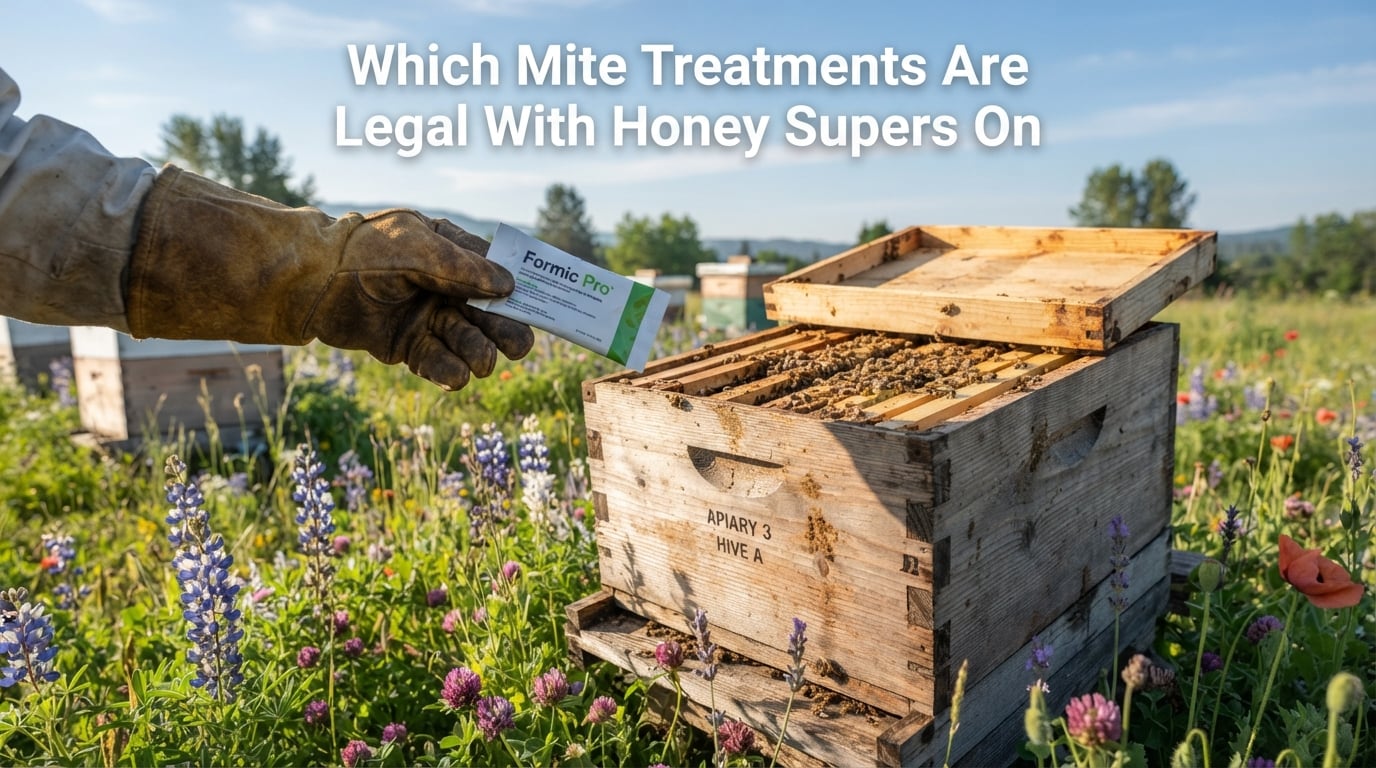
Three mite treatments are legal with honey supers on the hive: formic acid products (Formic Pro and MAQS), HopGuard 3 (hop beta acid strips), and oxalic acid (since the EPA restriction was lifted in 2021). This guide from our team at Apimondia walks through each option so you can protect your colonies without contaminating the honey crop you’re about to harvest.
I lost a yard to Varroa destructor years ago because I followed old advice to “wait until after the honey flow” to treat. The mites did not wait. Since then, I have run treatments during honey production every summer, and our colonies have stayed healthy and productive. Below is exactly what the law and the labels allow.
Table of Contents
Which Mite Treatments Are Legal With Honey Supers On? (Direct Answer)
Only three miticide classes are EPA-approved for use while honey supers remain in place. Formic acid (sold as Formic Pro and Mite Away Quick Strips), HopGuard 3 (hop beta acids), and oxalic acid (vapor or dribble) are the three. Every other common Varroa treatment, including Apivar, Apiguard, Apilife Var, and Checkmite+, is restricted to supers-off application because residues can carry over into the honey crop.
If you are facing a heavy mite load in July or August, these three options let you treat without pulling supers, breaking the honey flow, or risking contaminated honey. The rest of this guide explains how each one works, when to use it, and the temperature and timing rules that decide which one is right for your hive.
Why Most Varroa Treatments Cannot Be Used During Honey Flow
Honey is a food product, and the EPA regulates any substance that can come into contact with it. Synthetic miticides like amitraz (Apivar) and coumaphos (Checkmite+) leave residues that persist in wax and honey, so the labels prohibit use when supers are on.
Organic acid treatments behave differently. Formic acid, oxalic acid, and hop beta acids break down into compounds already found in honey or evaporate completely. Research submitted to the EPA demonstrated that residues do not accumulate above background levels, which is what unlocked the 2021 oxalic acid label change.
Every beekeeper should read the actual label before each application. The label is the law, and using a product off-label is a federal violation. Even with the three approved options, the labels carry temperature windows, dose limits, and timing rules you must follow.
Formic Acid Treatments: Formic Pro and MAQS
Formic acid is the only approved Varroa treatment that penetrates capped brood cells to kill reproducing mites. That is its superpower and also the reason it carries the strictest label rules. Formic acid occurs naturally in honey at trace levels, and the EPA approved both Formic Pro and MAQS for use with honey supers on the hive.
How Formic Pro Works
Formic Pro comes as paper-strip sachets you lay across the top bars of the brood box. The acid vaporizes over 7 to 14 days depending on the dose pattern (one strip vs two), filling the hive with vapor that kills phoretic mites and mites sealed inside worker brood cells.
You can leave honey supers in place. The vapor moves up through the hive and dissipates without leaving residues. Expect your bees to beard heavily outside the entrance for the first day or two. This is normal behavior, not a sign of colony stress.
Formic Pro vs MAQS (Mite Away Quick Strips)
MAQS was the original formic acid strip, and Formic Pro is the successor product with a longer release profile and more forgiving temperature window. MAQS runs hotter and faster, which means stronger mite kills but a higher risk of queen loss in hot weather.
If you are running hives in summer heat above 85F, Formic Pro is the safer choice. If you are treating in a narrow window of 50F to 78F with a fast mite knockdown goal, MAQS still works. Both are approved with supers on, but only Formic Pro gives you the two-strip, 14-day option that many commercial beekeepers prefer.
Temperature Restrictions and Queen Safety
Formic acid label rules set a daily high temperature window. Formic Pro allows application between 50F and 85F. Outside that range, efficacy drops or queen risk climbs. Some experienced beekeepers cage the queen for the first 72 hours to protect her, but the label does not require this.
Queen losses with formic acid are real but uncommon when you respect the temperature rules. In our yard, we lost one queen across 40 colonies treated with Formic Pro during the 2026 flow, and the colony requeened itself within three weeks.
HopGuard 3: Hop Beta Acid Strips
HopGuard 3 uses potassium salts of hop beta acids, the same compound that gives hops their bitter flavor in beer. The EPA approved HopGuard 3 for use with honey supers on, and it works by contact rather than vapor. Bees must walk across the strip for the active ingredient to transfer to mites clinging to their bodies.
HopGuard 3 Application Method
You hang two HopGuard strips per brood box, draped between frames so bees contact both sides of the strip. Treatment runs 7 to 10 days. Honey supers stay on, and there are no temperature restrictions the way there are with formic acid, which makes HopGuard 3 a flexible summer option.
HopGuard 3 has zero temperature constraints, so you can apply it on a 95F afternoon or a 55F morning. That flexibility alone makes it a favorite for beekeepers in hot Southern climates where formic acid cannot be applied.
HopGuard 3 Re-Treatment Schedule
HopGuard 3 does not kill mites inside capped brood, so a single application only catches the phoretic mites (those riding on adult bees). The label requires two applications spaced 7 to 10 days apart, timed so the second strip catches mites that emerge from brood after the first treatment window closes.
Plan your re-treatment on a calendar. Strip one goes in on day one, strip two goes in on day seven to ten. Skipping the second pass is the most common mistake I see new users make, and it leaves a substantial portion of the mite population alive to recover.
Honey Safety and Residue Profile
Hop beta acids occur naturally in trace amounts in some nectars. The EPA reviewed residue data and concluded HopGuard 3 does not contaminate honey above background levels, which is why the label permits supers-on use. Your honey crop is safe.
Oxalic Acid: Legal Status Since 2021
Oxalic acid was off-limits with honey supers on for years, even though researchers had long argued the data supported supers-on use. In 2021, the EPA reviewed new residue studies and lifted the restriction. Oxalic acid is now approved for application while honey supers remain in place, whether you choose vaporization or the dribble method.
This change was a turning point for integrated pest management. Beekeepers now have a third organic acid option that costs pennies per treatment and works in any temperature.
Oxalic Acid Vaporization
Vaporizing oxalic acid with a heated wand sublimates the crystals into a fog that fills the hive and condenses on all surfaces. Bees contact it as they move through the cluster, and it kills phoretic mites on contact. You can vaporize with supers on, and each treatment takes about two minutes per hive.
Many beekeepers run a series of three vaporizations spaced five to seven days apart to catch mites as they emerge from brood. Like HopGuard 3, oxalic acid does not penetrate cappings, so multiple passes are required to catch the full mite population.
Oxalic Acid Dribble
The dribble method mixes oxalic acid with a 1:1 sugar syrup and applies 5 ml per seam of bees with a syringe. It is faster than vaporization but less popular because the dribble wets the bees. Vaporization is now the standard for most US beekeepers.
Why Oxalic Acid Works Best in a Brood Break
If your colony is going through a brood break, such as after a swarm or a queen event, a single oxalic acid treatment can knock down 95% of the mite population because there is no capped brood sheltering the next generation. With brood present, expect 50% to 60% kill per pass, which is why the multi-pass schedule matters.
Comparison Table of Approved Treatments
The table below summarizes the three approved treatments. Use it to pick the right product for your temperature, brood condition, and honey flow timing.
| Treatment | Active Ingredient | Temperature Range | Kills Mites Under Cappings | Applications Needed |
|---|---|---|---|---|
| Formic Pro | Formic acid | 50F to 85F | Yes | 1 (7-14 day release) |
| MAQS | Formic acid | 50F to 78F | Yes | 1 (7 day release) |
| HopGuard 3 | Hop beta acids | Any | No | 2 (7-10 days apart) |
| Oxalic Acid | Oxalic acid | Any | No | 1-3 (5-7 days apart) |
Treatments NOT Approved With Honey Supers On
Several popular Varroa treatments are off-limits during the honey flow. Do not use the following products while supers are in place, even if your mite count is high.
Apivar (Amitraz)
Apivar strips contain amitraz, a synthetic miticide that leaves residues in wax and honey. The label requires supers off and a 14-day post-treatment wait before supers return. Treating with supers on violates federal law.
Apiguard (Thymol)
Apiguard is a thymol gel that taints honey flavor and leaves residues above background levels. The label prohibits supers-on use. Pull your supers, treat, and wait the required interval before returning them.
Apilife Var (Thymol + Other Oils)
Apilife Var combines thymol with eucalyptus oil, menthol, and camphor. The strong odor carries into honey, and residues persist. This treatment is also restricted to supers-off application.
Checkmite+ (Coumaphos)
Checkmate+ uses coumaphos, an organophosphate. Varroa resistance has spread widely, and the residue profile rules out supers-on use. Few beekeepers still reach for this product.
If you have a mite emergency and none of the three approved treatments fit your timing, pull your honey supers, store them properly, treat with the supers-off product that fits the situation, then return the supers after the treatment window and post-treatment interval pass.
How to Choose the Right Treatment During Honey Flow
Choosing between formic acid, HopGuard 3, and oxalic acid comes down to three questions: what is the daily temperature, how much capped brood is in the hive, and how quickly do you need a mite knockdown.
If you need mites killed inside capped brood and your temperatures stay between 50F and 85F, Formic Pro is the top pick. It is the only approved option that reaches mites under cappings in a single application, which makes it the right answer when mite counts are spiking.
If your temperatures are above 85F or below 50F, switch to HopGuard 3 or oxalic acid. Both work in any temperature. HopGuard 3 is easier for beekeepers who do not own a vaporizer, while oxalic acid is cheaper per treatment and easier to scale across many colonies.
Run an alcohol wash or sugar roll test before treating so you know your starting mite count. The Honey Bee Health Coalition recommends treating at 3 mites per 100 bees in summer. Counts above 5 mites per 100 bees warrant immediate action regardless of honey flow timing.
Temperature and Timing Considerations
Temperature is the single biggest variable in summer Varroa treatment. Formic acid vapor concentration rises with heat, which is why the label caps application at 85F. Treat in the early morning or evening when daytime highs will stay in range.
Honey flow timing matters as well. If your main flow is mid-July, a pre-flow treatment in late June catches mites before the colony devotes resources to honey production. A post-flow treatment in late August or September catches the mites that built up during the flow.
Watch for honey bound brood nests, which happen when bees pack the brood area with nectar and reduce the queen’s laying space. This concentrates mites in a smaller brood area and can be a useful pre-treatment condition if you are using oxalic acid and want a partial brood break.
State-Specific Regulations (California)
California beekeepers face one extra layer of regulation on top of EPA rules. The California Department of Food and Agriculture maintains its own registration list for miticides, and not every federally approved product is registered in the state.
Formic Pro, HopGuard 3, and oxalic acid are all currently registered in California, but beekeepers should verify registration status before each season. Some county agricultural commissioners also require notification before large-scale treatments, especially near commercial orchards.
If you operate across multiple states, check each state’s registration database. A product that is legal in Oregon may not be legal in California that same season. Treatment rules can shift between Apiary Inspection Service updates.
Frequently Asked Questions
Can I use Apivar with honey supers on?
No. Apivar contains amitraz, which leaves residues in honey and wax. The label requires all honey supers to be removed before application and a 14-day post-treatment interval before supers return. Using Apivar with supers on violates federal law and risks contaminating your honey crop.
What varroa mite treatment is safe for honey?
Three Varroa treatments are EPA-approved for use while honey supers are in place: formic acid products (Formic Pro and MAQS), HopGuard 3 (hop beta acids), and oxalic acid (since the 2021 label change). All three leave residues at or below background levels found naturally in honey.
Can you leave honey supers on when using formic pro?
Yes. Formic Pro is specifically labeled for use with honey supers on the hive. The formic acid vapor penetrates capped brood to kill reproducing mites, then dissipates without leaving residues above background honey levels. Keep daily temperatures between 50F and 85F for safe application.
Can you use HopGuard with honey supers on?
Yes. HopGuard 3 strips are approved for supers-on application with no temperature restrictions. Hang two strips per brood box for 7 to 10 days, then repeat the application 7 to 10 days later to catch mites emerging from capped brood after the first treatment window.
Can you leave honey supers on with oxalic acid?
Yes. The EPA lifted the supers-on restriction for oxalic acid in 2021 after reviewing residue data. You can vaporize or dribble oxalic acid with honey supers in place. For best results during active brood, run three applications spaced 5 to 7 days apart.
What is the most effective varroa mite treatment?
Formic Pro is the most effective single-application Varroa treatment during honey flow because it kills mites under capped brood, which no other approved product does. For temperatures outside the 50F to 85F window, HopGuard 3 or oxalic acid are the next-best options, applied as multi-pass schedules to catch emerging mites.
Final Thoughts on Treating Varroa During Honey Flow
Three mite treatments are legal with honey supers on in 2026: formic acid products, HopGuard 3, and oxalic acid. Choosing the right one comes down to your local temperature, your brood condition, and how fast you need a mite knockdown. Formic Pro remains the strongest single-application choice, while HopGuard 3 and oxalic acid give you temperature flexibility and lower cost.
Before you treat, run an alcohol wash or sugar roll test so you know your starting count. Treat at 3 mites per 100 bees in summer, and recheck two weeks after the final application to confirm your knock down. Healthy bees make more honey, and the labels on these three products exist so you can protect both your crop and your colonies at the same time.