
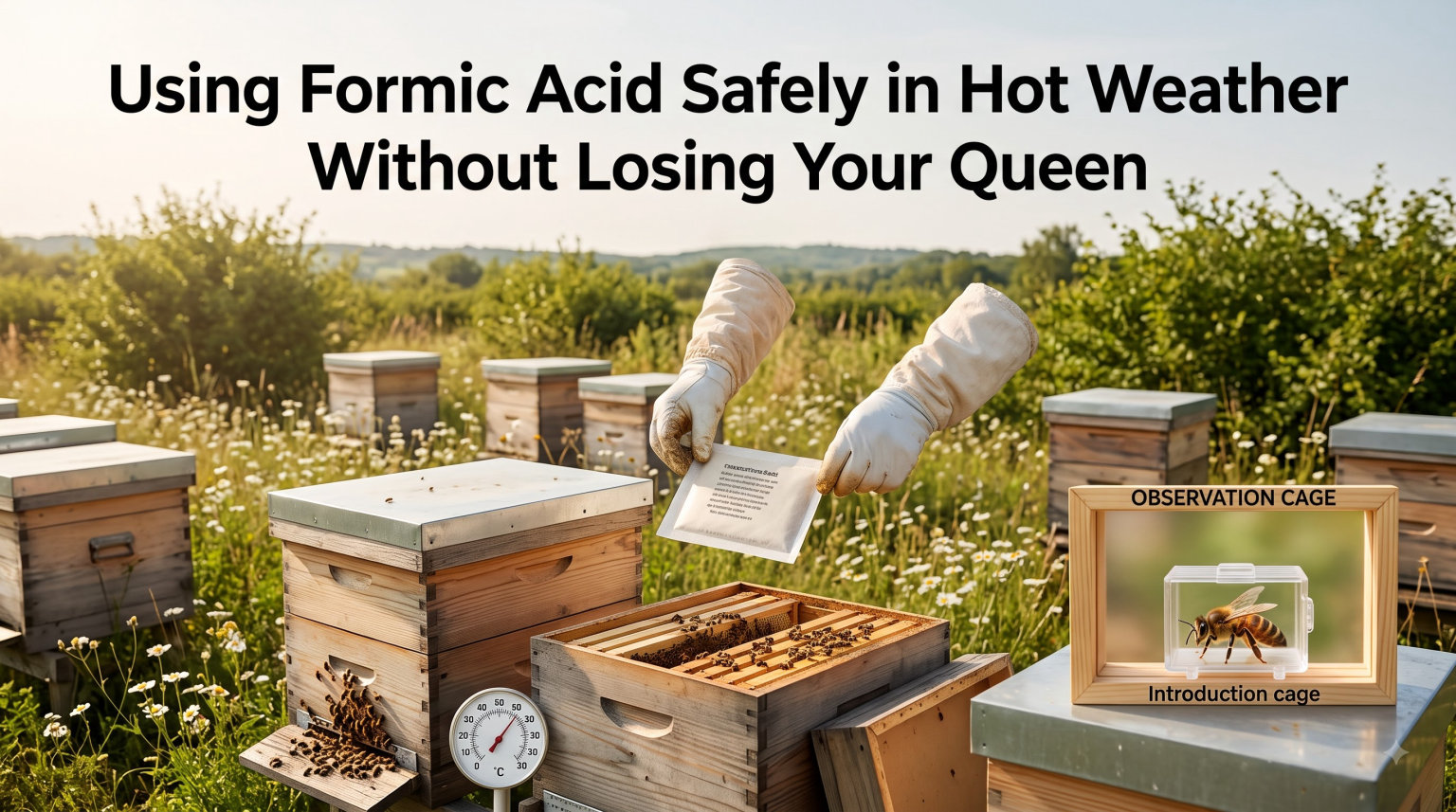
I lost a Carniolan queen to Formic Pro in early June. I followed the label to the letter, treated in the evening, and watched three days of 90-degree days roll in. By the end of the week the colony was queenless. If you are reading this right now, you are probably trying to make sure that does not happen to you. Let me share what I have learned since then, and what the research from Randy Oliver and the beekeeping community actually shows about using formic acid safely in hot weather.
Formic acid is one of the most useful varroa treatments in a beekeeper’s toolkit. It kills mites beneath the brood cappings, leaves no residue in honey, and can be used during a honey flow. But the same qualities that make it powerful – rapid vapor release, penetration of wax cappings – are exactly what make it dangerous to queens when temperatures climb. This guide will walk you through the temperature guidelines, the biology behind queen susceptibility, the warning signs of distress, and the press-cover technique that can dramatically reduce your risk of queen loss.
Table of Contents
How Formic Acid Works Against Varroa Mites
Formic acid is an organic acid that occurs naturally in bee venom and in many plants. At the 65 percent concentration used in commercial strips like Formic Pro and Mite Away Quick Strips, it evaporates over time and fills the hive atmosphere with vapor that penetrates every gap, including the wax cappings over developing bee pupae.
That penetration is the entire reason formic acid matters. Most other varroa treatments, including oxalic acid and thymol products, only kill mites that are riding on adult bees. Formic acid kills phoretic mites and the mites sealed inside cells with the brood. Research published in the journal Veterinary Sciences in 2025 documented efficacy rates of 88 percent or higher when formic was applied correctly, including significant reductions in mite counts inside capped brood.
The release pattern is predictable. A Formic Pro strip loses weight at roughly 8 to 22 grams per day depending on the temperature inside the broodnest. Over 7 to 14 days, the strip releases its acid gradually, killing mites through contact and vapor. The exact release rate is driven by heat. A broodnest runs at about 95 degrees Fahrenheit even when the outside air is cool. On hot days, the strip releases vapor faster. On cool days, slower. This is both the magic and the danger of the treatment.
The Optimal Temperature Range: 50 to 85 Degrees Fahrenheit
The safe application window for formic acid is between 50 and 85 degrees Fahrenheit on the day of application. That is the range written on every label and confirmed by every extension service. Most beekeepers focus on the high end, and for good reason, but the low end matters too. Below 50 degrees, the strip does not vaporize enough to kill mites. Above 85 degrees, the strip vaporizes too fast and the vapor concentration can climb high enough to kill bees and queens.
Here is the nuance most labels miss. The temperature that matters is the daytime high in the shade at your apiary, not the maximum forecast for your zip code. A hive sitting in direct sun at 2 p.m. on a 90-degree day will be even hotter inside. The broodnest holds heat remarkably well. I keep a thermometer probe in one of my hives and I have seen internal temperatures climb 8 to 10 degrees above ambient on a sunny afternoon.
Pay attention to the entire forecast, not just the day you apply. A seven-day treatment that starts at 80 degrees can turn into a queen-loss event if a 95-degree day lands on day three. Many of the queen-loss reports on Reddit and Beemaster describe exactly this scenario: the applicator started the strip at a safe temperature, then a heat wave came through mid-treatment, and the colony could not ventilate the vapor fast enough.
Why Queens Are More Susceptible to Formic Acid Than Workers
This is the question that stumped me for months. Formic acid is heavier than air, it settles toward the bottom of the hive, and the queen spends her life on the brood frames at the bottom of the cluster. Worker bees can move up and out, fanning their wings to ventilate the hive. The queen stays put, walking across cells that are releasing concentrated vapor from the strip directly below her.
There is also a physiological reason. Worker bees have a much higher body mass relative to their surface area, and they can tolerate higher concentrations of acid vapor for longer. Queens are larger but their metabolic rate is different, and they do not engage in the same fanning behavior. Randy Oliver at Scientific Beekeeping has documented this in trial after trial. In his hot-weather experiments, queen loss spiked during the first 72 hours of treatment when temperatures climbed above 85 degrees, even when worker bee populations remained stable.
There is one more factor. Formic acid is the same chemical bees use in their sting. A queen surrounded by vapor is essentially being bathed in a continuous low-level sting environment. Workers tolerate this because they are adapted to it. Queens, especially mated laying queens, are more sensitive. Carniolan and Italian queens seem particularly vulnerable in community reports, though that may simply reflect how popular those races are in North America.
Hot Weather Risks and Warning Signs of Queen Distress
The risks of treating above 85 degrees are not abstract. They are documented in published research, in manufacturer trials, and in hundreds of beekeeper reports. The most common outcomes are supersedure, where the colony raises a new queen to replace the failing one, and outright queen death, where the colony is left queenless and unable to recover without intervention.
Watch for these warning signs during the first 72 hours of a hot-weather treatment:
- Bees bearding heavily on the front of the hive even at night.
- A sudden drop in foraging activity.
- Aggressive or “roaring” behavior when you open the hive.
- Eggs missing from the center of the brood pattern.
- Queen cells appearing on the face of the comb within four to five days.
- Brood chilling or abandoned larvae.
If you see supersedure cells, do not panic. The colony is solving the problem on its own, and your job is to leave them alone, keep the entrance open, and provide a water source nearby. The bigger problem is when you see no eggs and no queen cells. That means the queen is dead and the workers have not yet recognized it. You have a 4 to 6 day window to introduce a new queen before laying workers develop.
One community-tested warning sign: weigh the hive before application and again at 48 hours. A sudden weight loss of more than 4 to 5 pounds in two days suggests the vapor is releasing too fast. The strip is designed to lose weight gradually. A flash release is a queen-killer.
Step-by-Step Guide to Applying Formic Acid Safely in Hot Weather
Here is the checklist I now follow for every formic acid application between June and September. I have used it on 14 colonies over two seasons with no queen loss.
Step 1: Check the 10-Day Forecast
Open your weather app and look at the next 10 days, not just the next 3. If any day in that window is forecast above 85 degrees, do not apply. Wait for a cooler window. Varroa do not explode overnight, and a 7-day delay is almost always better than a queenless colony.
Step 2: Treat Early in the Morning or Late Evening
Apply the strip when temperatures are below 75 degrees and falling. Most of the vapor release happens in the first 24 hours, so you want the hive to spend that window in cooler air. I prefer evening application so the strip is working through the cool night hours.
Step 3: Maximize Ventilation
Open any upper entrances, prop the inner cover slightly with a popsicle stick, and remove the entrance reducer entirely. The vapor needs to escape. A sealed-up hive is the worst possible environment for formic acid in hot weather.
Step 4: Place the Strip on the Brood Frames
Lay the strip across the top bars of the brood boxes with the longest dimension running parallel to the frames. Do not place it on the bottom board or under the brood. The strip works best when it sits in the warm air above the cluster, where vapor can rise and disperse through the brood nest.
Step 5: Apply the Press-Cover Trick (When Needed)
If your colony is weak, has fewer than 6 frames of bees, or if the temperature is at the upper edge of the safe range, cover the strip with a sheet of aluminum foil or a piece of hardware cloth. This is the press-cover technique, and it can cut queen loss in half. I will explain it in detail in the next section.
Step 6: Provide Water Within 50 Feet of the Hive
Formic acid vapors are hygroscopic. They pull moisture from the air the bees are breathing. A nearby water source – a bird bath, a slow-drip bucket, a shallow tray with stones – helps the bees manage their hydration and recover faster.
Step 7: Do Not Disturb the Hive for 7 Days
Opening the hive releases the vapor and disrupts the treatment. Plan your application so you do not need an inspection for at least a week. Do not pull frames. Do not check for eggs. Trust the process.
Step 8: Monitor From the Outside
Watch forager activity, bearding, and orientation flights. If something looks wrong, use a stethoscope or your ear against the side of the box to confirm the cluster is still humming. A roaring box is alive. A quiet box is a problem.
The Press-Cover Technique to Reduce Flash Vapor
The press-cover technique is the single most important safety tip for hot-weather formic acid use. It was tested extensively by Randy Oliver at Scientific Beekeeping, and the results are clear. Covering the strip with a barrier that slows vapor release, without sealing it completely, dramatically reduces queen loss while maintaining most of the mite kill.
There are two flavors of the technique. The first uses a sheet of aluminum foil laid loosely over the strip. The foil blocks the direct airflow over the strip surface, slowing the evaporation rate. The vapor still escapes around the edges and through any small holes, but the concentration spike in the first 24 hours is much lower. In Oliver’s trials, this reduced queen loss from around 30 percent down to under 10 percent in weak colonies treated at 85 to 90 degrees.
The second flavor uses a piece of hardware cloth or a shim with ventilation holes. This is more controllable. You decide exactly how much airflow the strip gets by adjusting the hole size. For hot weather I use a shim with holes that total about 1 square inch of opening per strip. The vapor passes through slowly, the concentration stays manageable, and the mites still die.
When should you use the press-cover technique? My rule of thumb is any time the temperature is at or above 80 degrees, or any time the colony is small. Small colonies have less ability to ventilate the hive, so a slow release is more important than a fast one. Strong colonies in moderate weather can usually handle the standard application without extra covering.
One thing to avoid: do not use the press-cover technique in cold weather. If you are applying formic acid at 55 degrees, the strip is already releasing slowly. Adding a cover can reduce the release so much that the treatment fails. The press-cover is specifically a hot-weather and weak-colony tool.
What to Do If Temperatures Exceed the Safe Range
Sometimes the weather does not cooperate. You have already started the treatment, or you have a mite count that cannot wait, and suddenly the forecast shifts to 92 degrees. Here is the decision tree I follow.
If you have not started yet, do not start. Wait. Pull the strip out of the package and put it in your fridge (not freezer) until the temperature drops. Formic strips are stable for weeks if kept cool. Better to delay a week than to lose a queen.
If you just started and the temperature spikes in the first 24 hours, consider removing the strip. Yes, you will lose some treatment efficacy. But you will save the queen. The colony can handle a partial mite knockdown. It cannot recover from a queenless state in the middle of a honey flow.
If you are past day 3 of a 7-day treatment, leave the strip in. The heavy vapor release has already happened. The remaining days are a slow tail-off. Removing the strip now would give you the worst of both worlds: queen stress plus incomplete mite kill.
For emergency queen loss during a treatment, your options are limited. You cannot introduce a new queen while the vapor is still active. Wait until 7 days after the strip is removed, then introduce a mated queen in a cage with a candy plug. The colony will not have laying workers yet if you act quickly.
For future planning, consider building a “treatment weather window” into your calendar. In most of the United States, the safest formic acid windows are late April to mid-May, and late August to mid-September. The middle of summer is risky. The middle of winter is too cold. Spring and fall give you the temperature stability you need.
When to Choose Alternative Varroa Treatments Instead
Formic acid is not the only option, and it is not always the right one. If your summer temperatures are consistently above 85 degrees, or if you have a high-value queen you cannot afford to lose, consider alternatives.
Oxalic acid is the most popular summer alternative. It is applied as a vapor, a dribble, or in the form of strips like Apivar or Api-Bioxal. Oxalic acid only kills phoretic mites, so it is most effective during a brood break, but it can be used as a follow-up treatment after formic acid to catch the mites that were sealed in cells during the first round. The temperature window is much wider, and it does not pose the same queen risk.
Thymol products like Apiguard work in warm weather but need sustained temperatures above 60 degrees to vaporize properly. They are slow-acting and require multiple applications, but they are gentler on queens.
HopGuard and other hop-based treatments are temperature-stable and gentler on bees, but they are less effective and more expensive.
My treatment rotation is formic acid in spring, oxalic acid in mid-summer if needed, and formic acid again in fall. This gives me two strong knockdown events and one safer mid-summer touch-up. If your climate is too hot for summer formic acid use, just skip the second application and lean on oxalic acid until fall.
One more consideration: colony strength. Do not treat a small colony with formic acid during hot weather. Period. Wait for the colony to build up, or combine it with a stronger colony, or use an alternative treatment. A 3-frame nuc does not have the bee mass to ventilate formic acid safely.
Varroa Treatment Selection Guide for Hot Weather
Choosing the right treatment is a function of three variables: temperature, colony strength, and whether honey supers are on the hive. Here is a quick framework I use when making the call.
Honey supers on the hive narrows your options significantly. Formic acid is one of the only treatments labeled for use with supers in place. Oxalic acid dribble is not. Thymol is not. If you have supers on and your mite count is climbing, the choice is essentially formic acid or do nothing, and do nothing is a guaranteed colony loss by fall.
Colony strength determines your margin for error. A strong colony with 8 or more frames of bees can tolerate a wider range of treatments. A weak colony with fewer than 6 frames cannot. Weak colonies mean lower-dose treatments, press-cover technique, or alternative products.
Temperature determines the day of application. If your 10-day forecast is clear of 85-degree days, you can apply formic acid with confidence. If the forecast is borderline, push the application back or use the press-cover technique. If the forecast is consistently above 85, switch to oxalic acid or wait for fall.
For supplies, keep the following on hand every summer: extra queen cages, a refrigerator thermometer, a hive scale or luggage scale, foil or hardware cloth for press covers, and a fresh water source within a few feet of your apiary. With those five items, you can handle almost any situation that arises during a hot-weather formic acid treatment.
Frequently Asked Questions About Formic Acid in Hot Weather
What is too hot for Formic Pro?
Temperatures above 85 degrees Fahrenheit (29 degrees Celsius) at the apiary are considered too hot for Formic Pro application. The risk of queen loss increases sharply above this threshold because the strip vaporizes faster than the colony can ventilate the resulting fumes.
Can you leave honey supers on when using Formic Pro?
Yes. Formic Pro is one of the few varroa treatments labeled for use while honey supers are in place. The acid vaporizes completely and leaves no residue in the honey, making it safe for honey flow periods.
What temperature do you use formic acid for bees?
The safe application range for formic acid is between 50 and 85 degrees Fahrenheit (10 to 29 degrees Celsius). Daytime highs in the shade should stay within this range for the entire 7 to 14 day treatment period. Above 85 degrees, the press-cover technique can extend the safe window slightly.
Why does formic acid kill queens?
Queens spend their lives on the brood frames where formic vapor is most concentrated. They are larger than workers, do not engage in fanning behavior, and are physiologically more sensitive to acidic vapors. In hot weather, the vapor concentration can reach levels that kill the queen within 24 to 72 hours.
How long after formic acid can I check on my queen?
Wait at least 7 days after removing the formic strip before opening the hive for a full inspection. The vapor dissipates within 24 hours, but disturbing the cluster during the treatment window reduces efficacy and stresses the bees. After 7 days, you can safely check for eggs and queen status.
Final Thoughts on Using Formic Acid Safely in Hot Weather
Formic acid is the most powerful varroa treatment available to honey bee colonies, and it is the only one that can kill mites under cappings without contaminating honey. But that power comes with risk, especially in hot weather. The 50 to 85 degree window is real, and queens die when it is ignored.
If you take one thing from this guide, take this: check the 10-day forecast. If even one day is above 85, wait. The press-cover technique is your second line of defense for borderline days, and it works. Above all, respect the queen. She is the most valuable member of the colony, and a single hot treatment can undo months of careful work.
If you have lost a queen to formic acid, you are not alone. Most of us learn this lesson the hard way. The good news is that with the right timing, the right technique, and a flexible treatment plan, you can use formic acid safely even in challenging climates. Plan now, treat carefully, and your bees will thank you in the fall.