
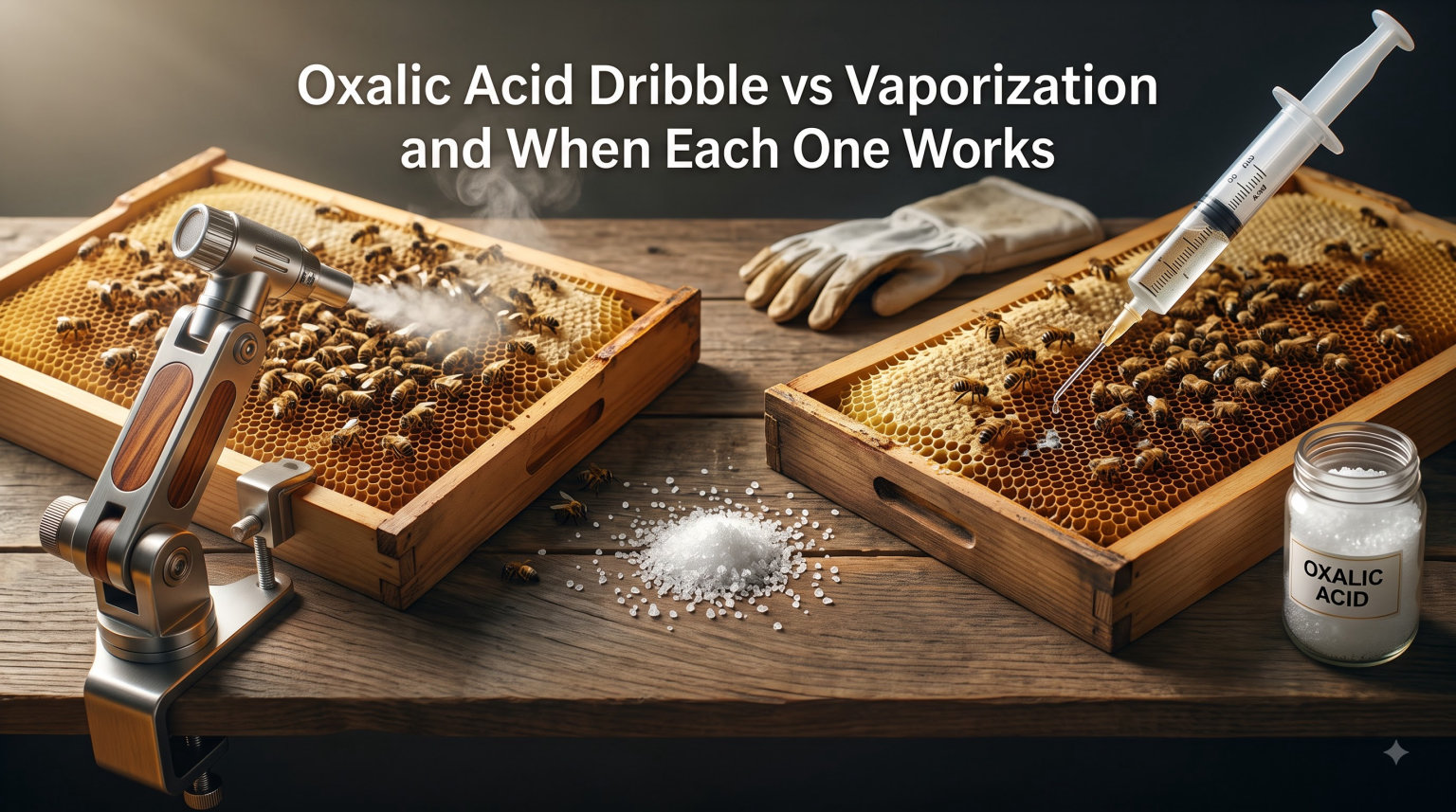
If you have been weighing oxalic acid dribble vs vaporization for varroa mite control, you already know both methods get the job done. The real question is which one fits your colony conditions, your climate, and your schedule. After running both treatments across my own apiaries for several seasons and watching results in dozens of fellow beekeepers’ hives, I have learned that the choice depends less on which method is “best” and more on which method matches your timing and brood situation.
Oxalic acid has become the go-to organic treatment for beekeepers who want effective varroa control without synthetic miticides. Two delivery methods dominate the conversation: the dribble (also called the trickle method) and vaporization. Each has clear strengths and clear limits. In this guide, I will walk you through what oxalic acid is, how each method works, when to use them, and how to decide between them for your own hives in 2026.
Table of Contents
What Is Oxalic Acid and Why Beekeepers Use It
Oxalic acid is a natural organic compound found in rhubarb, spinach, beets, and many other leafy plants. In beekeeping, it is used as an EPA-approved miticide to control Varroa destructor, the parasitic mite that weakens colonies and transmits damaging viruses like deformed wing virus and acute bee paralysis virus. Because it occurs naturally in the environment and breaks down into harmless byproducts after treatment, oxalic acid qualifies as an organic treatment option for hobbyist and commercial beekeepers alike.
The compound works on varroa mites through direct contact. When applied at the right dose, it kills phoretic mites (those riding on adult bees) while leaving honey, wax, and the bees themselves largely unaffected. That profile makes it attractive for beekeepers who want to avoid leaving chemical residues in comb, especially in operations that produce cut comb honey or sell beeswax products.
The catch is timing. Oxalic acid only kills mites that are exposed, meaning mites riding on adult bees. Mites sealed inside capped brood cells are protected. This is the single most important fact to understand when comparing oxalic acid dribble vs vaporization methods, and it shapes every decision you will make about which approach to use.
How Oxalic Acid Kills Varroa Mites
Oxalic acid kills varroa by entering the mite’s body through its feet and mouthparts, then disrupting its bloodstream and internal chemistry. At the doses beekeepers use, the compound is essentially harmless to adult bees, brood, and queens, although it can stress larvae if over-applied. The selective toxicity comes from the size difference between mites and bees. Mites absorb a proportionally larger dose relative to their body mass and cannot excrete the acid as quickly.
Because the acid only reaches exposed mites, treatment effectiveness depends heavily on the proportion of the mite population living outside capped cells. Research suggests roughly 60 to 80 percent of mites hide inside brood cells at any given moment during the active season. That leaves only a fraction of the population reachable by any single treatment, which is why timing matters so much.
This biology explains why the dribble vs vaporization debate exists. Each method delivers oxalic acid differently, and each interacts differently with brood and bees. The dribble is a wet application that lands on bees directly. The vaporization method turns the crystals into a gas that fills the hive and coats every surface, including the bees themselves, the comb walls, and the bottom board.
The Dribble Method: Step-by-Step Application
The dribble method, sometimes called the trickle method, involves mixing a 3.2 percent oxalic acid solution with a 1:1 sugar-water syrup and dripping it directly onto the bees clustered between frames. It is the simpler, cheaper option and is the method of choice when colonies are broodless in late fall or winter. Most beekeepers in cold climates use it as their primary winter mite knockdown because the application takes minutes per hive and requires no electricity.
Here is the procedure I follow when I dribble treat my own colonies. You will need oxalic acid crystals, granulated sugar, water, a 1-liter mixing container, a stir stick, and a 50 mL syringe.
- Mix 1 liter of 1:1 sugar water (equal parts sugar and water by weight), then add 35 grams of oxalic acid crystals to create a 3.2 percent solution. Stir until fully dissolved. Use the solution within a few days for best potency.
- Load a large syringe (50 mL works well) with the prepared solution. A kitchen basting syringe or veterinary dosing syringe both work.
- Open the hive and gently smoke the cluster to keep bees calm. Work quickly to avoid chilling the brood or cluster.
- Dribble 5 mL of solution directly onto the bees in each seam between frames, targeting the cluster. For a typical double-deep colony, that means roughly 50 mL total.
- Close the hive and let the bees redistribute the solution through grooming behavior. They will move it around the colony within a few hours.
- Repeat only once per queen per year. More frequent applications can harm brood and shorten queen lifespan. Mark your calendar so you do not forget.
The dribble method is highly effective in winter because the colony has no capped brood. Nearly all the mites are phoretic, and a single dose can eliminate 90 percent or more of them. It is also forgiving on equipment. You need only the solution, a syringe, and basic protective gear, and most of those supplies cost less than the price of a single nuc.
The main downside is that dribbling is hard on the bees if used repeatedly. The wet solution can stress larvae and open brood, which is why most beekeepers reserve it for a single annual treatment during the broodless window. Some keepers report slight queen supersedure in spring following a late-winter dribble, especially if the colony was already showing signs of an aging queen.
Pros and Cons of the Dribble Method
Pros:
- Inexpensive and easy to mix at home with basic supplies
- Highly effective when colonies are broodless, often exceeding 90 percent kill rates
- No specialized heating equipment required
- Fast application, takes about 5 minutes per hive once mixed
Cons:
- Limited to one application per queen per year to avoid harm
- Wet solution can stress open brood if used during active season
- Effectiveness drops sharply when brood is present
- Opening the hive in cold weather can disturb the cluster
The Vaporization Method: Step-by-Step Application
Vaporization (also called sublimation) heats oxalic acid crystals until they turn from a solid directly into a gas, then pumps that gas into the hive where it settles as a fine dust on every bee and surface. The crystals sublimate at around 157 degrees Celsius (315 degrees Fahrenheit), which is well above the temperature that kills varroa but well within the range of inexpensive battery-powered vaporizers sold by beekeeping suppliers.
The procedure I follow for vaporization is more involved than the dribble, but it gives you more flexibility on timing. You can vaporize at any temperature, in any weather, and without disturbing the cluster, which is why many sideliner and commercial beekeepers have switched to it as their default method.
- Set up a vaporizer on a stable surface near the apiary. Most units run on a 12-volt battery or propane torch. Keep a spare battery charged if you treat more than a few hives per session.
- Measure 2 to 4 grams of oxalic acid crystals into the vaporizer pan. Most hobby vaporizers use a 2-gram dose per deep brood box. Use a small digital scale for accuracy.
- Insert the vaporizer wand into the hive entrance or through a back entrance hole. Wear your respirator before this step.
- Seal the entrance with damp rags or a foam plug to trap the vapor inside. Block any upper entrances or cracks as well.
- Heat the vaporizer until all crystals have sublimated, usually 2 to 4 minutes. You will see vapor fill the hive as the crystals convert.
- Leave the hive sealed for another 10 to 15 minutes to let the vapor contact every bee and surface. Longer contact time improves kill rates.
- Remove the seal and air out the hive. Repeat every 5 to 7 days for a total of 3 to 5 applications to catch mites emerging from brood cells between treatments.
Vaporization is considered harmless to bees, brood, and queens when dosed correctly. That safety profile is the reason many commercial beekeepers prefer it over the dribble. Because the application does not require opening the hive, it is also the better option for cold-weather treatments when you do not want to break the cluster or expose brood to cold air.
Pros and Cons of the Vaporization Method
Pros:
- No application frequency limit, can be repeated as needed
- Treats the colony without opening the hive, ideal for winter and bad weather
- Safe for bees, brood, and queens at correct doses
- Vapor reaches mites hiding under cluster edges more effectively than liquid
Cons:
- Higher upfront equipment cost (vaporizer, battery, mask)
- Slower per hive, around 15 to 20 minutes including seal time
- Requires strict respiratory protection, fumes are hazardous to humans
- Less effective as a single dose when brood is present, requires multiple treatments
When to Use Each Method: Timing and Seasons
The most common mistake I see new beekeepers make is choosing a method without first checking the brood status of their colonies. Because oxalic acid only reaches phoretic mites, the timing of your treatment matters more than the brand of equipment you buy. A perfectly executed vaporization in mid-summer will underperform a sloppy dribble in mid-winter, simply because of where the mites are hiding when you treat.
Use the dribble method during the broodless window in late fall or winter. In most climates, that means a few weeks after the first hard frost when the queen has stopped laying and no new brood is being capped. A single application during this window is often enough to crash the mite population before spring buildup. If you are unsure whether your colony is truly broodless, lift a frame and look for eggs or capped cells. The presence of either means you should wait another week or two.
Use vaporization during the active season or whenever you cannot wait for a broodless period. Because vaporization can be applied without opening the hive, it is also the better choice for emergency treatments in cold weather, sudden mite crashes, or treating nucs that are too small to safely dribble. Many beekeepers run a vaporization series in late summer after pulling honey, then follow with a single dribble pass in mid-winter as a cleanup.
Climate matters more than most guides admit. In northern regions with a long, hard winter, you have a clean broodless window that favors the dribble. In southern regions where bees raise brood year-round, you almost never get a true broodless period, and vaporization with multiple doses is the realistic option. Coastal and humid climates can complicate both methods because condensation inside the hive can dilute dribble solutions and clump vapor crystals.
For most hobby beekeepers, a reasonable annual protocol looks like this. Monitor mite counts monthly with an alcohol wash or sugar roll. Treat with vaporization in early fall if counts exceed 3 mites per 100 bees. Then follow up with a single dribble treatment during the winter broodless window as a cleanup pass. This combination catches mites during the broodright season and then cleans up the stragglers before spring buildup.
For commercial operations managing dozens of hives across multiple yards, vaporization is almost always the better fit. The ability to treat without opening the hive saves significant labor, and the repeatability means you can run a multi-dose series across an entire yard in a single afternoon. The higher equipment cost amortizes quickly across a large operation.
Dribble vs Vaporization: Side-by-Side Comparison
This is the comparison table I wish someone had handed me when I started. It covers the practical differences that actually show up in an apiary.
| Attribute | Dribble Method | Vaporization Method |
|---|---|---|
| Best timing | Broodless period (late fall or winter) | Any time, including broodright seasons |
| Application frequency | Once per queen per year | Every 5 to 7 days, 3 to 5 rounds |
| Effectiveness single dose | 90%+ when broodless | 50 to 70% per dose |
| Equipment cost | Low (under $20 for syringe and supplies) | Higher ($100 to $300 for vaporizer and respirator) |
| Time per hive | 5 minutes | 15 to 20 minutes |
| Bee and queen safety | Safe once, harmful if repeated | Safe at correct dose |
| Weather tolerance | Needs calm bees, dry conditions | Works in cold and damp weather |
| Skill required | Beginner-friendly | Moderate, requires respirator discipline |
| Best for hobbyist | Yes, especially winter | Yes, year-round |
| Best for commercial | Rare, limited by single-dose rule | Yes, scales well across yards |
The tradeoff is essentially this: the dribble wins on cost, simplicity, and single-dose kill rate, but loses on flexibility. Vaporization wins on flexibility, repeatability, and bee safety, but costs more and takes longer per hive. Neither method is universally better, and the smartest treatment plan often uses both at different points in the season.
Safety Precautions and Protective Equipment
Both methods require respect, but the safety profile differs. The dribble is a wet solution that can irritate skin and eyes. The vaporization method releases fumes that are genuinely hazardous to human lungs at concentrations produced inside the hive. Skipping safety gear is one of the most common mistakes I see new beekeepers make, and it is also one of the most preventable causes of long-term health problems in the hobby.
Wear chemical-resistant gloves when mixing or applying either form of oxalic acid. Nitrile gloves work well and are inexpensive. The dry crystals are especially fine and easy to inhale accidentally, so avoid pouring them in windy conditions. Long sleeves and eye protection are smart for any application, especially when you are working above your head inside a hive cover.
For vaporization, a properly fitted respirator with acid-grade cartridges is non-negotiable. A dust mask is not sufficient. The vapor you see rising from the pan is oxalic acid gas, and breathing it can cause throat irritation, coughing, and long-term lung sensitivity. Treat the equipment the way you would treat paint stripper or any other respiratory hazard. Make sure the cartridges are rated for organic and acid vapors, and replace them on the schedule recommended by the manufacturer.
Keep children and pets out of the apiary during treatment. Store oxalic acid crystals in a clearly labeled container, away from food and out of reach. Wash all mixing equipment thoroughly after use, and never mix or apply in an enclosed space like a garage or shed. If you are treating multiple hives, work downwind and let fumes dissipate before moving on to the next colony.
One more precaution worth noting: do not vaporize a hive immediately after a recent sugar feeding or nectar flow. Heavy nectar in the comb can interfere with vapor distribution and reduce effectiveness. Similarly, do not dribble a colony that has been heavily fed recently, because excess moisture inside the hive can dilute the solution and stress the bees. Plan your treatments around your feeding schedule for the best results.
Frequently Asked Questions
What are the pros and cons of oxalic acid dribble method?
The dribble method is inexpensive, easy to mix at home, and highly effective during the broodless winter window, with kill rates above 90 percent in a single dose. The main downside is that it can only be used once per queen per year because the wet solution stresses larvae and can shorten queen lifespan if repeated. It also drops in effectiveness when brood is present.
When is the best time of year to use oxalic acid dribble?
Use the dribble method during the broodless window in late fall or winter, after the first hard frost stops the queen from laying and no new brood is being capped. A single application during this window catches nearly all phoretic mites and sets the colony up for a strong spring build.
Is vaporization easier on bees than dribble?
Yes. Vaporization is widely considered harmless to bees, brood, and queens at correct doses, which is why it has become the preferred method for commercial operations. The dribble method is also safe when used as directed but is much harder on open brood and queens if over-applied.
How many times can you apply oxalic acid vaporization?
You can apply vaporization as many times as needed across the year, since the dose is not harmful to the colony. The standard protocol is 3 to 5 applications spaced 5 to 7 days apart to catch mites emerging from capped brood cells between treatments.
What temperature is needed for oxalic acid vaporization?
Oxalic acid crystals sublimate directly into gas at about 157 degrees Celsius (315 degrees Fahrenheit). A quality vaporizer reaches this temperature quickly, and the full sublimation of a 2-gram dose usually takes 2 to 4 minutes per hive.
Choosing the Right Method for Your Apiary
There is no single winner in the oxalic acid dribble vs vaporization debate. The right choice depends on what your colonies need and what your calendar allows. If you operate in a region with a real winter and can wait for a broodless window, the dribble delivers a near-complete cleanup in a single cheap, simple pass. If you run a commercial operation, treat year-round, or face an emergency mite spike in cold weather, vaporization gives you the flexibility and repeatability that the dribble cannot match.
Whichever method you choose, monitor your mite load before and after treatment with an alcohol wash or sugar roll so you actually know whether the work paid off. Pair your oxalic acid program with good nutrition, strong genetics, and regular brood inspections, and you will give your colonies their best shot at overwintering strong and producing a healthy harvest in 2026.