
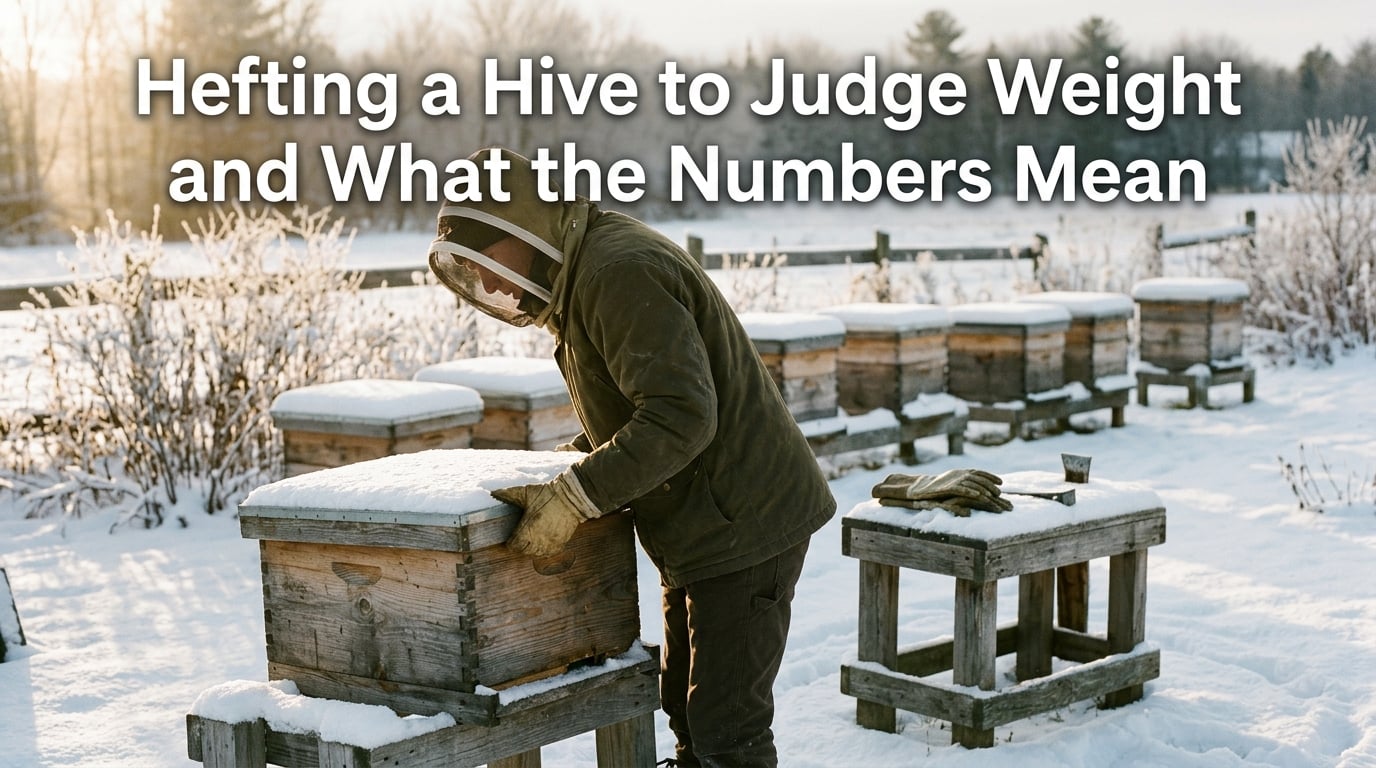
Hefting a hive is the single fastest way to know whether your bees have enough food to make it through winter. I learned this technique in my second year of beekeeping, after losing a colony to starvation that I thought was fine. One quick tilt of the box tells you more than almost any other winter check, and you do not even need to open the lid.
This guide explains what hefting means, how to do it correctly, and how to interpret the weight you feel so you can act before your bees run out.
Table of Contents
What Is Hefting a Hive?
Hefting a hive is a beekeeping technique where you gently tilt or lift one side of the hive to estimate the weight of the winter stores inside without opening the colony. The term comes from the verb “to heft,” meaning to lift something in order to judge how heavy it is.
The idea is simple. A full hive full of capped honey is heavy, and an empty hive is light. By lifting one side a couple of inches, you use the resistance you feel in your hands as a stand-in for a bathroom scale. It is non-invasive, takes about ten seconds, and disturbs the cluster far less than cracking open the inner cover.
Beekeepers have used this method for generations because it works in cold weather when opening the hive can chill brood or break the propolis seal the bees have worked to build.
Why Hefting Matters for Winter Survival
Hefting matters because a strong colony can starve to death in less than two weeks if it runs out of stores at the wrong moment. Once temperatures drop below about 12 degrees Celsius, bees cluster tightly and cannot forage for food even if you place it next to them. They depend entirely on what is already inside the hive.
In my own apiary, the colonies I lost to starvation in early 2026 were always the ones I thought were “probably fine.” When I finally hefted them in late February, they were feather-light. Hefting forces you to confront the truth your eyes will not give you through the entrance reducer.
This is the technique that separates beekeepers who winter successfully from those who keep buying replacement packages every spring.
How to Heft a Beehive Step by Step
The correct way to heft a hive takes less than a minute and uses just your hands and a clear sense of what “heavy” feels like. I will walk you through the four-finger method I use on every colony from October through March.
- Stand behind the hive. Approach from the rear so your shadow and breath do not fall across the entrance and disturb guard bees.
- Slide four fingers of your dominant hand under the back edge of the floor. Your thumb should rest on the back of the hive body for stability. Make sure the hive stand is solid and there is room to lift.
- Lift straight up about two inches. Do not jerk or shake. The goal is a smooth, controlled lift that you can repeat every time without disturbing the cluster.
- Judge the effort required. Note whether the hive feels like lifting a brick (heavy), a stack of paper (light), or somewhere in between. Commit that feeling to memory for that specific hive.
- Lower the hive gently back into place. Never drop it back down. The bees feel every jolt, and a heavy drop can break comb or split the cluster.
Repeat the same lift on each hive so you build a consistent baseline. The back-of-hive position is standard across the beekeeping community because the front lugs are usually bolted or strapped and harder to grip.
Interpreting the Weight and What the Numbers Mean
Interpreting hefting comes down to knowing what a well-stocked hive should weigh on a scale, then translating that number into what your arm feels like. As a rough guide, a full double brood box with a super of stores will weigh between 60 and 90 pounds (about 27 to 41 kilograms). A single brood box packed with winter stores typically weighs 40 to 60 pounds (18 to 27 kilograms).
If you do not have a scale, use the following touch-based scale for a standard National or Langstroth hive:
- Heavy: You cannot easily lift the back two inches. Stores are likely sufficient for winter.
- Moderate: You can lift it but it takes effort. Probably enough stores, but monitor weekly.
- Light: You can lift it with one hand. Feed immediately.
- Feather-light: The hive lifts like a stack of empty boxes. Emergency feeding required.
A practical shortcut is to weigh one full super of capped honey once, then remember that feeling. Anything noticeably lighter than that super means your hive is light on stores.
When and How Often to Heft Your Hive
Heft your hive once a month from October through January, then weekly from February through early spring. The February to March period is the most dangerous window because the cluster is raising brood, the queen is laying again, and food consumption roughly doubles within a few weeks.
Always heft at the same time of day, ideally mid-morning when temperatures are warmest. This keeps your comparison consistent and minimizes stress on the cluster.
What to Do if Your Hive Is Too Light
If a hive feels light in autumn, feed thick sugar syrup (2 parts sugar to 1 part water) until the bees stop taking it. In winter, switch to fondant placed directly on the frames above the cluster. Fondant is preferred over syrup because it does not freeze and adds no excess moisture to the hive.
I keep a brick of commercial fondant in the apiary shed from November onward. When a hive reads light on the lift, I cut a slab, score it with a knife, and lay it on a piece of newspaper directly over the top bars. The bees climb up and feed without leaving the cluster warmth.
For a more accurate reading before any feeding decision, slide a luggage scale under the back of the hive. Multiply the reading by 2.2 and you get a close estimate of the total hive weight. This trick from the British beekeeping forums is the cheapest way to turn a subjective lift into a real number.
Frequently Asked Questions
What is the 3 3 3 rule for bees?
The 3 3 3 rule is a simple beekeeping guideline that suggests you should aim to have 3 pounds of bees, 3 frames of brood, and 3 frames of stores when you set up a new colony or split. It is a quick way to make sure a hive is strong enough to survive on its own without supplemental feeding.
How to heft a bee hive?
To heft a bee hive, stand behind it, slide four fingers of one hand under the back edge of the floor, and lift straight up about two inches. Judge the effort required. Heavy hives have plenty of winter stores, light hives need immediate feeding. Always lift smoothly and lower the hive gently to avoid disturbing the cluster.
How much should a hive weigh going into winter?
A hive going into winter should weigh between 60 and 90 pounds for a double brood box, or 40 to 60 pounds for a single brood box, depending on your climate. Colder regions at the northern edge of the beekeeping range should aim for the higher end so the colony has enough stores to last until the first spring flow.
Why can’t beekeepers eat bananas?
Beekeepers are often advised to avoid eating bananas before working hives because the smell of banana peel resembles the alarm pheromone bees release when they sting. The scent can trigger defensive behavior and make the colony more likely to attack you during an inspection. It is a superstition as much as science, but many experienced beekeepers swear by it.
Final Thoughts on Hefting a Hive
Hefting a hive is the cheapest, fastest, and least invasive winter check you can perform. Master the four-finger lift, learn the weight of a full super on your own arm, and you will catch starving colonies weeks before they fail. Your bees give you almost no other warning, so make the lift part of every visit from October through March.