
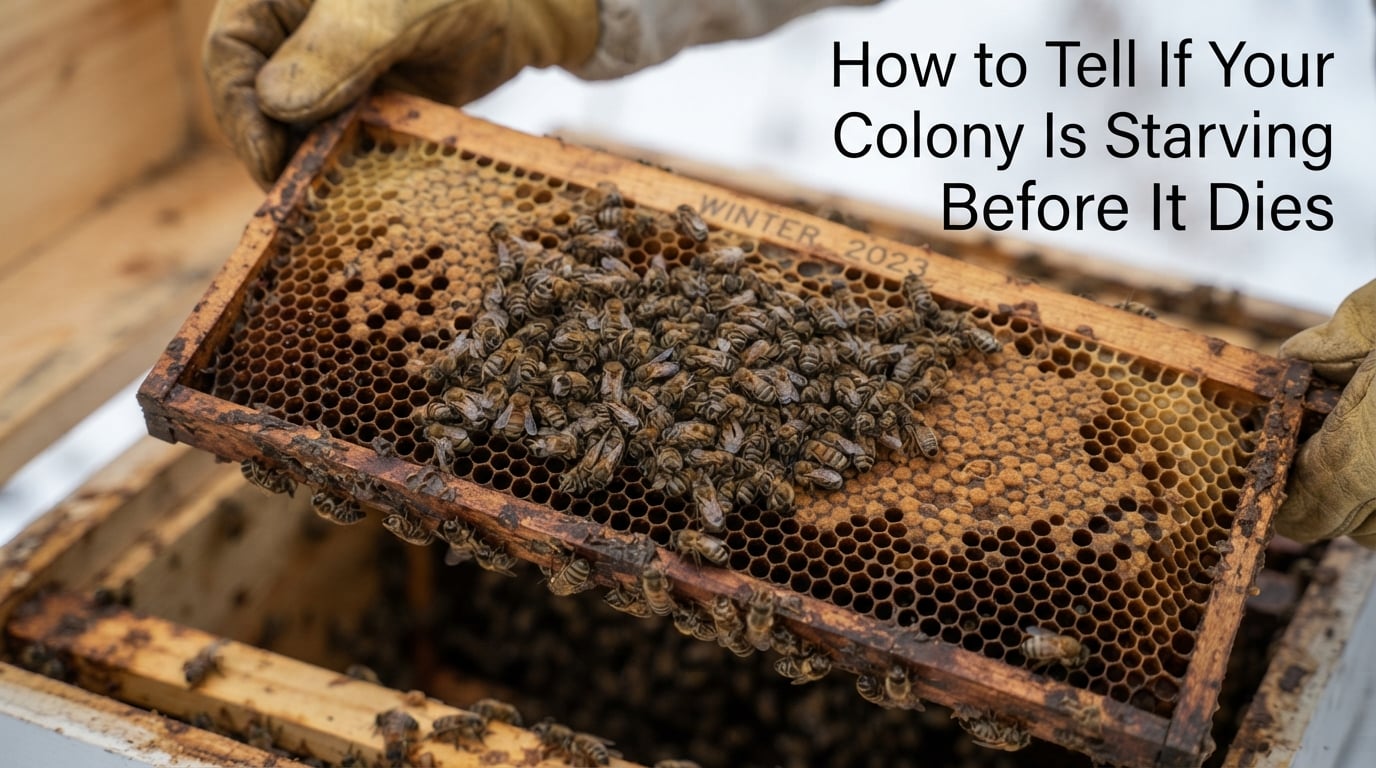
I’ve opened hives in late February expecting a healthy cluster and instead found a thousand bees head-first in empty cells. That image is burned into my memory, and it is exactly why I wrote this guide on how to tell if your colony is starving before it dies. Starvation kills more colonies than most beekeepers want to admit, and it kills fast.
Our team has lost two colonies to starvation and saved six others by catching the warning signs early. The difference came down to one skill: reading the hive before the cluster runs out of fuel. In this guide, I’ll show you the eight warning signs I look for, how to differentiate starvation from cold death, the 3-3-3 rule for routine checks, and the exact emergency feeding steps that bring a starving colony back from the brink.
Table of Contents
How to Tell If Your Colony Is Starving Before It Dies
A starving colony shows clear warning signs days or even weeks before it dies, and head-first bees in empty cells are the most reliable indicator. You can catch starvation early by checking hive weight, watching for behavioral shifts, and inspecting frames every two to three weeks during winter and spring.
Starvation is one of the few colony killers you can actually prevent. Disease, pests, and queen failure all take time to diagnose, but hunger gives you a window. That window opens the moment bees stop finding nectar and shifts their behavior. Miss the window, and the cluster can collapse in under a week. Catch it, and a few pounds of sugar or fondant can carry them through.
The Quick Answer: 8 Signs Your Colony Is Starving
If you only have sixty seconds, here are the eight signs that tell me a colony is on the edge of starvation. I’ll walk through each one in detail below.
- Bees crawling head-first into empty cells and dying there
- Lethargic cluster sitting on frames with no honey around it
- Sudden aggression when you open the hive
- Robbing behavior at the entrance or top of the hive
- Undersized bees emerging from the brood nest
- Queen stops laying or lays a spotty pattern
- Hive feels noticeably lighter when you heft it from behind
- Cannibalism of eggs and young larvae inside the cells
The 8 Warning Signs of a Starving Colony
The most reliable warning signs of a starving colony appear in this order: empty honey frames, lethargic cluster position, head-first bees in cells, then behavioral changes like aggression and robbing. Watching the order matters because each sign tells you how much time you have left to act.
1. Bees Found Dead Head-First in Cells
Head-first bees in cells is the classic starvation signature. A bee with her head buried deep in an empty cell has died reaching for food that was not there. You will see butts sticking up between the comb walls, often in a tight group.
This is the sign I check first during any winter or early spring inspection. I hold the frame up to the light and scan the lower third of the comb where the cluster sits. If I see three or more head-first bees, I treat it as an emergency regardless of what the rest of the hive looks like.
2. Cluster Sitting on Empty Frames
A starving cluster sits on bare comb with no capped honey arch above or beside it. Healthy winter clusters always have a “cap” of honey above them, and they migrate upward as they eat through stores. A cluster that stopped moving and is now stranded on empty comb is out of fuel.
I look for this by tilting the top box forward and peeking under the cluster. If the upper frames are dry and light when I tilt them, the bees have already eaten everything in reach and are about to starve.
3. Lethargic, Slow-Moving Bees
Lethargy is one of the first behavioral shifts in a hungry colony. Healthy winter bees move slowly anyway, but starving bees barely respond when you brush them. They feel cold and limp rather than firm and clustered tight.
On a 40°F morning, a healthy cluster will have bees at the top of the frames and a low buzzing sound when you tap the box. A starving cluster is silent and scattered. That silence is a red flag.
4. Sudden Aggression or Defensiveness
Hungry bees get mean. When nectar sources dry up, foragers compete with anything that smells like food, including your veil and gloves. If a hive that was gentle in October suddenly stings your jeans in January, starvation is one of the first things I check.
I have seen hives go from docile to hot overnight during a late summer dearth. The aggression comes from protein and carbohydrate stress, which is exactly what starvation looks like at the behavioral level.
5. Robbing Behavior at the Entrance
Robbing is a strong indicator of food stress, both in the robbing hive and the one being robbed. Robbing bees dart in and out without pollen on their legs, fight at the entrance, and chase guards. You may also see wax cappings scattered on the bottom board.
If you spot robbing during a dearth, check every hive in the apiary. The robbed colony may be the one already short on stores, and the robbers may simply be exploiting weakness.
6. Undersized or Malformed Bees
Undersized bees come from underfed larvae. Nurse bees feed larvae a mix of honey, pollen, and glandular secretions. When stores are low, the glandular secretions drop, and emerging bees have shorter abdomens, deformed wings, or pale coloring.
I check emergence by looking at the brood frames near the cluster. If the cappings look flat instead of domed, and the bees emerging look smaller than usual, the colony has been running on fumes for at least a brood cycle.
7. Queen Stops Laying or Lays a Spotty Pattern
The queen slows down or stops laying when food is short. Without incoming nectar and pollen, her body cannot support egg production. You will see fewer eggs, then fewer larvae, then a thin brood pattern that resembles a shotgun spread.
A spotty brood pattern in late winter is not always disease. Sometimes it is simply that the colony cannot afford to raise more mouths. Check food stores before reaching for antibiotics.
8. Cannibalization of Eggs and Larvae
Cannibalism is the colony eating its own young to recycle protein. Nurse bees pull eggs and young larvae out of cells and consume them. You will see wet, glistening cells where larvae used to be, and adult bees hanging around the brood area with distended abdomens.
This is one of the later signs. If you see cannibalization, you likely have less than a week to intervene before the cluster collapses.
How to Diagnose Starvation vs Cold Death
You diagnose starvation versus cold death by looking at cluster position, head orientation, and food proximity. A starved cluster is on empty comb with bees facing inward into cells. A cold-killed cluster is usually on full frames of honey with bees facing into the cells but with honey just out of reach, often split into smaller sub-clusters.
The two look similar at first glance, but the post-mortem pattern is different. I run through this checklist every spring when I find a deadout so I can adjust my management the following year.
Starvation vs Cold Death Comparison
Cold death happens when the cluster is too small to generate heat and freezes, often even with honey on the same frame. Starvation happens when the cluster has heat but no fuel. The post-mortem looks the same on the ground, but the frames tell the story.
- Starvation deadout: Frames above and beside the cluster are empty. Bees head-first in cells. Bottom board has many dead bees.
- Cold deadout: Frames above and beside the cluster are full of capped honey. Bees are clustered tightly, sometimes with frost on the comb. Few bees on the bottom board.
Using Hive Weight and Hefting
Hive weight is the single best quantitative check for starvation risk. A standard deep Langstroth frame holds about 8 pounds of honey when full, and a colony needs roughly 60 pounds of stores to make it through a typical northern winter. I use the heft test because it is fast and free.
I tilt the hive from the back by grabbing the bottom board. If it feels like lifting a bag of cement, the colony is fine. If it feels like lifting an empty box, I open it immediately regardless of the date.
For a more precise check, I weigh the hive with a luggage scale hooked to the back cleat. Anything under 50 pounds total in mid-winter for a single deep triggers a feeding decision. Anything over 80 pounds means I can stop worrying.
Seasonal Vulnerability and Prevention Strategies
Colonies are most vulnerable to starvation in late winter, early spring, and during summer dearths. Prevention means checking food stores before these windows open, feeding sugar syrup or fondant when stores drop below 50 pounds, and using the 3-3-3 rule to keep inspections short and consistent.
Winter and Spring Starvation
Winter starvation hits when the cluster eats through its honey cap before spring nectar arrives. The cluster moves upward into the top box and runs out of fuel near the inner cover. I lost a hive this way in March of 2026 when the queen started laying early and the brood nest consumed the last honey stores in three weeks.
Spring starvation hits when the colony is raising brood but cannot forage because of cold weather, rain, or a late nectar flow. The bees will starve with brood in the nest, which is one of the cruelest sights in beekeeping.
Summer Dearth and Nectar Shortage
Summer dearth happens when local flora stops producing nectar for two or more weeks. In the Pacific Northwest this hits in July, in the Midwest in late August. During a dearth, even strong colonies can run short, and robbing becomes a major risk.
During a dearth I stop inspections that break burr comb, I reduce entrance sizes to one inch, and I keep a close eye on weight. If I see robbing, I feed the victim and the robber colony, because feeding only the robber colony creates more robbing pressure on neighbors.
The 3-3-3 Rule for Routine Hive Checks
The 3-3-3 rule is a quick beekeeping inspection method: every 3 days, spend 3 minutes, and check 3 things. The three things are hive weight, food proximity to the cluster, and brood pattern. This rule is used by commercial beekeepers because it gives you the most survival-critical data in the least time.
I use the 3-3-3 rule from November through March, when opening a hive for more than three minutes risks chilling brood. It also keeps you from over-inspecting, which is one of the common mistakes new beekeepers make.
Emergency Feeding Protocols
If you catch starvation early, you can save the colony with sugar fondant, sugar bricks, or 2:1 sugar syrup depending on the season. Use fondant or sugar bricks in cold weather when bees cannot break down syrup. Use 2:1 syrup in spring and fall when bees can still take liquid feeds.
My emergency protocol is simple. I make a sugar brick by mixing 4 parts granulated sugar with 1 part water, pressing it into a parchment-lined tray, and placing it directly on the top bars above the cluster. For syrup, I use a frame feeder inside the brood nest.
For severely weakened clusters, I also add a protein patty within 24 hours. Pollen substitute gives the nurse bees the amino acids they need to restart brood-rearing once carbs are restored.
When to Intervene vs When to Watch
Intervene when you see head-first bees, an empty honey cap above the cluster, or a hive weight under 50 pounds in winter. Watch when stores are above 60 pounds, the cluster has honey on three sides, and the queen is laying a solid pattern.
The hardest part of starvation management is not feeding. It is knowing when not to feed. Over-feeding in spring can plug the brood nest with stored syrup, which the queen then refuses to lay in. I aim for steady reserves rather than heavy surplus.
A Simple Hive Inspection Checklist
Run through this checklist during every winter or spring inspection. It takes about three minutes with the 3-3-3 rule and tells you everything you need to know about starvation risk.
- Heft the hive from the back. Note the weight mentally.
- Peek under the inner cover. Is the cluster near the top?
- Check the uppermost frame in the cluster box. Is there capped honey above the bees?
- Scan the lower third of the brood frames for head-first dead bees.
- Look at the brood pattern. Solid or spotty?
- Check the bottom board for bee parts, wax cappings, or dead larvae.
Frequently Asked Questions
What are the stages of starving to death in bees?
Bees go through four stages before death from starvation. First, empty honey frames around the cluster. Second, lethargy and reduced flight activity. Third, head-first bees in cells as they reach for non-existent food. Fourth, total cluster collapse within three to seven days. Catching the first stage gives you weeks to act. Catching the third stage gives you hours.
What does a bee do when it is dying?
A dying bee from starvation crawls slowly, falls off the comb, and may sit on the bottom board twitching. In the cells, dying bees insert their heads and abdomens and never come back out. Some bees leave the hive to die outside, which is why you may see dead bees on the landing board even when the cluster is still alive.
What is the 3-3-3 rule for bees?
The 3-3-3 rule is a quick hive inspection method: check your colony every 3 days, spend only 3 minutes per visit, and focus on 3 things. The three things are hive weight, food proximity to the cluster, and brood pattern. Commercial beekeepers use this rule during cold months to avoid chilling brood while still catching starvation early.
How do you know if your bees are starving?
You know bees are starving when you see bees head-first in cells, an empty honey cap above the cluster, and a hive that feels light when you heft it. Other signs include lethargy, robbing behavior, undersized emerging bees, and a queen that has stopped laying. Checking every two to three weeks during winter and spring catches these signs before the colony dies.
Final Thoughts on Colony Starvation Prevention
Learning how to tell if your colony is starving before it dies comes down to routine, pattern recognition, and quick intervention. Heft the hive every few weeks. Watch for head-first bees. Keep fondant or sugar bricks on hand for emergencies. These habits turn starvation from a silent killer into a preventable problem.
If you take one thing from this guide, take the 3-3-3 rule. Three days, three minutes, three checks. Run that loop through winter and spring and your bees will almost certainly make it to the first major nectar flow in 2026.