
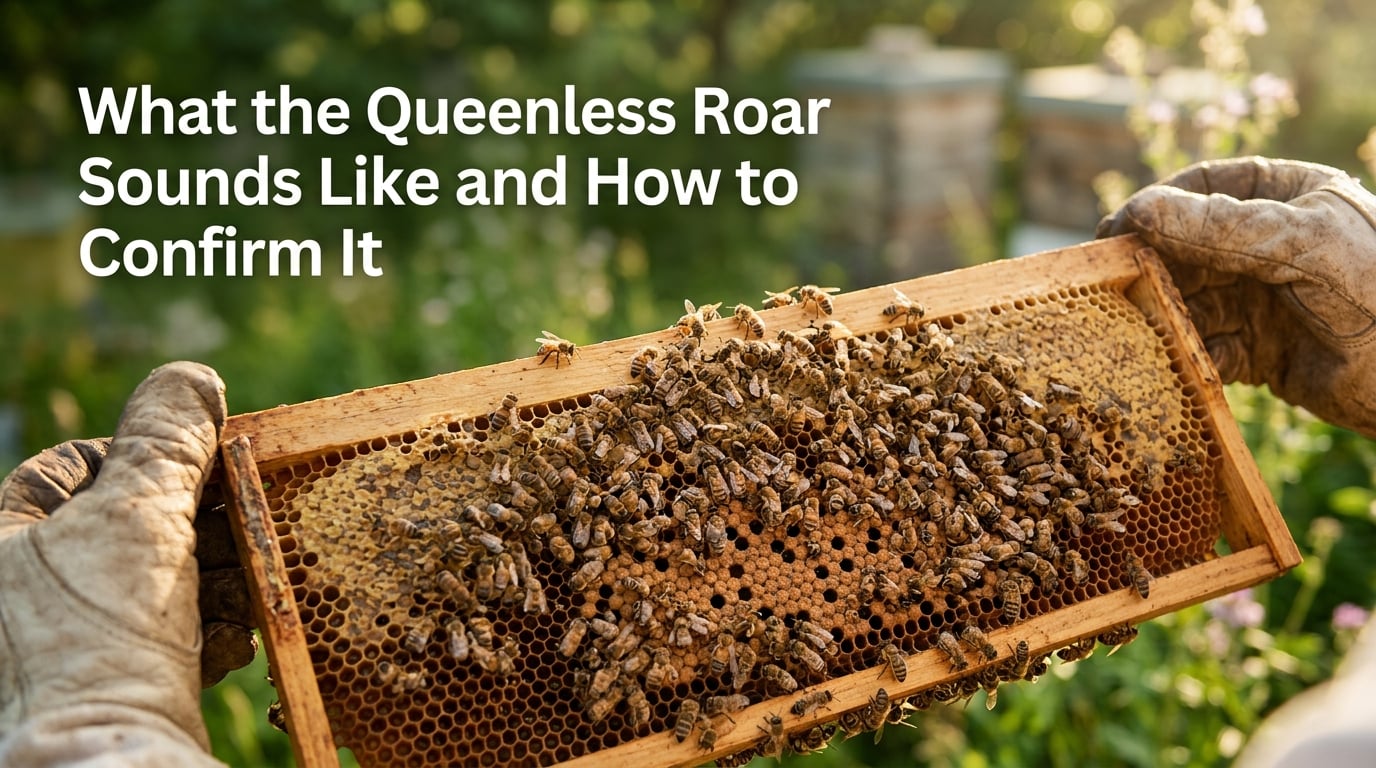
I still remember the first time I heard a queenless roar. I was standing beside a Langstroth on a warm May afternoon, and the colony was louder than any hive in the apiary. It was not the soft, contented purr I had come to expect. It was a rising, agitated buzz that made me step back half a pace.
That moment taught me how much a beekeeper can learn from sound alone. A queenless roar is a loud, rising, somewhat threatening noise that a bee colony makes after losing or rejecting its queen. It is distinctly different from the soft purr of a queenright hive, and learning to recognize it can save a colony from slow decline.
In this guide, I will walk you through exactly what the queenless roar sounds like, how to tell it apart from normal hive noise, and the step-by-step inspection I use to confirm whether my colony is actually queenless.
Table of Contents
What the Queenless Roar Sounds Like
The queenless roar is a loud, sharp, sustained buzz that fills the inside of the hive and spills out through the entrance. Beekeepers often describe it as a rising whine, a hiss, or the noise you hear when you accidentally bump a frame and the workers all take flight at once.
One beekeeper on Beesource put it best: the sound is “like when you drop a frame a little and they all roar.” I have heard the same thing in my own apiary, and the comparison is accurate. The roar is short-lived if you disturb them, but a truly queenless colony keeps it up for hours or even days.
By contrast, a queenright hive produces a soft, steady hum that beekeepers describe as a contented purr. Worker bees fan their wings gently to circulate air and distribute pheromones, and that motion produces the soothing background noise most beekeepers find relaxing.
Here is the quick comparison I use in my head when I walk up to a hive:
- Queenright hive: low, steady hum, like a small engine idling.
- Queenless hive: loud, rising whine, like static on an old radio dialed to the wrong frequency.
- Recently disturbed hive: sharp burst of buzzing that fades within a few minutes.
How Bees Behave When They Are Queenless
Queenless bees become noticeably more agitated, listless, or defensive depending on how long the colony has been without a queen. In the first hours, the workers often rush around the comb looking for her. After a day or two, that agitation settles into a low, unsettled roar.
The reason is pheromones. A healthy queen releases queen mandibular pheromone across the colony, and that chemical signal keeps worker behavior coordinated and calm. Once the queen dies, fails to return from a mating flight, or is rejected, the pheromone fades within hours and the workers lose their cohesion.
I have watched nurse bees shake their abdomens and fan their wings in empty queen cells, a behavior called “piping” or “quacking” that signals the colony knows it is in trouble. Aggressive bees, listless bees, and skittish foragers are all classic signs that the colony has lost its chemical anchor.
The Timeline of Queenlessness Signs
The queenless roar does not appear instantly, and the signs progress in stages. Knowing the timeline helps me decide when to act.
In the first few hours after queen loss, bees are visibly unsettled. They may run across the comb, fan their wings, and produce an unsteady hum. According to experienced beekeepers on BeekeepingForum, the colony starts to roar somewhere between a couple of hours and a day after the queen disappears.
Between two and seven days, the workers begin building emergency queen cells from existing young larvae. You may also hear the characteristic piping and quacking of virgin queens developing inside capped cells. By this stage, the roar is usually at its loudest.
After two to three weeks without intervention, the colony often develops laying workers. These are worker bees whose ovaries activate in the absence of queen pheromone, and they begin laying unfertilized eggs that become drone brood. Once laying workers are established, re-queening becomes much harder.
Outside Signs of a Queenless Hive You Can Hear
Before I open a hive, I spend two to three minutes listening at the entrance. Several audible cues can warn me that something is wrong.
A loud, persistent roar that does not fade after I tap the side of the box is the most reliable outside sign. So is a lack of normal orientation flights in the afternoon. Foragers in a queenright hive come and go in a steady stream, while a queenless colony often has bees clustered at the entrance, fanning and buzzing without purpose.
Another sign I watch for is defensive behavior. A colony without queen pheromone often feels more aggressive when I open it. They boil up at the top of the frames, hit my veil in waves, and produce a sharp, crackling buzz. Aggressive bees on their own do not mean queenless, but combined with a roar, they form a strong early warning.
Inside the Hive: Inspection Signs to Confirm It
Once I open the hive, I look for four specific clues. None of them is conclusive on its own, which is why I always check more than one before deciding.
The first and fastest sign is missing eggs. Eggs are the first thing to disappear when the queen is gone, so I scan freshly drawn comb with my phone flashlight for the tiny white grains of rice that indicate fresh laying.
The second sign is a poor or spotty brood pattern. In a queenright hive, capped worker brood forms a tight, solid pattern. A queenless colony often shows shotgun brood, scattered and uneven, with many empty cells between capped brood.
The third sign is queen cells. Supersedure cells on the face of the comb or emergency cells along the comb edges indicate the colony is already trying to replace a missing queen. Finding one or two supersedure cells is not necessarily bad. Finding many emergency cells usually means the queen has been gone for several days.
The fourth sign is drone brood in worker cells. Laying workers cannot fertilize eggs, so every egg they lay develops into a drone. Capped drone brood sticking up like bullets from worker-sized cells is a classic late-stage sign of queenlessness.
How to Confirm Queenlessness Step by Step
Here is the exact procedure I follow when I suspect a queenless hive. I run through every step before I commit to any treatment.
- Listen at the entrance for 2 to 3 minutes. Confirm a loud, sustained roar that does not settle after a soft tap.
- Smoke lightly and open the hive. Watch for behavior. Boiling bees and crackling buzz both point toward queenlessness.
- Pull a frame of fresh comb from the brood nest. Look for eggs with a magnifying glass or bright light. No eggs at all is a strong signal.
- Check the brood pattern. Shotgun brood, missing age groups, or no capped worker brood all suggest no queen.
- Scan every frame for the queen. Look on comb faces, edges, and the bottom board. Marked queens make this step much faster.
- Look for queen cells and laying worker signs. Supersedure cells, emergency cells, and bullet-shaped drone brood confirm the timeline.
- Recheck in 5 to 7 days. If eggs are still absent and no queen cells have appeared, the colony is almost certainly queenless.
If seven days pass and there are still no eggs, no queen cells, and no queen sightings, I treat the colony as queenless and decide whether to introduce a new queen, combine with another hive, or let them raise a queen from a frame of young brood I add from a healthy colony.
Common Mistakes When Trying to Identify a Queenless Hive
New beekeepers in our community run into the same handful of mistakes every season. Avoiding these will save you time and frustration.
Do not judge by sound alone. A disturbed hive roars briefly even when it has a queen. Judge by sound plus behavior plus eggs, in that order of importance.
Do not confuse supersedure cells with swarm cells and panic. A few supersedure cells mean the colony is already solving its own queen problem. Many capped emergency cells with no queen in sight is the alarm bell.
Do not wait too long to act. Once laying workers dominate the comb, the colony often rejects introduced queens. Combining a hopelessly queenless hive with a strong queenright hive using the newspaper method is a more reliable solution than fighting a laying worker colony.
Frequently Asked Questions
How can I tell if a colony is queenless?
Listen for a loud, sustained roar at the entrance, watch for agitated or listless behavior during inspection, and check freshly drawn comb for eggs. No eggs combined with a spotty brood pattern and no visible queen is the most reliable confirmation.
How long does it take bees to realize they are queenless?
Most colonies start showing restlessness within a couple of hours and produce a clear roaring sound within 24 hours of losing their queen. Emergency queen cells typically appear after 2 to 7 days.
What does a queen bee sound like?
A laying queen makes a soft tooting sound, called piping, especially when rivals are present in the hive. The workers around her make the familiar low, contented hum, not the queenless roar.
How do bees act without a queen?
Worker bees without a queen become agitated, run across the comb searching, fan their wings at empty queen cells, and may turn aggressive. Over time they slow down and appear listless as laying workers take over.
Will a queenless hive always roar?
No. The roar is strongest in the first week after queen loss. Older queenless colonies with laying workers often go quiet and listless instead, which can fool beekeepers into thinking the problem has resolved itself.
How long can a hive go queenless?
A strong colony can survive 4 to 6 weeks without a queen before laying workers and dwindling numbers make recovery impossible. Early detection and re-queening within the first 2 weeks gives the best results.
Final Thoughts on the Queenless Roar
The queenless roar is one of the most useful early-warning signals a beekeeper has. It tells you the colony has lost its chemical anchor and is starting to unravel, often days before you would notice anything by visual inspection alone.
Take five minutes before each inspection to listen at the entrance, compare the sound to your other hives, and confirm with an egg check before you treat. Combining sound, behavior, and brood observation is how our team catches queenlessness early in 2026 and gives colonies the best chance of recovery before laying workers take hold.