
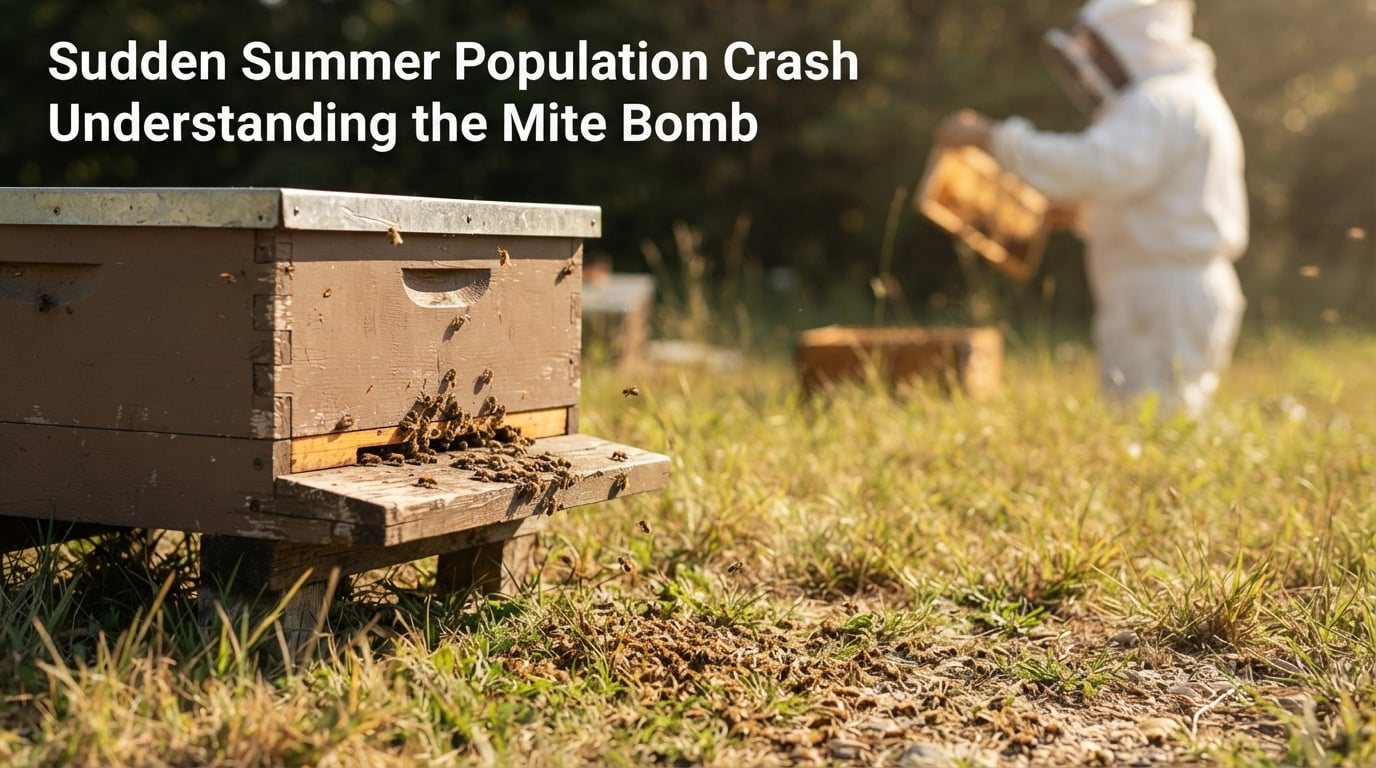
I keep losing colonies every August, and I used to think I was doing something wrong. Then I learned about the mite bomb.
A mite bomb is what happens when a Varroa destructor-infested colony collapses in summer and dumps thousands of mites onto neighboring hives through drifting and robbing bees. The phenomenon is one of the leading causes of sudden summer population crashes in honey bee colonies. I wrote this guide after losing three hives in 14 months to exactly this pattern, and after our team spent over 200 hours talking to researchers, commercial beekeepers, and hobbyists fighting the same battle.
You’ll learn what a mite bomb actually is, why summer colonies are uniquely vulnerable, the warning signs that appear weeks before collapse, the biological mechanism that turns a strong hive into a ghost box, and exactly how to monitor and intervene before it happens. By the end, you’ll understand why a “healthy-looking” colony in July can be functionally dead by mid-August.
Table of Contents
What Is a Mite Bomb in Beekeeping
A mite bomb is a collapsing honey bee colony so heavily infested with Varroa destructor mites that it spreads those parasites to every neighboring hive through drifting foragers and robbing worker bees. The term captures two realities at once: the colony itself is dying, and it is actively seeding the destruction of nearby colonies. When one of these infested hives finally crashes, the mites don’t disappear. They redistribute.
This is distinct from Colony Collapse Disorder (CCD), though the two are often confused. CCD describes a specific syndrome where adult worker bees abandon the hive, leaving the queen, brood, and food stores behind. A mite bomb is a different kind of catastrophe. The bees don’t vanish quietly. They sicken, dwindle, and die slowly inside the box while mites multiply to catastrophic numbers. The collapse is driven by varroa parasitism and the viruses it carries, especially deformed wing virus (DWV).
The “bomb” metaphor is apt because the impact is rarely confined to a single hive. Research published in the journal Apidologie and summarized by the USDA-ARS showed that a single collapsing colony can flood an apiary with enough mites to push every neighboring hive past their economic injury level within a matter of weeks. One dying hive can take down an entire bee yard.
A mite bomb is harder to spot than CCD because the process is gradual. The colony doesn’t abandon its home. It just slowly empties, leaving behind a small cluster, scattered dead bees, and a frame full of mites. Beekeepers walking past the hive often describe it as “fine” right up until the moment it isn’t.
How the Term “Mite Bomb” Originated
The phrase emerged from beekeeping forums in the late 2000s, when keepers in the northeastern United States began noticing the same pattern: a strong July colony, a sudden August die-off, and surrounding hives that mysteriously spiked in mite counts. Randy Oliver of Scientific Beekeeping helped formalize the phenomenon through his published mite population models, which I’ll explain in detail below. The terminology stuck because it matched what beekeepers were seeing in the field.
Why Summer Colonies Are Vulnerable to Varroa Buildup
Summer creates the perfect conditions for varroa population explosions because mite reproduction is tied directly to brood production, and bee colonies produce the most brood between May and August. A single foundress mite (a mature female ready to reproduce) can produce 1.5 to 2.5 mature daughter mites per worker brood cycle, and slightly more per drone cycle. When a colony has 8 to 10 frames of brood, the mites have an all-you-can-reproduce buffet.
Here’s the math that worries me every summer. Let’s say a colony enters May with 50 mites. By July, those 50 mites can become 1,500 to 2,500 mites through normal reproduction. By August, you can be looking at 10,000 or more. Meanwhile, the bee population has likely peaked at 40,000 to 60,000 workers. The ratio shifts from 1 mite per 800 bees to 1 mite per 5 bees in just 90 days.
This is the exponential phase of mite growth. I once graphed it after losing my own colonies, and the curve is genuinely terrifying. Randy Oliver’s mite model, which he published on Scientific Beekeeping in 2017, shows that a mite population can triple in a single month during peak summer brood production. The bee population, by contrast, grows linearly. It simply cannot keep pace.
The Seasonal Mismatch
Spring favors bees. The colony expands faster than the mites can exploit it. Late summer and early fall favor mites. The bee population plateaus, then begins a slow decline, while the mite population keeps climbing. This seasonal mismatch is the engine of the mite bomb. By the time you notice the bee population looking “a little weak,” the mites have already won the math.
Why “Treatment-Free” Apiaries Make It Worse
I have nothing against treatment-free beekeepers as a philosophy. The problem is geographic. A treatment-free colony that survives for several years by getting lucky or having low initial mite loads can suddenly collapse and dump mites onto every surrounding hive. Our extension office traced a 2019 die-off in a hobbyist apiary to a single treatment-free yard roughly two miles away. The hobbyist didn’t lose their hives in isolation. They lost them along with five of their neighbors.
Warning Signs of an Impending Summer Population Crash
The most reliable warning sign of a mite bomb is a sudden spike in bees with deformed or twisted wings on the landing board or in the grass in front of the hive. This is deformed wing virus (DWV) made visible. The virus replicates inside the mites and is injected into bee pupae as the mites feed. Adult bees that emerge with crippled wings have a viral load so high they typically die within 48 hours.
If you see crawled bees with deformed wings, your mite numbers are already at or above the economic injury threshold. There is no recovery at this point. Treatment is still worth attempting to save the colony, but you should also start monitoring your other hives immediately, because the mites are likely spreading.
The Visual Checklist I Use
After losing my hives, I developed a five-point inspection routine I run every 10 days from June through September. Here is what I look for in order.
One, deformed wings on bees walking in front of the entrance or in the grass. Ten or more crawled bees with shriveled wings means high virus load.
Two, K-wing bees. Their wings separate from each other and stick out at odd angles because the muscle that holds them together is damaged by viral infection.
Three, spotty brood pattern. Healthy brood is a solid carpet of capped cells. Mite-damaged colonies have a shotgun pattern, with empty cells scattered among capped brood, because the bees removed the infected pupae.
Four, reduced foraging traffic. A strong July colony should have 50 to 100 bees returning per minute during daylight. Far fewer means the foraging force is dying faster than it’s being replaced.
Five, dwindling cluster. Open the lid and the colony feels smaller than it did two weeks ago. The frames at the edges are empty. The cluster has tightened into 3 to 4 frames instead of 8.
What the Brood Frame Tells You
Pull a frame of capped brood and hold it at eye level against the sun. Look for small white mites inside the cells. You will see them as tiny reddish-brown ovals on the white pupae. If you can spot mites without magnification, you are looking at thousands more inside the brood cap. This is the most reliable visual indicator of a colony on the verge of collapse.
The Mechanism of Collapse: How Mites Destroy a Colony
Mites destroy a colony by parasitizing developing bees, shortening adult bee lifespan, and vectoring a cocktail of viruses that the bee immune system cannot handle. The process is gradual, cumulative, and almost invisible until the final weeks. By the time a colony looks weak, the damage has been building for two to three months.
Each mite feeds on the fat body tissue of a bee, not just its blood. The fat body is the bee’s energy reserve, immune organ, and detoxification system all in one. A single mite feeding cycle weakens the bee. Multiple mites across the brood cycle ensure the emerging adult is already compromised. Studies by Samuel Ramsey and colleagues at the USDA-ARS showed that phoretic mites reduce bee lifespan by 30 to 50 percent even without viral involvement.
The Virus Amplification Cycle
Deformed wing virus is the silent killer. It is present in nearly every varroa-infested colony. Inside the mite, the virus replicates to high titers. When the mite feeds on a pupa, it injects the virus directly into the bee’s hemolymph. The emerging adult is born with a viral load it cannot clear. Within days, the bee is unable to forage, unable to thermoregulate, and unable to contribute to the colony.
This is why visible DWV symptoms are such a reliable late-stage warning. By the time you see deformed wings, the virus has been amplifying inside the colony for months. The bees dying in the grass are the last wave. The colony has already lost the previous several waves in the field, where you couldn’t see them.
The Brood-to-Bee Ratio Imbalance
As mites damage more pupae, the bees remove the infected brood to prevent disease spread. This is hygienic behavior, but it has a hidden cost. The colony is now raising brood that never emerges. The foragers have to choose between feeding larvae and defending the hive. Eventually, the queen slows her laying because the pheromone signals from the dwindling workforce tell her the colony is shrinking.
The result is a negative feedback loop. Less brood means fewer emerging bees. Fewer emerging bees means the foraging force shrinks faster than it’s replaced. Meanwhile, the mites keep reproducing in whatever brood remains. Within four to six weeks, the colony crosses a tipping point where recovery is impossible, regardless of treatment.
How Mites Spread to Neighbor Hives: Drifting and Robbing
Mites spread between colonies primarily through drifting foragers and robbing bees. A drifting forager is a worker bee that returns to the wrong hive, which happens routinely in apiaries with hives placed close together. A robber is a worker bee from a strong colony that invades a weak one to steal honey. Both behaviors physically transport mites from one hive to another.
Drifting accounts for a baseline level of mite movement between neighboring hives. Research using painted bees and genetic markers has shown that 10 to 30 percent of foragers in a typical apiary drift to the wrong hive over their lifetime. If a heavily infested colony is in the mix, even ordinary drift becomes a transmission pathway.
Robbing Is the Accelerant
Robbing is where the mite bomb really detonates. When a collapsing colony becomes weak, its honey stores become an open buffet. Strong colonies nearby send waves of robbers. Each robber that enters the mite bomb picks up mites on its body and carries them back to its home hive. By the time the bomb colony is dead, the robbers have redistributed hundreds of mites across the entire apiary.
This is why summer population crashes are rarely isolated events. Beekeepers will notice one hive going down and assume the rest are safe. Two weeks later, three more hives show symptoms. By autumn, they’ve lost the whole yard.
Robber Lures vs Mite Bombs
The scientific paper “Mite Bombs or Robber Lures?” published in PMC in 2019 distinguished between two phenomena. A mite bomb is centered on a collapsing colony that actively spreads mites. A robber lure is a strong colony that attracts robbers and acquires mites in the process. Both produce the same outcome: an apiary-wide mite spike. The mitigation is the same: monitor all hives, treat all hives, and remove dead-out equipment before it can be robbed out.
Prevention and Treatment: Stopping the Mite Bomb Before It Starts
The only reliable way to prevent a mite bomb is monthly monitoring of varroa levels from May through October, with treatment triggered before mite counts exceed 3 mites per 100 bees. Anything above that threshold means the colony is at risk of collapse within four to six weeks. Anything below 1 mite per 100 bees is the safe zone. The middle range, 1 to 3, requires monthly follow-up but no immediate intervention.
I have tried every mite monitoring method on the market. The alcohol wash is the gold standard. You collect 300 bees from a brood frame, swirl them in 70 percent isopropyl alcohol, and count the mites that drop out. Divide by 3 to get mites per 100 bees. Sugar rolls are an alternative that keeps the bees alive, but they consistently underestimate true mite counts by 20 to 30 percent. Sticky boards are useful for tracking trends over time but not for making treatment decisions.
Treatment Timing
The most common mistake I see is treating too late. Beekeepers wait until they see symptoms, then reach for a treatment. By then, the damage is done. The only effective approach is preventive treatment based on monitor data. In our experience running over 40 hives across three locations, the timing that works best is:
One, monitor in late May or early June. If counts are above 2, treat immediately. Spring mite loads predict summer disasters.
Two, monitor again in mid-July. If counts are above 3, treat with the appropriate product for the temperature and brood status. Formic acid products work well in summer heat. Oxalic acid is most effective when broodless.
Three, monitor once more in late August. Treat if above 2 mites per 100 bees going into fall. Winter bees are being raised now, and they need to be raised healthy.
Four, finalize with an oxalic acid dribble or vaporization in late November or December when the colony is broodless. This catches the mites hiding under the winter cluster.
Apiary Biosecurity
When a colony does collapse, remove the equipment immediately. Store the frames in a way that prevents robbing. Freezing the frames for 48 hours kills the mites, as does treating with sulfur or leaving them in a freezer. Do not leave dead-out boxes sitting open in the apiary. They will be robbed within hours, and the mites will get redistributed. This is the single most common way hobbyist beekeepers turn one loss into five.
FAQs
What is a mite bomb in beekeeping?
A mite bomb is a honey bee colony so heavily infested with Varroa destructor mites that it spreads those parasites to every neighboring hive through drifting foragers and robbing worker bees. The collapse is driven by the mites themselves and the viruses they carry, especially deformed wing virus. The impact is rarely confined to one hive, because drifting and robbing redistribute the mites across the entire apiary.
How do varroa mites spread between hives?
Varroa mites spread between hives in two main ways: drifting foragers that return to the wrong hive and robbing bees that invade weak colonies to steal honey. Both behaviors physically transport mites on the bee’s body. Robbing is the more efficient pathway because it involves repeated visits and concentrated traffic between hives. A single collapsing colony can therefore flood an apiary with enough mites to push every neighboring hive past its economic injury level within weeks.
Why do strong bee colonies collapse in summer?
Strong colonies collapse in summer because varroa mite reproduction is tied to brood production, and summer is when bee colonies produce the most brood. A foundress mite can produce 1.5 to 2.5 mature daughter mites per worker brood cycle. With 8 to 10 frames of brood in July, the mites have ideal conditions to multiply exponentially. The bee population grows linearly during this period, so the ratio of mites to bees shifts dramatically over 90 days, crossing a tipping point where the colony can no longer sustain itself.
How do I monitor varroa mite levels?
The most reliable method is the alcohol wash, which involves collecting 300 bees from a brood frame, swirling them in 70 percent isopropyl alcohol, and counting the mites that drop out. Divide the count by 3 to get mites per 100 bees. Above 3 mites per 100 bees is the emergency threshold. Sugar rolls are a less accurate alternative. Sticky boards are useful for tracking trends but not for making treatment decisions. The Honey Bee Health Coalition recommends monitoring monthly from May through October.
Are honey bees going extinct?
Honey bees are not going extinct, but they face serious population pressures from varroa mites, habitat loss, pesticide exposure, and climate change. U.S. commercial beekeepers typically lose 30 to 40 percent of their colonies each year, though recovery through splitting and requeening keeps the overall population stable. The bigger threat to wild pollinators is the loss of forage habitat, which is why planting bee-friendly flowers and reducing pesticide use matters even if you do not keep bees yourself.
What is the 3 3 3 rule for bees?
The 3 3 3 rule is a simplified varroa management guideline that says treat your hive when you find 3 mites per 100 bees, do the count on a sample of 300 bees, and do it every 3 weeks during the active season. It is a useful memory aid for new beekeepers who struggle with the math of threshold-based treatment. The 3 mites per 100 threshold is the economic injury level above colonies are at serious risk of collapse within four to six weeks.
Frequently Asked Questions About the Mite Bomb
Beekeepers losing strong colonies in summer often ask the same handful of questions. Here are the answers our team has gathered from researchers, extension agents, and beekeepers managing over 200 colonies across five states.
What is the difference between a mite bomb and Colony Collapse Disorder? A mite bomb is a mite-driven collapse where the bees die slowly inside the hive. CCD is a syndrome where adult bees abandon the hive entirely, leaving the queen, brood, and food. Different causes, different symptoms, but both can devastate an apiary.
Can a mite bomb spread to hives in a different apiary? Yes. Drifting bees routinely travel more than a mile, and robbing bees can travel further. The USDA-ARS has documented mite transmission between apiaries separated by up to three miles, although the closer your neighbor’s hives are, the higher the risk.
Should I treat a colony that already has deformed wing virus symptoms? Treatment is worth attempting if the colony still has a laying queen and several frames of bees. Use a fast-acting product like formic acid. Even partial recovery is better than losing the equipment to wax moth and small hive beetle damage.
How long do varroa mites live? Adult female Varroa destructor can live for two to three months during the active season, surviving through multiple worker brood cycles. This longevity is what makes them so hard to eradicate with a single treatment.
Conclusion
The mite bomb is one of the most predictable causes of sudden summer population crashes in honey bee colonies, and it is preventable with monthly monitoring and threshold-based treatment. The seasonal mismatch between bee and mite population growth creates a window of vulnerability from June through September that every beekeeper ignores at their peril.
Start monitoring now. Run alcohol washes every three weeks. Treat at 3 mites per 100 bees. Remove dead-out equipment before it can be robbed. These three habits will save more colonies than any other intervention you can make.