
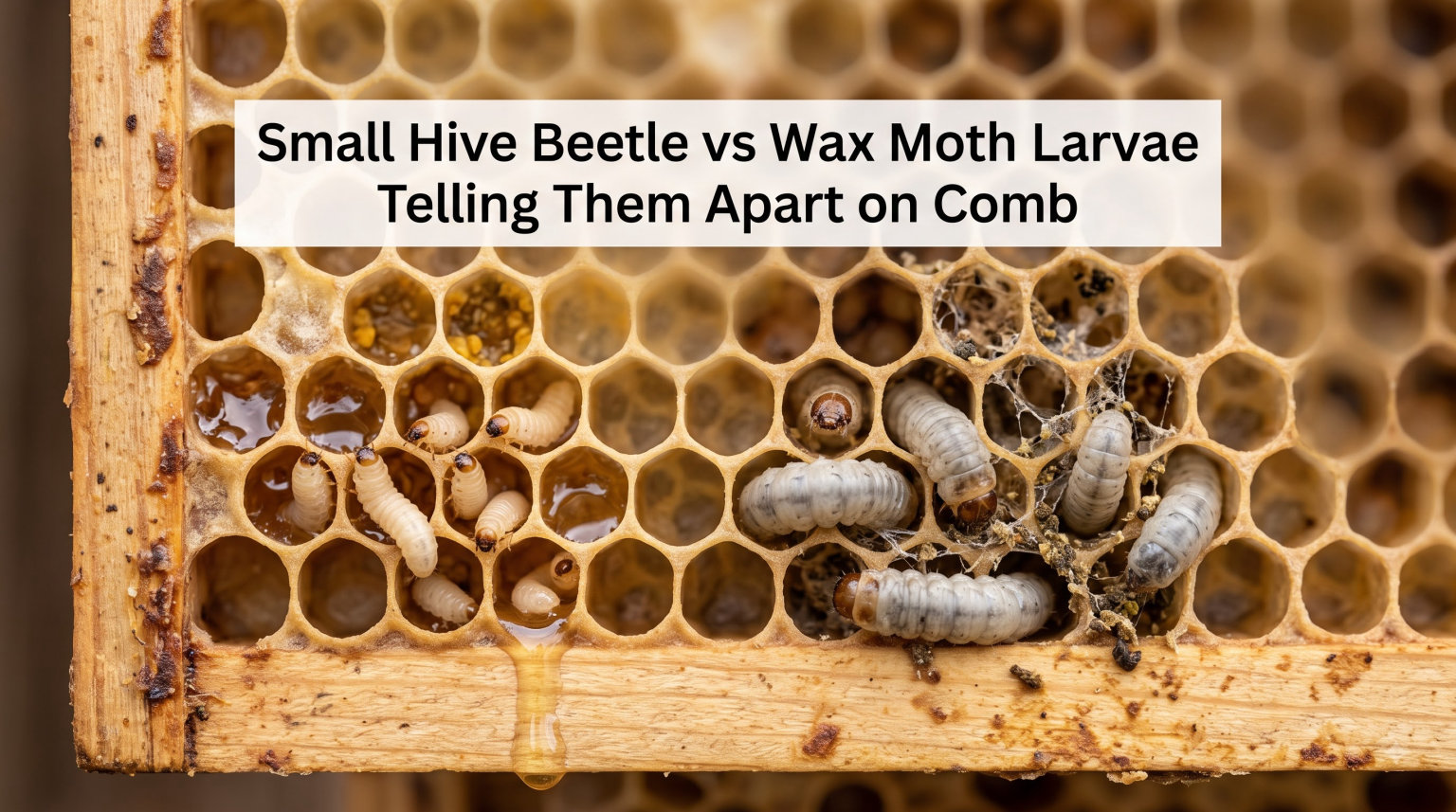
I pulled a frame last spring and stared at a cluster of pale, wriggling grubs on the comb. My first thought was wax moth. Then I noticed the spines. That moment of confusion is exactly what this guide solves.
If you are trying to distinguish small hive beetle vs wax moth larvae on your comb, you are not alone. Beekeepers on Reddit and beekeeping forums routinely post photos asking the same question, even after Googling. The two pests look similar at a glance, but their bodies, behavior, and the damage they leave behind tell very different stories. Getting the identification right matters because the two pests require different responses from you.
This guide walks you through the visual markers, the squish test, the location clues, and the hive symptoms that confirm which pest you are dealing with. By the end, you will be able to walk up to a frame, take one look, and know what you are looking at.
Table of Contents
Small Hive Beetle vs Wax Moth Larvae: Quick Field Comparison
Small hive beetle larvae have six legs clustered at one end (the head end), two rows of spines on their back, a rounded body that grows to about 1 cm, and they pupate in soil. Wax moth larvae have legs running along their body, no spines, a tapered shape, and they pupate in cocoons on the comb.
Here is the comparison at a glance for quick field reference:
- Legs: SHB larvae have six legs at one end only. Wax moth larvae have small legs (called prolegs) running along the body.
- Spines: SHB larvae have two rows of spines on their back. Wax moth larvae have no spines.
- Body shape: SHB is plump and rounded. Wax moth is tapered and segmented.
- Size at maturity: SHB reaches about 10-11 mm. Wax moth larvae can grow larger, up to 20-25 mm.
- Color: Both start cream-white, but SHB darken as they age. Wax moth stay pale and develop a grayish tint.
- Pupation: SHB crawl out of the hive and pupate in soil. Wax moth spin silken cocoons on the comb or in frame corners.
- Damage signature: SHB cause fermented “slimeout” of honey. Wax moth create silken webbing across the comb.
If you only remember one thing from this section, remember the spines. Two rows of spines down the back is a definitive marker for small hive beetle larvae. No other common hive pest has them.
Morphological Differences: Legs, Spines, and Body Shape
Small hive beetle larvae (Aethina tumida) and wax moth larvae (Galleria mellonella) share a similar pale, grub-like appearance, but close inspection reveals clear differences. Morphology is the most reliable way to separate them when you have a frame in hand.
Small Hive Beetle Larvae Appearance
Small hive beetle larvae are cream-colored grubs that grow to about 10 mm long when fully mature. They have a plump, rounded body with a slight taper at both ends. The key identifier is the pair of six true legs clustered at the head end, with two rows of protective spines running along the back. These spines are tiny but visible to the naked eye if you look closely, especially against bright sunlight.
The body has three thoracic segments, each with one pair of legs. The abdominal segments are smooth except for the dorsal spines. The head capsule is a pale brown, slightly darker than the rest of the body, and you can often see the dark gut line through the translucent skin.
Juvenile SHB larvae are tiny and harder to identify. As they go through their instars (growth stages), they molt and grow larger. By the third instar, the spines and body shape are unmistakable.
Wax Moth Larvae Appearance
Wax moth larvae are also cream-colored but grow larger than SHB larvae, reaching 20-25 mm at maturity. Their body is more tapered and segmented. Most importantly, wax moth larvae have small fleshy legs (prolegs) running along the entire body, not just at one end. This is the opposite of SHB larvae.
Wax moth larvae have three pairs of true legs at the front and additional pairs of prolegs along the abdominal segments. The body is smooth with fine hairs, but no spines. The head is darker, often reddish-brown, and the mouthparts are visible. Wax moth larvae can also vary slightly in color from cream to grayish-pink depending on what they have been eating.
The Squish Test
When in doubt, use the squish test. This is the field tip that experienced beekeepers swear by, and it works because of the structural differences between the two pests.
Pick up the larva between your thumb and forefinger and apply gentle pressure. If it squishes easily, it is a wax moth larva. If it resists and feels hard, it is a small hive beetle larva. The difference comes from the body structure. SHB larvae have tough, hardened plates and spines, while wax moth larvae are soft-bodied caterpillars.
I have used this test dozens of times in my own apiary. It is not gentle on the larva, but it is fast and reliable. Just be sure to wash your hands afterward, especially if you suspect SHB, because they can carry pathogens.
Behavioral Differences: Where They Pupate and How They Move
Behavior gives you another solid clue, especially when the larvae are not stationary. Movement patterns and pupation locations differ significantly between the two pests.
Small hive beetle larvae are voracious feeders that travel in clusters. They eat honey, pollen, brood, and eggs. As they mature, they leave the comb and crawl down the hive walls, out the entrance, and into the soil below the hive. They burrow 1-10 cm into the soil and pupate in earthen chambers. This is why SHB infestations continue to grow even after you remove adult beetles – the larvae escape to the ground to complete their life cycle.
Wax moth larvae behave differently. They tunnel through comb, eating beeswax, pollen, and brood remains. They spin silken tunnels as they move, which is one of the easiest signs to spot. When ready to pupate, they do not leave the hive. They find a protected spot in a frame corner, under a bottom bar, or in stored equipment, and spin a tough silken cocoon. The cocoons are often clustered together and covered in frass (insect droppings) and bits of wax.
Movement speed is also a clue. SHB larvae are slower and tend to clump together when disturbed. Wax moth larvae are more active and will quickly retreat into their silken tunnels when you pull a frame into the light.
Hive Symptom Differences: Slimeout vs Webbing
The damage each pest leaves behind is the third major identification tool. The hive itself tells you which pest is present.
Small hive beetle larvae cause what beekeepers call “slimeout.” The larvae feed on honey and carry a yeast called Kodamaea ohmeri, which they deposit in the honey. The yeast ferments the honey, turning it into a bubbly, smelly, brownish slime that runs out of the cells and drips down the comb. The smell is unmistakable – like rotten oranges or fermenting fruit. Affected frames are essentially ruined because the fermented honey cannot be salvaged.
Wax moth larvae cause a different kind of destruction. They chew through wax cappings and tunnel through the comb, leaving behind silken webbing. In severe infestations, the entire super of frames becomes a single matted web of silk, cocoons, and frass. The comb often turns dark and the beeswax is destroyed, but the honey is not fermented. The webbing is the giveaway here – SHB does not produce silk.
It is possible for both pests to appear in the same hive, especially in weak colonies. If you see both slimeout and webbing, you are dealing with a serious infestation that needs immediate action.
What to Do When You Find Larvae on Your Comb
Once you identify the pest, your response should be different for each. Here is the field-tested action plan that works in my own apiary.
If You Find Small Hive Beetle Larvae
SHB larvae are an emergency. They pupate in soil and will emerge as adults in 2-4 weeks, restarting the infestation cycle. Here is what to do:
- Remove affected frames and place them in a sealed plastic bag immediately.
- Check the ground around the hive for larvae crawling outward. They move at dusk and dawn.
- Treat the soil around the hive with approved ground treatments if available in your region.
- Reduce hive space so the bees can patrol and remove larvae themselves. Strong colonies manage SHB better than weak ones.
- Install beetle traps (oil traps or screen traps) inside the hive to catch adults.
- Requeen or strengthen the colony if it is weak. SHB thrives in weak hives.
The key point from experienced beekeepers: do not let the larvae make it to the ground. Every larva that pupates becomes 5-10 new beetles.
If You Find Wax Moth Larvae
Wax moths are less urgent but still serious. They indicate either a weak colony or stored equipment that needs attention. Here is the action plan:
- Remove affected frames and freeze them for 24-48 hours to kill all life stages.
- Scrape off webbing and cocoons from frame corners and hive boxes.
- Reduce hive space so the bees can defend the remaining frames.
- For stored equipment, store frames in a cool, dry place or use paradichlorobenzene (PDB) crystals in a sealed stack.
- Check queen status – if the colony is weak, combine it with a stronger hive or requeen.
Wax moths rarely destroy a strong colony. Their populations explode in abandoned or dead-out hives, which is why they are often called “hive cleaners of nature.”
Common Identification Mistakes and How to Avoid Them
Even experienced beekeepers mix these two pests up. Here are the most common mistakes I have seen and how to avoid them.
Mistake 1: Judging by size alone. Young SHB larvae are tiny and can look like small caterpillars. Always check for spines, not just size.
Mistake 2: Assuming webbing means wax moth only. Severely weakened SHB-infested hives can also have opportunistic wax moth invasions. Look for both slimeout and webbing.
Mistake 3: Confusing the color. Both pests are cream-colored. Color alone is not a reliable identifier. Use spines and leg placement instead.
Mistake 4: Not checking the bottom board. SHB larvae often hide in the bottom board debris before crawling out to pupate. Always check there.
Mistake 5: Ignoring the hive strength. SHB is a symptom of weak colonies. If you find SHB larvae, ask why the colony is weak – queen issues, disease, poor nutrition, or pesticide exposure.
One more tip from the forums: if you can easily squish it, it is wax moth. If it feels hard and resists, it is SHB. When in doubt, default to the squish test.
Frequently Asked Questions
What is the difference between wax moth larvae and hive beetle larvae?
Wax moth larvae have legs distributed along their body, no spines, and a soft body that squishes easily. Hive beetle (small hive beetle) larvae have six legs clustered at one end, two rows of spines on their back, and a harder body that resists squishing. Wax moth larvae also pupate in silken cocoons on the comb, while SHB larvae pupate in soil outside the hive.
What do small hive beetle larvae look like?
Small hive beetle larvae are cream-colored grubs about 10 mm long when fully grown. They have a plump body, six true legs clustered at the head end, two rows of spines running down their back, and a pale brown head capsule. They travel in clusters and cause a fermented slimeout of honey in infested hives.
What is the difference between moth larvae and beetle larvae?
Moth larvae (caterpillars) have prolegs running along their body and a soft, segmented, tapered shape. Beetle larvae have true legs only at the head end, a more rounded body, and often have protective spines or hardened plates. The squish test also works: moth larvae squish easily, beetle larvae resist pressure.
What to do with wax moth infested comb?
Remove affected frames and freeze them for 24-48 hours to kill all life stages. Scrape webbing and cocoons from frames and boxes. Reduce hive space so the bees can defend the remaining comb. For stored equipment, freeze frames before storage and keep them in a cool, dry place. Strong colonies can usually clean up wax moth on their own if given enough space to patrol.
Final Thoughts on Identifying Small Hive Beetle vs Wax Moth Larvae
Distinguishing small hive beetle vs wax moth larvae comes down to three things: spines (SHB has them, wax moth does not), leg placement (SHB at one end, wax moth along the body), and damage signature (slimeout vs webbing). Once you use the squish test and check the pupation location, you have a complete identification toolkit.
Take a frame into sunlight, look closely at the spines, and you will know within seconds which pest you are dealing with. Your bees will thank you for the quick action.