
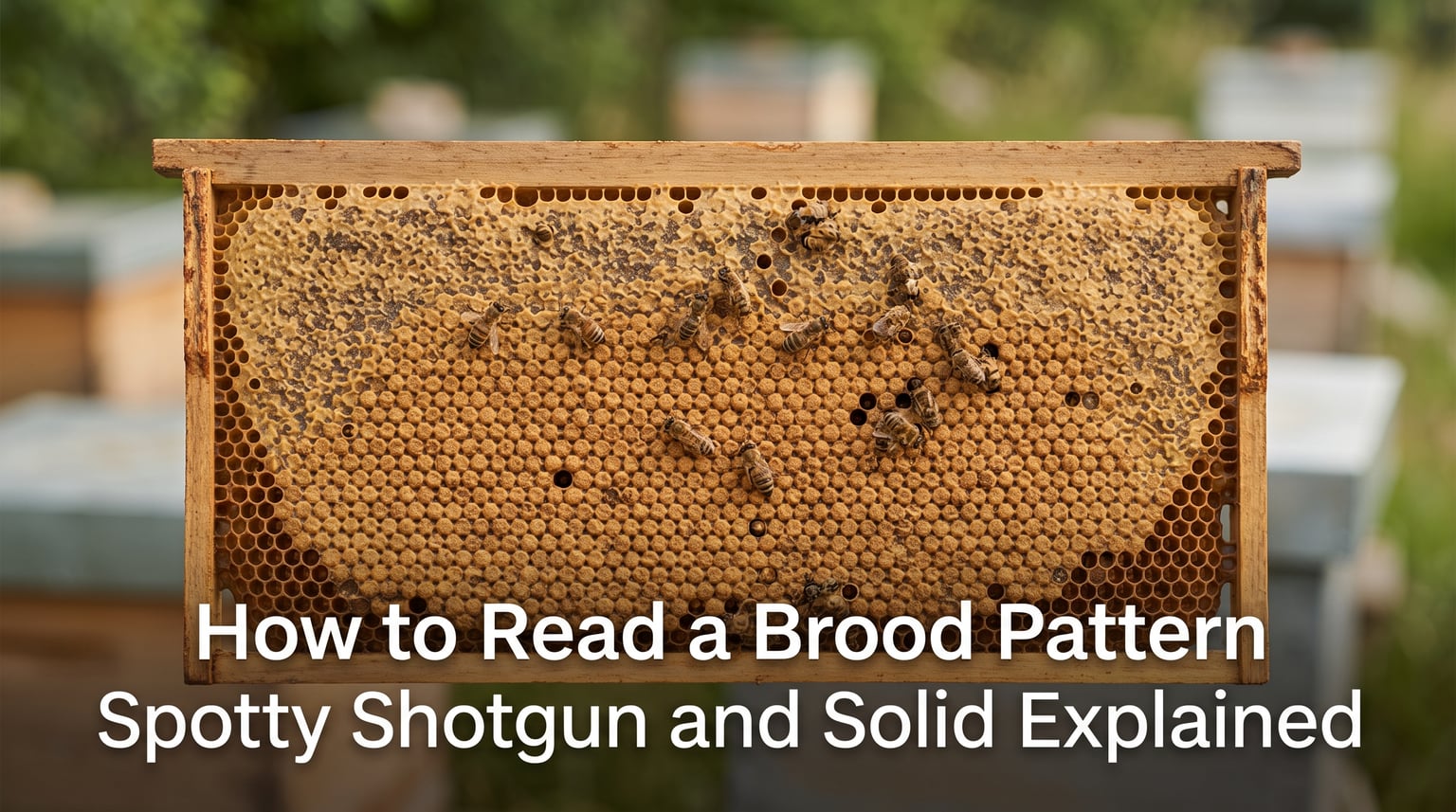
I remember pulling my first brood frame as a new beekeeper and feeling completely lost. The bees were everywhere, the wax looked chaotic, and I had no idea if what I saw was healthy or a disaster in the making. That moment is why I wrote this guide.
Reading a brood pattern is the single most important skill you can build as a beekeeper. Your brood frame is the colony’s medical chart, and it reveals queen quality, disease, and overall hive health weeks before you would otherwise notice a problem. In this guide, I’ll walk you through how to read a brood pattern, the difference between spotty, shotgun, and solid patterns, and a 60-second field diagnosis you can use during any hive inspection in 2026.
Table of Contents
What Is a Brood Pattern and Why Reading It Matters
A brood pattern is the visible arrangement of eggs, larvae, and capped brood across a frame inside your hive. It forms over a 21-day cycle as the queen lays eggs and worker bees raise the developing young into adult bees. When you pull a frame and look at it, you are looking at three weeks of colony activity compressed into one view.
A good brood pattern tells you your queen is healthy, well-mated, and laying consistently. A bad brood pattern can warn you about a failing queen, an outbreak of disease, or a damaging varroa mite infestation long before the colony collapses. This is why I teach every new beekeeper to score brood patterns during every inspection.
Bees raise brood in a roughly oval or football-shaped cluster called the brood nest. Worker cells are the smallest, drone cells are larger and domed, and queen cells stick out like peanuts along the frame edges. Healthy brood fills 80-90% of available cells in a tight, compact pattern with very few empty gaps.
The pattern reveals three critical things about your colony:
- Queen status (present, mated, laying, failing)
- Colony population trajectory (growing, stable, declining)
- Disease or pest pressure (AFB, EFB, chalkbrood, varroa)
If you learn nothing else from this article, learn this: a healthy brood pattern is the foundation of every successful hive. Everything else, honey production, swarm control, winter survival, depends on it.
The Three Brood Pattern Types: Solid, Spotty, and Shotgun Explained
Every brood pattern you will ever see falls into one of three categories: solid, spotty, or shotgun. Each one tells a different story about what is happening inside your hive.
Solid Brood Pattern: The Gold Standard
A solid brood pattern means 85-100% of cells in the brood area are filled with eggs, larvae, or capped brood. The capped cells form a tight, compact slab with very few empty gaps. Worker brood cappings are uniform, slightly raised, and tan to brown in color.
This is what a thriving colony looks like. A solid pattern usually means your queen is healthy, well-mated, and laying 1500-2000 eggs per day during peak season. The workers are keeping the brood nest at a steady 93-95°F, and disease pressure is low.
When I see a solid brood pattern, I close up the hive feeling confident the colony is on track. Most strong colonies produce solid patterns from early spring through mid-summer.
Spotty Brood Pattern: The Early Warning Sign
A spotty brood pattern has scattered empty cells mixed throughout otherwise capped brood. Coverage usually drops to 60-80% of cells, with visible gaps peppered across the frame. The pattern looks “polka-dotted” rather than solid.
Spotty brood is a yellow flag, not a red one. It can mean any of the following:
- A young queen whose laying rhythm is still settling in
- A aging queen whose sperm supply is running low
- Moderate varroa mite damage to developing larvae
- Incipient disease (early EFB or chalkbrood)
- Hygienic behavior where bees are removing sick larvae
Before you panic, I recommend tracking the pattern across 2-3 inspections spaced 7-10 days apart. Some spotty brood is normal in late summer as the queen’s laying tapers off. If the pattern stays spotty or worsens, it’s time to dig deeper.
Shotgun Brood Pattern: The Serious Problem
A shotgun brood pattern is severe and obvious. Large swaths of the frame are empty, capped cells are scattered, and the brood looks like it was shot with a shotgun blast. Coverage often falls below 50%, and drone cells frequently appear in worker-sized comb.
Shotgun patterns almost always point to one of three issues:
- A drone-laying queen (queen is present but only laying unfertilized eggs)
- A failing or dead queen with laying workers taking over
- Heavy varroa infestation with parasitic mite syndrome (PMS)
When I see a true shotgun pattern, I treat it as an urgent intervention. The colony cannot sustain itself long-term without a fertile queen laying worker eggs. Plan to requeen or combine the colony within 1-2 weeks.
How to Read a Brood Frame: Step-by-Step Inspection Guide
Pulling a brood frame and reading it correctly takes practice. Here is the exact sequence I use during every hive inspection, refined over 12 years of keeping bees.
The 3 3 3 Rule for Hive Inspections
Before you pull a single frame, remember the 3 3 3 rule: take 3 minutes, lift 3 frames, and look for 3 things. This is the simplest way to keep inspections efficient without stressing the colony.
The 3 3 3 rule breaks down like this:
- 3 minutes per hive box to avoid chilling brood or overheating it
- 3 frames per box to focus on (eggs, larvae, capped brood)
- 3 things to look for (queen status, food stores, brood pattern)
This rule keeps you from over-inspecting, which can slow colony growth by exposing brood to temperature swings. I follow it on every routine check and save longer inspections for problem-solving visits.
The 5-Step Brood Frame Reading Sequence
Once you’ve selected a frame from the brood nest, work through these five steps in order. This sequence matches what professional beekeepers use in commercial operations.
Step 1: Find Eggs. Hold the frame at a slight angle and look for tiny white eggs standing upright in the bottom of cells. If you see eggs, your queen was alive within the last 3 days. Eggs are also a sign the queen is not laying old brood on top of eggs that already hatched.
Step 2: Identify Larvae Stages. Look for pearly white C-shaped larvae curled in the bottom of cells. Healthy larvae float in a pool of royal jelly and look plump. Discolored, melted, or off-center larvae signal trouble. Larvae go through 5 instars over 6 days before being capped.
Step 3: Evaluate Capped Brood. Examine the cappings on sealed cells. Healthy worker cappings are slightly convex, dry-looking, and uniform in color. Sunken, perforated, or discolored cappings indicate disease. AFB causes sunken, wet-looking caps; chalkbrood leaves white mummies visible at the hive entrance.
Step 4: Distinguish Drone from Worker Brood. Drone cells are larger and capped with a domed, bullet-shaped covering that stands proud of the comb. Worker cells are smaller with flat or slightly raised caps. Drone brood scattered across worker comb usually indicates a failing queen or laying workers.
Step 5: Score the Overall Pattern. Estimate what percentage of the brood area is filled. Solid = 85-100%, spotty = 60-85%, shotgun = below 60%. Write this number down. Tracking the score over multiple inspections tells you whether your colony is improving, holding steady, or declining.
Spotty Brood Pattern Diagnostic Matrix: Causes and What to Do
When you spot a problem pattern, the next step is figuring out why. Here is the diagnostic matrix I use, organized by cause category.
Queen-Related Causes
Failing queen. Look for spotty patterns with mixed worker and drone cells, no eggs, and old dark cappings. The queen may still be visible but laying fewer eggs with higher drone production. Solution: monitor for 2-3 weeks, then requeen if pattern doesn’t improve.
Drone-laying queen. The frame is full of domed drone cells in worker-sized comb. Eggs are present but every one becomes a drone. Solution: requeen immediately. A drone-laying queen cannot produce a viable colony.
Laying workers. No queen present, no eggs in order, multiple eggs per cell, eggs on cell walls instead of bottoms. Solution: combine the colony with a queenright hive using the newspaper method, or requeen after a 24-hour queenless period.
Disease Indicators
American Foulbrood (AFB). Sunken, perforated, or greasy-looking cappings. Brown, ropy larvae when you insert a toothpick into a cell. Foul smell. Highly contagious, often requires burning equipment and notifying your bee inspector.
European Foulbrood (EFB). Twisted, off-center larvae in uncapped cells. Yellow-brown discoloration. Sour smell. Often resolves on its own with strong nectar flow, but severe cases may need requeening.
Chalkbrood. White, chalk-like mummies visible in cells and at the hive entrance. Larvae die after capping and turn hard and white. Usually clears up with requeening and improved ventilation.
Sacbrood. Larvae die before capping and form a watery sac inside the cell. Mild cases often resolve. Severe cases may need requeening.
Varroa Mite Connection
Varroa destructor mites are the number one cause of spotty brood patterns in modern beekeeping. High mite loads cause Parasitic Mite Syndrome (PMS), which produces spotty patterns that look identical to queen failure.
Always test for varroa before assuming a queen issue. I run an alcohol wash or sugar roll test on every problem hive. If mite counts exceed 3 mites per 100 bees in summer, treat before requeening. A new queen in a heavily mite-infested hive will fail within weeks.
Decision Tree: Quick Field Diagnosis in 60 Seconds
When you only have a minute between frames, run through this three-question decision tree. It will narrow down the cause of any spotty or shotgun pattern fast.
Question 1: Do you see eggs? If yes, the queen was alive within 3 days. If no, go to Question 2.
Question 2: Are multiple eggs in cells, or are eggs on cell walls? If yes, you have laying workers. If no, go to Question 3.
Question 3: Are cappings sunken, perforated, or discolored? If yes, suspect disease (AFB, EFB, sacbrood). If no, suspect a drone-laying queen or varroa damage.
This 60-second decision tree catches 90% of brood pattern problems I see in the field. It is the single most useful tool I teach new beekeepers.
Seasonal Variations and Common Mistakes to Avoid
Brood patterns naturally change with the seasons. Spring patterns are explosive as the queen ramps up laying. Summer patterns should be solid and full. Fall patterns tighten as the queen tapers off for winter. A spotty pattern in October is normal. The same pattern in May is a crisis.
The most common mistake I see beginners make is overreacting to a single inspection. Always confirm your diagnosis across 2-3 inspections spaced a week apart before requeening. Another frequent error is confusing pollen stores with brood. Pollen cells are uncapped and filled with bright yellow, orange, or white granules.
Frequently Asked Questions
What does a spotty brood pattern mean?
A spotty brood pattern has scattered empty cells mixed throughout capped brood, with coverage around 60-80%. It can indicate a young or aging queen, early disease, varroa mite damage, or normal hygienic behavior. Track the pattern across 2-3 inspections before deciding to requeen.
What does a healthy brood pattern look like?
A healthy brood pattern is solid and compact, with 85-100% of cells in the brood area filled with eggs, larvae, or capped brood. Cappings are uniform, slightly raised, and tan to brown. The pattern forms a tight oval or football shape called the brood nest.
What is the 3 3 3 rule for bees?
The 3 3 3 rule for hive inspections means taking 3 minutes per hive box, lifting 3 frames to examine, and looking for 3 things: queen status, food stores, and brood pattern. This keeps inspections efficient and prevents chilling or overheating the brood nest.
What does bad brood look like?
Bad brood has sunken, perforated, or discolored cappings, larvae that look melted or off-center, white chalk-like mummies in cells, or a shotgun pattern with large empty gaps. These signs point to disease, a failing queen, or heavy varroa mite pressure.
Reading Brood Patterns for Long-Term Colony Health
Learning to read a brood pattern is one of the highest-return skills you can build as a beekeeper. Every inspection becomes a data point. Track your scores over time, and you will spot problems weeks before they become emergencies.
Start with the basics: identify solid, spotty, and shotgun patterns. Use the 5-step reading sequence and the 60-second decision tree. Test for varroa mites before assuming queen failure. And remember, no single inspection tells the whole story. Patterns change with the season, and a good beekeeper reads them like a long-running conversation with the colony.