
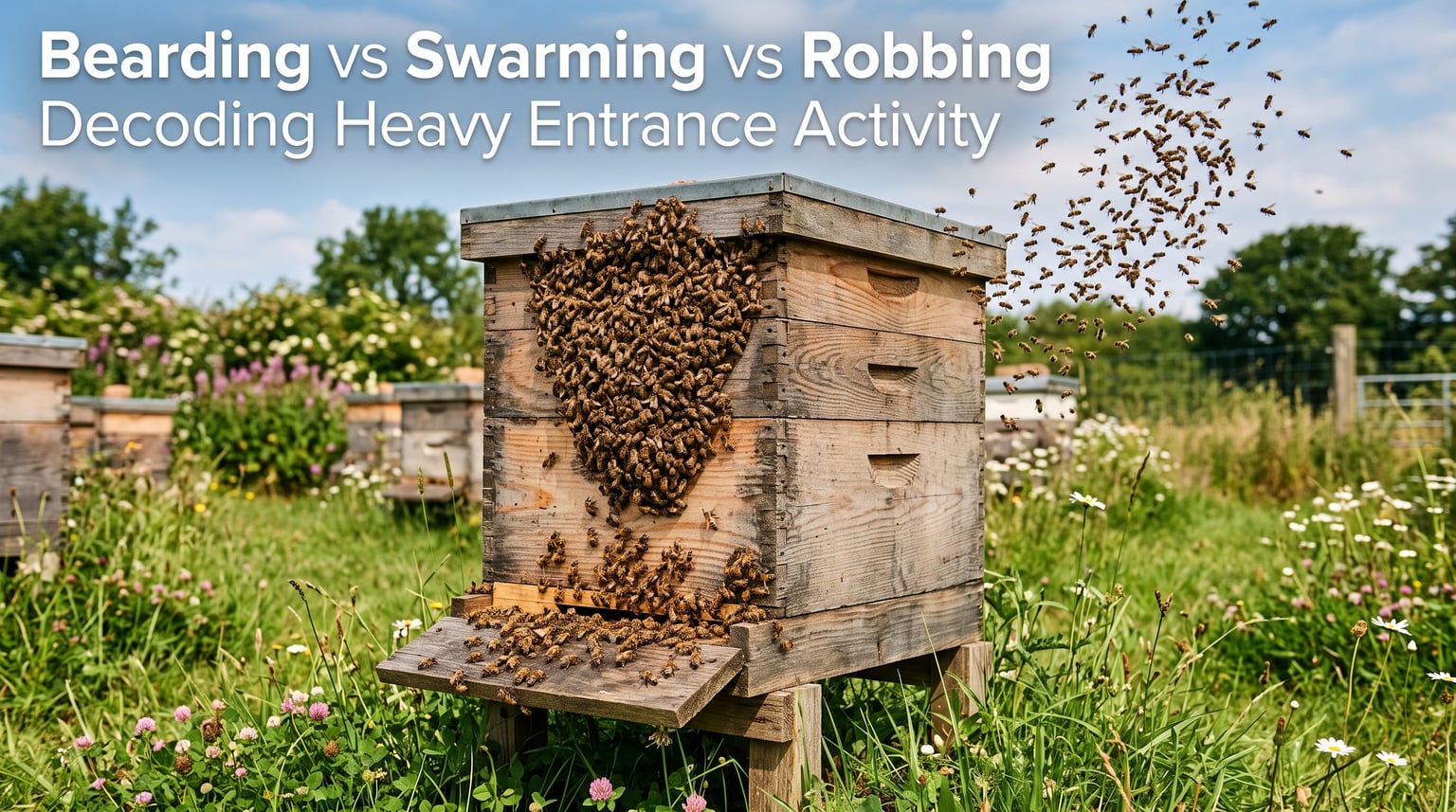
I’ve stood in front of my hives more times than I can count, staring at a buzzing mass and trying to figure out what’s actually happening. Bearding, swarming, and robbing can look almost identical at first glance, yet each requires a completely different response.
If you’ve ever panicked thinking your colony was about to swarm, only to realize they were just cooling off, this guide is for you. I’ll walk you through exactly how to tell bearding vs swarming vs robbing apart, what each behavior means for your colony, and the right action to take (or avoid) in each situation.
Misidentifying these behaviors is one of the most common mistakes new beekeepers make. Reducing the entrance during a heat wave can trap your bees inside a furnace. Missing a swarm costs you half your colony. We’ll fix all of that today.
Table of Contents
Quick Differentiators: Bearding vs Swarming vs Robbing at a Glance
The fastest way to identify heavy hive entrance activity is to check three signals: timing, behavior, and pollen. Here’s a comparison table I wish someone had handed me in my first year of beekeeping.
| Signal | Bearding | Swarming | Robbing |
|---|---|---|---|
| When it happens | Hot, humid days, often late afternoon into evening | Spring through early summer, typically mid-day | Late summer or fall during a nectar dearth |
| Where bees cluster | Hangs off the front of the hive in a stationary mass | Forms a swirling cloud or temporary cluster on a branch | Frantic activity at the entrance, fighting on the landing board |
| Sound | Quiet, steady hum | Loud roar during takeoff, then silence | Aggressive, chaotic buzzing with sharp zips |
| Pollen baskets | Usually empty | Often empty, foragers stay behind | Empty on invaders, defenders heavily defend |
| Bee behavior | Calm, clustered, slow movement | Excited, swirling, mass departure | Fighting, wrestling, dead bees on ground |
| Action needed | Usually none, just provide ventilation and water | Catch the swarm if possible, prevent with splits | Stop immediately with entrance reducer or wet sheet |
Keep this table bookmarked. After a season or two of checking your hives, the visual cues become second nature.
What Bearding Looks Like and Why Bees Do It
Bearding is when bees cluster on the outside of the hive, hanging off the landing board like a thick, shaggy beard. I see it most often on my colonies during July and August when afternoon temperatures push past 90°F with high humidity.
The reason bees beard is straightforward: they’re managing internal temperature. A healthy brood nest needs to stay right around 95°F for proper development. When the hive gets too hot, bees move outside to reduce crowding inside and to allow better airflow.
Workers also fan their wings at the entrance to push hot air out and pull cooler air in. Some bees leave the hive entirely to take pressure off the ventilation system. You’ll often see this behavior intensify in late afternoon as the colony prepares for a warm night.
Bees may also beard when they’re processing a large nectar flow. Fresh nectar contains a lot of water that needs to evaporate before it becomes honey. Evaporation generates heat and humidity, so the colony essentially steps outside to give the process room to work.
Key visual signs of bearding:
- Bees hang in a stationary cluster from the front of the hive
- Cluster expands and contracts with the temperature
- Activity is calm, with bees fanning their wings
- No fighting or wrestling on the landing board
- Bees return inside when temperatures drop in the evening
One summer I had a colony that bearded for three straight weeks during a brutal heat wave. I was convinced they were about to swarm. My mentor told me to leave them alone, and sure enough, the cluster shrank every night once the temperature dropped. They were just hot.
The best response to bearding is usually no response at all. Make sure the colony has a nearby water source so they can cool the hive through evaporation. Add a ventilated inner cover or remove a honey super if the hive is overcrowded.
What you should not do is block the entrance. Trapping bees in an already hot hive can quickly lead to serious problems, including melted comb and dead brood.
What Swarming Looks Like and When It Happens
Swarming is the natural way honey bee colonies reproduce. The old queen leaves with about half the worker bees to start a new hive, while a new queen takes over the original colony. It looks dramatic, and in many ways, it is.
Swarming is most common in spring through early summer when colonies are at their peak population. A strong nectar flow, congestion inside the hive, and an aging queen all trigger swarm preparations. You’ll often see bees with full pollen baskets hours before a swarm, then suddenly the baskets empty as the swarm departs.
The 3-3-3 rule is a common guideline beekeepers use to describe prime swarming conditions. It refers to 3 pounds of bees, 3 frames of brood, and 3 weeks of warm weather in spring. When your colony hits these benchmarks, swarm prevention becomes your main job.
Visual signs of an active swarm:
- A loud, building roar from inside the hive
- Bees pouring out of the entrance in a thick stream
- A swirling cloud of bees in the air, often 20 to 30 feet up
- A cluster forming on a tree branch, fence post, or other temporary perch
- The cluster is generally the size of a basketball or larger
The swarm cluster on a branch is temporary, usually lasting a few hours while scout bees search for a new home. Once the scouts agree on a location, the cluster breaks apart and flies away. This is your window to catch them.
If you see a swarm, don’t panic. Swarming bees are usually calm and focused on their mission. They’ve eaten honey before leaving and aren’t defending a hive. You can approach them, especially the cluster, with minimal protective gear.
To catch a swarm, shake the cluster into a cardboard box or nuc box and set it in a cool, dark location with ventilation. Provide a frame of brood from another hive if you have one. The bees will accept the new home quickly.
To prevent swarming before it happens, give the colony space by adding supers, perform a split during peak population, and consider requeening if your queen is more than a year old.
What Robbing Looks Like and How to Stop It
Robbing is what happens when bees from one colony invade another to steal honey stores. It’s the only one of the three behaviors that requires emergency action, because it can wipe out a weak hive in days.
Robbing typically happens during a nectar dearth, when flowers aren’t producing and bees are desperate for food. Late summer and fall are prime robbing seasons. Strong colonies, wasps, yellow jackets, and even bumblebees will target weak hives that can’t defend themselves.
Robbing looks chaotic and violent. You’ll see bees zigzagging in front of the hive, bumping into guards and wrestling on the landing board. Fights end with dead bees piling up on the ground in front of the entrance. The hive being robbed may show signs of stress like chewed comb at the entrance and exposed wax cappings.
Key visual signs of robbing:
- Erratic, darting flight patterns around the hive
- Bees wrestling and tumbling off the landing board
- Pile of dead bees accumulating in front of the hive
- Robber bees sneaking in through cracks and the top of the hive
- Defenders clustering thickly at the entrance, sometimes bearding defensively
Robbing is often confused with orientation flights, which are young bees learning the location of their home hive. Orientation flights happen on warm afternoons in healthy numbers. The bees circle in front of the hive, fly in widening arcs, and return. There’s no fighting, no dead bees, and the activity quiets down within an hour.
If you confirm robbing, act fast. The fastest intervention is an entrance reducer that limits the opening to a single bee width. This lets guards defend while keeping invaders out. For serious robbing, drape a wet bedsheet over the entire hive. The sheet confuses the robbers, who can’t find the entrance, and breaks the cycle.
You should also close any other openings. Cracks between boxes, gaps in the inner cover, or open ventilation holes are all entry points for determined robbers. Use tape, screen, or whatever you have to seal them.
After a robbing event, inspect the victim colony. If they’ve lost significant stores, feed them with sugar syrup or fondant to help them recover. Weak colonies that get robbed often need to be combined with a stronger hive to survive the winter.
Prevention works better than intervention. Keep entrances small on weak colonies. Feed inside the hive, never outside, where open syrup can attract robbers. Harvest honey carefully without leaving comb exposed near the apiary.
A Decision Guide for Identifying Heavy Hive Entrance Activity
When you’re standing in front of your hive and bees are everywhere, run through this quick mental checklist. I’ve used it for years and it works.
Step 1: Check the temperature. If it’s hot and humid, bearding is the most likely answer. Swarms happen in spring. Robbing is rare on cool days.
Step 2: Look at the cluster shape. A swarm forms a teardrop or beard hanging from a branch or object. Bearding hangs off the front of the hive. Robbing has no cluster, just chaos.
Step 3: Listen to the sound. Bearding is quiet and steady. Swarming has a dramatic takeoff roar. Robbing is sharp, angry, and chaotic.
Step 4: Check the landing board. Dead bees piled up means robbing. Calm traffic with bees coming and going normally means bearding. An empty entrance after the roar means a swarm just left.
Step 5: Look for pollen baskets. Robbers don’t carry pollen. Foragers returning from the field always have pollen on their legs when there’s any available. Pollen-heavy foragers confirm normal activity, even during heavy traffic.
Seasonal timing is also a huge clue. Swarm season runs from April through June in most climates. Robbing season starts when nectar flows stop, usually August through October. Bearding happens whenever it’s hot, so plan for it in summer.
One common question is whether bees beard before swarming. Sometimes they do, especially if it’s a warm spring day and the colony is crowded. But bearding alone isn’t a swarm warning sign. Look for queen cells on the bottom of frames to confirm swarm preparations.
Another question I hear often is whether bees with pollen baskets can still be part of a swarm. Yes, they can. Foragers don’t know about the swarm decision and may return with pollen just as the colony prepares to leave. Use pollen as supporting evidence, not a definitive answer.
Frequently Asked Questions About Heavy Hive Entrance Activity
How to tell the difference between bearding and swarming?
Check the location and timing. Bearding happens on hot days with bees hanging off the hive front in a stationary cluster. Swarming happens in spring with a loud roar, swirling cloud of bees, and a temporary cluster on a branch or other object.
What is the difference between honey bee robbing and orientation flights?
Robbing is chaotic fighting with dead bees on the ground and robbers trying to enter the hive by force. Orientation flights are calm circles in front of the hive as young bees learn the location, with no fighting and no dead bees.
How long do bees beard before swarming?
Bees don’t reliably beard before swarming. Bearding is a temperature response, not a swarm signal. Check for queen cells on frame bottoms to confirm swarm preparations, rather than relying on bearding as a warning.
What is the 3 3 3 rule for bees?
The 3-3-3 rule describes peak swarming conditions in spring: 3 pounds of bees covering roughly 3 deep frames of brood during 3 weeks of warm weather. When your colony meets these conditions, swarm prevention becomes your priority.
Final Thoughts on Reading Your Hive’s Behavior
The more time you spend observing your colonies, the easier bearding vs swarming vs robbing becomes to tell apart. Each behavior tells a different story about what your bees need, and learning that language is one of the most rewarding parts of beekeeping.
Keep this guide handy for your next inspection in 2026. Trust your eyes, listen to the sound, and remember that heavy entrance activity is rarely an emergency. Most of the time, your bees are just being bees.