
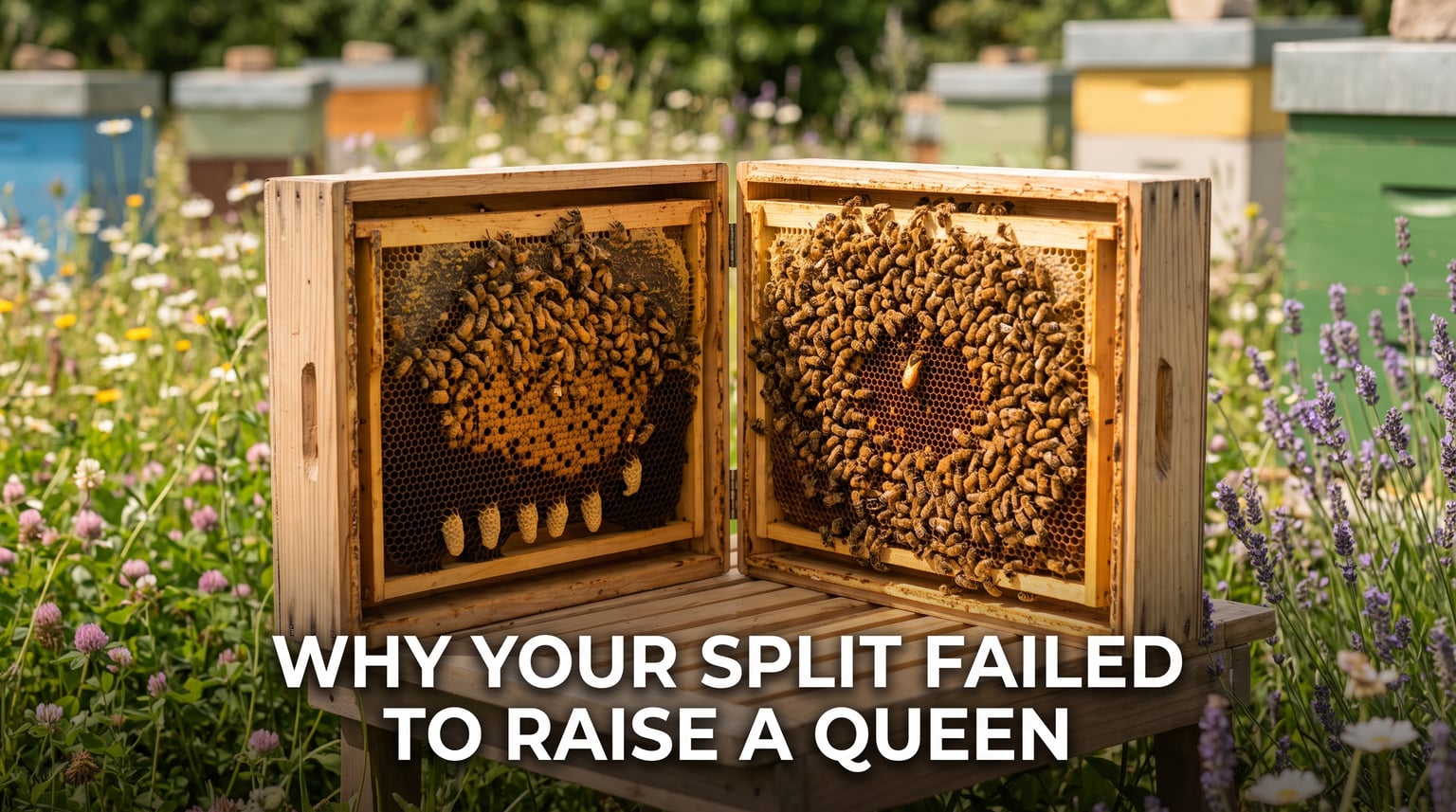
I made my first walk-away split three years ago, watched the colony ignore the eggs for a week, and ended up with a queenless hive covered in laying workers. That sting taught me to ask the right question: why does the split fail to raise a queen in the first place?
If you are staring at a brood box with no eggs after three weeks and wondering where things went wrong, this guide is for you. I will walk you through the seven most common reasons a split fails to raise a queen, the exact timeline you should expect, and the diagnostic steps that separate a slow split from a dead one. By the end, you will know exactly when to wait, when to buy a mated queen, and when to combine colonies.
Table of Contents
What Is a Split and Why Queens Sometimes Fail
A split is a controlled hive division where a beekeeper separates part of a colony from the rest, forcing one half to raise a new queen on its own. The half that keeps the original queen continues laying immediately. The queenless half must select young larvae under 36 hours old, build emergency queen cells, and rear a virgin queen from scratch.
Queen rearing depends on three things: the right age of larvae, an adequate population of nurse bees to feed royal jelly, and enough drones within mating range to fertilize the virgin queen. If any one of these fails, the split will produce nothing useful and your colony will slowly collapse into a laying-worker mess that draws robber bees and weakens neighboring hives.
Why Your Split Failed to Raise a Queen: 7 Common Causes
Most split failures come down to one of seven predictable problems. I have seen every one of these on my own hives, and they account for almost every failed split I hear about from other beekeepers on forums and in local associations.
1. No Eggs or Young Larvae Were Present
The single most common reason a split fails to raise a queen is that there were no larvae under 36 hours old in the queenless portion. Workers can only convert larvae that young into queens. If you shook mostly nurse bees and capped brood into the split, there was nothing for them to raise and the colony simply ages out.
2. Queen Cells Were Damaged During the Split
Queen cells are fragile. Bumping, shaking, or jarring the frames during the split can destroy the developing queens inside. One beekeeper on the Beekeeping Forum UK lost an entire split because a frame of cells tipped over in transit to the new hive stand, and the next inspection showed mashed pupae everywhere.
3. The Queen Was Accidentally Left in the Split
If you did not find the queen before splitting, you may have put her in the wrong half. A queenright colony will not raise a new queen. They will simply keep working as if nothing happened, while the half you thought was queenless actually has a laying queen and produces no cells at all.
4. Not Enough Nurse Bees
Raising a queen requires a strong nurse bee force to feed royal jelly continuously. A split with too few bees cannot maintain the temperature or feed the larvae, and the queen cells will be abandoned or the emerged virgin will be underfed. A good rule of thumb is to load at least four frames of mostly nurse bees into the queenless portion.
5. Poor Drone Population for Mating
A virgin queen needs to mate with 10 to 20 drones within a few weeks of emerging. If you split during a drone dearth, or your area has low drone density, the queen will fail to mate, develop into a drone layer, or vanish on her mating flight without ever returning. Watch for healthy drone brood before making the split.
6. Queen Acceptance Failure
When the new queen emerges, she must be accepted by the worker bees. If the colony has been queenless too long, workers may develop laying ovaries or become hostile to the new virgin. The virgin queen will be killed or simply disappear within hours of emerging, and you will find her corpse on the landing board.
7. Genetic and Seasonal Timing
Queens raised late in the season often fail because there are fewer drones and cooler weather. Queens raised from inferior stock produce smaller, weaker colonies. Season and genetics both influence whether your split succeeds, and choosing queens from hygienic, gentle lines saves years of frustration.
How Long Does It Take for a Split to Raise a Queen?
A split takes roughly 28 to 35 days from the day you make it to the day you see eggs from a new laying queen. Here is the typical timeline that I have observed across dozens of splits in my own apiary and those of the local club members.
Day 0: Make the split. Queenless half begins emergency queen cell construction.
Day 3 to 4: Queen cells are visible and capped around day 8.
Day 11 to 12: Virgin queen emerges from her cell.
Day 12 to 24: Virgin queen takes her mating flights and mates with drones.
Day 25 to 28: Mated queen begins laying eggs.
If you see no eggs after 30 days, something has gone wrong. The most common causes are a queen lost on her mating flight, a drone-laying queen, or a hive that never actually started queen cells in the first place. Recheck the timeline starting from the day you made the split.
Signs Your Split Is Queenless
A queenless colony looks different from a slow queenright colony. Here are the specific signs that tell you your split is failing rather than just taking its time.
No eggs at all after 21 days from the split.
No queen cells visible during a 7-day post-split check.
Workers laying eggs (multiple eggs per cell, eggs on cell walls).
A sudden drop in pollen collection and foraging activity.
Increased roar or “queenless” hum when you open the hive.
Bees appear listless or disorganized on the frames.
The presence of capped brood is actually a positive sign. If your split has capped brood but no eggs, the queen is likely present and just taking a break before laying again. If there is no capped brood and no eggs, the colony is in real trouble and needs your help this week.
Quick Diagnostic Methods: Test Frame and the 3-3-3 Rule
Two simple diagnostic techniques help you separate a queenless split from a slow one. I use both on every split I make, and they have saved me from buying queens I did not need while catching problems early on the colonies that did.
The Test Frame Method
Take a frame of very young larvae from a healthy donor hive and place it into the suspected queenless split. Mark the frame with a pushpin. Check it 3 days later. If the bees have started drawing emergency queen cells on the young larvae, the colony is queenless. If they ignore the frame, the colony is queenright and you can leave it alone.
The 3-3-3 Rule for Bees
The 3-3-3 rule is a popular memory aid for beekeepers. It stands for: check for eggs at 3 days, look for queen cells at 3 weeks, and expect a laying queen at 3 weeks after that. If you hit those checkpoints without seeing the expected signs, your split is failing and needs intervention before the worker force peters out.
When to Wait Versus When to Intervene
Patience separates good beekeepers from frustrated ones. Most splits need 4 to 5 weeks before you can be sure they have failed. If your split has queen cells, capped brood, or calm behavior, give it more time and avoid opening the hive more than once a week.
Intervene when you see no queen cells at day 10, no eggs at day 30, or laying workers present. At that point, buying a mated queen or combining the colony with another hive is your best move. Waiting longer will only weaken the worker force further and make acceptance of a new queen less likely.
How to Fix a Failed Split
You have three real options when a split fails to raise a queen. I have used all three, and each has its place depending on the time of year and how much brood you have to save.
Option 1: Introduce a Mated Queen
Buy a mated queen from a local breeder and introduce her using the slow-release method. Place the queen cage between frames of brood, with the candy plug facing the cluster. Worker bees will eat through the candy over 2 to 3 days, accepting her pheromone as they do and switching their behavior away from queen cells.
Option 2: Introduce a Queen Cell
If you have access to another strong colony raising cells, you can transfer a ripe queen cell into the failed split. Press the cell gently into the comb and leave the colony alone for 14 days. This is the fastest biological fix and avoids the queen acceptance issues that come with caged mated queens.
Option 3: Combine the Colonies
Newspaper combine the failed split with a strong queenright hive. Place a sheet of newspaper between the two hive bodies, cut a few slits, and let the bees chew through. By the time they meet, they share pheromones and accept each other, and the failed workers get a second chance to support a healthy queen.
Comparing Self-Raised Versus Purchased Queens
One thing competitors rarely discuss is the quality difference between self-raised and purchased queens. A self-raised queen from your own stock has genetic continuity in your apiary, but she may have mated with inferior drones. A purchased queen from a breeder is bred for hygienic behavior, honey production, and gentleness, but she costs more and may carry Africanized genetics if you live in the southern US.
For my money, local breeder queens are the best balance of cost and quality. They are adapted to your region, arrive already mated, and come with documented breeding history that helps you track traits like gentleness, honey production, and hygienic behavior over multiple seasons.
If you have never raised queens before, buying a few from a breeder in your first year is worth it. You will learn the difference between a healthy laying queen and a slow one while your splits are still learning to draw comb and gather stores. Self-raised queens can come later once your colony management is dialed in.
Why This Matters for Beekeepers in 2026
Climate change has shifted nectar flows and drone availability in nearly every region. That means splits that worked five years ago may fail today. Watching the calendar, the queen cells, and the egg pattern closely is more important than ever before.
I have started making splits earlier in the spring to ensure drones are abundant when virgins emerge. I also run two hives per split now instead of one, so if one half fails I have a backup. Small tweaks like these have nearly eliminated my queenless split problem and saved me from buying emergency queens every summer.
Frequently Asked Questions About Failed Splits
These are the questions I get most often from new beekeepers dealing with their first failed split. If your situation is not covered here, drop a comment below and I will follow up.
Final Thoughts on Failed Splits
Why your split failed to raise a queen comes down to a few clear causes: missing larvae, damaged cells, no drones, or weak acceptance. Diagnose carefully using the test frame method, wait at least 28 days, and only then introduce a new queen or combine your colony.
Every failed split is a lesson. I keep a notebook in my bee yard and mark each split with the date, the queen cell count, and what I saw at the 28-day mark. After three seasons, my failure rate dropped from 40% to under 10%. You can do the same with a little patience and a lot of observation.
FAQs
Why would a hive reject a queen?
A hive rejects a queen when workers do not recognize her pheromone, when the colony is already queenless with laying workers, when the queen is injured or mated poorly, or when environmental stress makes the colony defensive. Slow-release introduction with a queen cage usually fixes this.
How long does it take for a split hive to make a queen?
A split takes 28 to 35 days from division to a laying queen. Workers build queen cells in days 1 to 8, the virgin emerges around day 12, mating flights happen between day 12 and 24, and the mated queen begins laying around day 28. Wait 30 days before deciding the split failed.
What are the signs of a failing queen bee?
A failing queen shows spotty brood pattern, drone cells in worker comb, missing eggs, undersized workers, and reduced foraging activity. The colony may become defensive or unusually quiet. Replacing the queen within 2 weeks of spotting these signs usually saves the colony.
What is the 3 3 3 rule for bees?
The 3-3-3 rule is a memory aid for beekeepers. It means check for eggs at 3 days, look for queen cells at 3 weeks, and expect a laying queen at 3 weeks after that. Hitting all three checkpoints means your split is on track. Missing one means intervention is needed.
Can I split a hive without finding the queen?
Yes, you can split without finding the queen using a walk-away split. The queenless half raises a new queen from existing eggs. The risk is that the queen ends up in the wrong half, leaving you with one normal hive and one that fails. Finding the queen is more reliable.
Why would a beehive reject a new queen?
A beehive rejects a new queen when the old queen is still present, when the colony has been queenless too long and developed laying workers, when the queen’s pheromone is weak, or when the introduction is too fast. Use a slow-release cage and confirm queenlessness before introducing.