
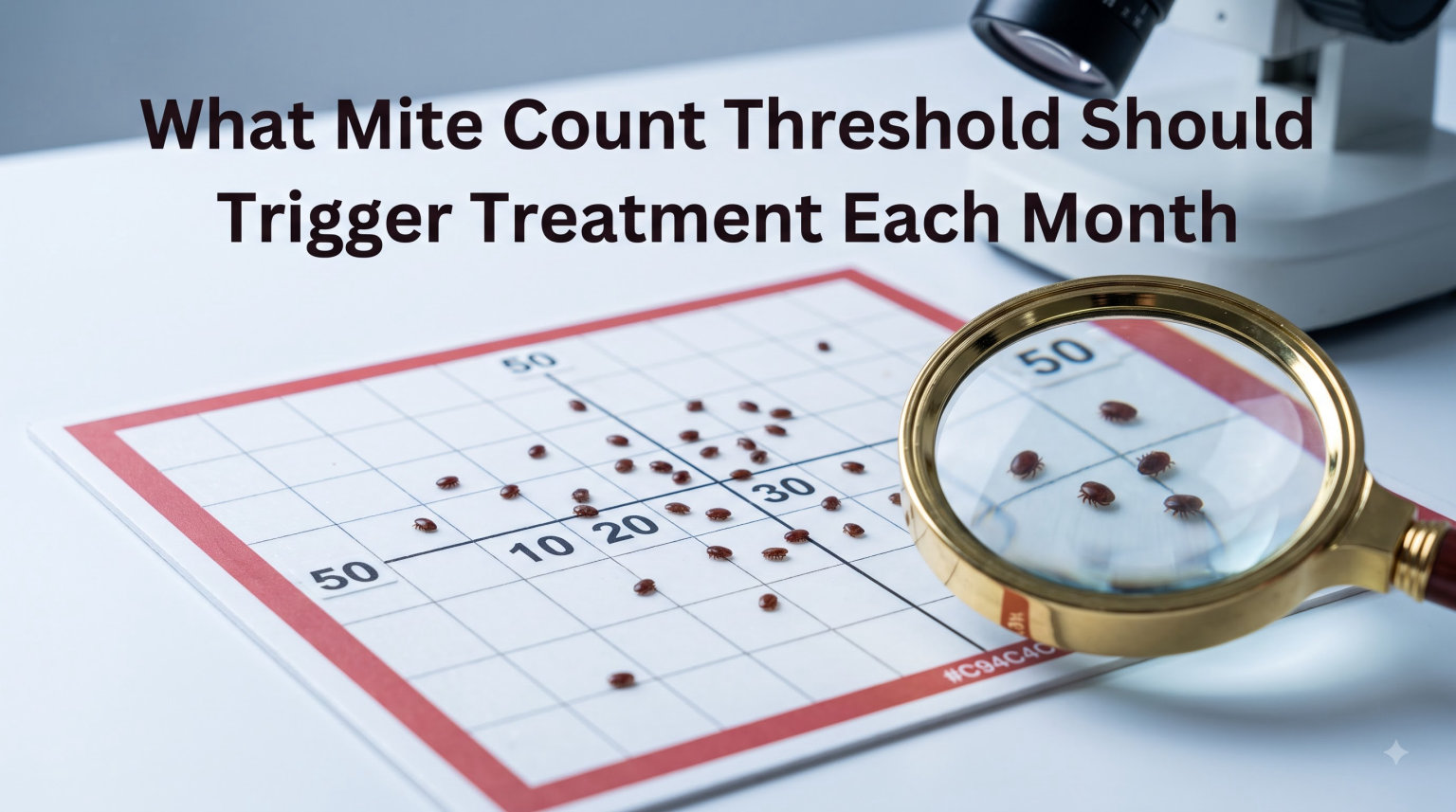
Varroa mites remain the number one threat to honeybee colonies worldwide, and knowing exactly when to treat can mean the difference between a thriving hive and a winter deadout. The varroa mite treatment threshold is the specific mite count at which research and field experience agree you should intervene rather than wait. Our team has compiled guidance from extension services, commercial beekeepers, and published research to give you a month-by-month framework you can actually use in 2026.
Here is the short version: from April through July, you should treat when your mite count reaches 2 percent, which equals 6 mites per 300 bees or 2 mites per 100 bees. From August through October, that threshold rises to 3 percent, meaning 9 mites per 300 bees. In late August and September across colder climates, the goal shifts to driving mite levels as close to zero as possible before winter bees are raised.
In this guide, we break down exactly how to calculate your mite count, what each monthly threshold means, how to adjust for your climate zone, and which monitoring method gives you the most reliable numbers. We also clear up the confusion around the so-called 3-3-3 rule that beekeepers keep asking about in forums.
Table of Contents
What Is a Varroa Mite Treatment Threshold?
A varroa mite treatment threshold is the infestation level at which the cost of leaving mites untreated outweighs the cost and risk of applying a treatment. Below that number, the colony can generally cope with the mite load on its own. Above it, mite populations grow exponentially and begin transmitting viruses that cause visible damage, reduced lifespan, and eventual collapse.
Researchers and extension programs express thresholds as a percentage of sampled bees carrying mites, using a standard 300-bee sample. A 2 percent threshold means 2 out of every 100 bees sampled have mites on their bodies at the time of testing. That translates to 6 mites found in a 300-bee sample. A 3 percent threshold means 9 mites in that same sample.
The concept comes from integrated pest management, or IPM, a framework that prioritizes monitoring and threshold-based decisions over calendar-based spraying. Instead of treating on a fixed schedule regardless of mite levels, you test regularly and treat only when numbers cross the line. This approach reduces chemical exposure for the bees, slows the development of mite resistance, and saves money on treatments you may not need.
One important distinction: the treatment threshold is not the same as the economic threshold. The economic threshold, studied extensively by researchers like those at Mississippi State University, represents the total mite population at which colony damage becomes economically significant. For colonies of 25,000 to 34,000 bees in the southern United States, that total sits in the range of roughly 3,200 to 4,300 mites in August. The percentage thresholds beekeepers use daily are a practical proxy for that deeper calculation.
Phoretic Mites vs Brood Mites: What Your Test Actually Measures
To understand why thresholds shift by month, you need to understand where mites are hiding when you run a test. Varroa mites live in two phases: phoretic and reproductive. Phoretic mites ride on adult bees, clinging to the space between abdominal segments where they feed on fat body tissue. Reproductive mites are sealed inside capped brood cells, where they lay eggs and raise offspring alongside the developing bee pupa.
An alcohol wash or sugar roll only counts phoretic mites. The mites locked inside capped brood are invisible to these tests. This matters enormously because a large percentage of your total mite population can be hiding under cappings at any given time, especially during peak brood rearing in late spring and summer.
Here is why the phoretic versus brood distinction drives the monthly threshold calendar. In early spring, as the colony ramps up brood production, mites pour into the newly available brood cells to reproduce. Your phoretic count may look low even though the hidden population is growing fast. By mid-summer, brood production is near its peak and a huge portion of mites are reproducing under cappings. Then in late summer and early fall, colonies begin reducing brood, and mites that would normally enter cells are forced out onto adult bees. The phoretic percentage spikes dramatically.
This August-through-October spike is the single most dangerous period in beekeeping. The same number of total mites that seemed manageable in July becomes a much higher phoretic percentage in September because there are fewer brood cells to absorb them. Those crowded phoretic mites are also the ones transmitting viruses most aggressively to the winter bees your colony desperately needs. This is why fall thresholds appear higher than spring thresholds in the standard chart, yet fall is paradoxically when you must be most aggressive about treatment.
How to Calculate Mites Per 100 Bees
Calculating mites per 100 bees is straightforward once you commit to a consistent sampling protocol. The standard method uses a 300-bee sample because it provides enough statistical reliability while keeping the math simple. Here is the step-by-step procedure we recommend based on methods from the Honey Bee Health Coalition and university extension programs.
Step 1: Gather your equipment. You need a wide-mouth jar with a lid modified to hold a wire mesh screen, a measuring scoop sized for approximately 300 bees (about half a cup of tightly packed bees), alcohol or windshield washer fluid for an alcohol wash, or powdered sugar for a sugar roll, and a white tray or plate for counting dislodged mites.
Step 2: Find the right frame. Select a frame from the brood nest where you can see capped brood and nurse bees. Avoid the queen. Many beekeepers use a queen excluder clipped to the top of the frame area or simply scan carefully before scooping. Sampling from the brood nest matters because nurse bees have the highest phoretic mite loads, giving you a more accurate picture of colony infestation.
Step 3: Scoop approximately 300 bees. Quickly but gently scoop bees from the frame face into your jar. Snap the lid on immediately. If you are using the sugar roll method, you keep these bees alive and release them after testing.
Step 4: Apply your testing agent. For an alcohol wash, add enough alcohol to cover the bees and shake vigorously for at least 60 seconds. For a sugar roll, add two tablespoons of powdered sugar, shake to coat the bees, then let the jar rest for two to three minutes before shaking again. The mites dislodge from the bees and fall through the mesh screen.
Step 5: Count the mites. Pour the liquid or shake the sugar through the mesh onto your white tray. Rinse with additional alcohol or water if needed to make mites visible. Count every mite you see. The mites are small, reddish-brown, and slightly wider than long. Good lighting and a magnifying glass help if your eyes are not what they used to be.
Step 6: Calculate the percentage. Divide the number of mites by 3 to get mites per 100 bees, since your sample is 300 bees. That number is also your percentage. For example, if you find 9 mites in your 300-bee sample, you divide by 3 to get 3 mites per 100 bees, which equals a 3 percent infestation rate.
Two quick examples make this clear. If you count 6 mites from 300 bees, that is 2 mites per 100 bees, or a 2 percent load. If you count 12 mites from 300 bees, that is 4 mites per 100 bees, or a 4 percent load, well above any seasonal threshold.
Consistency is more important than perfection. Use the same method, sample from the same area of the hive, and test on a similar schedule each time. Trends across months tell you far more than any single number.
Monthly Mite Count Threshold Chart
Use this chart as your primary reference for deciding when to treat. The thresholds below combine guidance from university extension services, the Honey Bee Health Coalition, and consensus from experienced commercial and hobbyist beekeepers. These numbers assume a standard 300-bee sample using an alcohol wash or sugar roll method.
For January through March, while colonies have minimal or no brood, the treatment threshold is effectively zero tolerance in most regions. If you find more than 3 mites per 300 bees (1 percent) during winter, that colony is at serious risk and you should use a broodless-period treatment like oxalic acid vaporization or dribble. Mites have nowhere to hide in capped brood during this period, so this is actually your most efficient treatment window.
From April through May, as brood rearing accelerates, keep mite levels below 6 per 300 bees (2 percent). Many experienced beekeepers treat proactively in early spring to knock mite populations down before the explosive summer growth phase. If your April count is already at 3 per 100 bees, you are behind and need to act.
From June through July, hold the line at a maximum of 6 mites per 300 bees (2 percent). This is the peak beekeeping season and also peak mite reproduction season. Colonies at or above 2 percent in July are on a trajectory to exceed dangerous levels by August. Treat now rather than waiting.
August is the pivot month. By mid-August, the threshold thinking flips from a percentage to a target: drive mites as low as possible, ideally under 3 mites per 300 bees (1 percent), before winter bees emerge. Colder-climate beekeepers often aim to have treatments completed by August 20 because winter bees are being raised right now and they must be virus-free to survive the coming months.
From September through October, the listed threshold rises to 9 mites per 300 bees (3 percent) as a maximum before mandatory treatment, but the reality is you should treat anything above 1 to 2 percent during this window. Fall is your last chance. Mites that survive into November will ride winter bees and spike again before spring.
For November through December in cold climates where colonies are broodless, return to zero tolerance. Any detectable mite load on winter bees represents a threat. Oxalic acid treatments applied during true broodless periods can achieve 90 percent or better efficacy because every mite is phoretic and exposed.
Quick reference summary: Treat at 2 percent (6 mites per 300) in spring and summer. Treat at 3 percent (9 mites per 300) as a fall ceiling, but aim much lower. Treat to zero in winter during broodless periods.
Seasonal Treatment Triggers Explained Month by Month
Understanding why thresholds change by season helps you make better decisions than blindly following a chart. The varroa mite treatment threshold is not arbitrary. Each number reflects the biology of mite reproduction, the colony population cycle, and the timeline of virus damage.
Spring: Keep Mites Low Before the Explosion
In spring, colonies are building population rapidly and there is abundant brood for mites to reproduce in. A colony that looks healthy in April can harbor a growing mite population that the adult bee count has not yet caught up to. This is why early spring counts that seem low can still be dangerous. A 1.5 percent load in April will multiply several times over by July because each reproductive cycle under cappings can increase the mite population by a factor roughly matching the brood cycle of about 12 days.
The spring trigger is about prevention. If you treat in early spring and drive mites below 1 percent, you give your colony a clean start before the nectar flow. Colonies that enter the flow with low mite loads produce more honey and build stronger populations for the critical fall period.
Summer: Hold the Line at 2 Percent
June and July represent peak colony strength but also peak mite reproduction risk. The colony is at maximum brood production, which means maximum opportunity for mites to reproduce under cappings. Your phoretic count is only showing a fraction of the total infestation during this period, possibly as little as one-third.
If your summer count hits 2 percent, treat immediately. The hidden brood mites mean your actual infestation is likely much higher. Beekeepers who wait to see counts climb above 2 percent in July almost always face emergency situations by August. The summer trigger exists to prevent you from arriving at fall with an unmanageable mite load.
Fall: The Most Critical Window of the Year
August through October is when most colonies are lost. The mechanism is well understood by researchers. Colonies begin reducing brood in late summer, which forces mites out of capped cells and onto adult bees. Those phoretic mites transmit viruses aggressively, particularly deformed wing virus, as they crowd onto fewer and fewer adult bees. The bees being raised during this period are your winter bees, the ones that must survive for four to six months to carry the colony through to spring.
If winter bees are raised in a high-virus, high-mite environment, they emerge with compromised lifespans and immune systems. The colony may look fine in October and November, then collapse during January or February when those damaged winter bees die off faster than the cluster can maintain warmth. This is the classic late-winter deadout that traces back to mite levels in August and September.
The fall trigger is therefore both a number and a deadline. Treat when mites exceed 3 percent, but ideally treat earlier to get under 1 percent before winter bees are raised. Know your regional deadline for completing fall treatments based on your first frost date and when winter bees are produced in your area.
Winter: Exploit the Broodless Advantage
In cold climates, colonies go broodless for weeks or months during winter. During this window, every mite in the colony is phoretic. There are no capped brood cells for mites to hide in. Treatments like oxalic acid vaporization or dribble applied during true broodless periods can achieve exceptional kill rates because no mites are protected.
Winter treatment is not about hitting a threshold number. It is about reducing the phoretic mite population so that when brood rearing resumes in late winter or early spring, the colony starts from as close to zero as possible. This is the single most efficient treatment opportunity of the year if you can confirm the broodless status.
Monitoring Methods Compared: Alcohol Wash, Sugar Roll, and Sticky Board
The accuracy of your threshold decisions depends entirely on the quality of your monitoring method. Three approaches dominate beekeeping practice, and each has distinct strengths and weaknesses. Here is how they compare.
The alcohol wash is considered the gold standard for accuracy. You submerge a 300-bee sample in alcohol, which kills both the bees and dislodges all phoretic mites. Research consistently shows the alcohol wash recovers 90 to 95 percent of phoretic mites, making it the most reliable method for quantitative threshold decisions. The downside is that it kills the sampled bees, though losing 300 bees from a colony of 30,000 is negligible. Some beekeepers use windshield washer fluid or soapy water as a less expensive alcohol substitute with similar recovery rates.
The sugar roll or sugar shake avoids killing bees. You coat the 300-bee sample in powdered sugar, which makes the mites lose their grip without harming the bees. After shaking, mites fall through a mesh screen and the bees are returned to the hive. The sugar roll recovers approximately 70 to 85 percent of phoretic mites, somewhat less than the alcohol wash. This means sugar roll counts may underestimate your actual mite load, which is important to account for when interpreting results against thresholds. If your sugar roll shows 5 mites per 300 bees, your actual load may be closer to 6 or 7.
The sticky board is a passive monitoring method rather than a quantitative sample. You place a coated board under the screened bottom board and count mites that naturally fall from the cluster over 24 to 72 hours. Sticky boards are useful for tracking trends over time and spotting sudden spikes, but they do not give you a reliable mites-per-100-bees percentage. The natural mite drop rate depends on colony size, brood amount, grooming behavior, and whether a treatment is in progress. Researchers have published formulas to estimate total mite population from natural drop counts, but these require accurate colony population estimates that most beekeepers cannot produce reliably.
Which method should you use? For threshold-based treatment decisions, use the alcohol wash. It gives you the most accurate percentage and removes guesswork. If you are unwilling to sacrifice bees, use the sugar roll but mentally adjust your results upward by 15 to 20 percent to compensate for lower recovery. Use sticky boards as a supplementary early-warning system between your regular wash tests, not as your primary decision tool.
Whichever method you choose, the key is consistency. Switching methods month to month makes it impossible to track trends. Pick one quantitative method, stick with it, and test on a regular monthly schedule.
Climate Zone Adjustments for Treatment Thresholds
The standard threshold chart assumes a temperate climate with a distinct winter brood break, typical of the northern and central United States, Canada, and northern Europe. If you keep bees in a different climate zone, you need to adjust both the thresholds and the timing.
Northern and Cold Climates
In regions with long, hard winters, colonies experience extended broodless periods from November through February or March. This is an advantage because it creates a reliable window for highly effective oxalic acid treatments. Your spring thresholds remain the same at 2 percent, but you should complete all fall treatments earlier. Northern beekeepers typically target completing fall treatments by late August or early September because winter bees are being raised during a narrow window and frost can arrive quickly. Use the broodless winter period to deliver a cleanup treatment that gets mites as close to zero as possible.
Southern and Warm Winter Climates
In the southern United States and similar warm climates, colonies may maintain some brood year-round. This eliminates the broodless treatment advantage and means mites can continue reproducing through winter at a reduced rate. Southern beekeepers face a longer active mite season and should test monthly even in winter. The economic thresholds calculated by Mississippi State University for southern colonies reflect this reality: total mite populations of 3,200 to 4,300 in a colony of 25,000 to 34,000 bees in August represent the danger zone. Southern beekeepers should plan for more frequent treatments, potentially three to four interventions per year, and use the summer threshold of 2 percent as their year-round baseline.
Subtropical and Year-Round Brood Climates
In Florida, south Texas, parts of Australia, and other subtropical regions, colonies rarely or never go completely broodless. Mites reproduce continuously, and there is no natural winter bottleneck to exploit. In these climates, you should treat at the first sign of approaching 2 percent in any month. The concept of seasonal thresholds blurs because mite pressure is constant. Monthly testing is mandatory, and many beekeepers in these regions follow a proactive rotation schedule, treating on a planned cycle rather than waiting for thresholds because mite populations can spike between tests.
Migratory and High-Pressure Areas
If your colonies are near commercial apiaries, almond pollination staging areas, or other high-density beekeeping operations, reinfestation pressure is constant. Mites drift between colonies on drifting bees and robbing events. In these situations, consider lowering your personal trigger threshold by half a percent to account for the ongoing influx of new mites. A colony you test at 1.5 percent today could be at 2.5 percent next week if a neighbor’s collapsing hive sends robbers your way.
Common Mite Testing Mistakes That Skew Your Count
Even experienced beekeepers make errors that produce misleading mite counts. Here are the most common mistakes we see and how to avoid them.
Sampling from the wrong location. The number one error is scooping bees from honey supers or the outer frames instead of the brood nest. Foragers and honey-storage bees carry far fewer mites than nurse bees tending brood. Always sample from a frame with open and capped brood, and confirm the queen is not on that frame before scooping.
Using too few bees. Some beekeepers scoop what looks like a large handful and assume it is close to 300 bees. In reality, an unmeasured scoop can easily be 150 or 200 bees, which throws off your entire percentage calculation. Use a dedicated measuring cup marked at the half-cup line, which corresponds to approximately 300 bees, or count more precisely when you first start.
Testing at inconsistent times. Mite levels fluctuate during the day and across the brood cycle. Test at roughly the same time of day and at consistent monthly intervals. Testing once in April, skipping to July, then panicking in September means you missed the trend that would have told you to treat in May.
Not testing every colony. Mite levels vary dramatically between colonies in the same apiary. Testing one hive and assuming the rest are similar is a recipe for surprise losses. Test every colony, or at minimum test a representative sample of your strongest and weakest colonies each month.
Miscounting mites on the tray. Dirt, pollen pellets, bee parts, and wax scales can all resemble mites to an untrained eye. Real varroa mites have a distinctive rounded, reddish-brown body about 1.1 millimeters wide and 1.5 millimeters long. Take your counting tray to good light and use a magnifier. When in doubt, count only what you are certain about, since overcounting leads to unnecessary treatment and undercounting leads to colony loss.
Treating without retesting. Applying a treatment is only half the job. You must retest 7 to 14 days after completing a treatment to verify it worked. Treatment resistance is a real and growing problem, particularly with amitraz-based products. If your post-treatment count shows minimal reduction, you need to switch active ingredients and try again.
FAQs
What is the threshold for varroa mite treatment?
The standard varroa mite treatment threshold is 2 percent, meaning 6 mites per 300 bees, during spring and summer months from April through July. From August through October, the threshold rises to 3 percent, or 9 mites per 300 bees. In winter during broodless periods, the goal is to drive mites as close to zero as possible.
What is the 3-3-3 rule for bees?
The 3-3-3 rule is not a standard varroa mite management guideline. In beekeeping forums, people sometimes refer to treating at 3 mites per 300 bees (1 percent) as a conservative personal trigger, but this is a beekeeper preference, not a published rule. Some also confuse it with a general rule of thumb about colonies needing 3 frames of bees, 3 frames of brood, and 3 frames of stores to survive. For actual varroa thresholds, follow the 2 percent spring and summer guideline and 3 percent fall ceiling from extension services rather than informal forum rules.
How many times should I treat for varroa mites per year?
Most beekeepers in temperate climates need to treat two to three times per year: once in spring if mites approach 2 percent, once in late summer or early fall as the critical pre-winter treatment, and optionally once during the winter broodless period using oxalic acid. Beekeepers in warm climates with year-round brood may need three to four treatments annually. The exact number depends on your monitoring results, not a fixed schedule.
Can you eat honey from a hive treated with Apivar?
Apivar strips must be removed at least 14 days before adding honey supers or during a honey flow. Honey produced while Apivar is in the hive should not be harvested for human consumption. Once the strips are removed and the withdrawal period passes, subsequent honey produced by the colony is safe to eat. Always follow the product label instructions for application timing and withdrawal periods.
How many mites per 300 bees is too many?
In spring and summer, 6 mites per 300 bees (2 percent) is the treatment trigger. In fall, 9 mites per 300 bees (3 percent) is the ceiling above which you must treat immediately. However, experienced beekeepers recommend treating at much lower levels in late summer to protect winter bees, ideally driving counts below 3 mites per 300 bees before the colony raises its winter population.
When is it too late to treat for varroa mites?
It becomes too late when winter bees have already been raised in a high-mite, high-virus environment, typically by mid to late September in cold climates. If treatments are not completed before winter bees emerge, those bees will carry virus damage regardless of later treatment. This is why completing fall treatments by the regional deadline tied to your first frost date is the most time-sensitive decision in beekeeping.
How often should I test for varroa mites?
Test every colony once per month during the active season from March through November. In warm climates with year-round brood, test monthly all year. Monthly testing lets you track trends and catch rising mite populations before they cross the treatment threshold. Testing only once or twice a year is one of the most common reasons beekeepers lose colonies unexpectedly.
Putting It All Together: Your Monthly Mite Management Plan
The varroa mite treatment threshold is your most important number in beekeeping. Treat at 2 percent, or 6 mites per 300 bees, from spring through summer. Treat at 3 percent maximum in fall but aim lower to protect your winter bees. Exploit broodless winter periods to drive mites to near zero. Adjust thresholds earlier and more aggressively in warm climates where mites reproduce year-round.
Test every colony monthly using a consistent method, preferably the alcohol wash for accuracy. Track your numbers in a log or spreadsheet so you can see trends before they become emergencies. And always retest after treatment to confirm it worked.
Start with your next hive inspection. Run a mite count on every colony, compare it to the monthly threshold for your climate zone, and make a treatment decision based on data rather than guesswork. Your bees are counting on you to get this right, and now you have the framework to do it.