
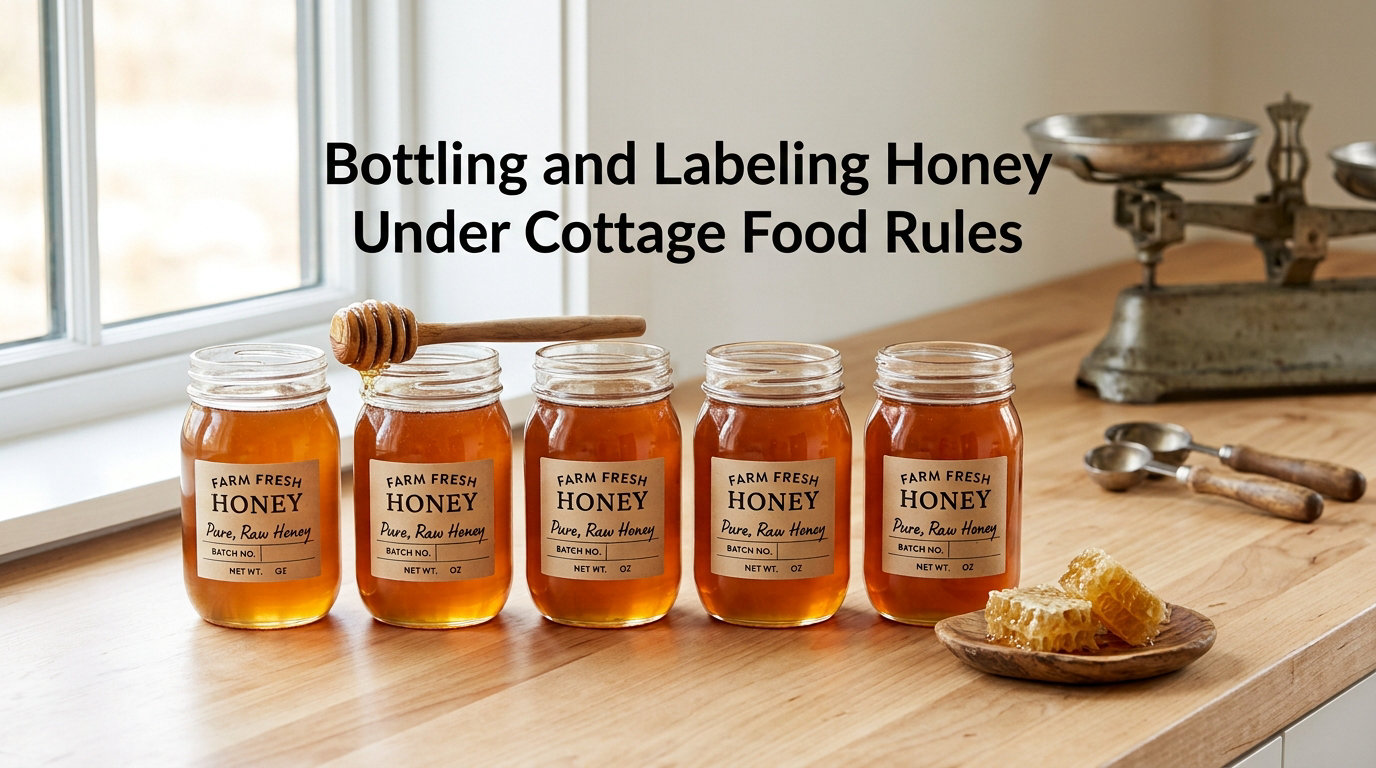
A cottage food operation lets small-scale producers bottle and sell certain non-potentially hazardous foods, including honey, from a home kitchen without a commercial food permit. Bottling and labeling honey under cottage food rules is the pathway our team uses, and the one most beginner beekeepers ask about first.
I run a few hives in my backyard, and the day I bottled my first harvest I spent more time worrying about the label than the honey itself. That is normal. The cottage food exemption exists to keep hobby beekeepers legal without forcing them into a commercial kitchen, but it comes with clear rules on bottling, labeling, and gross sales caps. This guide pulls those rules together in plain language so you can sell your honey with confidence in 2026.
Table of Contents
What Is a Cottage Food Operation and How Does It Apply to Honey
A cottage food operation is a home-based business that produces and sells certain shelf-stable, non-potentially hazardous foods directly to consumers. Honey is one of the most common products sold under this exemption because its low water content and natural acidity make it safe without refrigeration.
Under the Home Sweet Home Act in Florida, for example, cottage food operations do not require a food permit from the Department of Agriculture and Consumer Services. Florida Statute Section 500.80 is the legal backbone of that exemption, and most other states have similar language. The general principle is the same everywhere: if your annual gross sales stay under the cap, your honey is considered low-risk enough to skip the commercial kitchen.
To qualify for the cottage food exemption in most states, you must meet several baseline conditions:
- The honey must be produced in your home or a space directly under your control, like a small outbuilding used only for bottling.
- You must sell directly to the end consumer, not to a wholesaler or distributor.
- You must keep gross sales under your state’s annual cap, which ranges widely from $5,000 to $250,000.
- The product must carry a label that follows both state cottage food rules and federal honey labeling standards.
- You must comply with any required food safety training, registration, or inspection rules in your state.
One nuance many new beekeepers miss: the cottage food exemption typically covers pure honey only. If you plan to sell flavored honey with added ingredients, creamed honey blends, or honey combined with herbs and spices, some states require additional licensing. Always check your state’s specific list of approved cottage food products before bottling anything beyond raw or liquid honey.
Why Honey Qualifies as a Cottage Food
Honey is naturally low in moisture and high in sugar, which prevents the bacterial growth that cottage food laws are designed to guard against. The FDA classifies honey as a “non-potentially hazardous” food, which is why it appears on nearly every state’s approved cottage food list. Pasteurization is not required, and you do not need a pH test or water activity report for pure honey.
Step-by-Step Bottling Process for Cottage Food Honey
The bottling process for cottage food honey is straightforward once you set up a clean workflow. Our team follows the same five steps for every batch, and the consistency keeps us in compliance and our honey shelf-stable for years.
Step 1: Extract and Settle the Honey
After you remove frames from the hive, uncap them and spin out the honey in an extractor. Let the honey settle in a food-grade bucket for 24 to 48 hours. This resting period lets air bubbles, wax particles, and bee debris float to the top so you can skim them off.
Step 2: Strain Through a Fine Filter
Pour the settled honey through a nylon strainer or cheesecloth into your bottling bucket. Most cottage food producers use a 200-micron filter to catch wax and propolis while keeping the honey’s natural pollen content intact. This is the same straining step used by commercial operations.
Step 3: Sanitize Bottles and Lids
Wash glass jars in hot soapy water, rinse them, and let them air dry upside down on a clean towel. New lids are considered sanitary out of the package, so there is no need to boil them. If you reuse jars, run them through a dishwasher on a sanitize cycle and inspect each one for chips or cracks.
Step 4: Bottle at Room Temperature
Warm your honey to about 90 to 95 degrees Fahrenheit if it has crystallized. Honey flows best into jars when it is slightly above room temperature. Fill each jar to the proper headspace, wipe the rim clean with a damp paper towel, and screw the lid on firmly.
Step 5: Affix Labels Before Storage
Apply your labels before you stack the jars. This way you avoid having to handle sticky jars later and you can confirm each one carries every required element. Store the finished bottles in a cool, dry place away from direct sunlight.
I keep a checklist taped to my bottling station so I never skip the label step. It is easy to get excited about a fresh harvest and forget that an unlabelled jar cannot legally leave your kitchen.
Required Label Elements for Cottage Food Honey
Every cottage food honey label must include a specific set of elements to be legally compliant. Missing even one item can result in a warning from your state agriculture department or a stop-sale at a farmers market. Our team treats this list as a non-negotiable checklist for every jar.
Here is what your label must contain:
- Common name: The word “Honey” must appear prominently on the front label.
- Net weight: Both US (pounds/ounces) and metric (grams/kilograms) declarations are required by federal law.
- Producer name and physical address: Your full business or personal name and a street address, not a PO Box in most states.
- Ingredient declaration: If you sell pure honey, list “Honey” as the only ingredient. If you blend or add anything, list every ingredient in descending order.
- Allergen statement: Honey is not a major allergen under FALCPA, but it is a common allergen for some consumers, so a voluntary declaration is good practice.
- Cottage food disclaimer: Many states require wording such as “Made in a cottage food operation that is not subject to routine food safety inspections.”
- Infant botulism warning: Most states require a statement that honey should not be fed to children under one year of age.
- Country of origin: “Product of USA” or the specific country where the honey was harvested.
Net Weight Statement Format
Federal rule 21 CFR Part 101 governs how you declare net weight. The US measurement comes first, followed by the metric equivalent in parentheses. For example, “Net Wt 12 oz (340 g)” is a properly formatted statement. The metric conversion must be exact, so use a calculator rather than guessing.
Address Requirements: Why a PO Box Is Usually Not Enough
Most state cottage food laws require a physical address where the honey was produced. The reason is traceability: if a consumer has a complaint or a contamination concern, inspectors need to find the source. A PO Box does not satisfy this requirement in Florida, Texas, Colorado, or most other states with active cottage food programs. If privacy is a concern, some states allow you to list a road address with a directional cue, but you should confirm with your local agriculture department before relying on that workaround.
Allergen Disclosures and the Infant Botulism Warning
The infant botulism warning is the single most important safety statement on a honey label. Honey can contain Clostridium botulinum spores, which an infant’s immature digestive system cannot handle. Cooking honey does not reliably kill these spores, which is why the warning is required regardless of how the honey is processed.
The standard warning reads: “Do not feed honey to infants under one year of age.” Some states specify exact phrasing, so check your state’s cottage food rules for the precise language your inspector expects. Our team uses that exact wording on every jar, even though the rule can feel repetitive after the hundredth label.
Under the Food Allergen Labeling and Consumer Protection Act, honey is not classified as a major allergen, so a separate allergen statement is technically optional. Many producers still add “Contains: Honey” for transparency, especially when selling at farmers markets where customers may have questions.
Annual Sales Caps and Where You Can Sell
Annual gross sales caps vary dramatically from state to state, and the difference matters for anyone planning to scale up. Colorado caps cottage food sales at $10,000 per product per year, while Florida allows up to $250,000 in gross annual sales under the Home Sweet Home Act. Texas sits in the middle with a $50,000 cap for direct-to-consumer sales.
Here is a quick comparison of common state caps as of 2026:
- Colorado: $10,000 per product per year, direct to consumer only.
- Texas: $50,000 per year for direct-to-consumer cottage food sales.
- California: $75,000 gross annual sales cap for cottage food operations (AB-626 microenterprise home kitchen operations may differ).
- Florida: $250,000 in gross annual sales under the Home Sweet Home Act.
- Wyoming: $5,000 per year, one of the most restrictive caps in the country.
These caps reset each calendar year and include all gross revenue, not profit. If you cross the cap, you typically must upgrade to a commercial license rather than simply paying a fine.
Where You Can Sell Cottage Food Honey
Cottage food sales channels vary by state, but most allow several common options:
- Farmers markets and flea markets within the state of production.
- Roadside stands and on-farm sales directly from your property.
- Direct delivery to the end consumer, including through community supported agriculture (CSA) programs.
- Mail order and internet sales in some states, with restrictions on shipping across state lines.
- Wholesale to retail stores in a small number of states, including Florida under the updated Home Sweet Home Act.
Internet sales are the trickiest channel because shipping across state lines can pull you under the jurisdiction of the destination state’s food regulations. If you plan to ship honey out of state, verify both your state’s cottage food rules and the destination state’s cottage food or licensing rules before you list your product online.
FDA Nutritional Labeling vs Cottage Food Exemptions
Federal law under 21 CFR Part 101 requires most packaged foods to carry a Nutrition Facts panel. Cottage food honey is exempt from this requirement in most states, but only because the FDA gives small producers with low sales a pass through the same exemption used by very small businesses.
The general rule from the FDA is that if you have fewer than 100 full-time equivalent employees and sell fewer than 100,000 units of product per year, you are exempt from nutrition labeling. Honey produced and sold under a cottage food operation almost always falls under that threshold, which is why so many jars at farmers markets show no Nutrition Facts panel.
If you cross your state’s sales cap or expand into wholesale distribution, the FDA nutrition labeling exemption no longer applies. At that point you must either contract a commercial kitchen, register as a food facility with the FDA, and add a Nutrition Facts panel to your label. Some producers voluntarily include nutrition information even when exempt, since customers increasingly expect to see it.
FDA Facility Registration
The FDA Food Safety Modernization Act requires domestic and foreign facilities that manufacture, process, pack, or hold food for consumption in the United States to register with the FDA. Cottage food operations are typically exempt from facility registration because they sell directly to consumers and do not ship across state lines for wholesale. Once you cross into wholesale distribution, FDA registration usually becomes mandatory.
Common Labeling Mistakes to Avoid
Our team has seen the same handful of labeling mistakes trip up new cottage food producers. Avoiding these keeps your product on the shelf and out of an inspector’s office.
- Using a PO Box as the only address: Always include a physical address where the honey was produced.
- Skipping the metric weight: Federal law requires both US and metric declarations on the same line.
- Forgetting the infant botulism warning: This is the most common reason honey jars get pulled from a farmers market stall.
- Making unapproved health claims: Statements like “cures allergies” or “treats infections” violate FDA rules and can trigger warning letters.
- Labeling blended honey as “raw”: If you heat, blend, or filter heavily, the term “raw” may not apply. Reserve the term for honey that has not been heated above hive temperatures.
- Leaving off the cottage food disclaimer: Several states require specific wording about the operation not being subject to routine inspections.
- Using unapproved fonts or hidden information: All required elements must be legible and visible without removing the label.
I learned the metric weight lesson the hard way with my very first batch. I printed 200 labels with only ounces and had to throw them away when a customer pointed out the missing grams. Now I keep a label checklist on a clipboard next to the printer.
Frequently Asked Questions
What are the labeling requirements for honey under cottage food rules?
Every cottage food honey label must include the common name u0022Honey,u0022 a net weight statement in both US and metric units, the producer’s name and physical address, an ingredient list, an infant botulism warning, and any state-specific cottage food disclaimer. The exact wording of the cottage food statement varies by state, but the federal net weight rule applies nationwide.
Do I need a business license to sell honey from my home?
You typically do not need a business license to sell honey under cottage food laws, but you do need to register your cottage food operation with your state and stay under the annual gross sales cap. Most states also require basic food safety training and a clear label on every jar before you can sell at farmers markets or roadside stands.
Does raw honey have to be labeled differently than regular honey?
Raw honey does not require a different label than regular honey, but if you use the word u0022rawu0022 you must meet the generally accepted definition of honey that has not been heated above hive temperatures. Some states restrict the term further, and adding any heating, filtering, or blending can disqualify the raw claim.
Does honey have to be listed as an ingredient on cottage food labels?
Yes. If you sell pure honey with nothing added, the ingredient list reads simply u0022Honey.u0022 If you blend honey with spices, fruits, or flavorings, every added ingredient must be listed in descending order by weight, and any major allergens must be declared on the label.
Can I sell cottage food honey online or by mail order?
Some states allow internet and mail order sales of cottage food honey, but most restrict shipping to within the state of production. Shipping across state lines can pull your operation under the destination state’s licensing rules, so confirm both your home state rules and the recipient state’s rules before listing your honey for online sale.
Final Thoughts on Bottling and Labeling Honey Under Cottage Food Rules
Bottling and labeling honey under cottage food rules comes down to clean production, an honest label, and staying under your state’s sales cap. Our team has walked dozens of new beekeepers through their first compliant harvest, and the producers who treat the label checklist as seriously as the honey itself rarely run into trouble.
Start with your state’s cottage food statute, build a label that covers every required element, and keep good records of your gross sales each year. Once your honey is bottled, labeled, and compliant, you have a product that is both legally sound and ready for the farmers market table.