
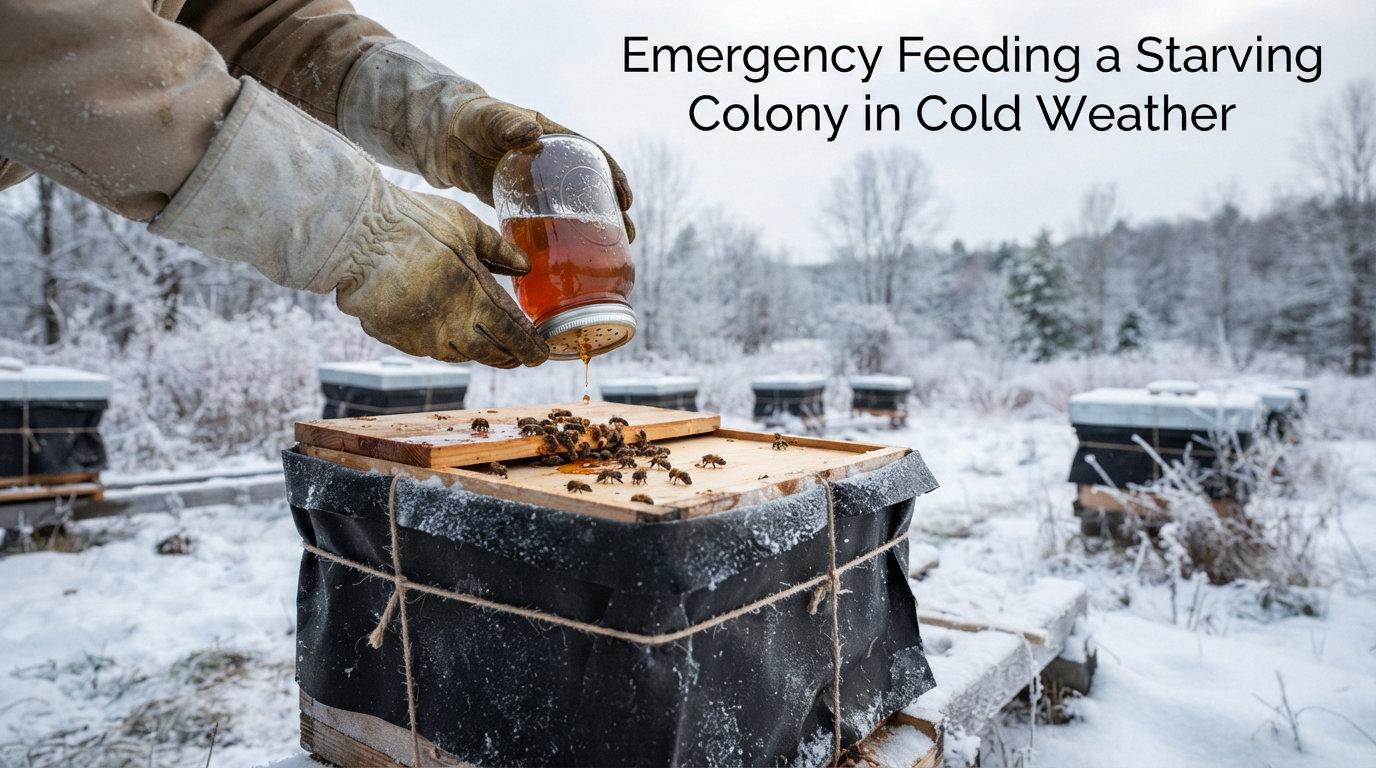
Emergency feeding a starving colony in cold weather is a crisis intervention beekeepers use when honey bees run out of stored food and cannot forage due to freezing temperatures. The goal is to deliver carbohydrates directly above the winter cluster so bees can access calories without breaking the thermal ball that keeps them alive. This procedure is most common in late winter and early spring, when stores are nearly depleted but the first nectar flow has not yet started.
I have managed colonies through cold snaps where the temperature dropped below freezing for weeks, and I can tell you: the difference between a colony that survives and one that collapses is often just a few pounds of sugar placed at the right moment. Our team has compiled research from apiary networks, the National Bee Unit, and years of field practice to help you make those critical calls.
This guide covers how to identify starvation, when to intervene, which feeding methods work in cold weather, and how to manage the risk of opening a hive when temperatures drop. By the end, you will have a clear decision tree and step-by-step procedures you can use in 2026 and beyond.
Table of Contents
Why Emergency Feeding Matters for Winter Colony Survival
Emergency feeding matters because bees cannot forage for honey or nectar when temperatures drop below 50F, yet they continue to consume stores every day to maintain cluster heat. A strong colony needs between 40 and 50 pounds of honey to survive winter, and that consumption accelerates dramatically in late winter when brood rearing begins.
The cluster itself maintains a core temperature around 95F, even when the outside air is below zero. To do this, bees shiver their flight muscles and metabolize honey and carbohydrates into heat. When stores run out, the cluster temperature collapses in a matter of days. Starvation is one of the leading causes of winter colony loss, and most of those losses are preventable with timely intervention.
Emergency feeding is fundamentally different from supplemental feeding. Supplemental feeding builds stores or supports spring buildup when the colony is healthy and active. Emergency feeding is a rescue operation that addresses imminent death. The mindset shift matters: if you are reading this in late February and your bees are alive but you are not sure they have enough food, you are already in an emergency situation.
Signs Your Bee Colony Is Starving
The clearest signs of a starving colony are light hive weight, dead bees on the landing board with extended abdomens, and a cluster positioned high in the hive near the top bars. These indicators tell you the colony has consumed its accessible stores and is reaching the upper boundary of the brood chamber.
Hefting the Hive
Hefting is the practice of lifting the back of the hive with one hand to gauge its weight. A well-stored double deep going into winter should weigh around 170 pounds. If you have been feeding and the hive feels light by late February, you are likely running out of food. Practice hefting in fall so you build a baseline sense of what a full hive feels like versus an empty one.
Visual Indicators at the Entrance
Dead bees on the landing board with their proboscis extended outward are a classic starvation giveaway. The bees died with their tongues out, desperately searching for food. A few dead bees are normal, but dozens piled up suggest the colony is in trouble, especially if you see them after a cold snap.
Cluster Position
A starving colony often moves upward in the hive as they consume lower stores. If you can quickly tilt the inner cover and see bees clustered at the very top of the frames, they have run out of food below. This is the moment to act.
The Spring Starvation Paradox
One of the most overlooked warning signs is the spring starvation paradox. A colony can come through winter looking healthy, then crash once brood rearing begins. The reason is simple: brood rearing requires the colony to maintain a 95F temperature in the nursery, which skyrockets honey consumption. Stores that seemed adequate in January can evaporate in three weeks of March brood rearing.
I have lost colonies this way. The hive seemed heavy in February, but by mid-March the cluster had moved up and the food was gone. Always check weight in late February or early March, even if the hive felt fine in midwinter.
Temperature Thresholds for Emergency Feeding
Liquid sugar syrup should not be fed when temperatures are below 50F (10C) because bees cannot evaporate the excess moisture and the syrup can ferment or freeze. Cold-weather feeding requires solid carbohydrates like fondant, sugar bricks, or dry sugar that bees can consume directly without further processing.
The 50F Liquid Feed Cutoff
Bees take liquid syrup and dehydrate it to store as honey. That evaporation process requires energy and warm ambient temperatures. Below 50F, syrup sits in the cells and can ferment, cause dysentery, or simply freeze. If you see advice about feeding syrup in winter, approach it with caution and check the temperature assumptions.
Safe Feeding Windows
For cold-weather feeding, focus on methods that work below 50F. Dry sugar, fondant, and sugar bricks are all effective. If you can wait for a warm day (above 40F) to open the hive for inspection, you can confirm starvation and place feed quickly. If you cannot wait, place feed without inspecting: the risk of chilling brood outweighs the diagnostic accuracy of a quick glance.
Below 32F Operations
Below freezing, do not open the hive. Bees in a broken cluster can chill within minutes. If you are confident the colony is starving and it is below 32F, you can place sugar bricks directly on the inner cover hole or use a candy board above the cluster without fully opening the hive. This is the safest cold-weather approach.
Emergency Feeding Methods Compared
The four most effective emergency feeding methods for cold weather are fondant, sugar bricks, mountain camp dry sugar, and candy boards. Each has strengths depending on your climate, equipment, and how much time you have to prepare.
Fondant
Fondant is a soft, pliable sugar paste that bees can consume at temperatures slightly above freezing. It is hygroscopic, meaning it absorbs moisture from the air and from the cluster, which makes it easier for bees to eat. Commercial fondant works well, and you can also make your own by heating sugar and water to the soft-ball stage (234F).
Sugar Bricks
Sugar bricks are similar to fondant but firmer, made by pressing dry sugar with a small amount of water into molds. They hold their shape better than fondant in warm spring weather and are easier to handle in cold conditions. Most beekeepers use a 5:1 sugar-to-water ratio by weight and bake the bricks at low heat to dry them out.
Mountain Camp Dry Sugar
The mountain camp method involves pouring 10 pounds of dry granulated sugar directly on a layer of newspaper above the cluster. The bees consume the sugar as it absorbs moisture from the cluster and hive. This is the simplest method for emergency feeding in cold weather because it requires no cooking and minimal equipment.
Candy Boards
Candy boards are wooden frames filled with hardened sugar that sit directly above the cluster. They function as both feed and a moisture-absorbing layer. Building a candy board takes some preparation but provides a long-lasting feed reserve that can sustain a colony through several weeks of cold weather.
Comparison Summary
For pure speed and simplicity, mountain camp dry sugar is hard to beat. For a longer-lasting feed in warmer spring conditions, sugar bricks or candy boards work better. Fondant is a good middle ground: it is ready to eat immediately and works in cold temperatures but can dry out or become runny if conditions fluctuate.
Mountain Camp Method: Step-by-Step Procedure
The mountain camp method involves placing newspaper directly above the cluster, then pouring 10 pounds of dry granulated sugar over the newspaper, and finishing with a light mist of water to start the sugar solidifying. This method is widely used because it requires no cooking and can be deployed in under 10 minutes.
Step 1: Choose a Warm Day
Pick a day when the temperature is at least 40F (preferably 45F or higher). You need enough warmth for bees to fly briefly and to soften any propolis seals. The hive will be open for only a few minutes, so chill risk is minimal if you work fast.
Step 2: Open the Hive
Remove the outer cover and inner cover. If you have an upper entrance or ventilation hole, leave it alone to preserve the cluster’s heat. Place the tools you need within arm’s reach before you start.
Step 3: Lay the Newspaper
Place a single sheet of newspaper directly on the top bars of the uppermost box. The newspaper acts as a barrier that prevents the sugar from falling between the frames and reaching the cluster, but it is porous enough for bees to chew through as they reach the sugar from below.
Step 4: Pour the Sugar
Pour 10 pounds of dry granulated white sugar evenly across the newspaper. Spread it out so it covers the entire cluster area, leaving a small margin around the edges to keep sugar from spilling into the hive walls.
Step 5: Mist Lightly
Use a spray bottle to mist the sugar with a small amount of water. Do not soak it. The mist helps the sugar clump together and form a solid cake that bees can access without it falling through the newspaper.
Step 6: Replace the Cover
Replace the inner cover and outer cover. If you have a quilt box with insulation, place it on top of the inner cover to help the colony retain heat and reduce condensation. Close the hive quickly and let the bees settle.
Step 7: Check in 2 to 3 Weeks
On the next warm day, peek at the sugar level. If the bees have consumed all the sugar and are still alive, add another 10 pounds. If they have not touched it, they may have found a different food source or the cluster may have moved.
Making and Placing Sugar Bricks or Fondant
Sugar bricks and fondant are made by combining sugar with a small amount of water and either baking or cooking the mixture to the right consistency. The key is placing the feed directly above the cluster so bees can access it without breaking their thermal ball.
Sugar Brick Recipe
Combine 5 pounds of granulated white sugar with 1 pint of water in a bowl. Mix until the sugar is evenly damp but not dissolved. Press the mixture firmly into silicone molds or a shallow baking pan lined with parchment paper. Bake at 200F for 2 to 3 hours, or air-dry for 24 hours until the bricks hold their shape.
Fondant Recipe
Combine 4 cups sugar, 1 cup water, and 1 tablespoon of vinegar or cream of tartar in a heavy pot. Heat slowly to 234F (soft-ball stage), stirring occasionally. Pour into a greased pan and let cool to a soft, pliable texture. Cut into blocks that fit directly above the cluster.
Placement Above the Cluster
Both sugar bricks and fondant should be placed directly on the top bars of the uppermost box, in the area where the cluster is located. Do not place feed on the bottom board or at the entrance: bees will not break cluster to reach it. Wrapping the fondant in wax paper with slits cut into the bottom side prevents it from drying out too quickly.
Add a Pollen Patty for Brood Rearing
If your emergency feeding happens in early spring and the colony is rearing brood, consider adding a protein patty alongside the sugar. Brood rearing without adequate pollen can cause nosema and failure to thrive. A small pollen patty (about 1 pound) placed next to the sugar brick supports both energy and protein needs.
Risk Management: When to Open the Hive
The risk of opening a hive in cold weather is real but it is generally less than the risk of starvation. A queenless or broodless colony can recover from a brief chill, but a starved colony cannot recover from being dead. Always work fast and minimize exposure.
Starvation Risk vs Chill Risk
If you are confident the colony is starving based on hefting and visual cues, the chill risk of a quick inspection is justified. Limit the hive opening to under 5 minutes. If you are unsure, wait for a warmer day (above 45F) to confirm before feeding.
Mid-40sF as the Practical Threshold
Most experienced beekeepers report that mid-40sF is the practical lower threshold for safe hive inspections. Below that, bees cluster tightly and chill quickly. Above that, bees can move within the hive and tolerate brief exposure.
Speed and Minimal Disruption
Have all your equipment ready before you open the hive. Bring sugar, newspaper, a spray bottle, and any tools to the apiary in advance. The goal is to open, place feed, and close in under 5 minutes. Do not examine frames or look for the queen during an emergency feeding.
Use a Top Entrance
If your hive has a top entrance or ventilation hole in the inner cover, you can sometimes place feed without opening the brood chamber at all. Set a sugar brick or candy board directly on the inner cover above the hole, and bees will come up to feed. This is the lowest-risk approach for below-freezing conditions.
When to Stop Emergency Feeding
Stop emergency feeding when natural forage becomes available, the hive regains sufficient weight, and the cluster is actively rearing brood on stored pollen and incoming nectar. The transition from emergency to supplemental feeding is gradual and based on observation, not a calendar date.
Signs of Natural Forage
Watch for early spring blooms in your area: skunk cabbage, willows, and maples are typical first sources. When bees are bringing in fresh pollen and nectar, you can shift from solid sugar to light syrup (1:1 ratio) if supplemental feeding is still needed.
Hive Weight Recovery
If the hive feels heavy again when you heft it, you can stop feeding. Sugar bricks and dry sugar can be left in place; bees will continue to consume them as needed. Remove fondant only if it has dried out and may fall onto the cluster.
Spring Supplemental Feeding
Once the immediate crisis is past, you may want to continue supplemental feeding to support buildup. Switch to 1:1 syrup in a feeder above the brood chamber if the colony is light but active. Stop supplemental feeding entirely when bees are consistently bringing in nectar and the hive weight is healthy.
Frequently Asked Questions
What temperature is too cold to feed bees?
Liquid sugar syrup should not be fed below 50F (10C) because bees cannot dehydrate it properly. For cold weather, use solid feeds like fondant, sugar bricks, or mountain camp dry sugar, which work even below freezing.
How do you feed bees in cold weather?
Place fondant, sugar bricks, or dry sugar directly above the winter cluster. Use the mountain camp method (newspaper plus 10 lbs of dry sugar), sugar bricks pressed into molds, or a candy board. Always place feed above the cluster so bees can access it without breaking their thermal ball.
How do you help a starving bee colony?
Confirm starvation by hefting the hive (light), checking for dead bees with extended proboscis on the landing board, and locating the cluster high in the hive. Place sugar bricks, fondant, or mountain camp dry sugar directly above the cluster within 5 minutes of opening the hive. Check again in 2 to 3 weeks.
What do you feed wild bees in winter?
Wild honey bees in a managed hive need the same emergency feeds as domestic colonies: fondant, sugar bricks, or dry sugar placed above the cluster. There is no effective way to feed truly wild bee colonies that are not in a hive, so focus on supporting managed and feral colonies that can be reached.
How much sugar do I emergency feed a colony?
Most beekeepers start with 10 pounds of dry sugar via the mountain camp method, or 5 to 8 pounds of sugar bricks or fondant. If the colony consumes the initial feed within 2 to 3 weeks, add another 10 pounds. Continue until natural forage is available and the hive regains weight.
Final Thoughts on Emergency Feeding a Starving Colony in Cold Weather
Emergency feeding a starving colony in cold weather comes down to two principles: place solid carbohydrate feed directly above the winter cluster, and act fast when signs of starvation appear. Mountain camp dry sugar, sugar bricks, and fondant are the most reliable methods for cold-weather rescue.
Check your hive weights in late February and early March, even if everything felt fine in January. Cold weather feeding is one of the most important skills a beekeeper can develop, and the colonies you save in 2026 will reward you with stronger spring buildup and better honey production. Reach out to your local beekeeping association for regional timing guidance, because climate variation matters more than any general rule.