
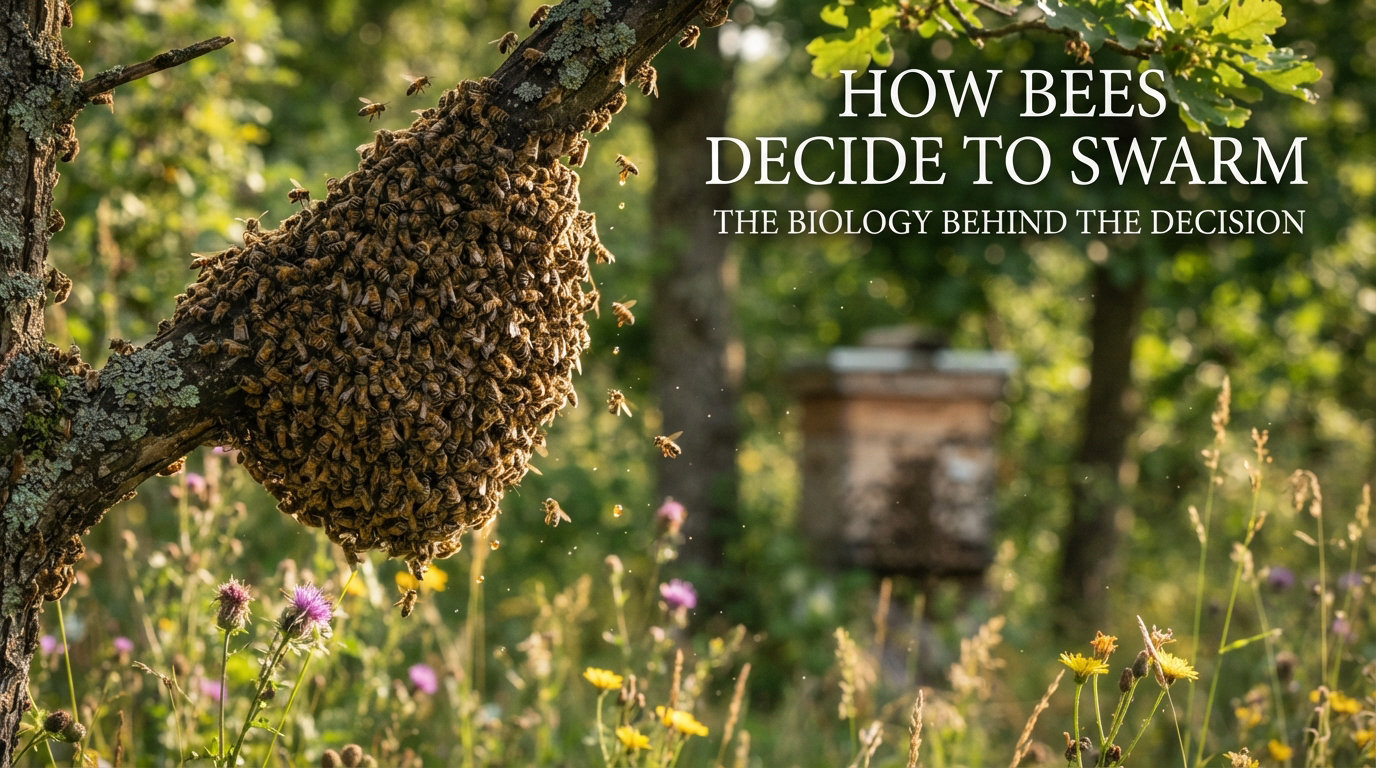
How bees decide to swarm is one of the most layered puzzles in insect biology. A honey bee colony does not swarm on impulse. It flips into swarm mode through a chain of internal signals, then thousands of workers choose a new home together through a process that looks uncomfortably like a vote.
I have spent the last several beekeeping seasons watching colonies prepare to swarm, lose their queens to a fat cluster on a tree branch, and rebuild. The more hives I run, the more I trust the swarm as a decision rather than an accident. In this guide I will walk you through the full biology behind that decision, from the first chemical whispers inside the brood nest to the moment a scout bee finishes her waggle dance and the swarm lifts off.
Table of Contents
What Is a Honey Bee Swarm and Why It Happens
A honey bee swarm is the colony-level reproduction of Apis mellifera. When conditions inside the hive become crowded and productive, the old queen leaves with roughly half the workers, leaving the original nest to a newly raised daughter queen. Two colonies result from one. Swarming is how honey bees spread their genetics across the landscape.
Beekeepers sometimes call swarming the colony’s way of “moving out,” but that framing is too casual. Swarming is an evolved reproductive strategy. A colony that swarms has judged that its workforce, food stores, and brood volume have crossed a threshold where splitting becomes safer than staying whole.
Most honey bee species and subspecies follow the same broad pattern, with a few telling variations. Africanized honey bees, for example, swarm more frequently and with smaller casts. European Apis mellifera ligustica tends to be more conservative, often issuing only one or two swarms per season. Apis cerana, the Asian hive bee, prefers absconding to swarming and will abandon a hive outright during stress. Understanding the variation matters because it tells you swarming is not a bug. It is a flexible solution tuned over millions of years.
Prime Swarm vs After Swarm
The first swarm to leave a hive is called the prime swarm. It carries the old, mated queen and typically 50 to 60 percent of the adult workers. If the daughter queen cells are still viable, the original hive may issue one or more after swarms led by a virgin queen. After swarms are smaller, more unpredictable, and often settle in inconvenient places like fence posts or shrubbery.
After swarms can chain. A strong colony can issue two, three, or even four casts over the course of a week, each one leaving fewer bees behind. By the fourth after swarm, the parent hive can be reduced to a handful of bees around a single capped queen cell. In the wild, this kind of over-swarming is a common cause of colony death. In managed hives, it is exactly the outcome a careful beekeeper works to prevent.
Seasonal Timing of Swarming
In temperate climates, swarming peaks in late spring and early summer when nectar flows are strongest. The window is narrow because the colony needs enough foragers to support both the departing swarm and the bees that stay behind. In warmer regions, you can see secondary swarm pulses in early autumn. The classic rule of thumb is that swarm season opens once daytime temperatures stabilize above 20 degrees Celsius and closes when the main nectar flow fades.
Climate change has shifted these windows. Across much of Europe and North America, recorded swarm dates now cluster 1 to 3 weeks earlier than they did 30 years ago. Warmer winters let colonies build brood faster, and the first major nectar flow often arrives before the colony has finished spring buildup. The result is a compressed swarm season that can catch even attentive beekeepers by surprise.
What Triggers a Swarm Inside the Hive
Three biological triggers converge before a colony commits to swarming. Researchers have debated their relative weight for decades, and the honest answer is that all three usually contribute. Think of them as pressure gauges rising in parallel until the colony breaks.
The debate matters because how you read a hive depends on which trigger you think is dominant. A beekeeper who treats brood food as the main lever focuses on queen laying rate. A beekeeper who treats congestion as the main lever focuses on adding space. In practice, both views are usually right in different moments of the season.
Brood Food Theory Explained
The brood food theory, championed by researchers like Tom Seeley, holds that nurse bees begin producing royal jelly faster than the queen can lay eggs to consume it. When the production of brood food outstrips demand, surplus workers shift their attention from brood care to queen cell construction. In practical terms, when I open a hive and see polished queen cups along the bottom bars in late spring, I know the brood food balance has tipped.
The royal jelly surplus shows up first in subtle ways. Nurse bees begin drumming on queen cups with their antennae, even when no egg has been laid inside. The cups get polished and widened. Worker cells that hold pollen and nectar get rearranged to make room for additional nurse activity along the bottom bars. None of these behaviors are swarming on their own, but together they form a recognizable signature.
Brood Nest Congestion Theory
The brood nest congestion theory focuses on space. As the brood area expands and the workforce grows, returning foragers have fewer empty cells to unload into. The congestion triggers a feedback loop: less fresh nectar storage, more bearding at the entrance, more queen avoidance by workers, and rising queen cell production. A congested hive is a hive in swarm mode.
Congestion shows up at the entrance as much as inside the hive. A hive that is congested has more bees clustering outside during the day, even when temperatures are mild. Returning foragers hover at the landing board instead of walking straight in. Guard bees become more reactive. If you stand near the hive in mid-morning, you can sometimes smell a slightly sour, fermenting scent as incoming nectar sits uncapped in the brood frames.
Queen Pheromone Dilution
The third trigger is chemical. A queen’s queen mandibular pheromone signals her presence to every worker in the colony. When the worker population grows past roughly 60,000 bees, the pheromone becomes too diluted to reach every worker effectively. Workers interpret that loss of contact as “something has changed.” The colony begins raising new queens as a hedge against perceived queen failure.
Pheromone dilution is invisible during a routine inspection, but its downstream effects are not. Workers start paying more attention to queen cells. They begin escorting the queen more closely around the brood nest, sometimes forming a tight retinue that limits her movement. If you watch a hive that is two weeks from swarming, you can sometimes see the queen hemmed in by attendants, hesitating to cross into a frame with capped brood. That hesitation is the chemical signal in action.
The Pre-Swarm Preparations Inside the Colony
Once the triggers are in place, the colony spends 7 to 14 days preparing. During this window the queen stops laying heavily, workers begin fasting, and queen cells are capped. It is the calm before the swarm.
This window is also when beekeepers still have time to intervene. Once the queen cells are capped and the foragers stop leaving on regular flights, the colony has crossed a behavioral threshold. Splits and demaree maneuvers before the cap can usually talk the colony out of swarming. After the cap, the colony is committed.
Queen Cells and Royal Nurseries
Workers draw out peanut-shaped queen cells, usually along the bottom or sides of frames. The queen lays a fertilized egg in each, and nurse bees flood the cells with royal jelly. Once capped, a queen cell takes roughly 8 more days before the virgin emerges. Most beekeepers learn to read the difference between supersedure cells (replacing a failing queen) and swarm cells (replacing a queen because the colony is splitting). Swarm cells cluster on the bottom of frames; supersedure cells usually hang in the middle of the brood face.
Number also tells a story. A colony that is superseding will typically raise one to four queen cells, often centered on a single frame. A colony that is preparing to swarm will raise eight, twelve, or even twenty queen cells distributed across multiple frames. The cells are usually packed with royal jelly from the moment they are drawn, and nurse bees visit them constantly. If you shake a frame gently and the nurse bees stay locked onto the cells rather than scattering, the colony is firmly in swarm mode.
Worker Fasting and Reduced Laying
In the days before departure, the queen shrinks her abdomen to prepare for flight. Workers stop feeding her as heavily, and she loses up to a third of her body weight. Foragers fill their honey crops. The hive essentially stockpiles fuel for a one-way trip.
You can sometimes spot a pre-swarm hive by watching the entrance at the right moment. Foragers bring in less pollen in the days before swarming. Drone production has usually peaked. The hum inside the hive drops in pitch as the population redistributes toward the bottom and edges of the frames. The colony is preparing to leave, even though the swarm event itself is still days away.
Piping and Tooting Signals
You can sometimes hear a queen piping through the side of a hive in the days before a swarm. Piping is a sharp, high-pitched vibration. Virgin queens pipe to challenge rivals still inside capped cells. Tooting is the response from a queen still sealed in her cell, advertising her readiness to emerge. These acoustic exchanges are part of how the colony sequences the departure.
Researchers using contact microphones have mapped the timing of piping in detail. Piping usually starts 2 to 3 days before the swarm, with several queens duetting in turn. The pattern settles the dominance hierarchy before departure. Only the dominant virgin leaves with the after swarm. The losers either kill each other or are killed by the workers.
How Scout Bees Explore and Report Nest Sites
The swarm itself is not the decision. The decision is happening in the air. As soon as the cluster forms on a tree branch or fence post, scout bees begin launching in every direction to evaluate cavity options within a roughly 5-kilometer radius.
Most swarms settle within a hundred yards of the parent hive, but scouts routinely fly much farther. The 5-kilometer search radius comes from Seeley’s tracking work on Apis mellifera and holds across most temperate landscapes. In forested terrain with abundant cavities, scouts usually find a usable site within a day or two. In open farmland or suburbs with few cavities, swarms can stall and eventually abscond to less optimal sites.
Scout Recruitment and the Waggle Dance
A returning scout that has found a promising cavity performs a waggle dance on the surface of the cluster. The angle of her waggle run points toward the new site relative to the sun. The longer she dances, the better the site. Other scouts follow her, fly out to inspect, and return either to dance for the same site or to argue against it. The dance floor is essentially a debate stage.
The waggle dance encodes three pieces of information. Distance shows up as the length of the waggle run. Direction shows up as the angle relative to gravity (which the bees interpret as the sun’s position). Quality shows up as the dance’s duration and vigor. A scout dancing for an excellent site may perform hundreds of waggle runs over several minutes. A scout dancing for a marginal site may only manage a few dozen runs before losing her audience.
The dance is also a social signal. Bees that have not yet left the cluster watch the dances and pick which scout to follow. The more often a particular site is danced for, the more bees follow that scout and convert to dancers themselves. This positive feedback is what makes the swarm converge toward an agreement rather than staying stuck between competing options.
Nest Site Quality Assessment
Bees evaluate cavities against a checklist that researchers have documented carefully. Scouts measure cavity volume (40 liters is the sweet spot), entrance height off the ground, entrance size (about 12 square centimeters), direction (south-facing entrances are preferred), dryness, and defensibility. A high-quality site gets a vigorous, long dance. A mediocre site gets a short dance that loses audience quickly.
Seeley’s group used artificial nest boxes to confirm these preferences. Scouts consistently chose cavities with the right volume, a south-facing entrance at least 3 meters above ground, and an entrance smaller than about 60 square centimeters. They rejected drafty cavities, cavities with wide openings, and cavities near obviously disturbed ground. The choices match what we would expect for a colony trying to overwinter safely and defend against hornets or ants.
Stop Signals and Cross-Inhibition
The clever part of the system is cross-inhibition. A scout that has just inspected a poor site and returned to the cluster will head-butt a dancer supporting a competing site and deliver a brief stop signal. The bumped dancer usually pauses or quits. This negative feedback prevents a mediocre site from snowballing into a decision just because it was discovered first. It is one of the cleanest examples of decentralized quality control in the animal kingdom.
Stop signals are short bursts of vibration, around 300 hertz, delivered through the comb. They last roughly a tenth of a second. A scout can deliver a stop signal and immediately leave to inspect another site. The result is a system where bees that hold strong opinions (backed by recent inspection) can dampen the recruitment efforts of bees holding weaker opinions. That filtering is a big part of why swarms rarely choose bad sites.
Quorum Sensing: How a Swarm Reaches Consensus
Once scouts are dancing for multiple candidates, the swarm has to converge on a single answer. It does this through a process biologists call quorum sensing. A site is “chosen” when roughly 15 to 20 scouts are simultaneously dancing for it inside the cluster.
The exact quorum threshold varies with swarm size and conditions. Larger swarms need a higher absolute number of supporters but a similar fraction of the cluster. Smaller swarms reach a quorum faster but with fewer inspections under their belt. Either way, the moment the threshold is crossed, the cluster shifts behavior within minutes. Piping and warm-up buzzes spread through the swarm, and lift-off follows.
What Quorum Sensing Means in Bees
Quorum sensing is borrowed from microbiology. In bacteria, cells release signaling molecules and switch behavior once the local concentration crosses a threshold. In honey bees, the threshold is the number of supporters. When a quorum forms for one site, the scouts quickly recruit the rest of the cluster through piping signals and a coordinated warm-up buzz. The swarm then warms its flight muscles to about 35 degrees Celsius and lifts off as one.
The thermal warm-up is striking. A scout that detects the quorum threshold will begin vibrating her flight muscles vigorously, generating heat. Nearby bees respond by warming up in turn. Within a few minutes, the entire cluster radiates heat, and you can feel the warmth by placing a hand near the surface. The warming phase is also a synchronization cue: it tells every bee that the decision has been made and the swarm is about to depart.
Speed and Accuracy Trade-Off
Thomas Seeley’s group at Cornell showed that swarms usually settle on a home within 2 to 3 days of clustering. They also showed that the quorum threshold matters. A low threshold gets the swarm moving fast but risks choosing a poor site. A high threshold improves accuracy but exposes the cluster to weather, predators, and energy loss. Bees seem to modulate the threshold based on conditions: rainy or cold weather pushes them toward a quicker, lower quorum.
This trade-off shows up clearly in field data. Swarms clustering in late season, when a long delay means running out of food stores, choose faster. Swarms clustering in early season, with abundant time, deliberate longer and more often pick the highest-quality cavity in the area. The swarm is not running on autopilot. It is making a context-sensitive decision that balances time, energy, and accuracy.
Thomas Seeley’s Research Findings
Seeley’s decades of work, summarized in Honey Bee Democracy, established that swarms consistently choose the best available cavity even when no individual bee knows the full landscape. No leader scouts. No queen issues orders. The decision emerges from hundreds of independent agents following simple local rules. That is the part I find most astonishing as a beekeeper, and it is what makes the biology behind bee swarming worth understanding.
Earlier work by Martin Lindauer in the 1950s set the foundation. Lindauer sat on rooftops with binoculars, watching marked scouts dance on swarm clusters for hours at a time. He documented the waggle patterns, the cross-inhibition, and the eventual commitment to a single site. Seeley’s later experiments added quantitative rigor: tracking individual bees, painting them with numbers, and using multiple identical nest boxes to test how the swarm discriminated between them. Together, the two research programs turned bee swarms into one of the most thoroughly understood examples of collective animal intelligence.
The Swarm Event Day by Day
The actual swarm event is short, but it has clear phases. Once you have seen a few, you can read the calendar in advance.
Day of Departure
Departure usually happens between 10 a.m. and 2 p.m. on a sunny, calm day. Workers stream out of the hive entrance in a spiraling plume. The queen takes off with them. Within 5 to 10 minutes, the air is thick with bees. They settle nearby, often within 30 meters, on a tree limb, fence post, or shrub. This first cluster is called the bivouac.
Wind and rain can delay departure. A colony that has queen cells ready to emerge will sometimes hold back for 24 to 48 hours waiting for good weather. Watchers often notice scout activity around the entrance the day before departure: workers hovering in pairs, drones circling the entrance in the late afternoon, and a quiet humming that gives way to a louder roar just before the swarm leaves.
Bivouac at the Interim Cluster
The bivouac stage can last from a few hours to several days. Scouts are already flying out during this window. In our own colonies, I have seen a cluster hang on a plum tree for two and a half days while scouts debated between a hollow oak and an abandoned shed. Beekeepers sometimes call this “waiting for the vote to finish,” which is exactly what it is.
The bivouac is also when swarm catching is easiest. The cluster is exposed, the queen is somewhere inside, and the bees are at their calmest. If you want to capture a swarm, the bivouac is your window. A cardboard box, a sheet, and a soft brush are usually enough. Once the swarm lifts off for its final destination, the opportunity is gone.
Movement to the Chosen Cavity
Once a quorum forms, the cluster suddenly warms, the scouts begin streaking through the bivouac piping their signal, and within minutes the entire mass lifts into the air. The swarm moves as a coordinated cloud toward the chosen site. Most swarms travel less than 3 miles, though recorded maximums reach about 6 miles. Once inside the new cavity, the queen resumes laying within days, and the cycle begins again.
The arrival itself is choreographed. Scouts fly back and forth along the route, dropping pheromone markers. The queen and most of the workers follow these scent trails. A small contingent of scouts lands at the new entrance and begins fanning their Nasonov glands to release an aggregation pheromone. Within minutes, the swarm funnels into the cavity. Bees that arrive late follow the scent plume back to the entrance. The new colony is essentially established in less than an hour.
How Beekeepers Read and Prevent Swarms
Understanding the biology pays off in the apiary. Prevention is far easier than catching a swarm halfway up a tree. After losing two colonies to unmanaged swarms in my second year, I started running weekly inspections from mid-April through June and never regretted it.
Early Warning Signs in the Hive
Watch for these signals during spring inspections. Queen cups with eggs or royal jelly inside. Backfilled brood cells where nectar is crowding out open brood. A drop in the queen’s laying pattern. Bearding at the entrance on mild mornings. A sudden drop in the hive’s weight curve during a strong flow. Any one of these is a hint; two together usually means swarm cells are already underway.
Track each colony’s behavior over time. A hive that has been productive for three weeks and suddenly slows its pollen intake is preparing to swarm. A hive that has been calm and now produces more guard bees at the entrance is gearing up for a split. The trick is reading the whole hive as a system rather than a checklist. One sign is data. Two signs are a pattern. Three signs mean the colony is days from leaving.
The 3 Feet 3 Miles 3 Months Rule
The so-called 3 3 3 rule for bees is a memorable heuristic for catching swarms. Once a swarm lands, you usually have about 3 feet of vertical space to work with on the cluster, the queen will likely move again within 3 miles of the original hive, and the cluster tends to stay put for around 3 hours if no scouts report back favorably. In practice, most backyard beekeepers find the cluster is stable for the first afternoon, which is the realistic window for a capture.
Some beekeeping clubs use a slightly different formulation: 3 feet up the tree, 3 miles from the parent hive, and 3 days before the cluster moves on. The exact numbers are less important than the principle: a swarm cluster is a temporary stage, not a permanent home. Use the time you have.
Splits, Supers, and Demaree
If you catch swarm cells early, three common interventions work. Adding a super of drawn comb gives the workforce room to store nectar and relieves congestion. A split takes the old queen plus a few frames of brood into a new box, leaving the swarm cells behind to raise a new queen in the original hive. The Demaree method moves all brood frames above a queen excluder, letting the foragers stay downstairs with the queen and breaking the swarm impulse. None of these are guarantees, but they are the standard toolkit for managing a colony that wants to split.
Timing matters more than technique. A split performed before queen cells are capped usually works. A split performed after capping often fails because the swarm impulse is already locked in. If you cannot inspect weekly during swarm season, add space early, harvest a frame or two of brood to weaken the colony slightly, and accept that some swarms will still happen. Every beekeeper loses swarms. The goal is to lose fewer than the colonies gain through splits.
FAQs
How do bees decide to swarm?
Bees decide to swarm when three internal signals converge: brood food production outpaces demand (brood food theory), the brood nest becomes crowded (congestion theory), and queen pheromone becomes too diluted across the workforce. Once those pressures build, the colony raises new queen cells and prepares to divide. Scout bees then compare potential nest sites and use quorum sensing to choose the best one.
What is the 3 3 3 rule for bees?
The 3 3 3 rule is a practical shortcut for swarm catching. Once a swarm lands, the cluster typically occupies about 3 feet of vertical space, the bees usually relocate within 3 miles of the parent hive, and the bivouac often remains in place for around 3 hours before moving on. It is a useful mental checklist, not a strict biological law.
Are bees angry when they swarm?
No. Swarming bees are among the most docile honey bees you will ever meet. Their honey crops are full, they have no brood or comb to defend, and their biological priority is finding a new home rather than protecting an existing one. Most swarm captures can be done without a veil, though eye protection is still wise.
Can bees change their mind about swarming?
Yes, under the right conditions. If weather turns bad, if a better cavity is discovered, or if scout bees fail to reach a quorum, the swarm will often stay in its bivouac and continue debating. A beekeeper who removes queen cells early in the preparation phase can also convince the colony to abandon the swarm impulse and settle back into growth mode.
The Biology Behind the Decision in One Sentence
How bees decide to swarm is, at its core, a story about a superorganism that runs on consensus. Internal pressure pushes the colony to split. Scout bees turn the decision into a structured debate. Quorum sensing closes the debate. The swarm lifts off.
Whether you keep bees, study them, or simply watch a cluster settle on a branch in your yard, the swarm rewards attention. Every phase, from the first queen cup to the final warm-up buzz, has a job to do. Once you can read those phases, the swarm stops feeling like chaos and starts feeling like one of the cleanest examples of collective decision-making in nature.
The swarm is also a reminder that the colony is more than the sum of its workers. No single bee knows the plan. No single bee knows the new address. The plan and the address emerge from thousands of independent agents acting on local cues, which is exactly the kind of distributed intelligence that computer scientists now model for swarm robotics and decentralized networks. Honey bees got there first, by roughly 60 million years.
Next time you spot a cluster hanging in a tree, take a quiet moment. You are watching a 60-million-year-old decision process in real time, and the bees are about to teach you something about how groups make good choices.