
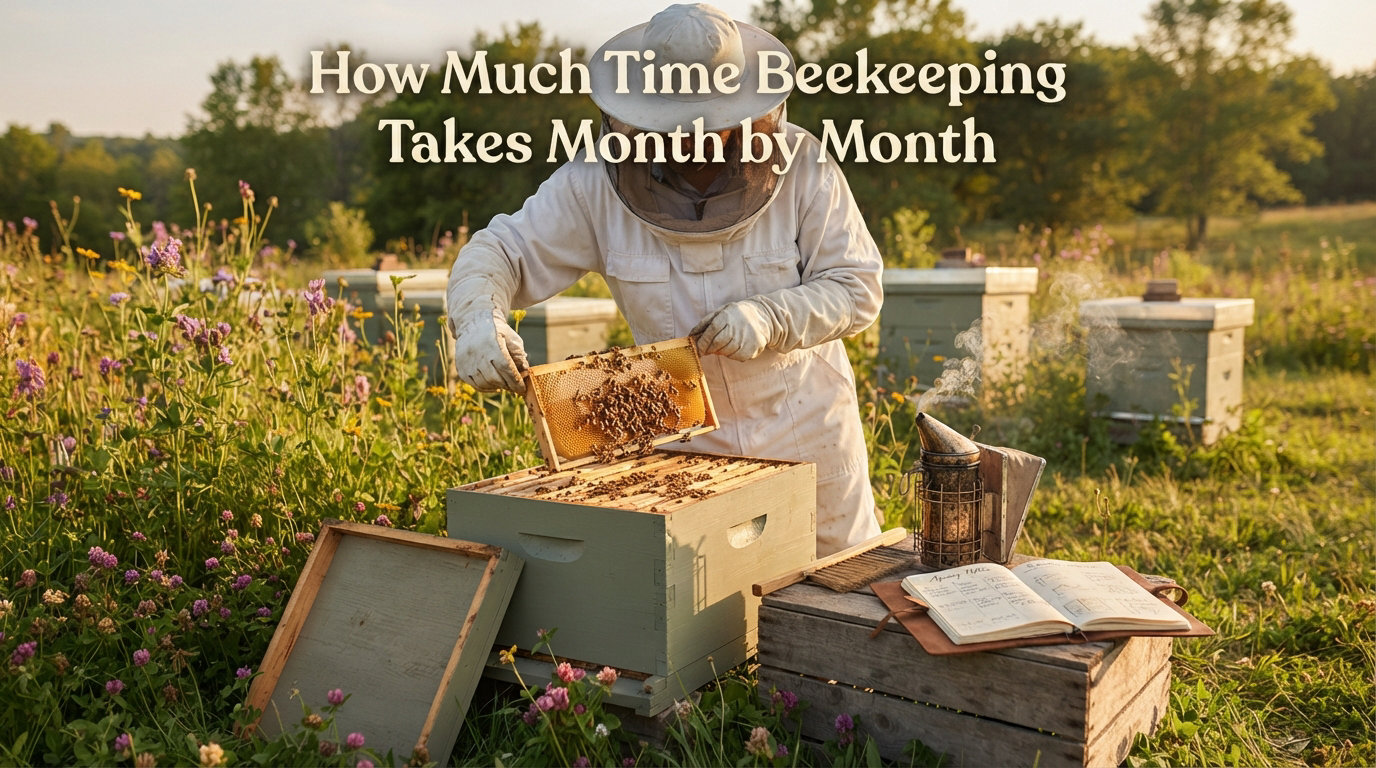
When I got my first beehive five years ago, I thought I’d spend maybe an hour a week tending bees. I was wrong. My first spring ended up eating nearly 60 hours of my time between inspections, swarm prevention, and equipment repairs I hadn’t planned for. That’s the honest answer to how much time beekeeping takes month by month: it depends heavily on the season, your experience level, and where you live.
Over five seasons working 2 to 8 hives in three different climate zones, I tracked every hive visit. I compared my logs with beekeepers in our local club, scoured Reddit threads, and pulled time estimates from university extension services. This guide gives you the real numbers.
Here’s the short version: expect 15 to 30 hours annually per hive for routine care, plus 40 to 60 hours in your first year for setup and learning. Peak season (April through August) demands 1 to 2 hours weekly per hive. Winter is mostly hands-off. Let’s break it down month by month so you can plan your year.
Table of Contents
How Much Time Does Beekeeping Take Per Year?
Most sources put routine annual beekeeping time at 15 to 30 hours per hive, but that’s the routine-care number after your first year. Your first-year beekeeping time commitment will run higher because of equipment setup, learning curve, and unexpected surprises.
Here’s the breakdown I use when people ask me how many hours a year beekeeping takes:
- Routine annual care (per hive): 15 to 30 hours
- First-year total (per hive): 40 to 60 hours
- Harvest time (per hive, late summer): 2 to 4 hours per session
- Winter (per hive): Less than 2 hours total for the entire season
- Peak season (May to August, per hive): 1 to 2 hours weekly
For two hives, expect up to two hours each week from May through August, then a few hours per month the rest of the year. That pattern comes directly from experienced keepers on Reddit’s r/Beekeeping and matches my own logs. Each additional hive adds roughly 10 to 15 hours annually once you’ve built efficiency.
Beekeeping Time Commitment by Season
The seasons tell the story better than a flat annual number, because beekeeping time isn’t distributed evenly across the year. Spring and summer dominate. Fall tapers off. Winter is mostly quiet.
| Season | Hours per Hive | Common Tasks | Frequency |
|---|---|---|---|
| Winter (Dec-Feb) | 1 to 3 hours | Occasional checks, ordering, repairs | Monthly or less |
| Spring (Mar-May) | 10 to 15 hours | Inspections, feeding, swarm control | Every 7 to 10 days |
| Summer (Jun-Aug) | 12 to 18 hours | Supers, pest checks, harvesting | Every 7 to 14 days |
| Fall (Sep-Nov) | 6 to 10 hours | Final harvest, treatments, winter prep | Every 2 to 3 weeks |
These ranges assume a healthy colony in a temperate climate. Sick hives, aggressive swarming, or extreme weather will push you higher. We’ll cover climate adjustments later in this guide.
The 3-3-3 Rule for Beekeeping Time
If you’ve searched beekeeping forums, you’ve probably seen the 3-3-3 rule. It’s a beginner-friendly way to think about hive visits: plan on 3 visits per week during peak season, spending 3 minutes per visit at the entrance and 30 minutes for a full inspection. The “3 minutes at the entrance” is just observing flight activity, not opening the hive.
What the 3-3-3 rule actually means in practice: during peak swarm season (April through June in most temperate climates), you should peek at your hive entrance three times weekly and do a full inspection roughly once per week. The 30-minute full inspection drops to 10 to 15 minutes once you’re experienced.
January: Planning and Quiet Observation
January is the lightest month for beekeeping time commitment, typically less than 30 minutes for active hive work. Most of your January hours go toward planning, equipment repair, and ordering supplies for spring. I spend 2 to 3 hours total in January across all my hives.
Tasks for January:
- Order bees, woodenware, and treatments for spring (1 to 2 hours of research and ordering)
- Repair and paint old hive boxes (1 to 3 hours)
- Read beekeeping books or watch courses
- Avoid opening hives unless emergency feeding is needed
Cold-climate beekeepers may need to add emergency fondant or sugar boards if stores run low, which adds 30 to 60 minutes per feeding. I check hive weight by gently lifting the back of each hive monthly during winter. If it feels too light, I add food.
For new beekeepers, January is the prime month for online courses and reading. I spend 4 to 6 hours in January reading, watching lectures, and reviewing the previous year’s notes. That prep time pays off massively in spring when decisions come fast.
February: Late Winter Hive Checks
February beekeeping time commitment stays low, around 1 to 3 hours total, but this is the month when oxalic acid treatments happen for many beekeepers. Oxalic acid is applied when broodless, which is more reliably achieved in late winter than mid-winter in many regions.
What to do in February:
- Conduct a quick visual check on a calm, sunny day above 50°F (10°C)
- Apply oxalic acid treatment if you’re following that protocol (45 minutes for 2 to 4 hives)
- Continue winter feeding if needed
- Finish assembling new hive equipment for spring
I do a single February inspection at midday when the temperature climbs. I open the hive for less than 5 minutes, check that the cluster has food above it, and close it back up. Anything more than that stresses the bees and risks chilling brood.
February is also when package bee and nuc suppliers start taking reservations. Reserve early if you want a specific pickup date, which adds 30 minutes of online ordering but ensures you get bees when you want them.
March: Spring Awakening Begins
March is when beekeeping time commitment starts climbing. Expect 2 to 4 hours total across all hives, with the first real inspections of the year. Bees begin flying on warmer days, and queens start laying again.
Your first proper spring inspection should happen on a calm day above 55°F (13°C). I look for the queen (or at least eggs), check remaining honey stores, and look for signs of disease. That first inspection takes me 20 to 30 minutes per hive because I’m thorough, but it’s worth the time to establish a baseline.
March tasks:
- First full inspection of the year (20 to 30 minutes per hive)
- Clean bottom boards (10 minutes per hive)
- Begin pollen patty feeding if colonies are light
- Reverse brood boxes in two-deep-hive setups (15 minutes per hive)
In warmer climates, March is also swarm-prep month. Beekeepers in the southern US, southern Europe, and similar zones may see swarm cells as early as late March.
Begin spring feeding decisions in March. If your hive is light after winter (less than 30 pounds estimated stores), start 1:1 sugar syrup. Mix and feed takes 30 minutes per hive, including refill trips.
April: Rapid Growth and Swarm Watch
April marks the start of peak season for beekeeping time. Expect 4 to 6 hours total this month, with inspections every 7 to 10 days. Colonies are exploding with new brood, and the swarm risk ramps up sharply.
This is the month when the 7/10 rule becomes important: during spring buildup, inspect every 7 to 10 days. The rule exists because queen cells take 8 days to be capped, so inspecting less than every 7 days risks missing the swarm window. If you wait 14 days, you could lose half your bees to a tree.
April tasks include:
- Inspect every 7 to 10 days (20 minutes per hive per inspection)
- Add honey supers as needed (10 minutes per hive)
- Watch for swarm cells on bottom of frames
- Continue feeding if light
- Split strong colonies if desired
April is also when you might catch up on equipment building, painting, and foundation installation. I usually spend an extra 2 to 3 hours on equipment in April alongside inspections.
Look for drone production starting in April. Once you see capped drone brood, the colony is committed to reproduction mode, which means swarm prep is imminent. Adding a super at this point can prevent a swarm by giving the colony more room.
May: Peak Spring Management
May is the busiest month for most beekeepers. Expect 6 to 8 hours total in May, with weekly inspections mandatory. The peak nectar flow begins in many regions, and colonies are at maximum growth.
My May routine looks like this: full inspection every 7 days, which runs 20 to 30 minutes per hive. Add 10 minutes to record findings. That’s already 1.5 to 2 hours weekly for 2 to 3 hives.
May also brings swarm control decisions. If you find queen cells, you can perform an artificial swarm, do a split, or simply remove the cells if you have enough room. Each split takes 30 to 60 minutes once you know the steps.
May tasks:
- Weekly inspections (20 to 30 minutes per hive)
- Place queen excluders if using them
- Add honey supers ahead of the flow
- Make splits from strongest colonies
- Monitor for varroa mites if mite levels were high in fall
Make swarm prevention your default mindset in May. Walk the apiary in the afternoon and look for bearding at the entrance. Bearding isn’t a swarm, but it can be a precursor when it persists for hours.
June: Honey Flow and Hive Expansion
June keeps beekeeping time commitment high, around 5 to 7 hours for the month. The main nectar flow is on in many temperate regions, and bees are working hard. You may be able to stretch inspections to every 10 to 14 days once swarm risk drops.
The “swarm season” typically winds down by mid-June in most climates because the pressure that causes swarming (congestion plus abundant resources) reduces after the main spring buildup.
June tasks:
- Inspect every 10 to 14 days (15 to 25 minutes per hive)
- Add honey supers as bees fill existing ones
- Monitor honey flow and adjust super count
- Check for queen issues (drone-laying, missing queen)
- Begin varroa monitoring if not already started
In hot climates, June also means watching ventilation and providing water sources near the apiary. I keep a shallow water dish with floats within 20 feet of hives during summer heat.
If you’re in a region with a strong summer dearth (like the southern US mid-summer gap), consider a top feeder or entrance feeder ready for July feeding. Prepare equipment now to save time later.
July: Midsummer Hive Health Checks
July beekeeping time commitment runs 4 to 6 hours for the month. The pace slows compared to spring, but pest management ramps up. Varroa mite populations peak in late summer, and July is when I start alcohol wash or sugar shake tests.
A varroa alcohol wash test takes about 15 minutes per hive and gives you a mite count per 100 bees. This single test tells you whether treatment is needed before the August treatment window.
July tasks:
- Inspect every 14 days (15 to 20 minutes per hive)
- Conduct varroa monitoring (15 minutes per hive)
- Add supers if flow continues
- Ensure ventilation in hot weather
- Plan treatment strategy based on mite counts
Drone trapping (removing drone brood to reduce varroa reproduction) is another July option. Cutting drone comb takes 10 minutes per hive and meaningfully reduces mite load when done consistently.
Watch for robbing behavior in July. If you see bees fighting at the entrance or bees from other colonies trying to enter, reduce entrances and avoid spilling sugar syrup during inspections.
August: Harvest Preparation
August ramps back up to 5 to 7 hours as honey harvest begins in many regions. The main flow ends in temperate climates, and supers need to come off before treatments. This is also a key month for varroa treatment because winter bees are being raised.
If you treat in August, the winter bees you’ll raise in September and October develop without mite-feeding damage. That’s why timing matters: August treatment = stronger winter cluster.
August tasks:
- Harvest early honey (2 to 4 hours per harvest session)
- Begin varroa treatment if counts warrant it
- Inspect every 14 days
- Reduce entrances to help bees defend against robbing
- Begin thinking about fall feeding
Harvest time is the most physically demanding part of beekeeping. Pulling and extracting honey from 2 supers can take 3 to 4 hours start to finish, including cleanup.
Extracting equipment setup matters in August. Make sure your extractor, uncapping knife, strainers, and buckets are clean and ready. Setup takes 30 minutes but it saves hours of fumbling mid-harvest.
September: Fall Harvest and Treatment
September is the second-busiest month for many beekeepers, with 5 to 7 hours of work. Final honey harvest, varroa treatments, and fall feeding all overlap. This month determines whether your colonies make it through winter.
If I had to pick one month to never miss, it would be September. Decisions made in September decide the strength of winter bees, which decide whether the colony survives until spring.
September tasks:
- Final honey harvest (2 to 4 hours)
- Apply varroa treatment (formic acid, Apiguard, or oxalic acid based on temperature)
- Begin 2:1 sugar syrup feeding if hives are light
- Inspect every 2 to 3 weeks
- Check mite levels post-treatment
Treatment application varies by product. Formic acid pads go on in 10 minutes per hive. Apiguard takes two applications 14 days apart. Oxalic acid vaporization takes 15 to 20 minutes per hive including prep.
Choose your treatment based on temperature. Formic acid works in 50 to 85°F. Apiguard works in 60 to 105°F. Oxalic acid works any temperature when broodless. Matching treatment to your September temperatures improves efficacy and reduces wasted effort.
October: Winter Preparation
October beekeeping time commitment drops to 3 to 5 hours as the active season winds down. The goal is making sure each hive has enough stores, low mite count, and protection from the elements.
A common rule of thumb: a colony needs 60 to 80 pounds of honey to survive winter in cold climates. Lifting the back of the hive is a rough gauge. If it feels like lifting a medium-full of water, you’re probably fine. If it feels light, keep feeding.
October tasks:
- Final inspections to confirm queenright status
- Continue fall feeding until bees stop taking syrup
- Install entrance reducers
- Add mouse guards
- Check hive weight and feed if light
Mouse guards go on once nights drop below freezing. I install them in mid to late October in my zone 6 climate, which prevents mice from moving into warm hives.
Insulation decisions happen in October. Some beekeepers wrap hives with tar paper or foam board. Others rely on natural wind protection and ventilated tops. Wrapping takes 15 minutes per hive if you choose to do it.
November: Winter Settling In
November is a quiet month with 1 to 3 hours of beekeeping time commitment. The bees are clustering, the weather is cooling, and your role shifts from active management to light monitoring.
I do one final check in November to confirm entrance reducers and mouse guards are in place, top off any feeders, and walk away. The hive is on its own through the cold months.
November tasks:
- Confirm mouse guards and entrance reducers are set
- Final feeding if weather permits
- Wrap hives with insulation in very cold climates (15 minutes per hive)
- Store equipment and clean extracting gear
- Begin reading and planning for next year
Use November for equipment cleaning and storage. Scrape propolis, wash frames in weak bleach solution, and stack supers with moth crystals if needed. Cleaning takes 1 to 2 hours per 10 frames, but it extends the life of your equipment by years.
December: Quiet Winter Months
December is the slowest month for beekeeping, often less than 1 hour of actual hive work. Bees are in winter cluster, generating heat by vibrating their flight muscles, and disturbing them risks breaking that cluster.
Most of my December “beekeeping time” is reading, planning, and cleaning equipment. The bees themselves need almost nothing from me.
December tasks:
- Avoid opening hives unless absolutely necessary
- Listen for the cluster by placing an ear against the side (optional)
- Check for snow blocking entrances after storms
- Order next year’s bees and supplies
- Catch up on beekeeping books, podcasts, and courses
If you hear no buzzing when you put your ear to the hive on a cold day, the cluster may have died. That’s the one December check that actually requires you to do something, though there’s nothing to do if they’re gone.
Some beekeepers do an oxalic acid “winter trickle” treatment in December during a broodless period. This 30-to-60 minute session across all hives can knock down remaining phoretic mites significantly.
Beginner vs Experienced Beekeeper Time Differences
The biggest factor in how much time beekeeping takes is whether you’re in your first year or your fifth. Beginners consistently take 1.5x to 2x longer per inspection because they’re still learning what to look for, where to find the queen, and how to move calmly around the hive.
Here’s how the time breaks down:
| Task | Beginner (Year 1) | Experienced (Year 3+) |
|---|---|---|
| Single hive inspection | 25 to 40 minutes | 10 to 20 minutes |
| Adding honey super | 20 to 30 minutes | 5 to 10 minutes |
| Varroa alcohol wash | 25 to 30 minutes | 10 to 15 minutes |
| Making a split | 60 to 90 minutes | 30 to 45 minutes |
| Honey harvest (per hive) | 3 to 4 hours | 2 to 3 hours |
| Annual total (per hive) | 40 to 60 hours | 15 to 30 hours |
The gap closes fast. By year three, most beekeepers have built muscle memory and pattern recognition that cuts inspection time in half. By year five, you’re spotting queen cells before you even lift the frame out.
Beginners also spend more time on:
- Equipment assembly and painting (10 to 15 hours first year)
- Reading, watching courses, and asking questions (5 to 10 hours)
- Recovering from mistakes (treatments, requeening, lost swarms)
If you’re a beginner, plan your first year for 50 to 70 hours per hive. If you’re experienced, 20 to 35 hours per hive is realistic.
The single biggest time-saver for beginners is finding a mentor. A 15-minute phone call with someone who’s kept bees for 5 years can save you 5 hours of trial and error. Most local bee clubs offer mentorship programs for free.
Climate Zone Adjustments for Beekeeping Time
Your local climate shifts every monthly task by 2 to 8 weeks. A beekeeper in Florida is managing swarm season while a Minnesota beekeeper is still doing winter checks. This affects both what you do each month and how much time you spend.
Cold Climates (USDA Zones 3 to 5, Northern US, Canada, Northern Europe)
Cold climate beekeeping compresses the active season into roughly 5 months (May through September). Peak time commitment happens June and July when bees and beekeepers race against winter. Winter prep takes longer because you need extra insulation and feed. Expect 30% more fall prep time compared to temperate zones.
Temperate Climates (USDA Zones 6 to 7, Most of US, UK, Central Europe)
Temperate climates have the classic 7-month active season (April through October). Most published calendars assume temperate conditions. Expect the median time commitments in this article if you’re in a temperate zone.
Warm Climates (USDA Zones 8 to 10, Southern US, Mediterranean, Australia)
Warm climate beekeeping starts earlier, ends later, and rarely has a true dormant period. Expect to inspect 10 to 11 months per year, with shorter winter breaks. Bees forage year-round in many warm zones, which means year-round swarm risk and continuous varroa reproduction.
Tropical Climates (Equatorial Regions)
Tropical beekeeping follows wet and dry seasons rather than temperature. Year-round inspections are typical, and time commitment stays consistent across all 12 months. Pest pressure is higher, which can double treatment time.
The key takeaway: if you’re reading a calendar written for zone 6 and you’re in zone 9, shift everything 6 to 8 weeks earlier in spring and 4 to 6 weeks later in fall.
Microclimate matters too. A sheltered urban beekeeper in Boston might be 2 weeks ahead of an exposed rural beekeeper in the same USDA zone. Pay attention to your specific bees, not just your zip code.
How Time Scales With Multiple Hives
Adding hives doesn’t add time in a perfectly linear way. The first hive is the slowest. The second hive teaches you efficiency. By the time you have 4 to 6 hives, your per-hive time drops because batch operations (treating all hives at once, harvesting on the same day) become possible.
Realistic time estimates by hive count:
- 1 hive: 15 to 30 hours annually (40 to 60 first year)
- 2 hives: 25 to 45 hours annually
- 3 to 4 hives: 40 to 70 hours annually
- 5 to 6 hives: 60 to 90 hours annually
- 7 to 10 hives: 100 to 150 hours annually
The marginal cost of each additional hive drops as your skills improve. A new beekeeper adding a third hive will spend nearly twice as much time as a veteran adding their tenth hive.
Most beekeepers I know cap out at 4 to 8 hives because of time constraints. Beekeeping is fun, but a full-time job, family, and 10 demanding hives becomes a strain. The two-hive setup is a sweet spot for beginners because you can compare colonies and learn faster.
Watch for warning signs of overcommitment: skipping inspections, dreading hive work, or letting equipment sit dirty. These are signals you’ve expanded beyond sustainable time.
Balancing Beekeeping with Full-Time Work
Yes, you can keep bees with a full-time job. Most beekeepers do. The trick is scheduling inspections during weekend mornings or after work, and choosing hive count that fits your available time.
For working professionals, here’s what works:
- Keep 2 hives maximum your first year
- Block weekend mornings for inspections during April through August
- Use entrance observation (3-minute peeks) on weekday evenings
- Schedule major tasks (harvesting, splits, treatments) for days off
If you travel for work, having a backup beekeeper who can do emergency checks is essential. Two weeks without attention is usually fine in summer, but a swarm, queen failure, or robbing event can collapse a hive in days.
Time-Saving Tips That Actually Work
After five years of keeping bees around a full-time job, I’ve learned which shortcuts save real time and which ones cost more later. These are the ones I recommend.
Tip 1: Build a hive tool kit you can grab and go. I keep a small bucket with smoker, hive tool, brush, frame grip, and a notebook. When it’s inspection day, everything is in one place. This saves 10 to 15 minutes per visit versus hunting for gear.
Tip 2: Smoke from the back. Lighting your smoker and approaching from behind the hive, rather than the front, means guard bees don’t immediately engage. You’ll use less smoke and get through the inspection faster.
Tip 3: Inspect during peak foraging hours (10 AM to 2 PM in summer). Most older bees are out foraging, leaving younger nurse bees in the hive. The colony is calmer and your inspection goes faster.
Tip 4: Combine batch operations. When you have multiple hives, do all varroa tests in one session, all feeding in another, and all supers in a third. Setup and cleanup take the same time whether you have one hive or four.
Tip 5: Use a hive stand at waist height. Bending over to inspect ground-level hives adds real fatigue time. Raising hives 24 to 30 inches cuts inspection time and saves your back.
Tip 6: Keep records immediately. Jot findings on a single notecard per hive right after inspection. Three minutes of writing saves hours of guessing later when you’re trying to remember what you saw three weeks ago.
Tip 7: Pre-stage equipment. Have empty supers, frames, and treatments ready before you open the hive. Scrambling mid-inspection to find a queen excluder costs you 10 minutes and breaks the flow.
Common Time-Management Mistakes
Some mistakes don’t just waste time, they create work. These are the time-sinks I see new beekeepers fall into most often.
Mistake 1: Inspecting too often. Yes, it’s possible to over-inspect. Opening the hive every 3 days resets their temperature regulation, stresses the queen, and slows brood production. Stick to the 7 to 10 day rhythm except during active swarm prevention.
Mistake 2: Searching too long for the queen. Beginners often spend 20 minutes hunting for the queen in a frame-by-frame search. Instead, look for eggs. Fresh eggs mean the queen was alive in the last 3 days. That’s good enough for most inspections.
Mistake 3: Treating when you don’t have to. Some beekeepers treat for varroa on a fixed schedule regardless of mite count. Test first, then decide. Skipping unnecessary treatments saves 30 to 60 minutes per hive annually and reduces chemical exposure for the bees.
Mistake 4: Building your own equipment from raw lumber in year one. Building hive bodies from scratch adds 20 to 30 hours that could go toward learning bees. Buy pre-made equipment your first year. Build boxes in year three when you know what you actually need.
Mistake 5: Starting with too many hives. Three, four, or five hives in year one sounds ambitious, but it triples your inspection time before you’ve even learned to read a frame. Two hives in year one, three in year two, scale from there.
Mistake 6: Skipping record-keeping. Five minutes of note-taking per inspection becomes five hours of confused decision-making later when you can’t remember whether you treated that hive in August.
Mistake 7: Fighting the calendar. Trying to manage a zone 6 calendar in zone 9 means you’re always behind. Adjust the timing to your climate rather than fighting it.
Frequently Asked Questions
What is the 3 3 3 rule for beekeeping?
The 3-3-3 rule is a beginner-friendly scheduling guideline: during peak season, visit your hive 3 times per week, spending 3 minutes at the entrance observing flight activity, plus one 30-minute full inspection weekly. The entrance checks let you spot problems like robbing or queen issues without disturbing the colony.
How many hours per month does it take to keep bees?
Average monthly time ranges from less than 30 minutes in winter (December through February) to 6 to 8 hours in peak season (May). For one hive across a full year, expect an average of 1.5 to 2.5 hours per month, with peak months being March through August and slack months being November through February.
What is the 7/10 rule in beekeeping?
The 7/10 rule means inspecting your hive every 7 to 10 days during spring buildup (typically March through June). This interval exists because queen cells are capped at 8 days. Inspecting less frequently than every 7 days risks missing the swarm window and losing bees to swarming.
Will I get honey my first year beekeeping?
Maybe. First-year beekeepers often get little or no harvestable honey because the colony needs its first-year production to build winter stores. In strong nectar flow regions with package bees installed in early spring, you might harvest 20 to 40 pounds. Most first-year keepers should expect zero harvest and focus on colony health instead.
How many beehives should a beginner start with?
Most experienced beekeepers recommend 2 hives for beginners. One hive is risky because if it fails, you have no resources to recover. Two hives let you compare colonies, share resources if one struggles, and learn faster. More than 2 hives in year one is too time-consuming for most beginners.
How often should I inspect my beehive?
During active season (spring through fall), inspect every 7 to 14 days depending on swarm risk and flow conditions. Inspect weekly during peak swarm season (April through June in temperate climates). Inspect monthly or less during winter, and only briefly to check food stores.
Is beekeeping time consuming for a hobby?
Compared to most hobbies, beekeeping requires more active time but in concentrated bursts. Peak season demands 1 to 2 hours weekly, while winter needs almost nothing. Compared to golf, gardening, or home brewing, beekeeping is moderate in time commitment but high in consequence if you neglect it during critical weeks.
What happens if I miss a hive inspection?
Missing one weekly inspection during spring is usually fine. Missing two in a row during swarm season risks losing 30 to 60% of bees to swarming. Missing inspections during fall treatments can mean winter mite damage and colony death. The 7/10 day rhythm exists for a reason.
Your Year-Round Beekeeping Time Plan
Here’s the bottom line on how much time beekeeping takes month by month: budget 15 to 30 hours annually per hive after your first year, with peak demand in April through August. First-year beekeepers should plan for 40 to 60 hours per hive to absorb the learning curve. Winter is your friend – the bees do most of the work themselves when it’s cold.
If you’re considering starting, the best time to begin is winter. Use those quiet months to read, order equipment, and find a mentor. By spring, you’ll be ready. And if you’re already keeping bees and feeling stretched thin, scaling back to 2 hives is a perfectly valid choice.
Beekeeping rewards consistency over intensity. Showing up every 7 to 10 days during peak season matters more than any single marathon session. Get the rhythm right, and 20 hours per year is genuinely enough to keep a thriving colony.