
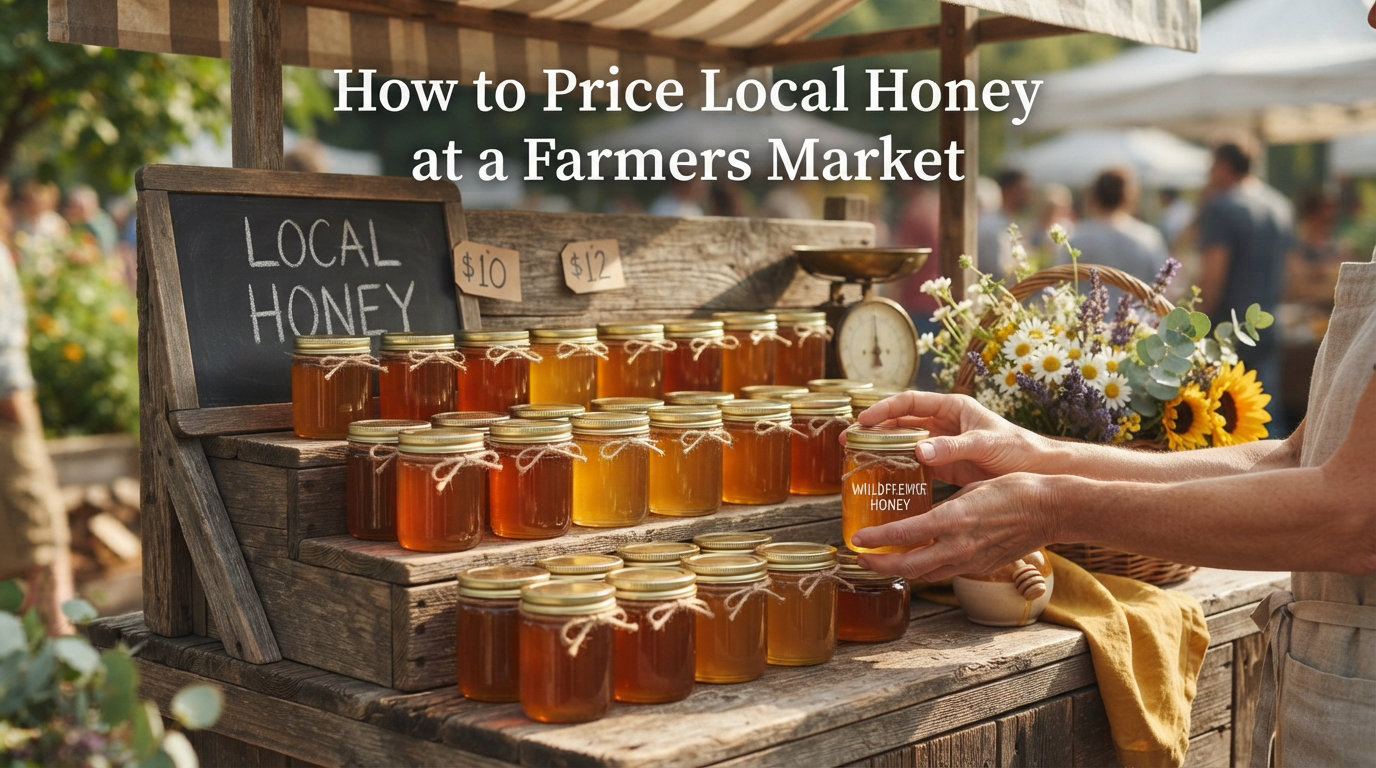
Pricing local honey at a farmers market comes down to three pillars: research what nearby vendors charge, calculate your true cost per jar, and apply a per-ounce pricing rule that covers expenses and rewards your time. Most small-batch raw honey in 2026 sells between $10 and $18 per pound, with specialty varietals like sourwood or tupelo reaching $20 to $25 per pound.
I pulled my first jar of honey out of the extractor in 2019 and stared at it for about ten minutes before I priced it. I had no idea what to charge. I almost gave it away for $8 a pound because I felt guilty charging more than the grocery store. That mistake cost me roughly $1,200 in the first season alone. Our team has helped dozens of new beekeepers skip that painful learning curve, and this guide walks you through the exact process we use with every new honey vendor.
Table of Contents
How to Price Local Honey at a Farmers Market
The most reliable framework for pricing local honey at a farmers market follows three steps. First, audit what other vendors in your area actually charge per ounce and per pound. Second, build a per-jar cost sheet that includes jars, lids, labels, market fees, and your time. Third, choose a pricing strategy (per-ounce, tiered, or specialty) that covers your costs and adds a 30 to 50 percent margin.
Skipping any one of these steps leads to the two most common problems I see in new honey sellers: pricing too low and burning out, or pricing too high without the story to back it up. The rest of this article breaks down each step in detail so you can set a confident price on your first market day.
Research What Other Vendors Charge in Your Market
Vendor research is the fastest way to find a realistic price range for your honey. Visit three to five farmers markets in your region before you ever set up a booth. Talk to other honey sellers, photograph their labels, and write down the price per ounce and per pound for every jar size they offer.
Pay attention to how they price specialty products. Sourwood, tupelo, orange blossom, and wildflower varietals usually sit at the top of a vendor’s price list. Generic wildflower and clover honey tends to anchor the lower end. I keep a small notebook for each market I scout and add the average price per ounce for each honey type I see.
Compare Your Local Grocery Store Baseline
Check the price of honey at two or three local grocery stores to anchor the lower bound of your pricing research. A 16-ounce jar of mass-produced clover honey typically sells for $5 to $8 at most supermarkets. Your raw, local honey will always cost more, and customers need to understand why.
The gap between grocery store honey and farmers market honey is your value proposition. If your raw local honey sells for $14 a pound and the store sells a comparable weight for $6, you are charging a 130 percent premium. That premium has to be earned with story, freshness, and quality. We will cover how to justify it later in this guide.
Calculate Your True Cost Per Jar of Honey
Cost calculation is the step most new vendors skip, and it is the one that determines whether your beekeeping hobby actually pays for itself. A real cost-per-jar number includes more than the jar itself. You also need to factor in labels, lids, market fees, equipment depreciation, and your time.
Direct Materials Per Jar
Start with the easy numbers. A standard 16-ounce glass jar with a lid costs between $0.65 and $1.20 when bought in cases of 24 or more. A printed label runs $0.15 to $0.40 depending on whether you print at home or use a commercial printer. Shrink-wrap seals and tamper-evident bands add another $0.10 to $0.25 per jar.
For a one-pound jar, your direct materials typically land between $1.00 and $1.85. Eight-ounce jars run $0.80 to $1.40 in materials. Three-ounce sampler jars cost $0.50 to $0.90. These are the numbers you write down first because they are easy to verify and they do not change week to week.
Market Fees and Vendor Table Costs
Farmers market fees vary more than almost any other cost. Some markets charge $20 per Saturday for a single table. Premium markets in major metro areas can run $50 to $75 per day, and a few exclusive markets in cities like San Francisco and New York charge $750 or more for a seasonal booth. One seller on Reddit reported paying $750 just to attend a high-end market, which forced them to price honey at the top end of the regional range to break even.
Divide your seasonal or annual market fees by the number of jars you expect to sell. If you pay $40 per Saturday and sell 30 jars that day, your per-jar market fee is about $1.33. That number gets added to your materials cost before you set your final price.
Time and Labor Amortization
Your time is a real cost, and treating it as free is the fastest path to burnout. Beekeeping forums are full of sellers who quit after two seasons because they earned less than minimum wage once labor was factored in. A good rule of thumb is to value your beekeeping time at $20 to $30 per hour when calculating cost.
Track the hours you spend extracting, bottling, labeling, transporting, and selling each batch. If you process 200 pounds of honey over 12 hours of work, that is 1,440 to 2,160 dollars in labor cost. Spread across 200 jars, that adds $7.20 to $10.80 per jar. Add this number last, after materials and market fees, so you can see exactly what your time is worth per unit.
Hidden Costs Most Vendors Forget
Fuel for driving to outyards and markets, electricity for the extractor and dehumidifier, foundation, frames, queens, sugar for feeding, mite treatments, and liability insurance all eat into your margin. Equipment like extractors and bottling tanks depreciate over five to ten years and should be amortized across the lifetime jars you expect to produce from them.
A beginner setup with extractor, tanks, and uncapping tools often runs $1,500 to $3,500. If you plan to bottle 2,000 jars over the life of that equipment, the depreciation cost is $0.75 to $1.75 per jar. Skipping these hidden costs is one of the top reasons first-year vendors believe they are profitable when they are not.
Pricing Strategies That Work for Small Beekeepers
Once you know your cost per jar, you can choose a pricing strategy that fits your market. The three approaches that work best for small-scale honey vendors are per-ounce pricing, tiered pricing by jar size, and specialty premiums for varietals. Each strategy has strengths depending on your customer base and honey type.
The Per-Ounce Pricing Rule
Many experienced beekeepers use a simple per-ounce benchmark: charge $1.00 to $1.25 per ounce for raw local honey. At that rate, a one-pound (16-ounce) jar sells for $16 to $20. An eight-ounce jar sells for $8 to $10. A three-ounce sampler sells for $3 to $3.75. This rule scales cleanly across jar sizes and is easy to explain to customers who want to compare prices.
If your calculated cost per jar is higher than $0.75 per ounce, the per-ounce rule will keep you profitable. If your costs are lower, you can drop toward $0.85 per ounce and still make money. The key is to set the per-ounce rate first, then check that the resulting jar price covers materials, fees, labor, and a healthy margin.
Tiered Pricing by Jar Size
Tiered pricing rewards customers who buy larger jars while protecting your margin on small sizes. A common tier structure looks like this: 3-ounce sampler at $1.25 per ounce, 8-ounce jar at $1.15 per ounce, 16-ounce jar at $1.05 per ounce, and 32-ounce jar at $0.95 per ounce. The per-ounce rate drops as the size grows, but total revenue per jar stays strong.
This setup nudges customers toward the mid-size and large jars where your margin is highest, while still offering an affordable entry point with the small sampler. Sampler jars also work as loss leaders that bring customers back for larger sizes on their next visit.
Specialty Varietal Premiums
Single-source honeys like sourwood, tupelo, orange blossom, and blackberry command real premiums because supply is limited and flavor is distinct. Sourwood honey from the Appalachian region often sells for $20 to $25 per pound. Tupelo honey from the Southeast regularly clears $22 per pound. Orange blossom from Florida and California can hit $15 to $18 per pound.
If your bees have access to a strong monofloral source, label it clearly and price it 25 to 50 percent higher than your wildflower baseline. Customers seeking out a specific varietal are already prepared to pay more, and the story behind a single-source honey is part of what they are buying.
Comb Honey and Creamed Honey
Comb honey is sold by weight in cut squares or round sections and typically fetches $3 to $5 per ounce because of the labor involved in cutting and packaging. Creamed honey, also called spun or whipped honey, sells for roughly the same per-ounce rate as liquid honey but can justify a 10 to 20 percent premium when sold in gift-sized jars or holiday packaging.
Both formats give customers a reason to buy from you instead of a generic grocery brand. They also widen your shelf at the market without competing directly with your liquid honey jars.
Factors That Influence How Much Honey Sells For
Three main factors drive the price customers will pay for your honey at a farmers market. Floral source and varietal distinction come first, processing method comes second, and the local story behind your apiary comes third. Vendors who lean into all three can charge significantly more than vendors who only emphasize one.
Floral Source and Varietal Distinction
Wildflower honey from diverse pasture and hedgerow blooms is your baseline. As soon as you can identify a dominant single source (clover, alfalfa, orange blossom, sourwood, tupelo, buckwheat), you can move into varietal pricing. Varietal distinction also gives you something to teach customers about, which builds loyalty beyond the transaction.
Raw, Unfiltered, and Minimally Processed
Raw honey that has not been heated above 115 degrees Fahrenheit retains more pollen, enzymes, and flavor compounds. Customers who buy local honey for allergy relief or health reasons specifically look for the words raw and unfiltered on the label. Charging 10 to 20 percent more for raw honey compared to filtered honey is standard practice and easy to defend.
Local Reputation and Story
The story of your apiary matters more than most new vendors expect. Customers at farmers markets are buying a relationship with you as much as they are buying the honey. Share where your hives are located, how many bees are in each colony, and what your bees forage on. Vendors who tell a good story consistently sell out before vendors who just put a jar on a table.
Wholesale vs Retail vs Direct-to-Consumer Pricing
Your pricing changes based on where you sell. Farmers market retail is the highest-margin channel for small beekeepers. Wholesale to stores, restaurants, and bakeries runs at 40 to 60 percent of retail. Direct-to-consumer online sales sit somewhere in between, depending on shipping costs and platform fees.
Farmers Market Retail Markup
At farmers markets, you are selling directly to the end consumer with no middleman. That allows you to keep the full retail markup, which is why most small beekeepers prefer this channel. Plan for a 50 to 100 percent markup over your cost per jar, depending on the per-ounce pricing rule you choose.
Wholesale Pricing to Stores and Restaurants
Wholesale buyers expect volume discounts. A typical wholesale price is 50 to 60 percent of your retail price. If your retail jar sells for $16, the wholesale price is $8 to $10 per jar. Wholesale only makes sense if you have surplus inventory that retail channels cannot absorb, because the per-unit profit is much lower.
Direct-to-Consumer Online and Farm Stand Sales
Online sales through your own website or platforms like Etsy add shipping costs that often run $6 to $12 per order. Build shipping into your product price or charge it separately. Farm stand sales at your home apiary work much like farmers market sales but skip the booth fee. Many beekeepers use farm stands as a low-cost supplement to their market schedule.
Regional Price Differences Across US Farmers Markets
Honey prices vary by region because forage conditions, customer expectations, and local economies all differ. Reddit threads in r/Beekeeping consistently show farmers market prices ranging from $8 to $23 per pound depending on where you sell. Knowing your regional baseline helps you price with confidence.
Northeast and Midwest Baseline Pricing
Northeast markets in states like New Hampshire, Vermont, and upstate New York typically price raw local honey between $10 and $14 per pound. Midwest markets in Ohio, Indiana, and Iowa run $9 to $13 per pound. These regions have strong local-food cultures and customers who appreciate raw honey, but the cost of living and average market spend are moderate.
Southeast Premium Pricing for Varietals
Georgia, the Carolinas, and Florida have access to high-demand varietals like tupelo, sourwood, and orange blossom. Wildflower honey in the Southeast typically sells for $12 to $16 per pound, while specialty varietals regularly exceed $20 per pound. Georgia sellers in particular report some of the highest farmers market prices in the country.
West Coast and California Pricing
California, Oregon, and Washington markets see prices from $14 to $20 per pound for wildflower honey, with some urban markets in San Francisco and Los Angeles pushing $22 to $25 per pound. Premium markets in these metros charge high vendor fees, so sellers need higher per-jar prices to cover booth costs and still profit.
Common Pricing Mistakes First-Time Vendors Make
Most first-time honey vendors make the same handful of pricing mistakes. Recognizing them ahead of time saves you from a season of selling honey at a loss. These are the issues I see most often when new beekeepers come to me confused about why their profit margins are gone.
Underpricing to Be the Cheapest Vendor
Competing on price is the fastest way to lose money as a small honey producer. You cannot beat imported honey on price, and you should not try. Customers at farmers markets are not looking for the cheapest option. They are looking for quality, freshness, and a real person behind the jar. Price your honey to reflect its actual value.
Ignoring the Value of Your Time
Many beekeepers forget to include their labor in the cost calculation. They count jars and labels but not the hours spent extracting, bottling, transporting, and selling. Once time is included, some vendors realize they are earning less than minimum hourly wage. Always add your labor at $20 to $30 per hour before you set your price.
Not Adjusting Prices After Costs Rise
Jar costs go up. Fuel costs go up. Market fees go up. If you set your price in your first season and never revisit it, your margin shrinks every year. Plan to review your cost sheet every January and adjust your per-ounce pricing to match. Most successful vendors raise prices 5 to 10 percent each year without losing customers.
Pricing Without Visiting Other Markets First
Setting a price before you have scouted three to five local markets is a guess, not a strategy. Without market research, you either underprice or overprice relative to your peers. Spend a few Saturdays at neighboring markets before your first sale so your price has real data behind it.
Certifications and Labels That Justify Premium Pricing
Certifications and label claims can support a higher price, but they are not all equal. Some certifications cost real money and require audits, while others are simple label statements that you can make as long as they are accurate. Choose the ones that match your operation and your customer base.
Organic Certification Considerations
USDA Organic certification for honey is possible but expensive. The certification process involves annual inspections, detailed bee forage documentation, and a three-year transition period for any treated hives. Most small beekeepers do not pursue organic certification because the cost outweighs the premium. If you do certify, expect to charge 30 to 50 percent more than uncertified honey.
State-Inspected and Cottage Food Compliance
Many states run honey-specific inspection programs or allow honey sales under cottage food laws. A state-inspected kitchen or approved cottage food registration adds credibility and lets you sell through a wider range of channels. The label claim itself is a marketing tool that some customers look for, and it justifies a small price bump.
Local Raw and Unfiltered Claims
The terms local, raw, and unfiltered are simple label claims that do not require third-party certification. As long as your honey is produced within a reasonable distance of your market, has not been heated above 115 degrees, and has not been force-filtered, you can use these words on your label. They add value in the customer’s mind and are free to implement.
Frequently Asked Questions About Pricing Local Honey
How much should I sell my raw honey for?
Most raw local honey at farmers markets in 2026 sells for $1.00 to $1.25 per ounce. That works out to $10 to $18 per pound for a standard 16-ounce jar. Specialty varietals like sourwood or tupelo can reach $20 to $25 per pound.
How much does 1 lb of honey sell for at a farmers market?
A one-pound jar of local raw honey typically sells for $10 to $18 at US farmers markets. Northeast and Midwest markets tend toward the lower end, while Southeast varietals and West Coast urban markets tend toward the higher end.
What is the 7/10 rule in beekeeping?
The 7/10 rule is a guideline that says a healthy bee colony needs at least 7 pounds of honey stores to survive the winter for every 10 frames of brood. It is a colony management rule, not a pricing rule, but it affects how much honey you can harvest and sell each year.
How do I calculate a fair price for my honey?
Add up your per-jar materials cost (jars, lids, labels), divide your market fees by expected jars sold, add your labor at $20 to $30 per hour, and include a share of equipment depreciation. Multiply your total cost by 1.5 to 2.0 to set a retail price that includes a healthy profit margin.
Why is local honey more expensive than store honey?
Local honey costs more because small-batch beekeeping has higher labor costs, smaller economies of scale, and stricter quality standards than industrial honey production. Customers also pay a premium for traceability, raw processing, and the local story behind the jar.
Final Thoughts on Pricing Local Honey at a Farmers Market
Learning how to price local honey at a farmers market comes down to research, honest cost accounting, and the confidence to charge what your work is actually worth. Start by scouting three to five local markets, build a per-jar cost sheet that includes materials, fees, labor, and depreciation, then choose a per-ounce rate between $1.00 and $1.25 for raw local honey.
Adjust your price for varietal distinction, raw processing, and the story behind your apiary. Review your numbers every January so your margin keeps up with rising costs. The beekeepers who last more than five seasons are the ones who price their honey to cover real costs and reward their time. Use the framework in this guide, and you will start your first market season with a price you can defend and a margin you can grow.