
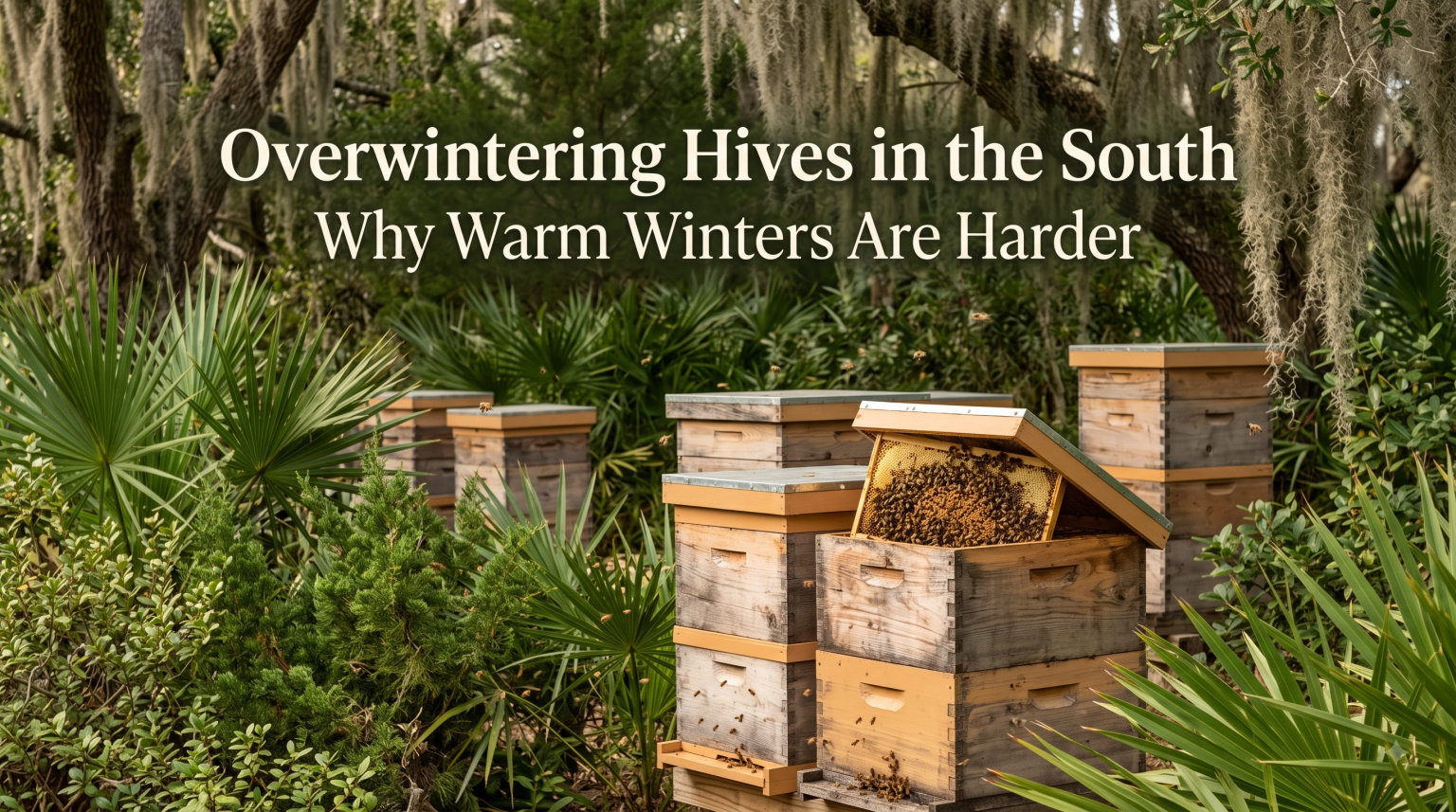
Most beekeepers picture a deadly winter the way northerners do: deep freezes, snowdrifts, and hives wrapped like mummies against the cold. But talk to keepers in Texas, Florida, Georgia, or along the Gulf Coast, and you hear a different story. Down south, the winters that wipe out colonies are often the warm ones.
It sounds backwards. A mild winter should mean easier survival, more flying days, and less stress on the cluster. The reality is the opposite. Warm southern winters create a cascade of problems that cold-climate bees rarely face: chronic moisture inside the hive, broken clusters, runaway brood rearing, and honey stores that vanish before the first nectar flow.
National winter losses averaged between 24 and 32 percent in recent Bee Informed Partnership surveys, and beekeepers in southern states regularly report losses that match or exceed northern numbers. The reasons have almost nothing to do with cold. This guide explains why overwintering hives in the south during warm winters is harder than cold-climate overwintering, and what southern beekeepers can do about it in 2026.
Table of Contents
How Honey Bees Naturally Overwinter
To understand why warm winters cause trouble, you first need to know what bees are supposed to do when temperatures drop. Honey bees do not hibernate. They form a tight cluster inside the hive and shiver their flight muscles to generate heat.
The cluster starts to form when outside temperatures fall below 65°F. As it gets colder, the cluster tightens. By the time temperatures hit 55°F, bees are packed tightly together. Below 45°F, a weak or small cluster can no longer maintain core temperature, and bees on the outside may freeze.
Inside the cluster, bees keep the core near 95°F all winter long. The queen stays in the warm center while outer bees insulate the group. Clustered bees move slowly upward through the hive, consuming honey as they go, and they only break cluster when temperatures rise enough to allow movement between frames.
This system evolved for cold, stable winters. Bees enter a form of reproductive diapause, slow their metabolism, and rely on fat bodies stored in their abdomens. The colony essentially waits for spring, burning honey at a slow, predictable rate. Warm winters disrupt that delicate balance.
Overwintering Hives in the South: Why Warm Winters Are Harder
Warm winters are harder on honey bee colonies because they prevent bees from settling into the tight, low-metabolism cluster they evolved to maintain through winter. When daytime temperatures repeatedly climb above 65°F, the cluster loosens, bees fly, brood rearing accelerates, and honey consumption spikes well beyond what the colony stored.
Southern winters rarely deliver the sustained cold that keeps a cluster calm and dormant. Instead, beekeepers see stretches of 70°F days followed by sudden arctic fronts that drop temperatures 30 to 40 degrees overnight. Each swing forces the colony to re-form the cluster, burn extra honey, and try to protect brood that should not exist in January.
The result is a colony that never truly rests. Instead of slowly drawing down honey reserves across a stable cold season, southern colonies stay active, fly on sunny afternoons, raise brood prematurely, and hit late winter with empty pantries just when natural forage is scarcest. Beekeepers who assume a mild winter means a thriving hive often discover the opposite in February.
The Real Killer Is Moisture, Not Cold
Ask experienced southern beekeepers what kills their winter colonies, and the answer is rarely cold. The answer is moisture. Inside a winter hive, bees respire constantly. Warm, humid air rises from the cluster and hits the cold inner cover or top boards. That air condenses into water droplets, which then drip back down onto the clustered bees.
In a cold, dry northern winter, beekeepers can control condensation with insulation and a quilt box, and the relative humidity stays manageable. In the humid South, ambient humidity already sits near 70 to 90 percent for much of the winter. Add a colony generating moisture, and the hive interior can become a wet cave where bees literally chill and rot.
Wet bees cannot maintain cluster temperature. A single cold drop of condensation hitting the cluster can kill dozens of bees in minutes. Over weeks, chronic dampness breeds mold on comb, encourages chalkbrood, and weakens the colony’s immune defense against nosema and viruses.
Forum beekeepers in Texas and Florida report losing more colonies to condensation on the inner cover than to any single freeze event. The standard advice on Beesource and in the EcoBased Sustainable Beekeeping group is blunt: insulate the top of the hive, not the sides, because moisture, not cold, is the real winter killer.
A few low-cost fixes go a long way. Tilt the hive forward just a few degrees so condensation runs out the entrance instead of pooling on the bottom board. Add a moisture quilt box or a shim filled with dry shavings above the inner cover. Provide a small upper entrance so humid air can escape. These steps matter far more than wrapping the hive in foam.
Temperature Swings Break the Cluster
Southern winters are not defined by their averages. They are defined by their swings. A week of 75°F afternoons can flip into a 20°F overnight freeze with no warning. Each swing stresses the colony in ways cold-climate bees never experience.
When temperatures climb above 65°F during the day, bees break cluster, fly, and often raise small patches of brood. When the cold front arrives that night, the colony must scramble back into a tight cluster fast enough to protect that new brood. Brood requires roughly 93 to 95°F to develop, and if the cluster cannot cover it, the brood chills and dies.
Every cluster reformation costs honey. Bees on the outside of the cluster sacrifice themselves to insulate the core. A winter with twenty major temperature swings can burn more honey than a winter with two months of stable cold. The colony arrives at spring lighter, weaker, and with fewer bees than it would have under continuous cold.
Beekeepers also notice bees flying on sunny afternoons even when air temperatures hover near freezing. This is normal sun-warmed flight, but it burns calories and exposes bees to risk if they get chilled away from the cluster. A winter with many warm, sunny days can quietly drain a colony through flight losses that never show up on an autopsy.
Early Brood Rearing Burns Through Winter Stores
Perhaps the biggest hidden cost of a warm southern winter is uncontrolled brood rearing. Bees use day length, temperature, and incoming nectar or pollen as cues to start raising brood for spring. In a normal cold winter, those cues stay quiet until late January or February, and the colony ramps up slowly.
In a warm winter, those cues fire early and often. Colonies in Texas, Louisiana, and Florida may have significant brood in December, weeks before any meaningful nectar flow. Rearing brood is metabolically expensive. Nurse bees consume large amounts of honey and pollen to produce brood food, and the colony’s honey reserves can drop twice as fast as they would in a cold winter.
This is the core reason southern beekeepers lose colonies in late winter. The hive looks active and healthy through January. The queen is laying. The cluster is loose. Then February arrives, the maple or elm bloom runs late, and the colony starves with brood on the frames because the honey is gone.
Southern beekeepers have to monitor hive weight and food stores more aggressively than northern keepers do. Hefting the back of the hive from the rear, also called the tilt test, tells you quickly whether stores are running low. If a hive feels light in January, feed immediately. Fondant, candy boards, or dry sugar on the top bars work in cold snaps when syrup will not be taken or can chill the cluster.
Weak Nucs and Small Colonies Are Most at Risk
Small colonies suffer worst in warm, swinging winters. A full-size production hive has enough bees to cover brood through a cold snap and enough mass to keep the cluster warm. A nuc or a late split does not. When a small cluster cannot cover the brood it has raised during a warm spell, the brood chills and dies, and the colony may collapse.
The NCAT guide on overwintering bees in warm places highlights this exact risk. Beekeepers in Texas and the Gulf states regularly overwinter nucs, but they have to choose sheltered microclimates, use entrance reducers, and protect the lightweight hives from wind. A nuc sitting in an exposed backyard can lose its cluster in a single cold night.
For very weak colonies in late fall, the most humane and practical option is often to combine them with a stronger hive rather than gamble on a marginal nuc surviving. Two weak colonies combined into one strong hive will almost always outperform two weak colonies wintered separately.
Northern vs Southern Bee Genetics
Bee genetics matter more than new beekeepers realize. Northern-bred bees, often Carniolan or Russian lines, are selected to enter winter early, form tight clusters, and hold brood rearing to a minimum until spring cues arrive. They conserve stores beautifully in a cold climate.
Southern-bred bees, often Italian or locally adapted lines, are selected for rapid buildup, large populations, and long laying seasons. In a warm southern winter, those traits can backfire. The colony keeps rearing brood, burns stores, and arrives at spring exhausted instead of rested.
Importing northern package bees into the deep South may seem like a smart way to get winter-hardy stock, but those bees often struggle with southern heat, humidity, and the long forage season. Locally adapted bees, bred in your region for several generations, tend to time their brood rearing to local flows and tolerate the regional disease and pest pressure better.
If you live in the South, ask your supplier whether their breeder stock is southern-adapted. Buying regionally bred queens is one of the most underrated winter survival tools available to a southern beekeeper.
Cold Climate vs Warm Climate: A Side-by-Side Comparison
The differences between cold-climate and warm-climate overwintering explain why advice from northern keepers does not always translate south. Here is how the two compare:
Cluster behavior: Northern bees hold a tight, dormant cluster for months. Southern bees break and reform the cluster dozens of times each winter.
Honey consumption: Northern colonies burn honey slowly and predictably. Southern colonies burn honey faster due to flight days, broken clusters, and continuous brood.
Primary threat: Northern losses come from extreme cold and starvation. Southern losses come from moisture, late-winter starvation, and chilled brood.
Varroa pressure: Northern bees get a natural varroa break when brood rearing pauses. Southern bees often keep brood in the hive all winter, giving varroa a continuous reproductive window.
Feeding window: Northern beekeepers feed heavy syrup in fall and shut down for winter. Southern beekeepers often have to feed again in January or February as warm weather depletes stores.
Insulation strategy: Northern hives benefit from full wraps and top insulation. Southern hives mostly need upper ventilation and a moisture quilt, not a full wrap.
Inspection timing: Northern keepers rarely open a hive from November to March. Southern keepers can, and should, do quick weight checks on warm afternoons throughout winter.
Varroa mites deserve a special mention. Because southern bees often maintain brood through winter, varroa never gets the brood-free gap that northern keepers rely on for oxalic acid treatment. Southern beekeepers have to treat earlier, more often, and use methods that work in the presence of brood, such as formic acid, thymol, or timed oxalic acid vapor treatments.
Practical Solutions for Southern Beekeepers
The good news is that southern winter losses are largely preventable with the right preparation. The five steps below are the highest-impact actions for any beekeeper managing hives through a warm winter.
1. Control moisture before anything else. Tilt the hive forward slightly so condensation drains out the entrance. Add a quilt box or moisture board above the inner cover filled with dry pine shavings or absorbent material. Provide a small upper entrance or notch in the inner cover so humid air can escape. These three changes prevent more winter losses than any wrap or insulation product on the market.
2. Verify hive weight every two to three weeks. Use the tilt test from the back of the hive. A winter colony should feel heavy through January. If a hive feels light, do not wait. Place fondant, a candy board, or dry sugar directly on the top bars above the cluster. Avoid liquid syrup during cold snaps because bees cannot evaporate the water and the syrup can chill the cluster.
3. Manage brood rearing, do not encourage it. Resist the urge to feed pollen patties or syrup in early winter just because the weather is warm. Stimulative feeding tells the queen to lay, which raises honey consumption and creates brood you then have to protect through the next cold snap. Save pollen patties for late winter, six to eight weeks before your main flow.
4. Use entrance reducers and wind protection. Reduce the entrance to a small opening in late fall to keep cold wind out and mice out. Place hives where they get morning sun and are shielded from prevailing north wind. A simple windbreak of fencing or evergreen shrubs works better than wrapping the hive itself in the humid South.
5. Treat varroa aggressively in late summer. Because southern bees maintain brood through winter, your varroa population never gets a natural reset. Test with an alcohol wash in August, treat if you are above two to three mites per hundred bees, and recheck in late fall. Going into winter with a high mite load is the single biggest predictor of colony loss.
One more habit worth building: keep a winter journal. Note when you heft each hive, what the weight felt like, when you fed, and when you saw bees flying on warm afternoons. Patterns emerge over a few seasons, and you will start to predict which colonies are heading for trouble while there is still time to intervene.
FAQs
How to keep hives warm in winter?
The best way to keep hives warm is not to wrap them but to keep them dry. Tilt the hive forward so moisture drains out, add a quilt box above the inner cover, and provide a small upper entrance for ventilation. In the South, top insulation matters far more than side wraps, because moisture condensation, not cold, is the main winter killer.
How cold is too cold for bee hives?
A healthy, full-size colony with adequate honey can survive temperatures well below freezing. Bees begin to cluster below 65°F and tighten the cluster as it gets colder. Below 45°F, weak or small colonies can lose bees on the outside of the cluster. Sustained temperatures below 10°F can kill even strong colonies if they run out of honey or cannot reach their stores.
What is the 3 3 3 rule for bees?
The 3 3 3 rule is a beginner guideline that says a new colony needs three pounds of bees, three weeks to draw comb, and three months to build into a productive hive. It is a rough rule of thumb, not science, but it helps new beekeepers set realistic expectations for how slowly a package or nuc grows in its first season.
When to cover bee hives for winter?
In cold northern climates, hives are typically wrapped in late fall after the first hard frost and after varroa treatment is complete. In the warm South, wrapping is rarely necessary and can trap moisture. Southern beekeepers should focus on top insulation and ventilation instead, and add wind protection in exposed locations rather than sealing the hive.
Why do bees struggle in warm southern winters?
Bees struggle in warm southern winters because temperatures repeatedly rise above 65°F, which breaks the cluster, triggers flight, and restarts brood rearing. The colony burns honey faster than expected, raises brood that then gets chilled during cold snaps, and accumulates dangerous moisture in humid air. The hive arrives at spring exhausted and light on stores.
Key Takeaways for Southern Beekeepers
Overwintering hives in the south during warm winters is harder than cold-climate overwintering because mild temperatures prevent bees from entering the dormant, low-metabolism state they evolved to depend on. The colony stays active, raises brood out of season, burns honey faster than expected, and accumulates moisture that cold-climate bees never deal with.
Survival comes down to a handful of habits: keep the hive dry, monitor weight all winter, do not stimulate brood rearing too early, protect small colonies from temperature swings, and treat varroa before winter begins. Get those right, and a warm southern winter becomes manageable instead of a season of losses.
If you take one thing from this guide, let it be this: in the South, your winter enemy is moisture and starvation, not cold. Plan for that, and your bees will be flying strong when the first spring flow arrives.