
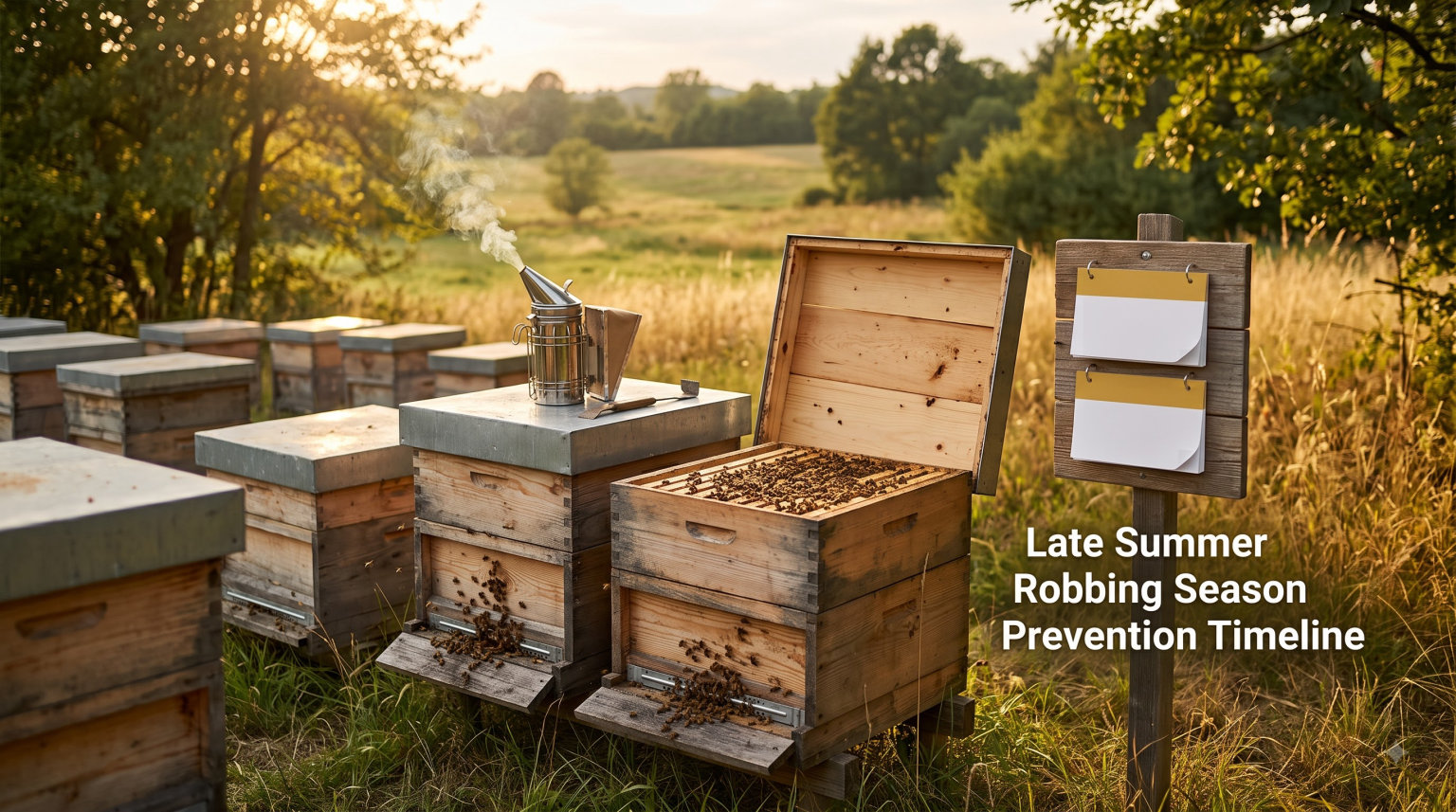
Late summer is the most dangerous time of year for honey bee colonies. The main nectar flow slows to a crawl, temperatures climb, and bees grow desperate for resources. That desperation triggers robbing behavior, where bees from strong colonies invade weaker hives to steal honey stores.
A single robbing event can destroy a colony in hours. I have seen thriving hives reduced to empty boxes overnight because their entrances were left wide open during a dearth. The damage is fast, permanent, and entirely preventable when you follow the right schedule.
Our team has spent years managing apiaries through the toughest months of the beekeeping year. We have learned that timing is everything with late summer robbing season prevention. Install your defenses too late and you lose colonies. Put them up too early and you restrict ventilation during the hottest weeks. The key is a structured timeline that matches your actions to the conditions of July, August, and September.
This guide walks you through what bee robbing is, when late summer robbing season hits hardest, and the month-by-month prevention timeline that keeps colonies alive. We cover entrance management, feeding strategies during dearth, emergency response techniques, and the link between varroa mite levels and robbing vulnerability. Whether you keep two hives or two hundred, these steps build a defense plan that works in 2026.
Table of Contents
Understanding Bee Robbing and Colony Defense
Bee robbing occurs when bees from one colony invade another hive to steal honey stores, most commonly during nectar shortages in late summer and fall. Scout bees from stronger colonies detect honey aromas drifting from nearby hives. Once they locate a vulnerable target, they recruit hundreds of workers to overwhelm the guard bees and tear open capped honey cells.
This behavior is fundamentally different from normal foraging. Foraging bees visit flowers, collect nectar and pollen, and return to their own hive. Robbing bees skip flowers entirely and go straight for another colony’s honey. The distinction matters because robbing behavior escalates rapidly once it starts.
The scent of exposed honey acts like a signal flare. Within hours, bees from colonies across the area converge on the target hive. Our team has watched a quiet apiary turn into chaos in a single afternoon because one frame of honey was left outside during an inspection.
The consequences of robbing go far beyond stolen honey. Guard bees and worker bees die on both sides of the conflict. Diseases and varroa mites spread between colonies as bees from different hives come into direct, prolonged contact. Robbed colonies lose the winter stores they spent months building, and even strong colonies can collapse if robbing pressure persists for days.
I always tell new beekeepers that robbing is a preventable disaster. No colony needs to be lost to robbing if you understand the timeline and take action before the dearth hits. Late summer robbing season prevention is not about reacting to problems after they appear. It is about building defenses ahead of time so the problem never starts in the first place.
Strong colonies with healthy populations can usually defend themselves against robbing attempts. Guard bees stand at the entrance and physically block or bite intruders. But a weak colony, a colony with high mite loads, or a colony with a reduced population from recent swarming cannot mount an effective defense. Those are the hives that fall first when robbing pressure builds.
Late Summer Robbing Season Timeline
One of the biggest gaps in beekeeping education is the lack of a clear, month-by-month robbing prevention schedule. Most resources tell you to watch for robbing and reduce entrances, but few give you specific dates to act on. Here is the timeline our team uses every year.
What time of year do bees rob? The answer depends on your local climate, but for most of North America, the main robbing season runs from mid-July through September. This window aligns with the end of the primary nectar flow, when natural forage dries up and colonies still have large populations that need feeding. That combination of high demand and low supply is exactly what drives robbing behavior.
July: Assessment and Early Preparation
July is your assessment month. The main nectar flow is ending or has already ended in most regions. Colonies are at peak population, which means they are also at peak honey consumption. Take stock of every hive in your apiary.
Begin by evaluating colony strength. Pop the lid on each hive and check brood patterns, honey stores, and overall bee population. Note which colonies are weak, which have high mite loads, and which are queenless. These are your high-risk hives that need priority protection.
Install entrance reducers on any colony that is below full strength by mid-July. Set the opening to the smaller notch for nucs and packages, and the larger notch for established colonies that need more airflow. This is also the time to run your summer mite count and plan treatment timing.
I start watching the forecast for dearth conditions in late July. When you see ten-day stretches with no rain and temperatures above 90 degrees, the nectar dearth has likely begun. That is your signal to shift from assessment mode into active prevention.
August: Peak Robbing Risk
August is the most dangerous month for robbing in most regions. The nectar dearth is in full swing, temperatures remain high, and colonies are hungry. This is when the majority of robbing events happen.
Install robbing screens on every hive in your apiary by the first week of August. Do not wait for robbing to start before putting them on. The screens work by forcing bees through a side or top entrance that resident bees learn quickly but invaders cannot find easily.
Switch to inside-the-hive feeding methods immediately. Boardman feeders and open feeding are robbing magnets during August. Use division board feeders, hive top feeders, or frame feeders that stay inside the hive body. Keep all syrup spills cleaned up and never leave burr comb or honey frames exposed.
Limit inspections to what is absolutely necessary. Every time you open a hive during dearth, you release honey scent that can trigger robbing. If you must inspect, do it late in the day when bee flight is winding down and close the hive quickly.
September: Final Defense and Fall Transition
September brings cooler temperatures but robbing risk remains high until the first hard frost. Colonies are shifting into winter preparation mode, and robbing pressure can persist through the entire month.
Keep robbing screens in place through September. Do not remove them just because the weather cools down. Late warm spells can trigger renewed robbing activity when you least expect it.
Complete your final feeding by mid-September in northern regions and by late September in southern zones. Any colonies that are still underweight going into October are unlikely to survive winter regardless of additional feeding.
This is your last chance to combine weak colonies with stronger ones. Newspaper combines work well in September because bees are less aggressive in cooler weather. Any colony that cannot defend itself by October should be merged with a stronger hive rather than left to die.
Regional Timing Variations
Your local climate shifts this timeline by weeks in either direction. In the southeastern United States, the dearth can start as early as late June and last through August. In the Pacific Northwest, the dearth may not begin until August and can extend into October. In mountainous regions, altitude changes everything, with higher elevations experiencing shorter but more intense dearth periods.
Talk to local beekeepers and your regional extension office to pin down the nectar dearth window for your specific area. The prevention timeline stays the same, but the calendar dates shift based on when your nectar flow ends and natural forage disappears.
Late Summer Robbing Season Prevention Methods
Now that you have the timeline, let us break down the specific prevention techniques. Our team groups these into four categories: entrance management, feeding practices, mite control, and weak colony handling. Each one addresses a different angle of the robbing problem.
Entrance Management: Reducers and Screens
Entrance management is your first and most effective line of defense against robbing. The goal is to narrow the opening so guard bees can effectively defend the entrance against invaders.
An entrance reducer is a simple wooden or plastic strip that blocks part of the hive entrance. Most reducers have two notch sizes. The small notch, roughly two inches wide, is for weak colonies and nucs. The larger notch, about four inches wide, works for established colonies during dearth. Entrance reducers are inexpensive, easy to install, and effective for basic protection.
A robbing screen goes a step further. Instead of just narrowing the entrance, it creates a maze-like pathway that resident bees learn to navigate but intruders cannot figure out. The screen mounts over the front of the hive and forces bees to enter and exit through a side gap or top slot. Robbing screens are more effective than reducers alone, especially against persistent robbing pressure.
I use entrance reducers on all colonies starting in July, then add robbing screens on weak hives and in apiaries with a history of robbing problems in August. The combination gives you layered defense that covers different threat levels as the season progresses.
Feeding Strategies During a Nectar Dearth
How you feed during a dearth is just as important as whether you feed at all. The wrong feeding method can trigger the very robbing you are trying to prevent.
Never use Boardman or entrance feeders during late summer. These feeders sit at the hive entrance, and the scent of open syrup attracts robbers from across the area. Open feeding, where you put syrup in a shared container outside, is even worse during dearth. It trains bees to associate your yard with easy food and spirals into mass robbing within hours.
Instead, use internal feeders that keep syrup contained inside the hive. Division board feeders fit inside the hive body in place of a frame. Hive top feeders sit above the upper box under the inner cover. Frame feeders slide in alongside the brood nest. All of these keep syrup enclosed where the scent stays trapped inside.
Feed in the evening, not the morning. Evening feeding gives bees time to take the syrup down overnight before robbing pressure builds the next day. Use a 2:1 sugar syrup ratio in late summer and fall to help colonies build winter stores quickly and efficiently.
Keep your feeding area spotless. Wipe up any syrup drips immediately, and never leave wet honey supers or extracted frames anywhere bees can find them. One frame of wet comb left on a hive tool can start a robbing frenzy that lasts for days.
Varroa Mites and Colony Vulnerability
The connection between varroa mites and robbing is something many beekeepers overlook. High mite loads weaken colonies by suppressing immune function, reducing brood viability, and shortening worker bee lifespans. A colony burdened with mites simply cannot defend itself the way a healthy colony can.
During late summer, mite populations typically peak right as the nectar dearth begins. This double threat is devastating. The colony is already stressed by lack of forage, and mite damage makes it even more vulnerable to robbing attacks from neighboring colonies.
Our team does a mite count in early July using a sugar roll or alcohol wash. If counts exceed three mites per 100 bees, we treat immediately. Completing mite treatment before the August dearth hits gives colonies the best chance of mounting an effective defense during peak robbing season.
The timing matters because some mite treatments require specific temperature ranges or have withdrawal periods before honey can be harvested. Plan your treatment schedule in July so that colonies are clean and strong by the time robbing risk peaks in August.
Managing Weak Colonies
Weak colonies are robbing magnets. A small population cannot guard the entrance effectively, and the scent of honey from a small hive is just as attractive to robbers as honey from a large one. Identifying and managing weak colonies before the dearth hits is a core part of late summer robbing season prevention.
Signs of a weak colony include low bee population visible at the entrance, spotty or limited brood patterns, lack of fresh eggs, and insufficient honey stores. If you can see daylight through the cluster when you pull a frame, the colony is too small to defend itself.
You have three options for weak colonies. First, you can boost them by adding frames of capped brood and young bees from a stronger colony. Second, you can reduce their entrance to the smallest setting and add a robbing screen for maximum protection. Third, if the colony is too far gone, combine it with a stronger hive using the newspaper method.
Do not wait until August to address weak colonies. By then, robbing pressure is already high and your options are limited. Make these decisions in July when you still have time and flexibility to act.
Warning Signs: How to Identify Active Robbing
Knowing the difference between normal bee activity and robbing can save your colonies. The signs are distinct once you know what to look for, but many new beekeepers miss them until it is too late to intervene.
What Active Robbing Looks Like
Normal foraging bees approach the hive entrance calmly, land, and walk inside. They carry pollen on their legs and move with steady purpose. The activity level at a healthy hive is orderly, with bees entering and exiting at a consistent, unhurried pace.
Robbing looks completely different. You will see a swirl of bees circling the hive in a frantic, erratic pattern. Robbers fly in fast, zigzagging movements around the front and sides of the hive. They try to enter through any crack or gap, not just the main entrance.
Look for fighting at the entrance. Guard bees will physically grab and bite intruders, and you may see pairs of bees tumbling off the landing board locked together. Dead bees on the ground in front of the hive are a strong indicator that robbing is already underway.
Robbing bees often appear darker and shinier than resident bees because they have lost body hair during fights. You will also notice them trying to squeeze into the hive through cracks between boxes, around the inner cover, and through ventilation holes rather than using the main entrance.
Triggers That Start Robbing Behavior
Several specific conditions trigger robbing, and understanding them helps you predict and prevent attacks before they happen rather than scrambling to respond.
A nectar dearth is the primary trigger. When natural forage disappears, bees search aggressively for alternative food sources. Nearby hives full of honey are the richest, most concentrated targets available.
Exposing honey during inspections is a common but avoidable trigger. Leaving honey frames out, spilling syrup, or forgetting to close a hive promptly releases scent that attracts scout bees from other colonies. Our team follows a strict rule: never open a hive during dearth unless absolutely necessary.
Entrance feeders and open feeding are major triggers. The scent of accessible syrup is impossible for scout bees to resist, and once they find it, they will bring hundreds of workers back to exploit the source.
Weak colonies trigger robbing simply by being easy targets. A colony that cannot defend its entrance invites attack. Combining or protecting weak hives early eliminates the trigger before it escalates into a full robbing event.
Emergency Response: How to Stop Active Robbing
If you catch robbing in progress, you need to act immediately. Once a full-scale robbing frenzy develops, it is extremely difficult to stop. Here are the steps our team takes when robbing breaks out at the apiary.
Step 1: Reduce the entrance immediately. Close the entrance to the smallest opening possible. If you have an entrance reducer, install it on the smallest notch right away. This gives guard bees a much smaller area to defend against the invading bees.
Step 2: Install or close a robbing screen. If you do not have a robbing screen, use a piece of wood, mesh, or even cardboard to create a barrier over the entrance. Force bees to enter through a side gap rather than flying straight in.
Step 3: Cover the hive with a wet towel. The wet towel method is a favorite among experienced beekeepers. Drape a soaking wet towel over the entire hive, covering all entrances and gaps. The moisture cools the hive and the towel blocks the scent of honey that attracts robbers. Resident bees find their way out through the damp towel, but robbers cannot follow the scent trail.
Step 4: Seal all cracks. Use duct tape or grass to plug every gap between boxes, ventilation holes, and any other entry point. Robbing bees will exploit any opening to get inside the hive.
Step 5: Wait until dusk. Close the hive and leave it until evening. When the sun sets, robbing bees return to their own colonies. You can then reopen the entrance slightly and let resident bees reorient overnight.
Step 6: Check the colony the next day. Assess damage, confirm the queen is present and laying, and check that the colony still has adequate honey stores. If the colony has been severely weakened, consider combining it with a stronger hive rather than trying to rebuild it alone.
Our team has used the wet towel method with excellent results during active robbing emergencies. The key is to act within the first hour of noticing robbing. The longer you wait, the more bees get involved and the harder it becomes to shut down the frenzy.
Frequently Asked Questions
What is the 3 3 3 rule for bees?
The 3 3 3 rule is a guideline for installing package bees: a new colony needs roughly 3 pounds of bees to start, 3 weeks to draw out initial comb, and 3 months to grow into a productive colony. Beekeepers use this framework to estimate when a new colony will reach full strength and whether it can defend itself before late summer robbing season begins.
Why can’t beekeepers eat bananas?
Beekeepers avoid eating bananas near hives because banana scent contains isoamyl acetate, the same compound found in honey bee alarm pheromone. Eating bananas close to your bees can trigger defensive behavior and agitation. During robbing season, any unnecessary stress makes colonies more vulnerable to attack.
What time of year do bees rob?
Bees most commonly rob during late summer, from July through September, when the main nectar flow ends and a dearth begins. Robbing can also happen in early spring before the first nectar flow, but late summer is the primary robbing season because colonies have large populations, natural forage is scarce, and warm temperatures allow sustained flight activity.
How late is too late to split a hive?
Most beekeepers should stop splitting hives by mid-July in northern climates and by early August in southern regions. A late-season split will not have enough time to draw comb, raise a queen, and build winter stores before cold weather arrives. Late splits also produce weak colonies that become prime targets for robbing during the fall dearth.
Building Your Late Summer Defense Plan
Late summer robbing season prevention comes down to timing and preparation. Assess your colonies in July, install entrance defenses by August, and maintain protection through September. The beekeepers who lose colonies to robbing are almost always the ones who waited too long to act.
Our team has used this timeline for years across multiple apiaries, and it works. Start with a mite count, reduce entrances before the dearth hits, switch to internal feeding, and address weak colonies early. When you follow this schedule, robbing becomes a problem that happens to other beekeepers, not to you.
Take action this week. Check your hives, evaluate colony strength, and install your entrance reducers. The nectar dearth is coming, and the colonies you protect now will be the ones that survive winter.