
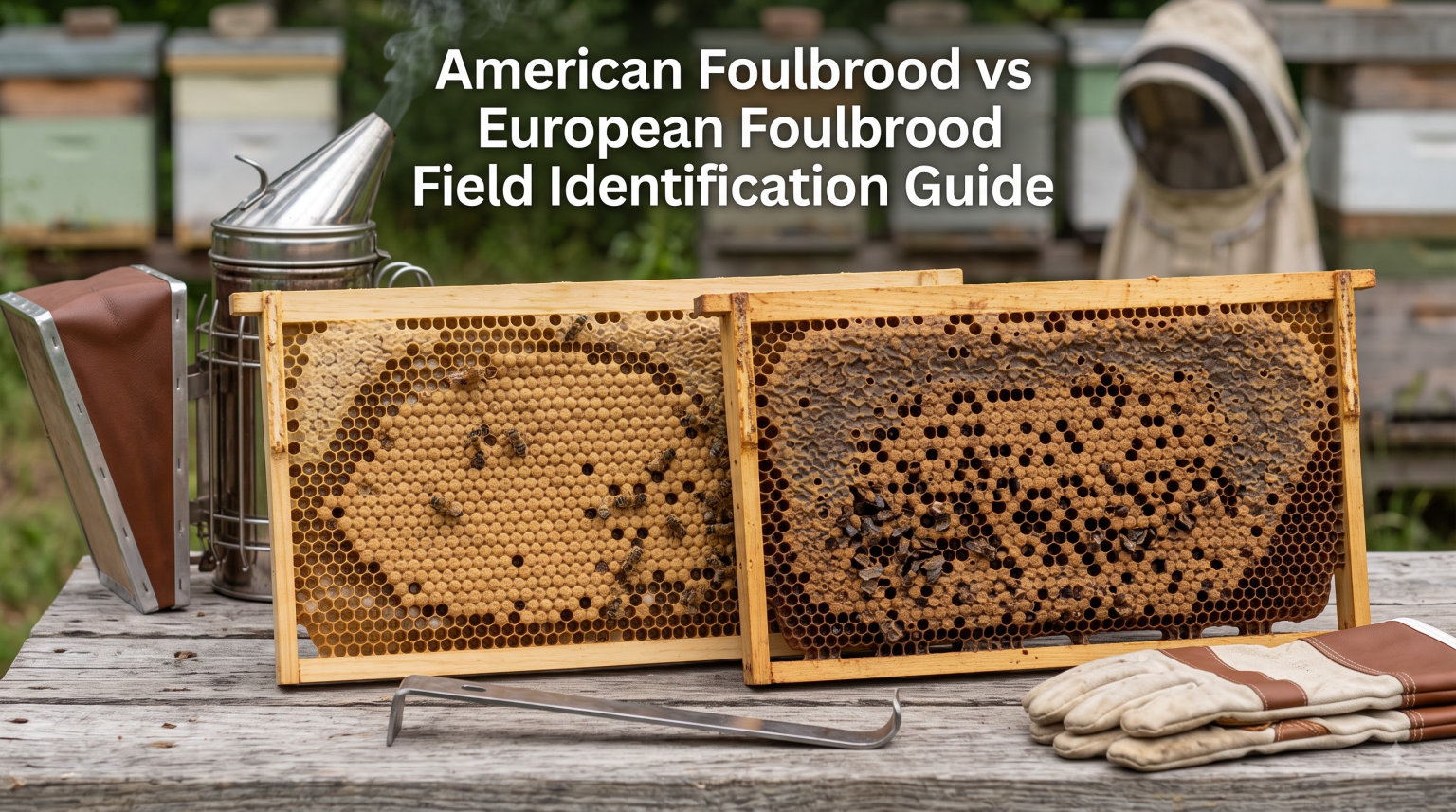
Every spring I open my hives expecting to find frames packed with healthy brood. Most seasons that’s exactly what I see. But twice in fifteen years I have pulled a frame and felt my stomach drop at the sight of melted larvae and a smell that turned my gloves sour. Those moments are why I keep a field identification guide close to my smoker.
American Foulbrood (AFB) and European Foulbrood (EFB) are the two most serious bacterial diseases a honey bee colony can face. They look similar at a glance but behave very differently. AFB is almost always a death sentence for the colony and frequently for the equipment. EFB can sometimes be saved with quick action and good management. Telling them apart in the field is one of the most important skills any beekeeper can develop.
This American Foulbrood vs European Foulbrood field identification guide for 2026 walks you through what to look for, how to perform the rope test, and what to do the moment you suspect either disease. I have included a side-by-side comparison table, a step-by-step rope test procedure, and answers to the questions I hear most often at bee club meetings.
Table of Contents
What Are American Foulbrood and European Foulbrood?
American Foulbrood and European Foulbrood are two distinct bacterial brood diseases that kill honey bee larvae before they can emerge as adults. Both are highly contagious, both can wipe out an apiary, and both deserve immediate attention when spotted.
AFB is caused by the spore-forming bacterium Paenibacillus larvae. The spores are tough. They can survive in old comb, hive wood, and honey for decades. EFB is caused by Melissococcus plutonius, a bacterium that does not form spores and is far less persistent outside a living host.
Both diseases spread when nurse bees feed larvae contaminated food. Once inside the larva, the bacteria multiply in the gut. The timing of death and the visual signs left behind are what allow us to tell them apart in the field.
American Foulbrood: Cause and Transmission
American Foulbrood is caused by Paenibacillus larvae, a rod-shaped bacterium that produces billions of spores per infected larva. A single diseased larva can produce more than 100 million spores, and a single spore is enough to infect a one-day-old larva.
Spores enter the hive on drifting bees, contaminated equipment, honey from infected colonies, or beekeeper tools. Nurse bees inadvertently feed these spores to young larvae while feeding them royal jelly and brood food. The spores germinate in the larval midgut, where the bacteria multiply rapidly before rupturing through the gut wall.
By the time the larva dies, usually after the cell is capped, the body has become a spore factory. A single frame swap between apiaries can introduce enough spores to start an outbreak that takes years to resolve. This is why burned equipment, scorched hive bodies, and strict tool hygiene are the standard recommendation once AFB is confirmed.
How Spores Survive in Equipment
AFB spores are resistant to heat, cold, drought, and most chemical disinfectants. Field studies have shown spores remaining viable on woodenware for over 50 years. That is why many states mandate burning all wooden frames and comb, and often the entire hive body, when AFB is confirmed.
European Foulbrood: Cause and Transmission
European Foulbrood is caused by Melissococcus plutonius, a bacterium that does not produce spores. It multiplies inside the larval gut and competes with the larva for nutrition. The larva typically dies before its cell is capped, which is the single biggest visual difference from AFB.
EFB outbreaks are strongly tied to colony stress. Poor nutrition during a dearth, weak queen genetics, an imbalance between nurse bees and larvae, and concurrent Varroa mite infestation all suppress colony immunity and allow EFB to take hold. When the nurse bee to larvae ratio drops, larvae are underfed and more susceptible.
The bacterium spreads through the same pathways as AFB: contaminated food, drifting bees, beekeeper tools, and shared equipment. Because EFB does not form spores, it cannot survive long outside a living host. This is why EFB colonies can sometimes recover with intervention, while AFB colonies almost never do.
The Stress Connection
Many experienced beekeepers first see EFB in late spring during a strong nectar flow. Paradoxically, a heavy flow can outpace the nurse bees’ ability to feed larvae, leaving underfed larvae vulnerable. Improving the nurse bee to larvae ratio by adding brood from healthy colonies or making splits can help resolve EFB without antibiotics.
Visual Symptoms: Side-by-Side Comparison
Below is the comparison table I wish I had during my first inspection fifteen years ago. Print it and keep it in your bee truck.
| Characteristic | American Foulbrood (AFB) | European Foulbrood (EFB) |
|---|---|---|
| Causative bacterium | Paenibacillus larvae (spore-forming) | Melissococcus plutonius (non-spore-forming) |
| Age at larval death | After capping, typically pre-pupal stage | Before capping, 4-6 days old |
| Capping appearance | Sunken, perforated, greasy, dark | Often uncapped, twisted larvae visible |
| Larva color | Coffee brown, ropy, melts into scale | Yellow-brown, watery, twisted |
| Scale | Adheres tightly to cell wall, black, brittle | Loose, rubbery, easily removed |
| Rope test | Positive, ropy string longer than 1 inch | Usually negative, rarely ropes |
| Smell | Sour, glue-like, very pronounced | Sour to slightly rancid, milder |
| Brood pattern | Scattered, “shotgun” pattern | Patchy, “spotty” pattern |
| Spore persistence | Decades in equipment | Does not persist outside host |
| Reportable disease | Yes, all US states and most countries | Yes, but with more management options |
| Common treatment | Burning of bees and equipment | Shook swarm, requeening, oxytetracycline |
The single biggest differentiator in the field is whether larvae die before or after capping. AFB larvae are capped when they die. EFB larvae die before the bees cap the cell.
Field Identification Techniques for Beekeepers
When you suspect foulbrood, slow down and use your senses in order. My routine takes about 60 seconds per frame once I know what to look for.
Step 1: Smell First
Hold the frame six inches from your nose and breathe in. AFB gives off a sour, almost glue-like odor that you cannot miss once you have smelled it. EFB smells sour but milder, more like old fruit. Both smell distinctly different from healthy brood.
Step 2: Look at the Cappings
AFB cappings are sunken, dark, and often have small holes where bees have attempted to clean out infected cells. EFB often shows uncapped cells with twisted, discolored larvae inside. Run your finger lightly across the capping surface. AFB cappings feel sticky and slightly greasy.
Step 3: Check the Brood Pattern
Healthy brood forms a tight, solid pattern with every cell capped at the same height. Both AFB and EFB break this pattern. AFB produces a “shotgun” pattern with gaps scattered across the frame. EFB produces a patchy, “spotty” pattern with whole sections of missing brood.
Step 4: Pop a Test Cap
Use the corner of your hive tool to flick off a suspicious capping. Look at the larva underneath. A healthy larva is pearly white and glistening. AFB larvae are coffee brown and have a melted appearance. EFB larvae are yellow to brown, twisted, and watery. Always perform the rope test next.
How to Perform the Rope Test for AFB
The rope test is the single most reliable field test for American Foulbrood. It takes 30 seconds and costs nothing. I do it on every suspicious larva I find during an inspection.
- Remove a suspicious capping with your hive tool.
- Insert a small twig, toothpick, or matchstick into the dead larva.
- Slowly pull the stick out and away from the cell.
- Look at the larva. If it stretches into a brown, mucousy rope longer than half an inch, the test is positive for AFB.
- Repeat on a second larva to confirm.
Healthy larvae break apart and do not rope. EFB-infected larvae may show a very short stretch but rarely exceed a quarter inch. A positive rope test, combined with sunken perforated cappings and the characteristic smell, gives a field diagnosis of AFB with high confidence. Confirm with your state inspector or a lab test before taking destructive action.
Common Rope Test Mistakes
Do not test larvae that look fresh. AFB takes hold in older, decaying larvae. Test multiple larvae across the frame. A single negative rope test does not rule out AFB if other symptoms are present. When in doubt, bag the frame and call your inspector.
Key Differences at a Glance
Here is the quick version I share at bee club meetings. If you remember nothing else, remember these three points.
AFB rops. EFB usually does not. A positive rope test longer than half an inch is the field hallmark of American Foulbrood.
AFB scales stick. EFB scales lift out easily. Try to remove the dried scale with a twig. If it is brittle and adheres tightly, suspect AFB.
AFB spores last decades. EFB does not. This single fact drives every treatment decision. There is no cheap way to sterilize AFB-contaminated equipment, which is why burning is the standard recommendation.
When to Contact Your State Bee Inspector
Both AFB and EFB are reportable diseases in every US state and most countries. State bee inspectors are free, knowledgeable, and trained to confirm field diagnoses. They can also order lab testing when needed.
Contact your inspector immediately if you see any combination of: sunken perforated cappings, a positive rope test, melted brown larvae, scale that adheres to the cell wall, or a sour glue-like odor. Most states have an apiary inspection hotline through the Department of Agriculture.
Do not move bees, frames, or equipment between yards until an inspector clears your apiary. This is the single fastest way to spread both diseases.
Treatment Options for Each Disease
Treatment paths diverge sharply between the two diseases because of the spore question. AFB spores persist, EFB does not.
American Foulbrood Treatment
The standard recommendation for AFB is burning of bees, frames, and contaminated hive bodies. Some states allow a “shook swarm” rescue of the adult bees onto new foundation only when the inspector approves and you can prove the equipment is not contaminated. Antibiotics like oxytetracycline suppress symptoms but do not kill spores, which is why most states no longer permit antibiotic-only treatment of AFB.
European Foulbrood Treatment
EFB has more options because the bacterium does not form spores. Common approaches include:
- Shook swarm method: Shake adult bees onto new foundation, destroy old comb, feed heavily for two weeks.
- Requeening: Replace the queen with hygienic stock to improve colony genetics.
- Oxytetracycline (Terramycin): Available by veterinary prescription under the Veterinary Feed Directive. Does not cure the disease but suppresses it during recovery.
- Improve nutrition: Feed 1:1 syrup and pollen substitute during dearth to reduce colony stress.
The shook swarm method is the most popular EFB treatment among commercial beekeepers. It works because old comb is the bacterial reservoir, and replacing comb breaks the cycle.
Prevention Best Practices for Healthy Apiaries
I have walked away from many apiaries with all my colonies healthy. Prevention is what made that possible. Build these habits into your seasonal routine.
- Inspect every hive at least four times per season. Catch diseases before they spread.
- Never buy used frames or comb. Spores travel in old equipment.
- Keep a dedicated set of tools per yard. Or flame your hive tool between hives.
- Requeen annually with hygienic stock. VSH and SMR traits reduce EFB severity.
- Manage Varroa mites aggressively. Mite-stressed colonies are vulnerable to EFB.
- Feed during dearth. Stressed, underfed colonies are where EFB thrives.
- Keep detailed apiary records. You cannot diagnose trends without data.
Frequently Asked Questions
How can I tell the difference between American Foulbrood and European Foulbrood?
The three most reliable field differences are: (1) AFB larvae die after the cell is capped while EFB larvae die before capping, leaving uncapped twisted larvae visible; (2) AFB produces a positive rope test where the larva stretches into a brown string longer than half an inch, while EFB does not rope; (3) AFB scales adhere tightly to the cell wall and are brittle and black, while EFB scales are loose and rubbery. Smell is also distinctive, with AFB giving off a sour glue-like odor.
What does American foulbrood look like in the hive?
American Foulbrood shows up as a scattered shotgun brood pattern with sunken, perforated, greasy-looking cappings. Underneath the cappings you find coffee-brown larvae that melt into a ropy, gluey mass. The dried scales stick tightly to the lower cell wall and cannot be removed easily with a toothpick. The whole frame smells sour and resembles liquid glue.
What causes American foulbrood outbreaks?
American Foulbrood is caused by the spore-forming bacterium Paenibacillus larvae. Outbreaks begin when spores enter the hive through contaminated equipment, drifting bees, robbing, or beekeeper tools. A single spore is enough to infect a one-day-old larva, and a single diseased larva can produce more than 100 million spores. Spores remain viable in equipment for decades.
How is European foulbrood spread between colonies?
European Foulbrood spreads through contaminated food, drifting bees, shared equipment, and beekeeper tools. Unlike AFB, the bacterium Melissococcus plutonius does not form spores and cannot survive long outside a living host. Outbreaks are strongly linked to colony stress, poor nutrition, weak queen genetics, and heavy Varroa mite loads that weaken the colony’s ability to fight infection.
Can European foulbrood be treated without antibiotics?
Yes, the shook swarm method is a popular antibiotic-free treatment for European Foulbrood. It involves shaking all adult bees onto new foundation, destroying the old comb, and feeding the colony heavily with 1:1 syrup for two weeks. Requeening with hygienic stock at the same time improves recovery. Many colonies clear EFB on their own once stress is removed and the nurse bee to larvae ratio improves.
When should I burn equipment contaminated with foulbrood?
Burning is the standard recommendation for American Foulbrood because the spores persist for decades in woodenware and cannot be reliably sterilized. EFB does not require burning because the bacterium does not form spores and dies without a host. Always follow your state inspector’s guidance, as regulations on burning versus salvaging equipment vary by state.
Final Thoughts on Foulbrood Field Identification
American Foulbrood and European Foulbrood both deserve your full attention the moment you suspect them, but they demand different responses. AFB almost always means burning and starting over. EFB often means management changes, shook swarm, and patience.
Make a habit of doing the rope test on every suspicious frame you pull. Keep the comparison table handy. Build a relationship with your state bee inspector before you need one. These three habits are what separate beekeepers who lose whole yards from those who keep their colonies thriving season after season.
The more you inspect, the more confident your field identification becomes. Every healthy frame you pull is practice for the one diseased frame you will eventually find.