
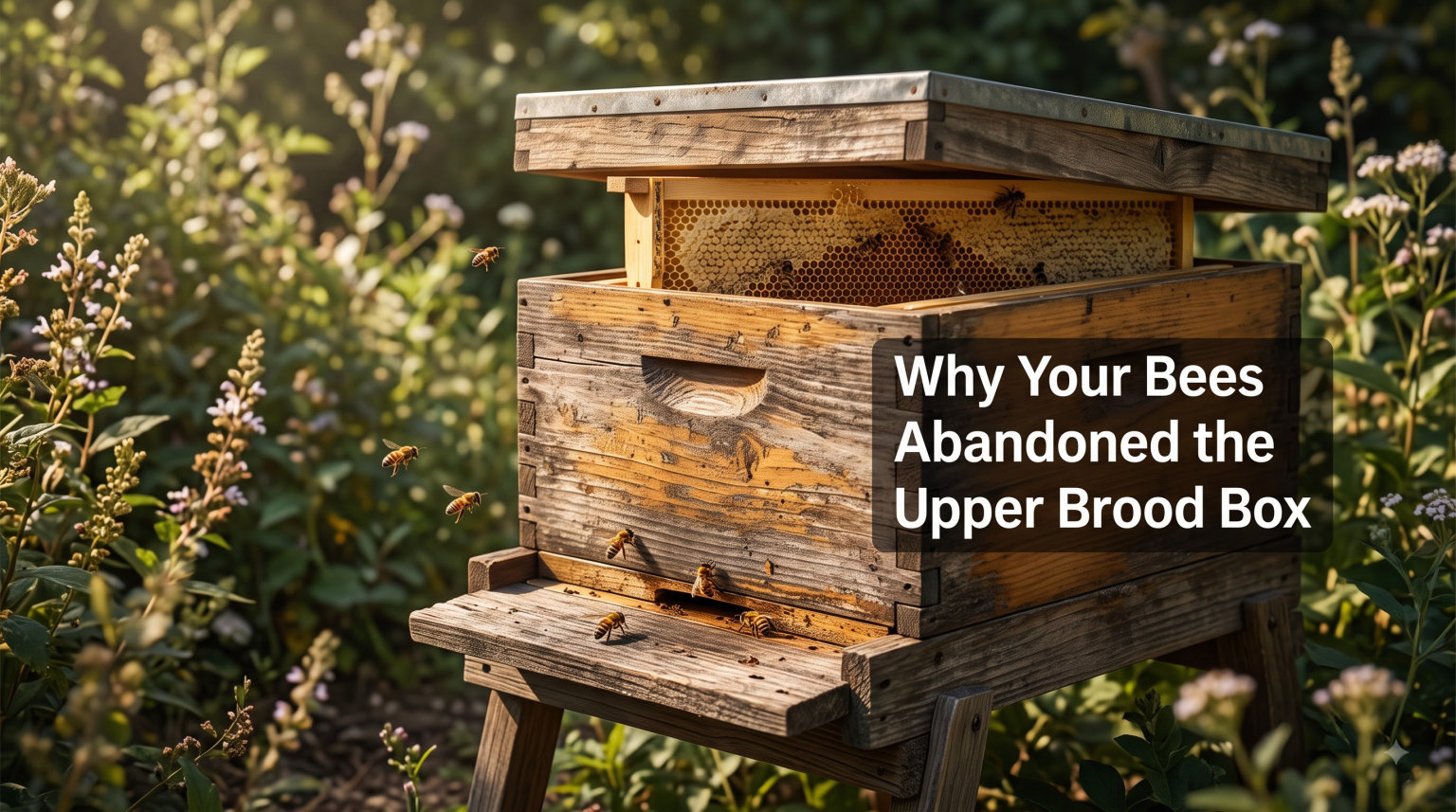
Bees abandon the upper brood box for predictable reasons: the colony is too small to occupy two stories, the queen excluder is blocking upward movement, honey has solidified into a “honey-bound” ceiling, or the queen simply prefers to lay eggs in the lower chamber. Understanding why your bees abandoned the upper brood box is the first step toward fixing the problem, and in most cases the fix is simpler than you think.
I have run two-story Langstroth hives for over a decade, and I have seen empty upper boxes more times than I can count. Sometimes the cause is benign and the bees simply need more time. Other times, it points to a colony struggling with food storage, queen issues, or environmental stress. This guide walks through the seven most common reasons bees leave an upper brood box empty, the chimney effect that complicates winter survival, and the practical interventions that bring your colony back into balance.
Table of Contents
Understanding Why Bees Abandon the Upper Brood Box
Bees abandon the upper brood box when conditions above the brood nest are unfavorable for expansion or survival. The most common triggers include honey-bound blockages, queen excluders, undersized clusters, and seasonal timing. Each of these disrupts the natural upward flow of bees and forces the colony to remain concentrated in the lower box.
Honey bees evolved in vertical cavities, so their instinct is to move upward as they consume honey and expand the brood nest. When this instinct is interrupted, the upper brood box sits empty or partially empty. Recognizing the trigger helps you decide whether to intervene or simply wait.
What “abandoned” really means in a two-story hive
An abandoned upper brood box is one where frames remain undrawn, drawn but empty, or filled only with isolated honey without brood or bees. You may see a few bees wandering up but no cohesive cluster, no eggs, no larvae. This is different from a healthy upper box where the queen is laying and brood is being raised.
Some beekeepers call any upper box with light activity “abandoned,” but a small amount of bees using the top frames is normal. True abandonment means the colony has stopped treating the upper box as part of its living space.
Common Reasons Bees Leave the Upper Brood Box Empty
There are seven reasons bees abandon the upper brood box, and most hives that show this behavior are dealing with more than one. Honey-bound ceilings, queen excluders, and small clusters are the three most frequent triggers, but seasonal timing, swarming history, and poor ventilation also play a role.
The queen excluder problem
A queen excluder placed between the two brood boxes keeps the queen confined to the lower chamber, but it also discourages worker bees from moving up freely. Workers are larger than they seem when loaded with pollen or nectar, and many beekeepers see workers clustered at the excluder refusing to cross. Without workers policing the upper box, the queen has no reason to lay there and the comb goes undrawn.
If you installed a queen excluder the same season the upper brood box went empty, remove it for a few weeks and watch the behavior change. Most experienced beekeepers reserve queen excluders for honey supers only, never between brood boxes.
Honey-bound blockages
A honey-bound hive is one where stored honey has filled every cell in the upper brood box, leaving the queen no room to lay. The bees below run out of space, the queen slows her laying, and the colony may even prepare to swarm. Ironically, this abundance of honey is what blocks further upward expansion.
To check for honey-bound conditions, hold a frame from the upper box up to the light. If every cell is capped with honey and you see no empty cells, the queen cannot work up there. Pull a few frames and extract the honey, or move them up into a super to free up laying space.
Small cluster limitations
A weak colony simply cannot maintain two boxes of brood and bees. If your package or split has fewer than four frames of bees, adding an upper brood box too early leaves them unable to patrol and heat the empty space. The bees will cluster in the lower box and leave the upper one cold and unguarded.
Our team recommends waiting until the lower box has eight frames of covered bees before adding a second brood box. Rushing this step is one of the most common causes of upper brood box abandonment in new colonies.
Queen preferences and pheromone boundaries
The queen produces pheromones that signal her presence, and workers orient to those pheromones in a roughly oval shape around her. If the queen stays in the lower box, the pheromone gradient thins out as you move up. By the time workers reach the upper box, the signal is too faint to stimulate comb building or nursing behavior.
This is why even a strong colony sometimes ignores an upper box: the queen simply never went up. Encouraging the queen to cross into the upper box usually requires either removing an excluder or baiting the upper frames with a frame of fresh brood from below.
Seasonal timing and nectar flow
Bees draw comb fastest during a strong nectar flow. If you added the upper brood box after the main flow ended, the bees have little incentive to invest energy in drawing new wax above them. They may instead consolidate in the lower box and focus on defending what they have.
Spring and early summer are the best windows for adding a second brood box. Adding one in late summer or fall often results in undrawn frames all winter.
Swarm aftermath
If your colony swarmed recently, the upper brood box may be partially empty because the swarm left with a large portion of the bees. The remaining colony often retreats to the lower box where the new queen is establishing herself. After a few weeks, the population rebuilds and the upper box gets reused.
Ventilation and humidity issues
Poor ventilation in the upper box makes it uncomfortable for bees to cluster. Condensation, musty smells, or damp wood can all push bees downward. Check that your hive has adequate upper ventilation and that the inner cover allows moisture to escape.
The Chimney Effect and Overwintering Behavior
The chimney effect is what happens when bees consume honey directly above their cluster and refuse to move laterally to reach untouched stores in the lower box. The cluster can starve within inches of full frames because bees in a cold cluster cannot break away to fetch food sideways.
How the chimney effect works
During winter, the cluster generates heat by vibrating flight muscles. To preserve energy, bees stay packed tightly together and only move upward into honey stores immediately overhead. They will not cross a cold frame to reach honey four inches sideways, even if that honey is plentiful.
This is why bees “abandon” the lower box in winter: not because they choose to, but because they physically cannot move laterally to access it. The honey below them remains untouched while the cluster slowly ascends and may eventually starve if the upper stores run out.
Why bees starve in the upper box
A small cluster is more vulnerable to the chimney effect than a large one. Large clusters radiate enough heat for some bees to peel off and forage laterally. Small clusters stay tight and only move up. If the upper stores are insufficient, the cluster dwindles and dies.
Reversing brood boxes in fall or feeding candy cakes above the cluster are the two most reliable ways to prevent chimney-effect starvation. I have saved colonies this way in late January when the cluster was sitting on empty frames with full honey boxes just below.
Normal vs Problematic Upper Brood Box Abandonment
Not every empty upper brood box is a problem. Bees often ignore the upper box during dearth periods and resume using it when nectar returns. The key is to distinguish normal consolidation from a colony in distress.
Warning signs of trouble
Three warning signs indicate the abandonment is problematic: shrinking population, no new brood in either box, and visible pests like wax moths or small hive beetles in the empty comb. If you see any of these, the colony needs intervention within days, not weeks.
When to leave bees alone
If the lower box is full of brood, the queen is laying actively, and you simply see light activity in the upper box during a dearth, the situation is normal. Bees consolidate when forage is scarce and expand when it returns. Patience often resolves the issue without intervention.
How to Fix and Prevent Upper Brood Box Abandonment
Fixing an abandoned upper brood box requires matching the intervention to the cause. Honey-bound conditions need frames extracted, queen excluders need to come out, small clusters need feeding, and seasonal mismatches need patient waiting. Prevention starts with timing and cluster strength.
Reversing brood boxes
Reversing brood boxes means swapping the upper and lower boxes so the empty one ends up on the bottom. The bees, now sitting on top of their stores rather than under them, often move down quickly to resume brooding. This is the classic fix recommended in older beekeeping literature.
Step-by-step reversing process:
Step 1: Inspect both boxes and confirm the queen is in the lower box before you start.
Step 2: Set the upper brood box aside on an inverted lid nearby.
Step 3: Lift the lower brood box and place it on top of the now-empty bottom board position.
Step 4: Place the original upper box on the new bottom position.
Step 5: Close the hive and wait 7-10 days before re-inspecting.
Reversing works best in spring when bees are expanding. In late fall or winter, reversing can do more harm than good by splitting the cluster.
Feeding strategies
Light syrup (one part sugar to one part water) stimulates comb drawing and encourages bees to move into the upper box. Feed continuously until the upper box is fairly full of bees, then stop. Heavy syrup (two parts sugar to one part water) is better for winter stores and less useful for drawing comb.
For overwintering colonies at risk of chimney-effect starvation, fondant or sugar candy placed directly above the cluster gives them accessible food without forcing them to break cluster and move laterally.
Removing queen excluders
If a queen excluder sits between the two brood boxes, remove it for at least two weeks. Most colonies will move up within days once the excluder is gone. You can always reinstall it later if you need to confine the queen for honey production.
Encouraging upward expansion
Moving a frame of fresh brood from the lower box into the upper box is a powerful baiting technique. Nurse bees follow the brood upward and begin establishing the upper box as part of the colony’s living space. Replace the lifted frame with an empty drawn comb or foundation in the lower box.
Combining this technique with light syrup feeding and a removed excluder resolves most upper brood box abandonment issues within two weeks.
Prevention before it happens
Adding the second brood box at the right time prevents most abandonment issues. Wait until the lower box has at least seven frames of covered bees and the colony is actively drawing comb on the outer frames. Spring, during a steady nectar flow, is the ideal window.
Avoid adding upper brood boxes during dearth, late summer, or right after a swarm. Each of these scenarios reduces the colony’s natural inclination to expand upward.
FAQs
Will bees return to an abandoned hive?
Bees will return to an abandoned hive only if the original colony is still alive and the conditions that caused abandonment are resolved. If the colony died out, the abandoned hive will be claimed by swarms or robbing bees within days. Wax moths and small hive beetles move in quickly, so act within one to two weeks if you want to reuse the equipment.
Why are my bees making honey in the brood box?
Bees store honey in the brood box when there is no room above them or when the queen excluder blocks access to supers. A strong nectar flow combined with no drawn super pushes bees to fill any available cell with nectar, including cells the queen would otherwise use for eggs. Add a super or pull honey frames to relieve the pressure.
Should I place the second brood box above or below the first?
Place the second brood box above the first, not below. Honey bees naturally move upward to expand their nest, and placing the new box on top matches their instinct. Putting it below separates the queen from her pheromone gradient and is rarely successful at encouraging expansion.
How do I reverse brood boxes?
Reverse brood boxes in early spring once the colony is active. Confirm the queen is in the lower box, lift it off, swap positions so the empty box is on the bottom, and place the full lower box on top. Wait 7-10 days before re-inspecting to let the cluster reorganize. Avoid reversing in fall or winter as it can split the cluster and cause chill damage.
Final Thoughts on Upper Brood Box Abandonment
An empty upper brood box is one of the most common concerns in two-story hive management, and the answer usually lies in one of seven causes: queen excluders, honey-bound conditions, small clusters, queen preferences, seasonal timing, swarm aftermath, or poor ventilation. Identifying the cause takes one inspection, and the fix is often a single change. Once you understand why your bees abandoned the upper brood box, you can apply the right intervention and get your colony expanding again within a few weeks.
For more beekeeping guidance, the 2026 season is a great time to revisit your spring management checklist and confirm that your second brood box is timed, baited, and positioned correctly.