
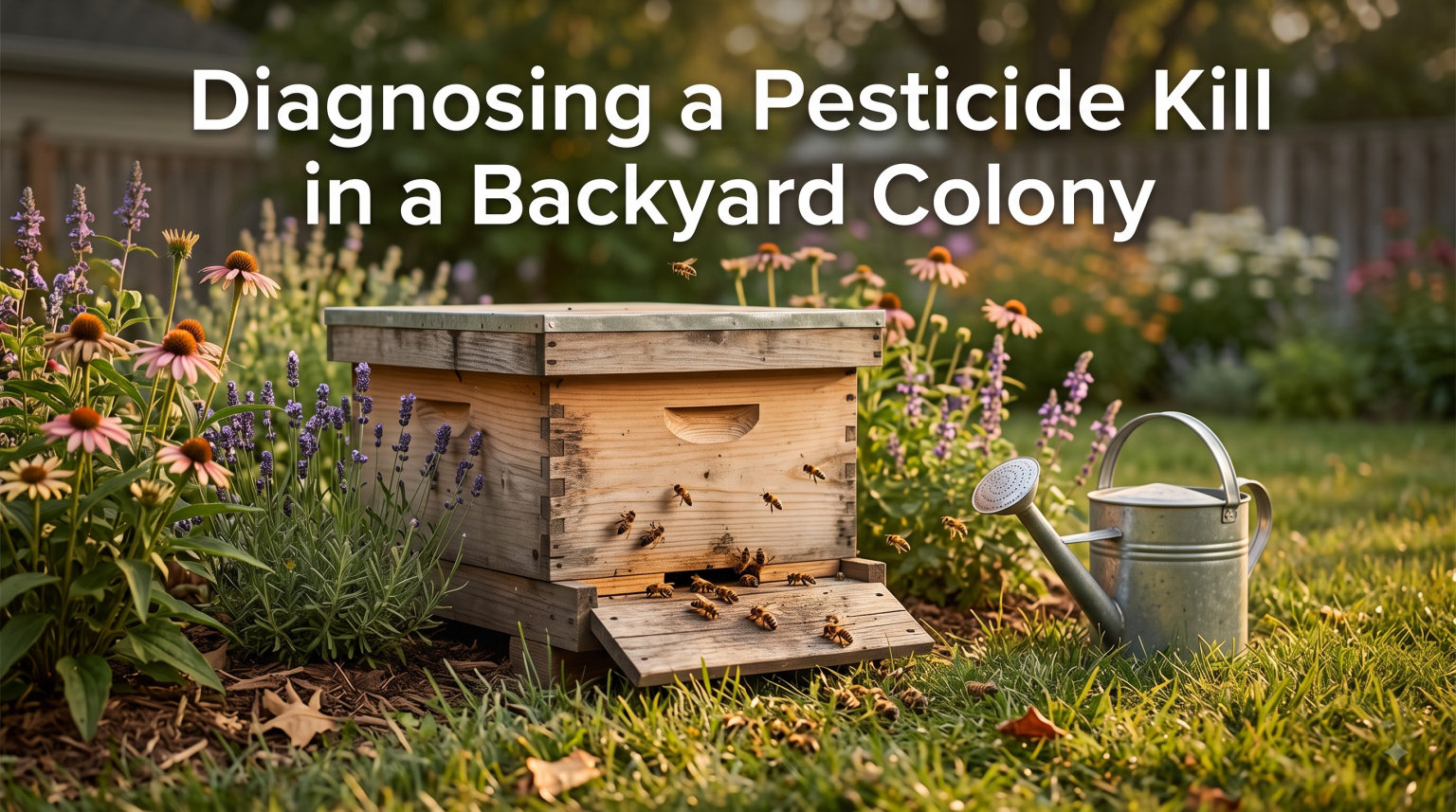
You walk out to check your hives on a warm 2026 morning and your stomach drops. There are thousands of dead bees piled in front of one colony. Some are still twitching on the ground, spinning on their backs with their tongues stuck out. Your first thought is probably Varroa, or maybe a bad queen. But when the die-off is this sudden and this dramatic, a pesticide kill deserves to be at the top of your suspect list.
Diagnosing a pesticide kill in a backyard colony is one of the hardest things a beekeeper will ever do. The signs can look like disease, the timeline is often unclear, and the emotional toll of losing a hive you nurtured for months is real. I have talked with dozens of backyard beekeepers who watched healthy colonies crash overnight with no obvious explanation, and the confusion they feel is always the same.
This guide walks you through everything you need to know about identifying, confirming, and responding to a suspected pesticide kill in your backyard apiary. You will learn the specific physical signs to look for, how to run a field necropsy on dead bees, how to tell pesticide poisoning apart from disease, how to collect and ship samples for lab testing, and how to report the incident to the right authorities. I have also included real beekeeper experiences from community forums so you can see what this actually looks like in practice.
Whether you keep two hives in your suburban backyard or run a dozen colonies on a small rural property, the ability to recognize and document a pesticide kill protects your bees, your investment, and the broader pollinator population. Let us break it down step by step.
Table of Contents
What Exactly Is a Pesticide Kill?
A pesticide kill happens when bees are exposed to a toxic level of agricultural or residential pesticides and die as a direct result. The exposure can occur in a matter of minutes or build up slowly over weeks depending on the chemical involved and how the bees encounter it.
There are three main ways bees come into contact with pesticides. First, direct contact occurs when bees are sprayed while flying or resting on a treated plant. Second, drift happens when pesticide spray or dust blows from a neighboring field or yard onto flowering plants your bees are visiting. Third, and most insidious, is ingestion, where foragers carry contaminated pollen, nectar, or water back to the hive and feed it to the colony.
Once inside the bee, most pesticides attack the nervous system. Organophosphates and carbamates disrupt nerve signal transmission, causing tremors, paralysis, and death. Neonicotinoids, which are systemic and can persist in plant tissue for weeks, cause sublethal effects at lower doses, including disorientation, navigational failure, and immune suppression. The result is either a dramatic acute die-off or a slow chronic decline, and beekeepers need to recognize both.
The key distinction beekeepers should understand is between an acute pesticide kill, where a large number of bees die suddenly within 24 to 48 hours of exposure, and chronic pesticide damage, where the colony weakens gradually over weeks or months from repeated low-level exposure. Both are serious, but they present very differently and require different documentation approaches.
How to Tell if Your Bees Have Been Poisoned: First Signs
Recognizing the first signs of pesticide poisoning comes down to knowing what normal hive mortality looks like and noticing when something is drastically off. A healthy colony loses some bees every day, and finding 50 to 100 dead bees at the entrance over a 24-hour period is perfectly normal. When you suddenly see thousands, that is a red flag.
Here are the most common and reliable physical signs of acute pesticide poisoning in a honey bee colony:
Massive dead bee piles: Thousands of dead bees on the bottom board, at the entrance, and on the ground in front of the hive, appearing suddenly within a day or two.
Proboscis extension: Dead bees with their tongues (proboscis) sticking out, a classic sign of neurotoxic poisoning that affects muscle control.
Spinning and twitching: Living bees found on the ground spinning in circles, trembling, or flipping onto their backs and unable to right themselves.
Wing disorientation: Bees walking on the ground near the hive unable to fly, or flying erratically and crashing into objects.
Aggressive or agitated behavior: Surviving bees may be unusually defensive, irritable, or milling around the entrance in confusion.
Paralysis and trembling: Bees with legs trembling or wings held at abnormal angles, unable to walk or grip surfaces.
Sudden loss of foragers: The hive population drops sharply because foragers die in the field and never make it home, leaving behind mostly nurse bees and house bees.
Dead brood: In severe cases, larvae and pupae die when nurse bees are too sick to care for them, or when contaminated food is fed directly to brood.
The proboscis extension sign is one of the most diagnostic. When a bee’s nervous system is overwhelmed by a neurotoxic pesticide, the muscles that retract the tongue fail, and the proboscis remains extended after death. If you see dozens or hundreds of dead bees with tongues out, pesticide poisoning should be your leading theory.
Spinning bees are another strong indicator. Beekeepers on community forums describe finding bees walking in tight circles or spinning on their backs near the hive entrance, unable to orient or fly. This behavior points to neurological damage rather than disease, and it is one of the most distressing things a beekeeper can witness.
The speed of the die-off matters too. A pesticide kill typically happens fast. You check your bees on Saturday and everything looks great. By Monday morning, there is a carpet of dead bees in front of the hive. Disease processes like Varroa or Nosema take weeks or months to reach that level of mortality. Sudden, dramatic losses over 24 to 48 hours are the hallmark of acute poisoning.
Acute vs Chronic Pesticide Poisoning
Not all pesticide damage shows up as a dramatic overnight die-off. Understanding the difference between acute and chronic pesticide poisoning is essential for accurate diagnosis, because the two forms look very different and require different responses.
Acute pesticide poisoning is what most beekeepers picture when they hear the phrase “pesticide kill.” A large number of bees, often tens of thousands, die within a short window, typically 24 to 48 hours after exposure. You will see massive dead bee piles, spinning and twitching bees, proboscis extension, and a sudden population crash. Acute kills are usually caused by a single high-dose exposure event, such as direct spray, significant drift during a spraying operation, or bees foraging on freshly treated blooming crops.
Chronic pesticide damage is far more subtle and much harder to diagnose. Instead of a sudden mass die-off, the colony gradually weakens over weeks or months. Signs include a shortened lifespan for adult worker bees, a weakened colony unable to cover all its brood, poor queen acceptance or supersedure failures, reduced honey production, and a general failure to thrive that cannot be explained by Varroa, Nosema, or other common stressors alone. Chronic damage often results from repeated exposure to low levels of systemic pesticides, particularly neonicotinoids, which can persist in soil and plant tissue for extended periods.
Chronic exposure is the form most commonly missed by backyard beekeepers because it mimics so many other problems. A colony that seems to struggle for no clear reason, with patchy brood, a shrinking population, and a queen that keeps getting superseded, could be suffering from low-level pesticide contamination in its pollen and nectar stores. Without residue testing, chronic damage is usually a diagnosis of exclusion, meaning you rule out every other cause first.
The practical takeaway is this: if your colony dies suddenly and dramatically, suspect acute poisoning. If your colony slowly fades despite good Varroa management and adequate food, consider chronic pesticide exposure as a possibility and think about testing your pollen stores.
Step-by-Step Field Necropsy Guide
A field necropsy is a systematic examination of your dead and dying bees and the affected hive to gather evidence and determine whether pesticide poisoning is the likely cause. You do not need specialized equipment, but you do need to be methodical and document everything. Here is how I recommend approaching it.
Step 1: Survey the Scene Before Touching Anything
Before you open the hive or pick up a single bee, stand back and look at the overall picture. How large is the dead bee pile in front of the entrance? Are there dead bees on the landing board, on the ground, or on nearby plants? Is the pile concentrated at one hive, or are multiple colonies affected? Take wide-angle photos of the entire area before you disturb anything. Note the date, time, and weather conditions in your beekeeping journal.
Step 2: Examine Individual Dead and Dying Bees
Pick up several dead bees and examine them closely, ideally with a magnifying glass or macro phone photos. Look for the classic signs: is the proboscis extended? Are the wings held at odd angles? Do you see any bees still alive but twitching, trembling, or spinning? Are the bees’ bodies normal-looking or do they appear hairless and shiny (which might point to Chronic Bee Paralysis Virus instead)? Photograph the most diagnostic specimens from multiple angles.
Step 3: Open the Hive and Assess the Interior
Open the affected hive carefully and examine the frames. What does the brood pattern look like? In an acute pesticide kill, you may see healthy-looking capped brood with no bees to cover it, because the adult population has been wiped out. You may also find dead or dying brood if contaminated food was fed to larvae. Check for pollen stores, which may contain residues, and note whether honey stores are present or if starvation could be a factor. Smell the hive, as some pesticide kills produce no unusual odor, while American Foulbrood has a very distinct fishy smell.
Step 4: Check the Queen
Locate the queen if possible. In an acute kill, she may have survived because she does not forage, or she may be dead if the contamination reached the hive interior. Note her status, whether she is laying, and whether the remaining workers are attending to her normally. Queen failure within 30 days of a suspected exposure event is a well-documented consequence of pesticide poisoning, so this information matters for your records and any future investigation.
Step 5: Document and Collect Evidence
Write down everything you observe, including the number of dead bees (a rough estimate is fine), which colonies are affected and which are not, what is blooming in the area, and whether you know of any recent pesticide applications nearby. Collect samples of dead bees and potentially contaminated pollen or wax for lab testing before you clean up or move anything. Photograph your notes and store everything where you can find it later.
Important: Do not discard dead bees or clean up the hive area until you have collected samples and documented the scene thoroughly. Once evidence is gone, it cannot be recovered, and a later investigation will have nothing to work with.
Pesticide Kill or Disease? How to Tell the Difference
One of the most common questions I see on beekeeping forums is, “How do I know if my bees died from pesticides or disease?” This is a critical question because the two can share some symptoms, and misdiagnosis leads to the wrong response. Here is how to separate pesticide poisoning from the most common disease-related causes of colony death.
Pesticide Kill vs Varroa and Parasitic Mite Syndrome
Varroa mites and the viruses they transmit are the number one cause of colony loss, and severe Varroa damage can look dramatic. However, Varroa kills develop over weeks to months, not overnight. You will see deformed wing virus, spotty brood, mite drop on the bottom board, and a gradual population decline. Pesticide kills are sudden and explosive by comparison. If your mite counts were low and your colony was thriving a week ago, a sudden crash points more toward poisoning than mites.
Pesticide Kill vs Chronic Bee Paralysis Virus
This is the trickiest distinction beekeepers face. CBPV causes trembling, paralysis, and crawling bees that cannot fly, which can look similar to pesticide poisoning. However, CBPV-infected bees typically develop a distinctive hairless, shiny, dark appearance due to the virus causing other bees to nibble their hair off. You will also see piles of dead bees at the entrance, but the timeline is usually more gradual than an acute pesticide kill. If affected bees look shiny and black rather than normal-colored, suspect CBPV first and confirm with lab testing.
Pesticide Kill vs Nosema
Nosema causes dysentery, with brown streaks on the hive and frames, and leads to a gradual population decline as worker bees die prematurely. You will not see proboscis extension, spinning bees, or a sudden overnight mass die-off with Nosema. If your bees have diarrhea symptoms and are slowly shrinking over weeks, think Nosema, not pesticides.
Pesticide Kill vs Starvation
Starvation can cause sudden colony death, but the signs are different. Starving bees die head-first in cells, clustered tightly, and you will find no honey stores in the hive. There will be no spinning, twitching, or proboscis extension. Always check honey and pollen stores to rule out starvation before concluding pesticide poisoning.
The single most reliable differentiator is speed and the presence of neurological symptoms. A sudden, massive die-off with bees showing tongue extension, spinning, or twitching is almost certainly pesticide-related. A gradual decline with no neurological signs points toward disease or management issues.
Collecting Samples for Lab Testing
If you want to confirm a pesticide kill, laboratory residue testing is the gold standard. Without it, you have strong circumstantial evidence but no definitive proof. Collecting samples properly is critical, because a mishandled sample can ruin your chances of getting useful results.
What to Collect
Collect at least 100 bees, and ideally 200 or more. Freshly dead bees are best, but bees that are dying but still twitching are even more valuable because pesticide residues degrade quickly after death. You can also collect live but visibly affected bees if you find them. In addition to bees, consider collecting samples of pollen from pollen traps or from cells in the hive, wax from affected comb, and any stored nectar or honey that foragers may have brought back recently.
How to Store and Ship
Place bee samples in a sealed plastic bag or aluminum foil, label them with the date, colony identification, your name, and your contact information, and freeze them immediately. Freezing preserves pesticide residues and prevents further decomposition. Ship samples to the testing lab frozen, packed with ice packs, using the fastest shipping method available. Never ship samples at room temperature during warm weather, as heat accelerates residue breakdown.
Chain of Custody
If you are reporting to a state agency for investigation, maintaining a documented chain of custody matters. Record who collected the sample, when, from which hive, and who has handled it since. Use sealed containers that you sign and date. This documentation can make the difference between a report that leads to action and one that gets dismissed.
State Labs vs Private Labs
State agriculture departments may offer free or low-cost pesticide residue testing as part of an official investigation, but you usually need to file a complaint first. Private labs provide faster results but at significant cost, typically ranging from $475 to $1,255 depending on the scope of testing. For many backyard beekeepers, the state investigation route is the most practical first step. If the state declines to test or the results are inconclusive, private testing is the fallback option.
What to Do Immediately After Discovering a Pesticide Kill
The first hours after you discover a suspected pesticide kill are the most important for documentation and evidence preservation. Here is what to do, in order.
First, do not clean anything up. Leave the dead bee pile, the hive, and the surrounding area exactly as you found them. Photograph everything before you touch it, including wide shots of the yard, close-ups of dead bees showing any proboscis extension or twitching, and images of the hive interior once you open it.
Second, collect your samples immediately. Dead bees, pollen, and wax should be bagged, labeled, and frozen right away. Time is your enemy here, because pesticide residues break down and evidence disappears fast.
Third, document the context. Note the weather over the past several days, especially wind direction and rain. Write down what crops or gardens are blooming within a two-mile radius. Record whether you heard or saw any spraying activity, whether neighbors recently treated lawns or gardens, and whether any agricultural operations nearby were active. Check online resources like DriftWatch for registered pesticide application sites near your apiary.
Fourth, contact your state apiary inspector or state department of agriculture pesticide division. Do this as soon as possible, because some states have time-limited investigation windows. Ask them how to file a formal pesticide complaint and what evidence they need from you.
Finally, keep your surviving colonies calm and contained. If spraying may still be ongoing in the area, you may want to close the hive entrances temporarily with screening to prevent further foraging exposure, providing ventilation and water inside.
Saving Your Surviving Colonies
If some bees survived the initial exposure, your focus shifts to helping them recover. Pesticide-damaged colonies can bounce back, but they need support and careful management in the weeks following the event.
Start by removing contaminated pollen and comb. If you suspect that foragers brought back pesticide-laden pollen or nectar, the safest course is to remove those frames from the hive. Replace them with clean drawn comb or foundation. This prevents continued exposure as bees consume the stored food.
Provide clean food and water. Offer fresh sugar syrup in a clean feeder and ensure a clean water source is available nearby. This helps the colony redirect its energy toward recovery rather than foraging in potentially still-contaminated areas.
Assess the queen within two to four weeks. Pesticide exposure can cause queen failure, including reduced egg-laying, supersedure behavior, or complete loss of the queen. If you find queen cells or a failing queen, plan to requeen promptly with a mated queen from a reliable supplier.
Consider combining weak colonies. If a colony has lost too many bees to sustain itself, merging it with a stronger colony using the newspaper method can save the remaining population and preserve the genetics. Make this decision based on the colony’s strength two to three weeks after the event, not on the day of the kill.
Monitor for secondary problems. Pesticide-stressed colonies are more vulnerable to Varroa mites, Nosema, and other pathogens because their immune systems are compromised. Keep up your mite monitoring schedule and be prepared to treat if levels rise. A colony that seemed to survive the initial kill can still collapse weeks later from secondary infections.
Legal Reporting Requirements: FIFRA and State Channels
Reporting a pesticide kill is not just about getting answers for yourself. It is a civic responsibility that helps regulators track pesticide impacts on pollinators and can lead to changes in how products are labeled, applied, and regulated. Here is what you need to know about the legal framework and reporting process.
What Is FIFRA?
FIFRA stands for the Federal Insecticide, Fungicide, and Rodenticide Act, the federal law that governs the registration, sale, and use of pesticides in the United States. Under FIFRA, using a pesticide in a manner inconsistent with its label is a violation, and pesticide kills caused by misuse or off-label application can trigger formal investigations. If a neighbor or applicator sprayed in violation of label instructions, including spraying during bloom when bees are present, that may constitute a FIFRA violation worth reporting.
How to Report a Pesticide Kill
Pesticide enforcement in the United States is primarily handled at the state level. Each state has a designated lead agency, usually within the state department of agriculture, that investigates pesticide complaints. The general process is:
Contact your state department of agriculture pesticide division or state apiary inspector to file a complaint.
Provide documentation including photos, sample collection details, colony history, and observations about nearby pesticide activity.
Allow the state investigator to visit your apiary and collect their own samples if they choose to investigate.
Cooperate with the investigation, which may involve the investigator contacting nearby landowners or applicators.
You can also report bee kills incidents to the EPA through the National Pesticide Information Center, though state-level reporting is usually the more direct and effective route. Some states have online pesticide complaint forms that streamline the process.
What to Include in Your Report
A strong pesticide kill report should include the date and time you first noticed the problem, the number of colonies affected versus unaffected, an estimated number of dead bees, photographs showing the dead bee piles and any physical symptoms, weather conditions for the 72 hours before the event, your beekeeping records showing the colony was healthy prior to the incident, and any information about nearby pesticide applications you are aware of. The more documentation you provide, the more likely your report will be taken seriously and investigated.
Managing Expectations
Be realistic about outcomes. Many reported pesticide kills never result in a definitive finding or enforcement action. Investigators may not be able to identify the source, residues may have degraded before testing, or the application may have been legal. The frustration of unresolved investigations is a common theme in beekeeper forums. Still, reporting matters because patterns of complaints build a record that can eventually drive regulatory change.
Proactive Registration
Before you ever have a problem, register your apiary with your state agriculture department and list it on DriftWatch or FieldWatch if your state participates. These registries alert pesticide applicators to the presence of managed pollinators so they can take precautions. Many states also have BeeCheck programs specifically for beekeepers. Registration is free, takes minutes, and is one of the most effective preventive steps you can take.
Prevention Strategies for Backyard Beekeepers
The best way to deal with a pesticide kill is to prevent one from happening in the first place. While you cannot control what every neighbor and farmer does, there are concrete steps you can take to reduce the risk to your colonies.
Talk to your neighbors. This is the single most effective prevention strategy for backyard beekeepers. Introduce yourself, explain that you keep bees, and ask them to let you know before they spray pesticides on their lawns or gardens. Most people are happy to cooperate once they understand the stakes. Offer to help them find pollinator-friendly alternatives if they are open to it.
Register your apiary. Use DriftWatch, FieldWatch, or your state’s beekeeper registry to flag your colonies so commercial applicators know you are nearby. This is especially important if you live near agricultural land where spraying is routine.
Learn to read pesticide labels. The EPA requires extended residual toxicity values, known as RT25 values, on many pesticide labels. The RT25 tells you how long a pesticide remains toxic to bees after application. If you know a neighbor is applying a product, knowing the RT25 helps you understand how long your bees need to stay confined.
Position hives thoughtfully. If possible, locate your apiary away from property lines and agricultural fields. Use natural windbreaks like hedges or fences to reduce drift exposure. Consider the prevailing wind direction when placing colonies.
Confine bees during high-risk periods. If you know spraying is imminent, close your hive entrances the evening before with screened closures that allow ventilation. Keep bees confined for the duration of the RT25 period, then release them in the early morning after residues have dried or broken down.
Encourage pollinator habitat. Plant diverse, bee-friendly forage on your own property so your bees have plenty of safe food sources close to home. A colony with abundant clean forage nearby is less likely to range into treated fields and gardens.
Real Beekeeper Experiences: What a Pesticide Kill Looks Like
Theory is helpful, but nothing prepares you like real stories from beekeepers who have lived through a pesticide kill. These experiences, drawn from beekeeping communities and forums, illustrate how pesticide poisoning actually presents in the field.
Case 1: The Overnight Crash
A suburban beekeeper in the Midwest checked her two hives on a Saturday afternoon and found both booming with bees, loaded with honey, and queenright. On Monday morning, she discovered a pile of roughly 30,000 dead bees in front of one hive and thousands more on the bottom board. Live bees were spinning on the ground with their tongues extended. The other hive, 20 feet away, was completely unaffected. She learned later that a neighbor had sprayed an insecticide on blooming fruit trees on Sunday. The colony never recovered despite her best efforts, and she lost it within three weeks.
Case 2: The Slow Decline
A hobbyist with four backyard hives near a cornfield noticed that one colony seemed perpetually weak. Mite counts were low, the queen was present and laying, but the population never grew like the others. Brood patterns were spotty, and the bees seemed sluggish. Over the course of three months, the colony shrank to a handful of bees and eventually died out. Pollen testing later revealed low levels of neonicotinoid residues, likely from corn planting dust that drifted onto nearby blooming weeds. This was chronic pesticide damage, not an acute kill, and it was nearly impossible to diagnose without lab testing.
Case 3: The Queen Failure
A beekeeper reported a strong colony that experienced a moderate pesticide exposure event after nearby spraying. The colony lost significant forager numbers but seemed to stabilize after a week. Three weeks later, the beekeeper found emergency queen cells. The queen had stopped laying and the colony had initiated supersedure. The new queen failed to mate successfully, and the colony eventually went queenless. Queen failure within 30 days of pesticide exposure is a well-documented pattern, and this case fits it perfectly.
The lesson across all three cases is the same: document everything, test when possible, and learn from the experience so you can protect your remaining colonies.
FAQs
How long after pesticide exposure do symptoms appear?
Acute pesticide poisoning symptoms typically appear within 24 to 48 hours of exposure. Bees that are directly sprayed or that forage on freshly treated plants can show symptoms within hours. Chronic poisoning from systemic pesticides like neonicotinoids can take weeks or months to manifest as gradual colony weakening.
What are the first signs of pesticide poisoning in bees?
The first signs include a sudden large pile of dead bees at the hive entrance and on the ground in front of the hive (well beyond the normal 100 per day), dead bees with their tongues extended, and living bees twitching, spinning, or unable to fly. A rapid forager population drop is also an early indicator.
Can a bee recover from insecticide?
Individual bees severely affected by insecticide poisoning rarely recover, as the neurological damage is often irreversible. However, a colony can recover if enough healthy bees remain, the queen survives, and contaminated pollen and comb are removed. Recovery takes several weeks, and the colony may need requeening and supplemental feeding.
How do you tell if your bees have been poisoned?
Look for a sudden mass die-off (thousands of bees within a day or two), proboscis extension on dead bees, spinning or twitching live bees near the entrance, wing disorientation, and a sharp drop in forager numbers. These neurological symptoms combined with rapid onset strongly indicate pesticide poisoning rather than disease.
How do you detect pesticide poisoning in a bee colony?
Run a field necropsy by documenting dead bee numbers, examining individual bees for proboscis extension and tremors, checking brood and queen status inside the hive, and ruling out disease and starvation. Then collect 100 to 200 freshly dead or dying bees plus pollen and wax samples, freeze them, and send them to a state or private lab for pesticide residue testing.
What is the earliest symptom of pesticide poisoning in bees?
The earliest symptom is usually a sudden increase in dead bees at the hive entrance and on the ground in front of the hive, often accompanied by disoriented or twitching bees. You may also notice bees walking on the ground near the hive unable to fly before the full-scale die-off begins.
Conclusion
Diagnosing a pesticide kill in a backyard colony requires you to act as both a detective and a record-keeper. The signs are often unmistakable once you know what to look for: a sudden mass die-off, dead bees with extended tongues, spinning and twitching survivors, and a forager population that vanishes overnight. These neurological symptoms, combined with the speed of the die-off, separate pesticide poisoning from the gradual decline caused by disease, mites, or poor nutrition.
The steps you take in the first 24 hours matter most. Document the scene with photographs before you touch anything. Collect and freeze samples of dead bees, pollen, and wax for lab testing. Record the weather, the blooming plants nearby, and any pesticide activity you know about. Then file a report with your state department of agriculture, because every documented incident adds to the body of evidence that drives better pollinator protection.
Prevention is your best long-term strategy. Talk to your neighbors about your bees, register your apiary on DriftWatch, learn to read pesticide labels, and position your hives to minimize exposure risk. The backyard beekeepers who lose the fewest colonies to pesticides are the ones who build relationships, stay informed, and act proactively.
If you take one thing from this guide, let it be this: when you suspect a pesticide kill, document everything and report it. Even if the investigation does not produce the answer you hope for, you are building a record that matters for your apiary, your community, and pollinators everywhere. Keep your notes, keep your photos, and keep advocating for your bees.