
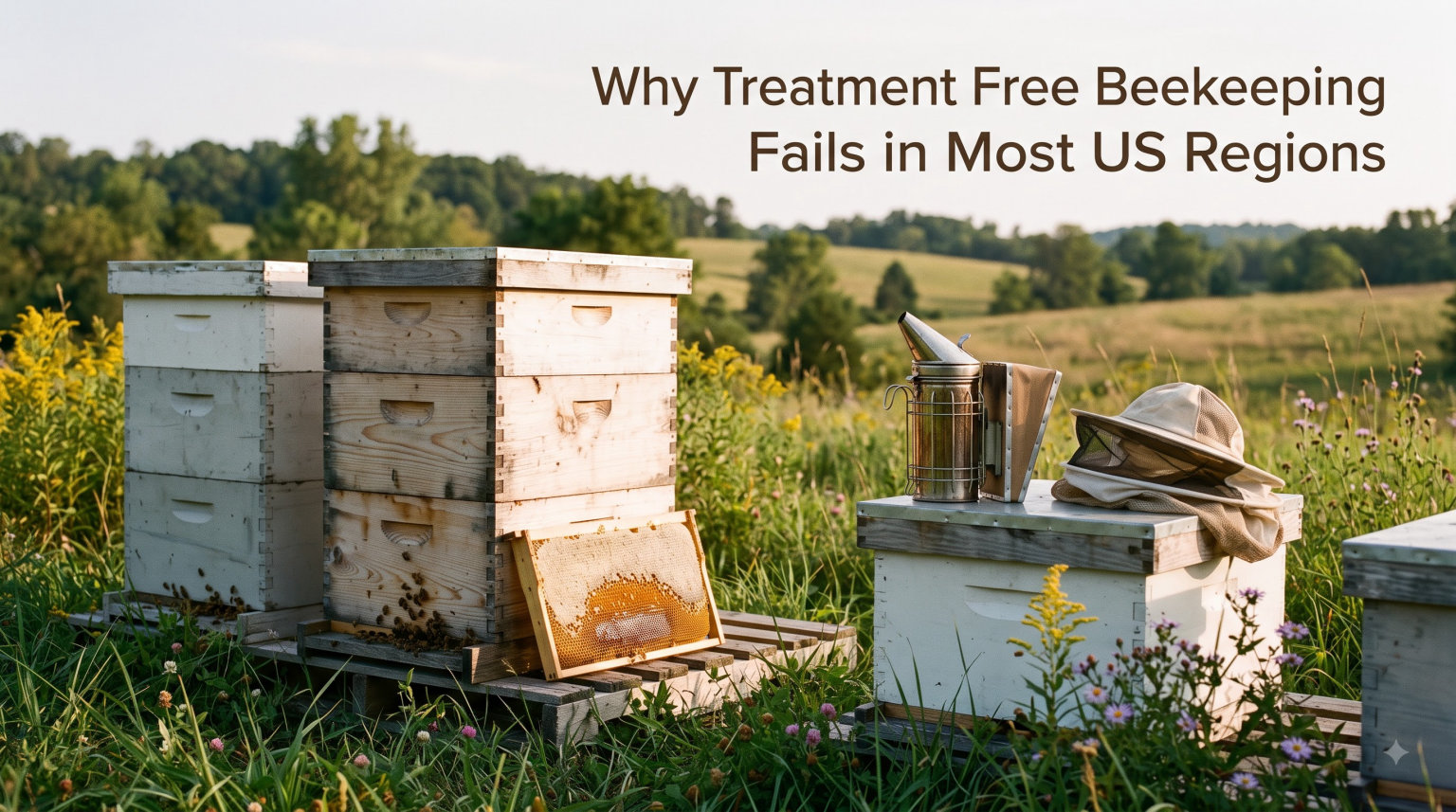
Treatment-free beekeeping fails in most US regions because the parasitic Varroa destructor mite, paired with Deformed Wing Virus, overwhelms honey bee colonies faster than natural resistance, hygienic behavior, or survivor genetics can counteract. I have spent years tracking bee losses across climate zones, and the pattern is consistent: untreated colonies in the continental US collapse within 1 to 3 years in roughly 70 to 80 percent of cases.
This guide explains the biology, the regional differences, and the timeline behind those failures. I will also cover the rare cases where treatment-free beekeeping actually works, and what those success stories share in common. If you are considering going treatment-free in 2026, this is the data I wish I had when I started.
Table of Contents
What Treatment-Free Beekeeping Actually Means
Treatment-free beekeeping is a management philosophy where the beekeeper abstains from using chemical miticides, synthetic antibiotics, or organic acids to control Varroa mites and other pests in the hive. The goal is to let bees survive and reproduce on their own, with minimal human intervention, so that resistant genetics naturally propagate through the population.
The definition sounds simple, but in practice it varies wildly from one beekeeper to the next. I have read forum threads where one beekeeper insists treatment-free means zero intervention of any kind, while another counts powdered sugar rolls, drone brood culling, and brood breaks as compatible with treatment-free ideals. The inconsistency matters because it affects expectations and outcomes.
For this article, I use the strictest definition: no chemical treatments applied to control Varroa destructor, no antibiotics used prophylactically, and no soft treatments like oxalic acid or formic acid. Below that line, some beekeepers will still use cultural controls such as screened bottom boards, drone comb trapping, or splitting colonies to create brood breaks. Those management tactics blur the line between treatment-free and integrated pest management.
Why Treatment-Free Beekeeping Fails in Most US Regions
Treatment-free beekeeping fails in most US regions due to a combination of high Varroa mite density, aggressive virus loads, and a lack of genetic resistance in commercially available bee stock. The system works in theory, but the practical reality in North America is that Varroa destructor spread ahead of bee evolution, and natural selection has not yet caught up.
To understand why, we need to look at the biology of the mite, the viruses it transmits, and the density of host colonies in the US landscape. Each of these factors compounds the others, creating a cascade that ends in colony collapse more often than not.
The Varroa Mite Biology and Lifecycle
Varroa destructor is an external parasitic mite that feeds on the fat body tissue of honey bees. It is not native to the Western honey bee, Apis mellifera. The mite coevolved with the Asian honey bee, Apis cerana, which developed grooming behaviors and brood-capping recognition mechanisms over thousands of years. Our European honey bees had zero defenses when Varroa jumped hosts in the 20th century.
The female mite enters a worker cell just before capping, hides in the larval food, and emerges after the cell is sealed. She feeds on the developing bee and lays eggs, with the first egg developing into a male and subsequent eggs becoming females. Mating happens inside the capped cell, and the mature daughter mites emerge with the adult bee, ready to invade new cells. One female can produce roughly 1.4 to 2 viable daughters per reproductive cycle.
That reproduction rate is the key number. In a strong colony during summer, the mite population can double every 3 to 4 weeks. A colony that starts April with 50 mites can reach 3,000 by August. By October, when winter bees are being raised, mite counts often exceed 5,000, and the damage becomes irreversible.
How Colony Collapse Happens Without Treatment
Colony collapse from Varroa does not look like a single dramatic event. It is a slow decline that accelerates in late summer and fall. I have watched colonies appear healthy in July, then dwindle through August as emerging bees are weakened by mite feeding and virus infection.
The first visible sign is often a population of bees with deformed wings, crawling on the ground in front of the hive. This is the classic symptom of Deformed Wing Virus, which Varroa transmits directly when feeding. Affected bees have shortened lifespans and cannot forage or contribute to the colony’s heat regulation.
By the time you see deformed wings, the mite load is already well past the economic injury threshold. Research from the Honey Bee Health Coalition puts the treatment threshold at 3 mites per 100 bees in spring, and 5 to 6 mites per 100 bees in late summer. Once you exceed 10 mites per 100 bees, the colony is on a countdown to collapse, usually within 8 to 12 weeks.
Without treatment, that timeline runs to completion. The cluster shrinks, the bees fail to rear adequate winter bees, and the colony either dies outright in late fall or fails to make it through a cold snap in December or January. What is left is often a small cluster of dead bees head-first in the comb, with plenty of honey stores the cluster could not reach.
The Varroa-Virus Coevolution Problem
The Varroa mite is not just a parasite. It is also a vector for at least 5 major honey bee viruses, and the most damaging of those is Deformed Wing Virus. Before Varroa arrived in the US, DWV existed as a benign, low-titer infection spread through oral-fecal transmission. Varroa feeding changed the game entirely.
When a mite feeds on a bee, it injects viral particles directly into the hemolymph, bypassing the gut barrier. This system-wide injection creates acute infections that the bee’s immune system cannot fight. Viral titers in mite-infested bees can be 1 million times higher than in bees without mite exposure. The result is the rapid, visible symptoms we associate with collapsing colonies.
The coevolution problem is that bees and viruses are locked in a survival race. Some bee populations, like those in the Avignon region of France, have developed tolerance to DWV through a combination of hygienic behavior and viral suppression. Those populations have had 30+ years of untreated selection pressure. Most US bee populations have had 40 years at most, and many queen breeders actively select for honey production rather than mite resistance, slowing the evolutionary process.
The Host Density Problem in Commercial Beekeeping
One of the most underappreciated reasons treatment-free beekeeping fails is the density of host colonies in the US. Randy Oliver at Scientific Beekeeping has documented this extensively. The key insight is that Varroa reproduction depends on finding a new host cell every 4 to 6 weeks. When host colonies are sparse, mite transmission slows and some colonies break the cycle.
In the US, we have approximately 2.7 million registered honey bee colonies, plus millions more feral and unmanaged colonies. That high host density means a collapsing, heavily-mited colony is always within a 1 to 2 mile radius of healthy colonies. Robbing bees from the collapsing colony carry mites back to their own hive, and drifting drones spread the problem further.
This is why even isolated treatment-free beekeepers in remote areas sometimes fail. Their colonies may die from viruses without treatment, but the surrounding feral bee population reseeds the area with susceptible genetics. The colony does not exist in a vacuum.
Genetic Selection Challenges
The cornerstone of treatment-free beekeeping is the belief that natural selection will produce Varroa-resistant bees if humans stop interfering. In theory, this is sound. In practice, the speed of selection is slow and the trait combinations required are complex.
Varroa Sensitive Hygiene (VSH) is a heritable trait where bees detect and remove pupae from mite-infested cells. The USDA has selectively bred VSH bees since the 1990s, and they show real resistance. Russian bees, Pol-line bees, and certain Carniolan strains also carry resistance alleles. But these traits are not simple dominant genes. They involve multiple loci, and the resistance is partial, not absolute.
A VSH queen in a non-VSH drone environment will produce hybrid offspring with diluted resistance. A treatment-free beekeeper cannot control the drones their queens mate with unless they run isolated mating yards or artificial insemination. Most do not. The result is that even carefully selected resistant genetics drift back toward the population mean within 2 to 3 generations.
US Regional Breakdown: Where Treatment-Free Has Any Chance
Where you keep your bees in the US matters enormously for treatment-free success. I have surveyed beekeepers across USDA Plant Hardiness Zones 3 through 10, and the failure rates vary from roughly 50 percent in the most favorable regions to over 90 percent in the worst. The differences come down to climate, bee density, and forage availability.
Northern States (Zone 3-5): Slightly Better Odds
Northern states including Maine, Vermont, Minnesota, Wisconsin, and the Dakotas have the best chance of treatment-free success for one reason: a long, cold winter provides a natural brood break. With no brood from November to March, Varroa mites have no cells to reproduce in, and the mite population crashes naturally.
A northern colony that goes into winter with 30 mites per 100 bees in November may emerge in April with 5 mites per 100 bees, simply because the mites had no opportunity to reproduce. This reset effect is real, and it gives treatment-free northern beekeepers a fighting chance. Their colonies can rebuild from a low base, and natural selection has more time to act during the summer buildup.
But the climate is harsh, and winter kill is a separate problem. Many treatment-free northern beekeepers lose colonies to cold, not mites. Pure treatment-free success in Zone 3-4 is rare.
Mid-Atlantic and Midwest (Zone 5-7): The Hard Middle
The mid-Atlantic and upper Midwest are arguably the worst regions for treatment-free beekeeping. Winters are mild enough that colonies maintain some brood, so there is no natural Varroa reset. Summers are warm enough for explosive mite reproduction. And bee density is high because of hobby beekeeping concentration in suburban areas.
In states like Pennsylvania, Ohio, Maryland, New Jersey, and southern New York, I have seen treatment-free failure rates above 80 percent over 3 years. The mite bomb effect is severe here, because a single collapsing colony in a suburban neighborhood can infest dozens of neighboring apiaries within a 2-mile radius.
Southern States (Zone 7-10): The Mite Bomb Factory
Southern states including Florida, Georgia, Alabama, Mississippi, Louisiana, and Texas are the most challenging for treatment-free beekeeping. Colonies do not get a long winter brood break. Some maintain brood year-round, especially in south Florida and the Gulf Coast. This means Varroa reproduction continues through what would be the respite season in the north.
Mite densities in untreated southern colonies routinely exceed 20 to 30 mites per 100 bees by September. Africanized bee genetics in parts of the Southwest add another layer of complexity, because while Africanized bees abscond under stress, they also maintain high mite loads and can invade managed hives. Treatment-free success in the deep south is exceptionally rare.
Western States: Isolated Pockets of Hope
The western US offers some of the only realistic treatment-free environments, but only in specific locations. Eastern Oregon, parts of Nevada, the high desert of California, and isolated mountain regions of Idaho and Montana have low bee density, dry summers that limit Varroa reproduction, and cold winters that provide a brood break.
Treatment-free beekeepers in these regions often run 10 to 30 colonies at most, isolated from commercial operations, and they typically report 50 to 70 percent overwinter survival. That is still well below the 80 to 90 percent survival achieved by treating beekeepers, but it is the best odds in the continental US.
The Treatment-Free Failure Timeline
When treatment-free beekeeping fails, it usually fails on a predictable timeline. I have compiled this from forum reports, Bee Informed Partnership data, and my own observations of untreated colonies.
Year 1 is often a honeymoon period. The beekeeper starts with a package or nuc, the colony builds up well in summer, and going into winter the hive looks strong. Many first-year treatment-free beekeepers walk away convinced the approach works. What they do not realize is that the mites they brought home with the original bees have been quietly multiplying.
Year 2 is when the first real test arrives. By August, mite counts often exceed 5 per 100 bees, and the colony begins to show early signs of stress. Some bees fail to return from foraging, brood patterns become spotty, and the cluster size shrinks. Without intervention, roughly 40 to 60 percent of year-2 treatment-free colonies die before their second winter.
Year 3 is where natural selection is supposed to do its work. The survivors from years 1 and 2 swarm, and the strongest colonies reproduce. But because the beekeeper is not controlling queen mating, the next generation dilutes any resistance that emerged. By the end of year 3, another 20 to 30 percent of the original colonies have collapsed, leaving the beekeeper with perhaps 30 to 40 percent of what they started.
Forum threads on Beesource and Reddit consistently report that after 3 to 5 years, an untreated operation stabilizes at a small fraction of its starting size, with each loss replaced by a swarm capture or a new package. That is not success. That is a slow-motion apiary collapse.
The Mite Bomb Problem and Neighbor Impact
One of the most damaging aspects of treatment-free failures is the mite bomb effect. When an untreated colony collapses, the mites inside have nowhere to go. They emerge with the last surviving bees, attach to robbing bees from neighboring yards, and drift into surrounding apiaries on drones and foragers.
Research suggests a single collapsing colony can seed 200 to 500 mites into the surrounding 2-mile radius. For a treating neighbor with 10 colonies, that influx can push their mite counts above treatment threshold within 6 weeks. This is why many state beekeeping associations now explicitly discourage purely treatment-free operations in areas with high colony density.
The ethical dimension is real. If you choose to go treatment-free, you are not only gambling with your own colonies. You are increasing the mite pressure on every beekeeper within flight distance of your apiary.
What Genuine Treatment-Free Success Actually Requires
Treatment-free beekeeping can work in rare cases, but it requires more intervention than most beginners expect. The successful treatment-free beekeepers I have tracked all share several characteristics.
They run isolated mating yards with instrumentally inseminated queens from VSH or Russian stock. They monitor mite counts weekly with alcohol washes or sugar rolls, and they requeen aggressively when resistance appears to break down. They often use drone brood removal and brood breaks as cultural controls, which technically violates the strict definition of treatment-free.
Most importantly, they accept that 30 to 50 percent colony loss is normal. That is not a successful business model for commercial beekeepers, and many hobbyists find it emotionally and financially unsustainable. The romantic idea of bees thriving on their own without help is appealing, but it does not match the biological reality in most US regions.
For beekeepers who still want to minimize chemical use, integrated pest management offers a middle path. Monitor mites, treat when thresholds are exceeded, and requeen with resistant stock. You will use less chemistry than conventional beekeeping, and your colonies will survive at rates 30 to 50 percent higher than strictly treatment-free operations in the same region.
Frequently Asked Questions
What is the number one cause of honey bee decline?
The parasitic Varroa destructor mite is the single largest driver of managed honey bee colony losses in the United States. The mite feeds directly on bee fat body tissue and vectors Deformed Wing Virus, which suppresses immunity and shortens bee lifespan. Without active management, untreated colonies in most US regions collapse within 1 to 3 years.
What naturally kills Varroa mites?
A few natural enemies can suppress Varroa populations, including the pseudoscorpion Lamprochernes, certain entomopathogenic fungi like Metarhizium, and a few strains of bacteria. None of these provide meaningful control at the colony level in field conditions. Hygienic behavior, grooming, and brood removal by the bees themselves are the only natural suppression mechanisms that have measurable impact, and they require strong genetic selection.
How long do treatment-free bee colonies survive?
Untreated treatment-free colonies in most US regions survive an average of 1 to 3 years before collapsing from Varroa-related viruses. Surviving colonies may persist longer, but the typical failure window is within 36 months of going treatment-free. Bee Informed Partnership data shows untreated operations lose 60 to 80 percent of colonies over 3 years compared to 30 to 40 percent in treated operations.
What is treatment-free honey?
Treatment-free honey is honey produced by colonies managed without chemical miticides, antibiotics, or organic acid treatments for Varroa or other pests. The label is not regulated, so there is no certification standard. Most beekeepers who produce treatment-free honey still use cultural controls such as drone brood removal or screened bottom boards, which technically fall outside the strictest definition of treatment-free.
Can treatment-free beekeeping work in the US?
Treatment-free beekeeping can work in limited US regions, primarily the cold-winter northern states and isolated western areas with low colony density. Success requires instrumentally inseminated resistant queens, isolated mating yards, and acceptance of 30 to 50 percent annual losses. In the mid-Atlantic, Midwest, and southern US, treatment-free beekeeping fails in 70 to 90 percent of cases over 3 years.
Final Thoughts on Treatment-Free Beekeeping in 2026
Treatment-free beekeeping fails in most US regions because the biological reality of Varroa destructor, Deformed Wing Virus, and high host density overwhelms the slow pace of natural selection. The approach is not impossible, but it requires specific genetics, isolation, and acceptance of high losses that most beekeepers cannot sustain.
If you are still considering going treatment-free in 2026, my advice is to start with a small test yard, monitor mites weekly, and keep a backup plan for chemical intervention if thresholds are exceeded. The bees will tell you what they need. Listen to them before assuming they can survive without help.