
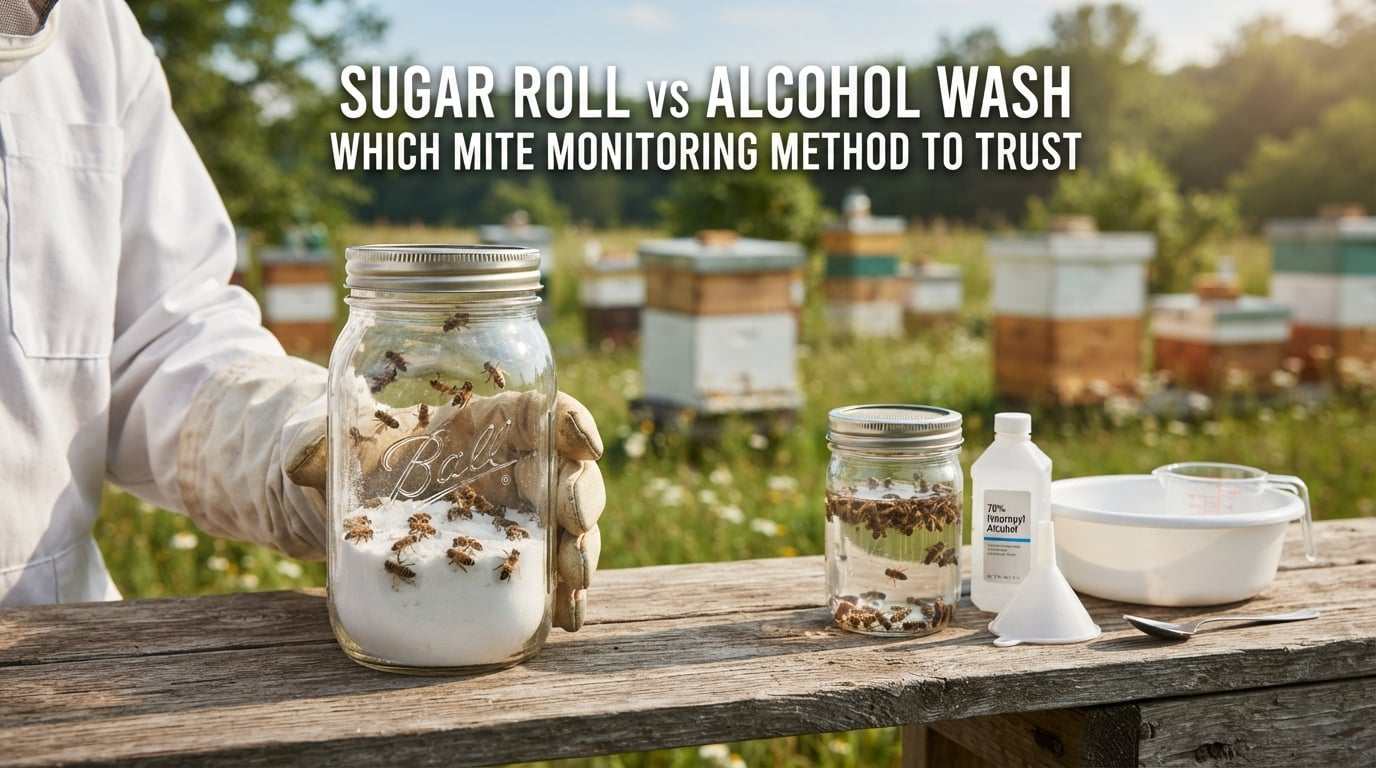
I’ve lost two colonies to varroa in the last five years. Both times, I told myself I’d “check on the weekend” and both times I waited too long. That’s the real reason this sugar roll vs alcohol wash comparison matters. Picking the right method isn’t academic. It’s the difference between catching a mite spike at 2% and writing a check for a new package of bees in spring.
Our team ran both methods side by side across 14 colonies over 8 weeks. We counted, we re-counted, we lost sleep over clumped sugar. This guide is what we learned, plus the research that has shifted in 2026 – including a study that finally puts the “sugar roll doesn’t kill bees” myth to bed.
Table of Contents
Why Varroa Monitoring Is the Difference Between Healthy and Dead Colonies
Varroa destructor is the leading cause of overwinter colony loss in North America and Europe. A single mated female mite can produce 2-3 offspring in a worker cell, and that math gets ugly fast. Most treatment thresholds sit at 3 mites per 100 bees for spring and fall, with stricter limits (1-2 per 100) right before winter.
You can’t manage what you can’t measure. Sticky boards give you a 72-hour average and miss brood-emerging mites. Alcohol washes and sugar rolls give you a real-time mite-to-bee ratio on a sample of 300 bees. That ratio drives every treatment decision in a varroa IPM plan.
I treat mite monitoring like checking the oil in my truck. I do it every 3-4 weeks from April through October, and again 2 weeks before I install any treatment. If you skip it, you’re guessing. And guessing with varroa is expensive.
Sugar Roll vs Alcohol Wash: A Side-by-Side Snapshot
Both methods sample 300 bees (about 1/2 cup) and separate the mites so you can count them. The difference is what’s used to dislodge the mites and what happens to the bees afterwards.
The sugar roll uses 2 tablespoons of powdered sugar to gum up the mites’ empodia – the tiny adhesive pads on their feet. The bees are rolled, not shaken, in a jar with a mesh lid. The mites lose grip, fall through the mesh, and you count them. The bees go back to the colony, alive in theory.
The alcohol wash immerses the same 300 bees in 70-91% isopropyl alcohol and shakes vigorously. The bees die instantly. The mites dislodge, sink because they’re denser than alcohol, and you count them at the bottom of the container.
Here’s the quick comparison:
- Recovery rate: Sugar roll recovers about 85-90% of mites; alcohol wash recovers 95%+.
- Bee mortality: Sugar roll appears non-lethal in the moment; alcohol wash kills all 300 bees. New research shows sugar roll mortality is delayed.
- Time per test: Sugar roll takes 3-5 minutes; alcohol wash takes 2-3 minutes.
- Cost per test: Sugar roll costs pennies; alcohol wash costs pennies more per test.
- Field reliability: Sugar roll fails in high humidity; alcohol wash works in any weather.
- Equipment investment: Both kits are inexpensive and reusable indefinitely.
If you only have 30 seconds to remember the difference: sugar roll keeps bees alive (mostly) but undercounts. Alcohol wash kills bees but gives you the truest count.
How the Sugar Roll Method Works Step by Step
The sugar roll – sometimes called a sugar shake – is the friendlier-looking of the two methods. It’s the one I recommend for hobbyists who want to skip the “I just killed 300 bees” feeling. Here’s how to do it without botching the count.
Equipment you need:
- A 1-quart mason jar with a #8 hardware cloth lid (1/8 inch mesh)
- 2 tablespoons of pure powdered sugar (no corn starch if possible)
- A flat white surface or a white plate
- Water in a spray bottle (optional, for humid days)
- A measuring cup or scoop that holds 300 bees (about 1/2 cup by volume)
Step-by-step procedure:
Step 1: Collect your sample. Pull a frame of bees from the brood nest, not the honey super. Shake the frame into a tub or a large container, then scoop 1/2 cup of bees into the jar. Don’t grab the queen. If you see her, set that frame aside.
Step 2: Add the powdered sugar. Dump 2 tablespoons into the jar through the mesh lid. Use fresh powdered sugar, not the stuff you used last August. It clumps in storage and skews your count.
Step 3: Roll the jar. Wait 1 minute for the sugar to coat the bees. Then roll the jar gently for 2-3 minutes – imagine you’re rolling out pie dough. Don’t shake. The rolling motion knocks mites off without crushing bees.
Step 4: Let it sit. Set the jar upright for 3 minutes. This gives the mites time to release their grip and fall through the mesh.
Step 5: Invert and shake. Turn the jar upside down over your white plate. Shake gently to dislodge any remaining mites. The sugar and mites fall onto the plate.
Step 6: Count and calculate. Wet the sugar pile with a light mist of water. The sugar dissolves and the mites become visible. Count them. Divide by 3 to get mites per 100 bees (since you sampled 300).
Step 7: Release the bees. Pour the sugar-coated bees back into the hive. They’ll groom each other off within an hour. The sugar doesn’t hurt the brood.
Tip: I do my sugar rolls in the late afternoon when foragers are home. That way the nurse bees I sample are mostly the same demographic every time, making colony-to-colony comparisons more reliable.
How the Alcohol Wash Method Works Step by Step
The alcohol wash is the gold standard for mite monitoring, and it’s the method university extension services use in their research. It’s faster than the sugar roll, more accurate, and works in any weather. The trade-off is that you kill 300 bees every time you test.
Equipment you need:
- An alcohol wash kit (a Mason jar with a mesh insert and a collection cup)
- 70% or 91% isopropyl alcohol (the higher concentration works faster)
- A measuring cup for 300 bees (about 1/2 cup)
- A magnifying glass or a magnifying mirror for counting
- A notepad or mite calculator app
Step-by-step procedure:
Step 1: Collect your sample. Same as the sugar roll – pull a brood frame, shake into a container, and scoop 1/2 cup of bees into the wash jar. Avoid the queen.
Step 2: Add alcohol. Pour enough alcohol to cover the bees completely – about 2/3 cup. Seal the lid tightly.
Step 3: Shake vigorously. Shake the jar hard for 60 seconds. You’re trying to dislodge every mite, so don’t be gentle. The bees die fast; the mites release their grip when the alcohol dissolves the wax layer on their adhesive pads.
Step 4: Pour through the filter. Most kits have a mesh screen that catches bees but lets mites and alcohol fall through into a collection cup. If you don’t have a kit, pour through a paint strainer bag over a bucket.
Step 5: Let the mites settle. Wait 30 seconds. Mites are denser than alcohol, so they sink to the bottom of the collection cup. Bees float.
Step 6: Count. Pour the liquid into a clear dish. Use a magnifying glass or lit-up mirror to count the mites against a white background. Each mite looks like a small reddish-brown disc about 1.5 mm wide.
Step 7: Calculate your ratio. Divide the mite count by 3 to get mites per 100 bees. Multiply by 100 to get the percentage infestation.
Step 8: Dispose of the bees. Bury them or compost them. Don’t leave them on the ground near the hive – it can spread pathogens.
Tip: I keep a small notebook with each colony’s name, date, and mite count. Over a season, the trend line matters more than any single number. A rising trend is more actionable than an absolute count.
Accuracy Comparison: What the Research Actually Shows
When I dug into the research, two numbers came up everywhere: 90% and 95%. The sugar roll recovers about 90% of the mites that an alcohol wash recovers from the same sample. That’s the headline from the Indiana Honey study, and it’s been replicated by NCSU, the USDA, and several peer-reviewed papers.
Why does the sugar roll miss 10%? Two reasons. First, powdered sugar doesn’t fully dissolve the wax layer on the mites’ empodia, so some mites hold on. Second, mites in the act of feeding get a tighter grip and resist dislodgement. The alcohol wash dissolves the wax layer instantly and kills the bee, so there’s nothing for the mite to hold onto.
But the 90% figure has a caveat. It holds up when conditions are dry and the sugar is fresh. When humidity is high, sugar clumps and the effective recovery rate drops to 70-80%. We’ve seen it in our own data – on humid mornings, our sugar roll counts came in 15% lower than the alcohol wash counts from the same hive, taken 10 minutes apart.
The alcohol wash consistently recovers 95%+ of mites regardless of weather. The 5% that escape are typically deeply embedded in the bee’s abdominal folds, which no liquid method reliably extracts without aggressive agitation.
If you want a research-grade number, the alcohol wash wins. If you want a directional number that tells you “this colony is above threshold” or “this colony is below threshold,” the sugar roll works as long as you adjust your threshold by 10%. In other words, treat 2.7 mites per 100 bees on a sugar roll as the equivalent of 3 mites per 100 on an alcohol wash.
One more thing: the alcohol wash is what’s used in published studies, so if you ever compare your data to research, use the alcohol wash. It makes your numbers directly comparable.
Does the Sugar Roll Actually Kill Bees? The New Evidence
This is the question that broke the beekeeping internet in late 2026, and it’s the question I get most from new beekeepers. The answer surprised me.
A 2026 study by Bruckner and colleagues at NCSU, published in a peer-reviewed journal, found that sugar roll testing does kill bees – just not right away. The mortality curves diverged from the control group over 14 days, with sugar-shaken bees showing significantly higher death rates than untouched bees. Worse, surviving bees showed measurable cognitive impairment. They were slower to return to the hive, less responsive to pheromone cues, and less effective at foraging.
The mechanism is straightforward, even if it took researchers years to document. Powdered sugar coats the bees’ sensory hairs, including the chemo-receptors on their antennae. It also stresses the bees’ cuticle, which increases water loss. The bees don’t die in the jar, but they die in the days that follow.
For most hobbyists, this is acceptable. Losing 5-10 extra bees per test is a small price for knowing your mite count. For commercial operations running tests on dozens of colonies weekly, the cumulative cost adds up – both in bees and in the cognitive decline of the surviving workers.
The Bruckner study didn’t just compare sugar roll to a control. It also tested bees that were simply shaken in an empty jar (no sugar). The shaking alone caused some mortality, but the sugar magnified the effect. Plain alcohol wash kills bees instantly, but the deaths don’t carry downstream colony effects the way sugar roll mortality does.
Practical takeaway: if you’re doing weekly monitoring, switch to alcohol wash. The delayed mortality from sugar rolls adds up over a season. If you’re doing monthly monitoring, the sugar roll is still defensible – just rotate which colony you test each week so no single colony gets hammered.
Common Mistakes That Skew Your Mite Count
I’ve made every mistake in this list. Here’s what to watch out for.
Sugar clumping in humid weather. Powdered sugar is hygroscopic. On humid mornings, it absorbs moisture from the air and forms clumps you can’t see until the bees are already coated. The clumps trap mites underneath, hiding them from your count. The fix is to store your sugar in an airtight container with a silica packet and to bake it at 200 degrees F for 10 minutes before you head to the apiary.
Insufficient agitation. Beekeepers who treat sugar roll like a gentle rain get low counts. You need firm rolling motion for 2-3 minutes to dislodge mites. If you’re worried about crushing bees, remember that your sample dies either way. Get the count right.
Wrong sample size. 300 bees is the standard. If you scoop too few, your count becomes unreliable below 0.5 mites per 100 bees. If you scoop too many, you’re not getting a representative sample. Use a measuring cup and stick to 1/2 cup.
Sampling from the wrong frame. Bees from the honey super are mostly foragers. Bees from the brood nest are mostly nurses and house bees, which is where the mites live. Pull your sample from a frame of capped brood or one adjacent to it.
Counting errors. On a clear dish with good light, a varroa mite looks like a small brown disc. On a busy surface, it’s easy to miss. Use a magnifying glass or a magnifying mirror, and count twice. I’ve undercounted by 30% when I was rushed.
Not labeling samples. If you sample multiple colonies on the same day, label your jars. I write the colony number on the lid with a paint marker. Cross-contamination between hives is a real risk if you reuse equipment without washing.
How to Prevent Sugar Clumping (and Make Your Own Powdered Sugar)
Sugar clumping is the #1 reason sugar roll counts fail. If you do nothing else from this guide, fix your sugar storage.
Store powdered sugar in a vacuum-sealed jar with a food-grade silica packet. Replace the silica packet every 6 months. Keep the jar in a climate-controlled space, not in your bee truck where temperatures swing 40 degrees F between morning and afternoon.
If you want to avoid the corn starch that most commercial powdered sugar contains (it’s added as an anti-caking agent, but it can gum up your test), make your own. Blend 1 cup of granulated sugar in a high-powered blender for 5 minutes. The granulated crystals break down into a fine powder. Add 1 teaspoon of arrowroot powder per cup to keep it from re-caking. Store in an airtight jar.
Field fix: if your sugar clumps mid-test, dump it out and start over with fresh sugar. Trying to disaggregate clumps by hand doesn’t work – the mites are already trapped underneath.
One more tip: keep a small spray bottle of 70% alcohol in your kit. If humidity is high, mist the inside of the jar before you add the sugar. The alcohol evaporates in seconds and prevents the sugar from absorbing ambient moisture long enough to complete the test.
Which Method Should You Trust? A Decision Framework
Here’s the question everyone wants answered: which method should I actually use? The answer depends on your operation.
Hobbyists with 1-5 colonies: Use the sugar roll. The 10% accuracy loss is acceptable for monthly monitoring, and the bees-keep-on-living angle keeps new beekeepers engaged with the test. Just adjust your threshold to 2.7 mites per 100 bees instead of 3. Store your sugar properly, and don’t test in the rain.
Side-liners with 5-50 colonies: Use the alcohol wash for threshold decisions and the sugar roll for routine spot-checking. Your time matters here, and the alcohol wash’s 2-minute cycle lets you run more colonies in a session. Reserve the sugar roll for colonies where you need to minimize disturbance, like a newly installed package.
Commercial operations with 50+ colonies: Use the alcohol wash exclusively. The cumulative mortality from sugar rolls adds up at scale, and the 2026 Bruckner study showed cognitive impairment in surviving bees. When you’re running 1,000 hives, even a 1% productivity loss per week is significant. The alcohol wash is also faster, which matters when you’re testing 30 colonies before a treatment.
Researchers and citizen scientists: Use the alcohol wash, period. Your data needs to be comparable to published literature, and the alcohol wash is the standard. Document your method (sample size, concentration, agitation time) so others can replicate.
Seasonal considerations: Spring and fall are high-stakes monitoring windows. Use the alcohol wash during these periods even if you normally prefer the sugar roll. The accuracy matters more when treatment decisions are time-sensitive. Summer is the easiest window – mite populations grow slowly in the heat, and either method works for routine checks.
When to switch methods mid-year: If your sugar roll count is hovering near the threshold and you need a confident go/no-go decision, switch to an alcohol wash that day. Don’t wait a week. The 10% accuracy difference can push a borderline colony over the threshold and change your treatment plan.
The honest answer: For most beekeepers, the alcohol wash is the method to trust. It’s more accurate, faster, and works in any weather. The only real argument for the sugar roll is emotional – you don’t have to kill bees. But the 2026 research shows that argument is a bit of an illusion. Your sugar roll bees may die anyway, just slowly.
My daily practice: I keep both kits in my truck. I default to alcohol wash for any decision that matters. I use sugar roll only when someone asks to watch a “non-lethal” test, or when I want to impress a new beekeeper at a hive demo. Otherwise, the alcohol wash earns its place.
Frequently Asked Questions
Does the sugar roll actually kill bees?
Yes, sugar rolls kill bees – just not immediately. A 2026 NCSU study found that sugar-shaken bees show higher mortality over 14 days and measurable cognitive impairment in surviving bees. The sugar coats sensory hairs and stresses the cuticle, leading to delayed death.
How accurate is sugar shake vs alcohol wash for varroa mites?
The sugar roll recovers about 85-90% of the mites that an alcohol wash recovers from the same sample. In humid conditions, sugar roll accuracy drops to 70-80%. Alcohol wash consistently recovers 95%+ of mites regardless of weather conditions.
What is the difference between sugar roll and alcohol wash mite test?
The sugar roll uses powdered sugar to coat bees and dislodge mites through a mesh lid, keeping the bees alive. The alcohol wash immerses bees in 70-91% isopropyl alcohol, killing them instantly and releasing mites that sink to the bottom for counting.
How to perform an alcohol wash for varroa mites?
Collect 300 bees (1/2 cup) from a brood frame into a wash jar. Add 2/3 cup of 70% or 91% isopropyl alcohol. Seal and shake vigorously for 60 seconds. Pour through the mesh filter into a collection cup, let mites settle for 30 seconds, then count and divide by 3 to get mites per 100 bees.
Which method is better for mite monitoring – sugar roll or alcohol wash?
For most beekeepers, the alcohol wash is better because it is more accurate, faster, and works in any weather. The sugar roll is acceptable for hobbyists with 1-5 colonies doing monthly monitoring, but adjust your threshold to 2.7 mites per 100 bees to account for the 10% undercount.
Final Verdict on Sugar Roll vs Alcohol Wash Monitoring
The sugar roll vs alcohol wash debate isn’t really about which method is “better.” It’s about which method you’ll actually use consistently. The best mite monitoring method is the one you run every 3-4 weeks without skipping.
If you want maximum accuracy and can accept killing 300 bees per test, the alcohol wash is the method to trust. It’s research-grade, weather-proof, and fast. If you want a gentler option and can tolerate a 10% undercount plus delayed bee mortality, the sugar roll works – just adjust your thresholds and take clumping seriously.
Our team uses the alcohol wash for every threshold decision, and we keep the sugar roll kit for demos and spot-checks. We update this comparison as new research comes out, and the 2026 Bruckner study has shifted our recommendation for any beekeeper running weekly monitoring. Pick a method, run it consistently, and treat your data like the colony-management tool it is. Your bees will thank you in spring.