
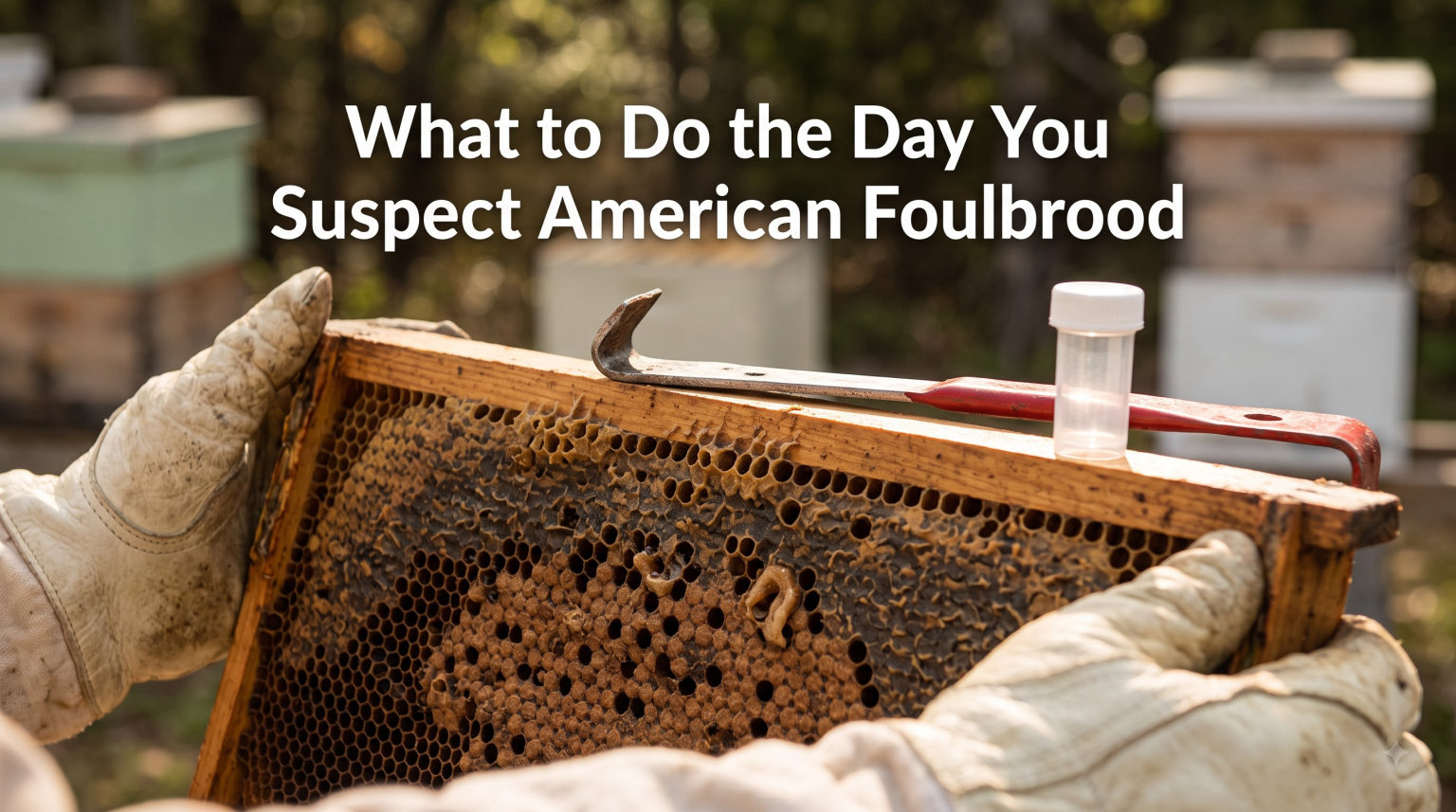
The moment you spot something wrong in your brood frames, your stomach drops. A sunken, greasy-looking cell here, a punctured capping there, and maybe a faint smell that doesn’t belong. If you’re wondering what to do when you suspect American foulbrood, you’re in the right place.
Here’s the short version: stop inspecting, close the hive, and call your apiary inspector immediately. American foulbrood (AFB) is a reportable disease in every U.S. state and Australian territory. It cannot be cured, and every minute you spend second-guessing or continuing to work your hives increases the risk of spreading spores to your other colonies.
I’ve talked with beekeepers on forums like r/Beekeeping and BeeSource who have been through this exact situation. The stories share a common thread: the faster you act, the better your chances of protecting the rest of your apiary. The beekeepers who hesitated or hoped it would resolve on its own lost multiple hives.
In this guide, I’ll walk you through exactly what to do on the day you suspect AFB. We’ll cover how to confirm your suspicion with the ropiness test, the step-by-step actions to take right now, the difference between AFB and the treatable European foulbrood (EFB), and what happens after diagnosis.
I’ll also address the emotional side that no other guide talks about. Destroying a colony you’ve nurtured for months or years is devastating, and the beekeepers I’ve spoken with all say the same thing: having a clear plan helps you get through it.
Let’s start with understanding exactly what you’re dealing with.
Table of Contents
What is American Foulbrood?
American Foulbrood (AFB) is a fatal bacterial disease of honey bee brood caused by the spore-forming bacterium Paenibacillus larvae. It kills developing bee larvae and cannot be cured with any treatment available today.
The disease works through a simple but devastating mechanism. Nurse bees feed spores to larvae under 24 hours old while providing brood food. A single larva needs to ingest only about 10 spores to become infected. Once inside the larval gut, the spores germinate, and the bacteria multiply rapidly, eventually killing the brood at the pre-pupal or pupal stage.
What makes AFB so dangerous is the spore itself. Paenibacillus larvae spores can remain viable for more than 50 years. They resist heat, cold, drought, and most common disinfectants. A hive that housed an infected colony decades ago can still sicken new bees if the equipment is reused without proper sterilization.
This is why destruction of infected colonies and hives, or irradiation of infected material, is the only recognized management option. Antibiotics like oxytetracycline can temporarily suppress symptoms by masking visible signs of the disease. They do not kill spores. Once antibiotic treatment stops, the disease returns, often worse than before because the beekeeper has unknowingly spread contaminated equipment and honey throughout the apiary.
If you suspect AFB, understanding this spore biology explains why every recommendation in this guide leans toward caution and speed.
Recognizing American Foulbrood: Symptoms to Watch For
The symptoms of AFB appear in the capped brood area of the frame. Knowing exactly what to look for can save your entire apiary from infection.
Sunken and Perforated Cappings
Sunken and perforated cappings are usually the first visual sign beekeepers notice. Healthy brood cappings are raised and uniform across the frame. When a larva dies from AFB inside the cell, the capping above it sinks inward and often turns dark brown or black.
Worker bees attempting to clean out the dead brood create small holes in the cappings, giving them a perforated or peppered appearance. If you see cappings that look like they’ve been repeatedly pinpricked, take a closer look.
Patchy Brood Pattern
A patchy or spotty brood pattern develops as the disease progresses through the colony. Instead of a solid wall of capped cells, you’ll see healthy and dead brood mixed together in an irregular, scattered arrangement.
This happens because some larvae were infected while others weren’t. The result is a brood frame that looks distinctly different from the even, compact pattern of a healthy hive.
Greasy Appearance and Foul Smell
The cappings may also develop a greasy or wet appearance. This is caused by the decaying larval remains seeping through the perforations in the wax.
A distinct sulphurous or foul smell often accompanies advanced infections. Some beekeepers describe it as resembling a dead animal or rotting protein. The smell comes from the decomposing brood and is where the disease gets its “foulbrood” name.
However, early infections may not produce a noticeable smell. The absence of any odour does not rule out AFB, so don’t let a normal-smelling hive lull you into a false sense of security.
Pupal Tongue and Scale Formation
The pupal tongue is one of the most diagnostic signs of AFB. When a pupa dies from the disease, its tongue sometimes sticks straight up from the remains, visible through the perforated capping. This upright tongue is nearly unique to AFB and serves as a strong confirmatory sign.
Scale formation occurs in the final stage of the disease cycle. The dead larval remains dry down to a dark, hard scale that adheres tightly to the bottom wall of the cell. These scales contain billions of spores and are incredibly difficult to remove, even with a hive tool scraped firmly across them.
How to Perform the Ropiness Test
The ropiness test, also called the matchstick test, is the simplest field diagnostic for AFB that a beekeeper can perform without lab equipment. Here is how to do it step by step.
Step 1: Find a Suspect Cell
Look for a cell with a sunken, perforated, or dark-colored capping in the capped brood area. The cell should contain decaying or dried larval remains, not an empty cell that has already been cleaned out by the bees.
Step 2: Insert a Matchstick or Toothpick
Push a matchstick, toothpick, or small stick straight down through the capping into the larval remains. Go about 1 to 2 centimeters into the cell.
Step 3: Slowly Withdraw the Stick
Pull the stick straight up and out of the cell at a slow, steady pace. Watch the material that adheres to the end of the stick as you withdraw it.
Step 4: Observe the Result
If the material stretches into a brown, ropy thread of 1 to 2 centimeters before snapping and retracting back into the cell, this is a positive ropiness test. The ropy consistency comes from the bacterial breakdown products of the dead larva, and it strongly indicates AFB.
A negative result looks different. If the material comes out watery, granular, or doesn’t string out at all, you may be looking at European foulbrood or another brood condition entirely.
Step 5: Test Multiple Cells
Always perform the ropiness test on several suspect cells if possible. A single test can sometimes be ambiguous, but finding ropy material across multiple cells in the same hive is a very strong indicator of AFB.
One important caution: the ropiness test is a field diagnostic, not a laboratory confirmation. Only a lab test or a trained apiary inspector can give you a definitive diagnosis. Treat any positive ropiness result as a reason to stop, close the hive, and contact your inspector before doing anything else.
What to Do the Day You Suspect American Foulbrood
If you suspect AFB, follow these steps in order. Your goal today is to confirm the suspicion, prevent spore spread, and get professional help as quickly as possible.
Step 1: Stop Inspecting Immediately
The moment you see suspect symptoms, close the hive. Do not continue pulling frames or moving through the colony. Every frame you pull and every tool you use can pick up spores and carry them to other hives in your apiary.
Step 2: Isolate Your Tools
The hive tool, gloves, smoker, and any frame you’ve already pulled are now potentially contaminated. Place them on a surface where they won’t come into contact with other equipment. Don’t set them on top of your other hive boxes or on shared work surfaces.
Step 3: Take Photos
If you can do so without further disturbing the hive, document the symptoms you saw. Photograph the sunken cappings, perforated cappings, and the brood pattern. If you performed a ropiness test, photograph the ropy thread on the matchstick.
These photos will help your apiary inspector assess the situation quickly and may save you time waiting for an in-person visit.
Step 4: Perform the Ropiness Test
If you haven’t already done so, follow the ropiness test procedure described above. Use a disposable toothpick or matchstick and discard it immediately in a sealed plastic bag afterward.
Step 5: Contact Your Apiary Inspector
This is the single most important step in the entire process. AFB is a reportable disease in every U.S. state and in all Australian states and territories. Your inspector can provide a definitive diagnosis, guide you on legal requirements, and help you through the destruction or irradiation process.
To find your inspector, search online for your state name plus “apiary inspection service” or contact your state’s department of agriculture. For example, the Texas Apiary Inspection Service explicitly asks beekeepers to contact them at the first suspicion of American foulbrood, not after confirmation.
Do not wait for laboratory confirmation before reaching out. Your inspector would rather hear from you early than after the disease has spread.
Step 6: Don’t Open Other Hives With the Same Equipment
This is where many beekeepers accidentally spread the disease without realizing it. If you were mid-inspection when you noticed the symptoms, your gloves, hive tool, and smoker may already carry spores. Use only clean, disinfected tools for any remaining inspections, or better yet, stop inspecting for the day.
Step 7: Mark the Suspect Hive
Place a visible marker or written note on the hive so you or anyone else doesn’t accidentally work it. If you manage multiple bee yards, clearly identify which location has the suspect colony so nothing gets confused during follow-up.
Step 8: Don’t Move the Hive or Equipment
Resist the urge to relocate the suspect colony to an isolated position. Moving infected equipment is one of the primary ways AFB spreads between apiaries. Leave everything exactly in place until your inspector advises you on next steps.
Step 9: Don’t Feed Honey From the Suspect Hive
Never feed honey from unknown or suspect sources to your colonies. AFB spores survive perfectly well in honey, and feeding contaminated honey is a direct pathway to infecting healthy hives. This applies to honey from the suspect hive, purchased honey, and honey from any unknown origin.
Step 10: Plan Next Steps With Your Inspector
Depending on the diagnosis, you’ll discuss either destruction by burning or irradiation of the equipment. Your inspector will walk you through the legal requirements and proper procedures for your specific state or territory.
Step 11: Notify Neighboring Beekeepers
If there are other beekeepers within foraging range of your apiary, your inspector may recommend informing them. Bees can spread AFB through robbing behavior when a colony is weak, and neighboring hives may need monitoring as a precaution.
Step 12: Change and Wash Your Clothes
After handling a suspect hive, your bee suit and gloves may carry spores on the fabric. Wash everything in hot water as soon as possible. Some experienced beekeepers keep a dedicated set of protective gear specifically for working suspect or quarantined hives.
Step 13: Clean and Sterilize Your Hive Tool
Scorch your hive tool with an open flame or dip it in a strong bleach solution after working the suspect hive. For smokers, the high internal heat generally kills spores, but you should still clean the exterior surfaces before using the smoker on other colonies.
What NOT to Do
Don’t panic, but don’t delay either. Don’t try to treat the colony with antibiotics on your own. Don’t try to requeen your way out of it. Don’t assume it might be EFB and wait to see if the symptoms resolve on their own.
These responses come up constantly in forum discussions, and they consistently lead to worse outcomes. Every beekeeper who shared their story of losing multiple hives mentioned one of these missteps.
American Foulbrood vs European Foulbrood
Telling AFB apart from European foulbrood (EFB) is one of the most important diagnostic skills in beekeeping, because the management actions are completely different. EFB is treatable. AFB is not.
The table below summarizes the key differences between the two diseases.
| Feature | American Foulbrood (AFB) | European Foulbrood (EFB) |
|---|---|---|
| Causative organism | Paenibacillus larvae (spore-forming) | Melissococcus plutonius (non-spore-forming) |
| Stage affected | Capped brood (older larvae and pupae) | Open brood (uncapped larvae) |
| Color of dead larvae | Dark brown to black | Yellowish to brown |
| Larval position | Lies flat along cell bottom | Twisted, coiled, or melted appearance |
| Ropiness test | Positive (ropy brown thread) | Negative (granular or watery) |
| Smell | Sulphurous, like rotting protein | Sour, acid-like |
| Scale | Hard, dark, adheres tightly to cell wall | Soft, rubbly, easy to remove |
| Treatment | No cure. Destruction or irradiation required. | Treatable with antibiotics and good nutrition |
| Spore longevity | 50+ years | Does not form resistant spores |
EFB affects open, uncapped brood. The affected larvae appear twisted, coiled, or melted in their cells, often with a yellowish coloration. EFB produces a sour, acid-like smell rather than the sulphurous rotting smell characteristic of AFB.
AFB affects capped brood. The larvae die after the cell is sealed, which is why you observe sunken, perforated cappings as the primary sign. The ropiness test is positive in AFB and negative in EFB.
The most important practical difference is this: EFB can sometimes resolve on its own with good nectar flow and strong colony health, and it can be treated with antibiotics under veterinary supervision. AFB cannot be cured by any means. Antibiotics only mask the symptoms temporarily while spores remain viable.
If you’re unsure which disease you’re looking at, treat it as if it’s AFB. Contact your inspector for a definitive diagnosis. Misidentifying AFB as EFB and attempting treatment would only delay proper management and spread spores further through your equipment.
Destruction vs Irradiation: Managing Infected Equipment
Once AFB is confirmed, you have two recognized management options: destruction by burning or irradiation of equipment. Your apiary inspector will help you decide which approach is appropriate for your situation.
Destruction by Burning
Burning is the traditional and most definitive method of managing an AFB-infected colony. The process typically involves killing the bees humanely, burning the colony along with the frames and wax, and then burying or containing the ashes.
Wooden hive boxes can sometimes be scorched with a flame and reused if your inspector approves. However, the frames, comb, and all wax must be destroyed completely. The fire eliminates the spores entirely, leaving no risk of reinfection from the affected materials.
The specifics of burning vary by location and regulation. Some states require the inspector to be present during the burn. Some specify particular methods for disposing of the live bees. Your inspector will provide the exact protocol required for your area.
Irradiation
Irradiation is the alternative for beekeepers who want to save their wooden equipment rather than burn it. Frames and hive components are sent to a commercial gamma irradiation facility, which kills the AFB spores without damaging the wood.
After irradiation, the equipment can be safely reused with new foundation and bees. The catch is that you must remove all bees and wax from the equipment before sending it, and you typically need to ship the material to a facility that offers this service.
Irradiation tends to be more practical for commercial beekeepers with large amounts of affected equipment than for hobbyists with one or two boxes. Your inspector can tell you whether irradiation facilities are available in your region.
What About Bleach, Freezing, or Boiling?
This question comes up constantly on beekeeping forums. Bleach does not reliably kill AFB spores. Some beekeepers soak equipment in strong bleach solutions, but the scientific evidence is mixed at best, and this is not a recognized management method by any apiary inspection service.
Freezing, boiling water, and prolonged UV exposure also do not reliably kill Paenibacillus larvae spores. These spores evolved to survive extreme environmental conditions, and they are exceptionally good at it. Don’t rely on household methods to sterilize AFB-contaminated equipment.
Protecting Your Remaining Hives
The day you suspect AFB, your focus needs to shift from the affected hive to every other colony in your apiary. Here is how to protect the rest of your bees.
Inspect the Suspect Hive Last
If you have a suspect hive, always work it at the very end of your inspection route. This way, any spores on your tools or gloves won’t be transferred to healthy colonies earlier in the day. Better yet, don’t inspect your other hives at all until you have a confirmed diagnosis.
Use the Barrier Management System
Barrier management means keeping equipment organized by yard or group and never sharing frames, boxes, or tools between apiaries. Label every piece of equipment so you know exactly where it has been.
If AFB appears in one yard, you want to be able to trace precisely which equipment has been exposed and which hasn’t. This system limits the blast radius of any disease outbreak.
Sterilize Tools Between Every Hive
Scorch your hive tool with a flame between every colony you inspect. Some beekeepers carry a small propane torch or use their smoker flame for this purpose. This is a good habit to maintain at all times, not just when AFB is suspected.
Watch Remaining Colonies Closely
After an AFB diagnosis, inspect every hive in the apiary every 7 to 10 days for at least a full month. Look for the same symptoms you now know to recognize: sunken cappings, patchy brood patterns, foul smell, and ropy larval remains.
Early detection in a second hive can prevent a total apiary loss. AFB spreads fast through shared equipment and robbing, so vigilance in the weeks following a diagnosis is essential.
Don’t Combine Hives or Swap Frames
If you have a weak colony nearby, resist the urge to strengthen it with resources from the suspect hive. You could easily be transferring spores along with the bees, honey, or pollen. No frame or resource from the affected apiary should enter another hive until an inspector clears it.
Feed Only Trusted Sources
Never feed honey from unknown sources, purchased honey, or honey from the suspect hive to any of your colonies. AFB spreads through contaminated honey and pollen. Stick to your own known-clean honey or commercial sugar syrup for feeding.
When You Have to Destroy a Colony: The Emotional Reality
No other guide on American foulbrood talks about this, but it matters deeply. Losing a colony to AFB is emotionally devastating, and beekeepers who have been through it deserve to hear this acknowledged.
On r/Beekeeping and BeeSource, I’ve read dozens of firsthand accounts from beekeepers who had to burn their hives. The emotion is raw and real. You’ve invested months of care, watched the colony grow from a package or nuc, and now you have to destroy it. Beekeepers describe feeling grief, guilt, and frustration all mixed together.
Here’s what experienced beekeepers want you to know: this is not your fault. AFB spores are present throughout the environment. They can arrive through purchased package bees, contaminated second-hand equipment, robbing of infected wild colonies, or even bees drifting between apiaries. Even the most careful, diligent beekeeper can encounter AFB.
Acting quickly is the kindest thing you can do for your remaining bees. Destroying one infected colony prevents the suffering and death of many more. The beekeepers who delayed, hoping for a different outcome, almost universally say they wish they had acted sooner and followed the protocol from day one.
Talk to other beekeepers about what you’re going through. The beekeeping community is remarkably supportive, and many experienced beekeepers have been through this exact situation themselves. Your apiary inspector has seen it many times and can often connect you with local beekeeping groups and resources to help you rebuild.
FAQs
What to do if you have American foulbrood?
If you have or suspect American foulbrood, contact your apiary inspector or state apiarist immediately. AFB is a reportable disease in every U.S. state and Australian territory. The only recognized management options are destruction of the infected colony and equipment by burning, or irradiation of equipment at a commercial facility. There is no cure, and antibiotics only mask symptoms temporarily.
How do you tell if you have American foulbrood?
Look for sunken and perforated cappings on capped brood cells, a patchy brood pattern, dark brown or black dead larvae, and a sulphurous foul smell. The ropiness test is the simplest field diagnostic: insert a toothpick into a suspect cell, withdraw slowly, and if the material stretches into a brown ropy thread of 1 to 2 centimeters, AFB is strongly indicated. Only a lab test or apiary inspector can give a definitive diagnosis.
What does American foulbrood smell like?
American foulbrood produces a sulphurous, foul smell that many beekeepers compare to rotting protein or a dead animal. The odour comes from the decomposing brood inside the capped cells. However, early infections may not produce a noticeable smell, so the absence of odour does not rule out AFB.
What kills AFB spores?
AFB spores produced by Paenibacillus larvae are extremely resistant and can survive for over 50 years. The only reliable methods that kill them are fire (burning the infected materials) and gamma irradiation at a commercial facility. Bleach, boiling water, freezing, and UV exposure do not reliably kill AFB spores.
Is American foulbrood reportable?
Yes. American foulbrood is a legally reportable disease in every U.S. state and in all Australian states and territories. If you suspect or detect AFB, you are required to contact your apiary inspector or state department of agriculture immediately. Failure to report can result in legal penalties and increases the risk of spreading the disease to neighboring apiaries.
Can you treat American foulbrood with antibiotics?
Antibiotics such as oxytetracycline can temporarily suppress the visible symptoms of AFB, but they do not kill the spores. Once treatment stops, the disease typically returns, often worse because the beekeeper has unknowingly spread contaminated equipment. Antibiotics are not a cure and are not a substitute for destruction or irradiation of infected materials.
Conclusion
Suspecting American foulbrood in your hive is one of the most stressful moments a beekeeper can face. But knowing what to do when you suspect American foulbrood makes the difference between losing one colony and losing your entire apiary.
The protocol comes down to a few key actions: stop inspecting, close the hive, isolate your tools, perform the ropiness test, and call your apiary inspector immediately. Don’t move the hive, don’t share equipment, don’t feed suspect honey, and don’t try to treat with antibiotics on your own.
AFB spores are relentless, surviving for over 50 years and resisting nearly every disinfectant available. That is why destruction or irradiation remains the only effective management path. Acting fast is not just the right thing to do for your remaining bees. It is the only thing that works.
If you’re reading this because you suspect AFB right now, take a breath and follow the steps in this guide. You have a plan. Call your inspector, follow their guidance, and know that beekeepers before you have rebuilt successfully from exactly this situation.