
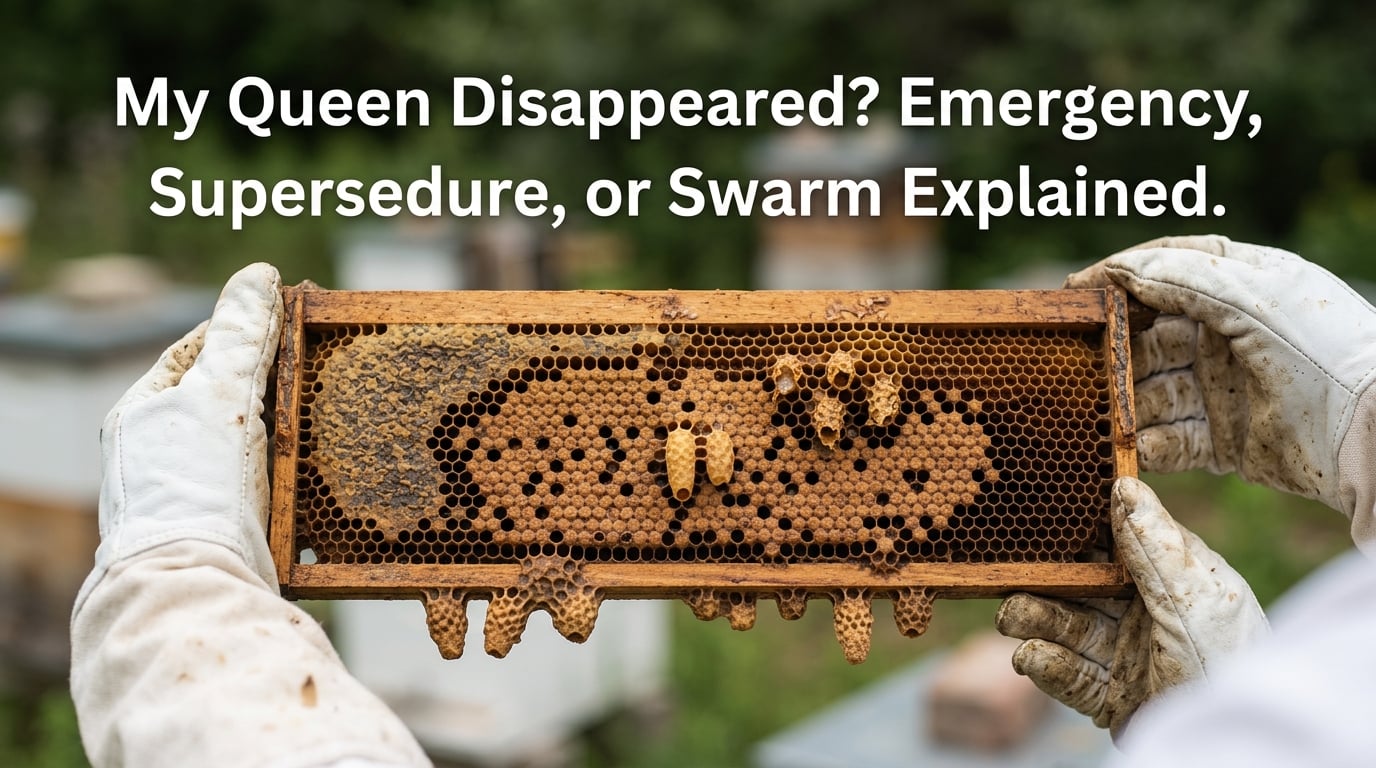
You open the hive, scan the frames, and your stomach drops: your queen bee disappeared. Before you panic, take a breath. In most cases, your colony has already started solving the problem. Bees build three different kinds of queen cells, and each one tells a different story about what happened. I have walked dozens of new beekeepers through this exact moment, and the answer almost always lies in the shape, location, and number of cells you find.
This guide walks you through how to read your hive after a queen disappears. You will learn the difference between swarm cells, supersedure cells, and emergency queen cells, what each one means for your colony, and what to do next. By the end, you will know how to identify which scenario you are dealing with and how to act in 2026.
Table of Contents
What Happens When Your Queen Bee Disappears
When your queen bee disappears, the colony does not simply give up. Worker bees quickly sense the change through lost pheromones, then they take one of three biological paths. Each path produces a different type of queen cell, and the type you find reveals exactly what your bees are doing.
Three Possible Scenarios Your Colony Could Be Facing
The first scenario is a swarm. A healthy, crowded colony decides to split. The old queen leaves with roughly half the bees, and the remaining bees raise a new queen from swarm cells they built in advance.
The second scenario is supersedure. The queen is failing, aging, injured, or simply losing her pheromone signal. The colony quietly raises one or a few replacement queens while the old one is still present, often before she is officially gone.
The third scenario is an emergency response. The queen has suddenly vanished due to accident, predation, or unexpected death. Workers scramble to convert very young worker larvae into queens using existing emergency cells. This is the crisis path, and it requires the fastest decisions from you as a beekeeper.
The good news is that you do not need a lab to tell these apart. You just need to know where to look and what to look for.
How to Identify Swarm Cells
Swarm cells are the easiest to spot, and that is intentional. The colony wants a strong, healthy queen ready before the old one leaves with the swarm. Swarm cells are the colony’s planning announcement.
Location and Appearance of Swarm Cells
Swarm cells hang from the bottom edge of frames or along the sides of frames, often in clusters of 8 to 20. They look like peanuts glued to the rim of the comb. They are almost always on the outer edges and toward the bottom, never in the middle of the brood nest.
You will usually find swarm cells during the spring buildup or early summer, when the colony is strong, nectar is flowing, and congestion in the brood box is at its peak. If you see 10 or more swarm cells in a populous hive with plenty of bees and a laying queen still present, the colony is most likely preparing to swarm.
Swarm cells are typically built on existing queen cups that workers have been maintaining quietly for weeks. The cup suddenly gets extended into a full peanut-shaped cell, the queen lays an egg in it, and the workers flood it with royal jelly.
How to Identify Supersedure Cells
Supersedure cells tell a quieter, more urgent story. The colony has noticed something is wrong with its queen and is replacing her, but without splitting the hive.
Why Bees Build Supersedure Cells
Bees raise supersedure cells when the queen is failing in some way. Common reasons include age, injury, disease, drone-laying, or a declining pheromone signal. Unlike a swarm, the colony does not want to split. It just wants a better queen.
Supersedure cells are usually located in the middle of the frame, right in the heart of the brood pattern. You will typically find only 1 to 4 cells, often built directly on the face of the comb rather than the edges. They look like small, smooth, peanut-shaped protrusions emerging from the flat brood surface.
In many cases the old queen is still present and still laying when you find supersedure cells. Do not be surprised if you see eggs, larvae, capped brood, and queen cells all on the same frame. The colony is replacing her quietly, without splitting. This usually happens in late summer or fall, but it can occur any time the colony senses the queen is slipping.
One important note: bees do not always follow the textbook. I have seen strong colonies raise a few supersedure-style cells in the middle of the frame and still swarm, and I have seen what looked like swarm cells turn out to be supersedure after closer inspection. Use cell location and number as your main guide, but always check the queen status too.
Emergency Queen Cells: A Crisis Response
Emergency queen cells mean the colony has lost its queen with no time to plan. This is the scenario that worries beekeepers most, and rightly so. A hive without a queen and without young larvae cannot recover.
Emergency cells look different from the other two types. They are built by modifying existing worker cells that already contain very young worker larvae, typically less than 3 days old. The workers tear down the walls between adjacent cells and reshape the comb to create a peanut-shaped cell that sticks out from the surface of the brood comb.
You will find emergency cells clustered together in the middle of the brood nest, often in groups of 3 to 10 or more. They look ragged compared to swarm or supersedure cells because they are improvised from worker cells rather than purpose-built cups.
How Long Until an Emergency Queen Emerges
If your colony has eggs and very young larvae, the bees can raise an emergency queen. Here is the typical day-by-day timeline:
Day 0: Queen disappears. Workers sense her absence within hours.
Day 1 to 3: Workers select larvae under 36 hours old and begin enlarging their cells.
Day 3 to 6: Selected larvae are flooded with royal jelly. Cells are capped around day 8.
Day 8: Queen cells are capped. The pupa develops inside.
Day 15 to 16: Virgin queen emerges from her cell.
Day 20 to 24: Virgin queen takes mating flights.
Day 25 to 28: Mated queen begins laying eggs.
From queen loss to new laying queen, expect about 4 weeks. The original laying queen’s pheromone can suppress worker ovary development for around 3 weeks, which gives the colony a small window to requeen. After that, laying workers may appear if the new queen fails.
Side-by-Side Comparison of Queen Cell Types
Here is a quick reference for telling the three cell types apart at a glance.
Swarm cells: 8 to 20 cells, on bottom and side edges of frames, peanut-shaped, in spring or early summer, healthy laying queen often still present.
Supersedure cells: 1 to 4 cells, in the middle of the brood frame on the comb face, queen may still be present but failing, any time of year but common in late summer.
Emergency cells: 3 to 10 or more cells, clustered in the middle of the brood nest, built from modified worker cells, ragged appearance, queen is gone, sudden crisis.
If you only remember one rule, remember this: edges of the frame mean swarm. Middle of the frame means supersedure or emergency. Then count the cells and check the queen.
What to Do After Finding Queen Cells in Your Hive
Your next step depends entirely on which type of cell you found. Here is the action plan I share with every beekeeper who calls me after finding queen cells.
If You Found Swarm Cells
A swarm may already be in the air, or it may be coming soon. Decide whether you want to keep the swarm or prevent it. Common swarm management options include making a split, adding a super for more space, performing a checkerboarding technique, or removing queen cells while also breaking the swarming impulse by giving the colony more room. Acting within 7 days of finding capped swarm cells is important, because the new queen can emerge and leave with a secondary swarm shortly after.
If You Found Supersedure Cells
In most cases, leave supersedure cells alone. The colony has decided its queen is failing, and the bees are often right. Removing supersedure cells without solving the underlying problem usually leaves you with a queenless hive. The exception is if you plan to introduce a purchased, mated queen within 24 hours. In that case, remove the supersedure cells, place the new queen in her cage, and let the colony accept her.
If You Found Emergency Cells
First, confirm the queen is actually gone. Look for eggs, freshly emerged brood, and the queen herself. If you see no eggs and no queen, the colony is truly queenless and you have one job: make sure there are young larvae available for the bees to convert. If you find no eggs at all and no capped worker brood, the colony has been queenless too long and cannot raise its own queen. Order a mated queen from a local breeder as soon as possible.
Give the emergency cells 24 days to develop and another week for the new queen to mate and start laying. After that, check for eggs. If there are none, you have a failed queen or a laying worker situation, which requires more aggressive intervention.
If You Found Nothing
Sometimes your queen bee disappeared without leaving any queen cells at all. Check again in 4 to 5 days. If workers have access to eggs or young larvae, they will often begin emergency cells within that window. If nothing appears, the colony has been queenless too long and laying workers are likely developing. Combining the queenless hive with a strong queenright hive using the newspaper method is usually the best recovery option.
FAQs
Will bees swarm with supersedure cells?
Usually no. Supersedure cells mean the colony wants to replace a failing queen without splitting the hive. However, bees do not always follow the textbook, and some colonies raise supersedure-style cells and then swarm anyway. Always check whether the queen is still present and laying when you find cells in the middle of the frame.
How long does it take bees to make an emergency queen?
If the colony has eggs or larvae under 36 hours old, expect a new queen to emerge about 16 days after queen loss. Add another 7 to 10 days for mating flights and the start of egg laying. In total, plan on roughly 4 weeks from queen disappearance to a new laying queen, assuming everything goes well.
Should I destroy supersedure cells?
In most cases, leave them alone. The colony knows its queen is failing and is choosing a replacement. Destroying supersedure cells usually results in a queenless hive within weeks. The only time to remove them is when you are replacing the queen with a purchased, mated queen on the same day.
How can I tell if my queen is truly gone or just hidden?
Look for eggs, freshly emerged larvae, and the queen herself. A laying queen produces eggs at the bottom of cells in a tight pattern. If you cannot find her but you see eggs, she is still there. If there are no eggs and no very young larvae, the colony is likely queenless. Queens can hide deep in the cluster during cool weather, so do a second check on a warmer, sunny day before concluding she is gone.
How long can a hive survive without a queen?
A strong colony with plenty of young larvae can survive 3 to 4 weeks without a queen by raising an emergency queen. After about 21 days, worker bees may begin laying unfertilized eggs, which leads to a drone-laying situation that is very hard to recover from. Without intervention, a truly queenless colony will collapse within 2 to 3 months.
Final Thoughts on My Queen Disappeared Emergency Supersedure or Swarm
Finding that your queen bee disappeared feels overwhelming, but your bees are already working on a solution. Read the cells: edges of the frame mean swarm, middle of the frame means supersedure or emergency. Count the cells. Check for the queen. Then act based on what you see. With a clear head and the right inspection, you can turn a crisis moment into a successful requeening in 2026.