
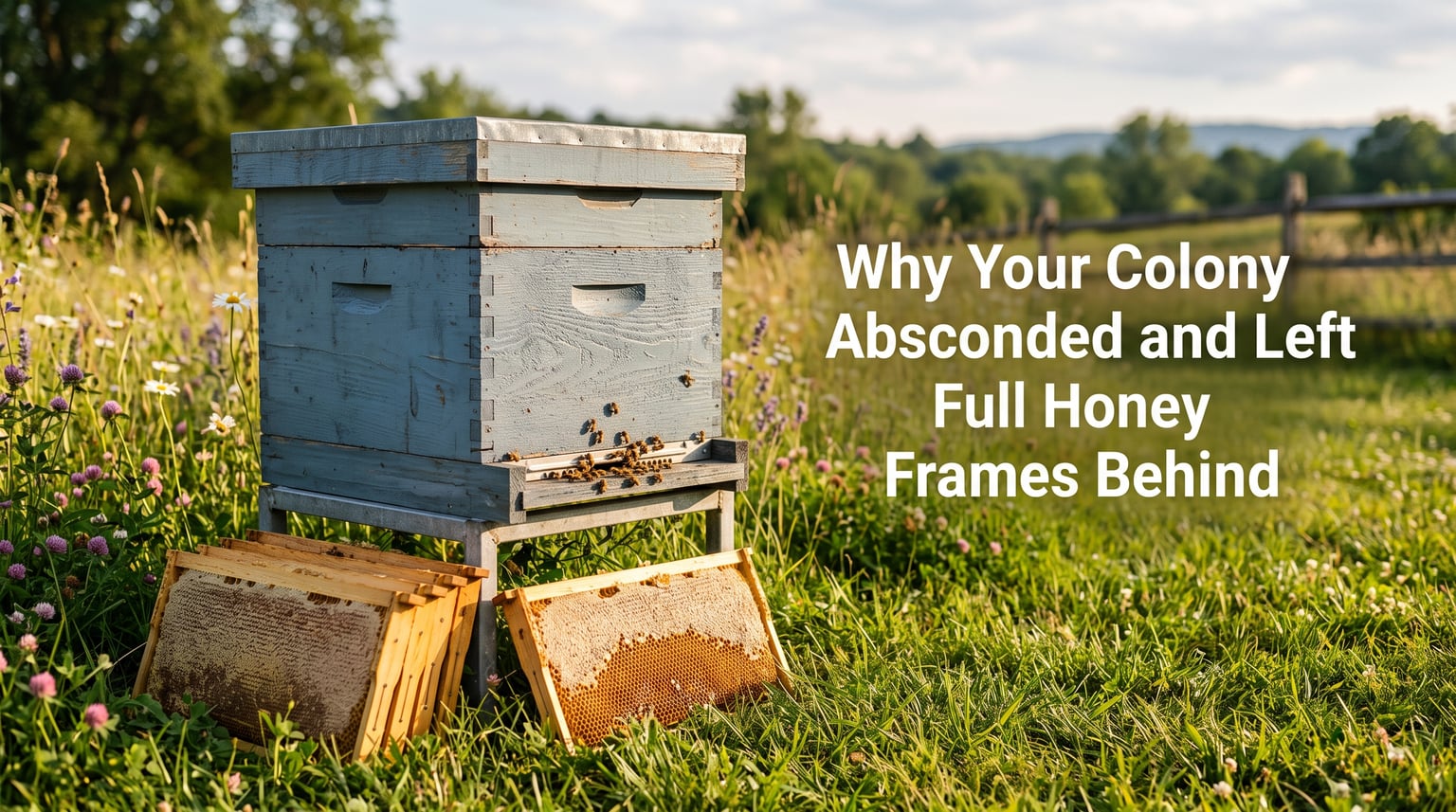
You opened your hive expecting a calm cluster of bees on capped honey, and instead found silence. Frame after frame of golden honey, untouched brood, scattered pollen, and an empty box. That is one of the most disorienting moments in beekeeping, and it almost always means your colony absconded.
Bee colonies abscond when conditions inside the hive become so hostile that the queen and every flying bee leave together. They can take everything they need to survive, but they almost never take your honey.
Instead, they abandon it along with empty comb, pollen stores, and often uncapped brood. This is the question that brings most people to this page: if the honey was right there, why would they leave it behind?
I have lost colonies this way, and I have helped dozens of beekeepers dissect what happened in theirs. The short answer is that bees do not leave a hive because of food. They leave despite the food.
The honey is a symptom of a colony that already decided to go, and the real reasons almost always involve a pressure the bees cannot tolerate any longer. In this guide, I will walk you through the primary drivers, the difference between absconding and swarming, the warning signs, and a recovery protocol you can use the day you find your hive empty.
Table of Contents
Quick Answer: Why Bees Abscond With Full Honey Frames Still in the Hive
Bees abscond with full honey frames because honey is not what triggers an abandonment. A colony abandons its hive when internal conditions become unbearable, and the resources left behind are simply what the bees could not carry in the short window they had to leave. The most common triggers in 2026 are:
Heavy Varroa destructor mite loads, often with secondary viral infections like Deformed Wing Virus
Queen failure or loss of queen pheromone cohesion
Overheating, poor ventilation, or humidity extremes
Small hive beetle, wax moth, or ant infestations
Frequent disturbance, bad odors, or unfamiliar smells on new equipment
Forage shortage combined with stress
Honey is heavy. A full deep frame can weigh 7 to 9 pounds. When bees abscond, they fill their honey stomachs with what they can carry and leave the rest behind. The untouched honey you see is a clue, not a cause.
What Is Absconding and Why Do Bees Leave Full Honey Frames
Absconding is when an entire colony, including the queen and every adult bee, leaves the hive and does not return. Unlike swarming, absconding is not a reproductive split. It is a total evacuation, and the colony leaves behind everything it cannot carry out in a few hours.
This is why you find full honey frames, drawn comb, pollen, and even young brood sitting untouched. Honey is the most expensive resource to transport. A worker can carry roughly half her body weight in nectar or honey in her honey stomach.
For a colony of 30,000 bees, that is a meaningful amount, but it is a fraction of the stores in a single Langstroth super. The bees prioritize the queen, the brood they can cover, and a small emergency ration of honey. The rest is left because the cost of relocating it is higher than the cost of replacing it later.
I learned this the hard way with a colony I treated for Varroa in late summer. By fall, the mites had rebounded, the hive was packed with honey, and the cluster looked strong. One morning I opened the lid and the box was empty.
No dead bees, no sign of disease, frames fully capped. The bees had simply left, and they had left the evidence of a productive season behind. The cause was almost certainly a Varroa spike that crossed the threshold the colony could tolerate.
There is also a biological logic to leaving food behind. When a colony decides to abscond, the queen must leave, and the window for moving her is narrow. Workers cannot induce swarm cells or supersedure in a single afternoon.
They simply gather what they can, guide the queen out, and cluster on a nearby branch while scout bees search for a new cavity. Honey frames seem generous to us, but to a bee in evacuation mode, they are luggage she cannot lift.
The Absconding Process: How a Colony Abandonment Actually Happens
Absconding is a quiet, coordinated exodus, not a dramatic swarm. The first sign is usually a sudden absence of returning foragers. Within a few hours, the population inside the hive drops sharply, and the queen stops laying.
Workers begin loading their honey stomachs from the nearest cells, and the brood is left uncapped and uncovered. The departure usually happens within a single day, often in mid-morning or early afternoon.
The queen flies with the cluster, and the bees form a temporary bivouac cluster on a tree, fence post, or structure near the hive. From this bivouac, scout bees fly out to evaluate candidate cavities.
Within 24 to 72 hours, the cluster relocates to its new home, often 100 yards or more away. Because the process is so fast, beekeepers typically discover the absconding after the fact.
The empty frames, the small amount of dead brood, and the curious absence of wax cappings on the honey tell the story. If you see torn capping debris and a few dead larvae scattered across the frames, that is a strong indicator of absconding rather than disease or starvation.
Primary Causes of Colony Absconding
Bees abscond for many reasons, but in modern beekeeping, the causes tend to cluster into a handful of categories. Understanding which one affected your hive is the difference between losing one colony and losing every colony you keep.
Varroa Mite Infestations and Varroa-Mediated Absconding
Varroa destructor is the single most common cause of absconding in temperate climates. When the mite load passes roughly 3 mites per 100 bees in late summer, the colony enters a crisis state.
Parasitized bees have shorter lifespans, deformed wings, and compromised immune systems. Researchers have documented a specific phenomenon called Varroa-mediated absconding, in which heavily infested colonies abandon the hive rather than face collapse in place.
The mechanism is hormonal and pheromonal. Mite infestation disrupts the queen’s pheromone output and the workers’ response to it. As colony cohesion breaks down, the trigger to leave becomes stronger than the trigger to stay.
The bees carry Varroa with them to the new hive, which is why the new location often fails within a season unless the beekeeper treats. I treat Varroa in late summer every year, no exceptions.
If your colony was strong in August and gone in October, the mite count is the first place to look. Sticky board counts, alcohol washes, or sugar rolls give you a number you can act on. A colony that absconds in fall almost always had a mite count above 5 per 100 bees in the previous weeks.
Queen Failure and Queen Pheromone Breakdown
A queen releases a complex blend of pheromones, including 9-ODA and several queen mandibular pheromone components, that hold the colony together. When she fails, ages out, or dies, the pheromone signal weakens, and the colony’s sense of home erodes.
Workers may begin to develop ovaries, brood patterns become spotty, and the cohesion that anchors a colony to a specific cavity dissolves. This is one of the most common causes of absconding in package bee installations.
A new package has no comb, no brood, and no established queen pheromone footprint. If the queen is rejected, the workers drift, and within days the cluster may leave the hive entirely. Even established colonies with failing queens occasionally abscond rather than supersede.
Environmental Stress: Heat, Humidity, and Ventilation
Bees regulate hive temperature within a narrow band, keeping the brood nest around 95°F. When ambient temperatures climb above 95°F and the hive lacks ventilation, bees beard heavily and may begin to evacuate.
In extreme heat, an overcrowded hive with no upper entrance or vent will abscond in a single afternoon. I have seen this happen in full sun Langstroth hives in the American South.
The colony clusters on the front of the box for hours, then leaves. After the move, the empty hive is hot, dry, and smells of wax. If your region regularly crosses 95°F in summer, shade cloth, screened bottom boards, and an upper entrance are not optional.
Invasive Pests: Small Hive Beetle and Wax Moth
Small hive beetles (Aethina tumida) reproduce inside the hive, and heavy infestations slime the honey and frame surfaces. When beetles overwhelm a colony, the bees often abscond rather than fight.
Likewise, greater wax moth larvae can destroy comb and create a foul environment that bees will not tolerate. Weak colonies are most vulnerable, but even strong ones can leave when beetle pressure spikes after a honey flow.
Persistent Disturbance and Bad Odors
Bees that are inspected too often, especially in the first weeks after installation, may abscond. New equipment smells of cedar, pine, or solvents, and bees do not always recognize these as home.
Odors from nearby livestock, compost, or chemical treatments can also drive colonies out. If you install a package and start opening the hive every three days, expect trouble.
Forage Shortage and Starvation Conditions
This is the most counterintuitive cause. A colony that has run out of nearby forage may abscond rather than stay and starve. The bees abandon the hive in search of resources, traveling several miles if needed.
The honey frames you find behind may be capped stores the colony never accessed because the cluster had already broken contact with the brood nest, or because the bees were never able to forage enough to even use them.
Absconding vs Swarming: The Key Differences
Swarming and absconding look similar from outside the hive, but they are fundamentally different events. Swarming is reproduction. The queen leaves with about 60% of the workers, leaving behind a new queen cell, brood, and half the colony.
Absconding is abandonment. The queen leaves with essentially the entire colony, and the hive is left empty. The simplest test is to look at the brood and queen cells.
A hive that swarmed has capped swarm cells and a laying queen in residence. A hive that absconded has neither, and often has chilled or dead brood from the rapid departure.
| Feature | Swarming | Absconding |
|---|---|---|
| Purpose | Reproduction and propagation | Escape from hostile conditions |
| Population remaining | Half the colony, plus brood and a new queen | No bees, no queen, only abandoned brood |
| When it happens | Spring to early summer, peak nectar flow | Any time, often late summer or fall |
| Honey left behind | Most of it, untouched | Most of it, untouched |
| Capped queen cells | Present on the comb | Usually absent |
| Trigger | Crowding, queen pheromone dilution, healthy colony | Pests, disease, poor conditions, weak queen |
| Outcome for original hive | Continues with new queen | Dead hive, must be restarted |
Seasonal Patterns: Why Fall Absconding Is So Common
Fall is the peak season for absconding in temperate climates. The combination of rising Varroa loads, declining forage, and shorter days creates a perfect storm.
By September, mite populations in an untreated hive have grown for months, and the bees that emerged in late fall are the ones that will carry the colony through winter. When those bees are heavily parasitized, the colony often decides to leave.
African honey bees, Apis mellifera scutellata, follow a similar pattern but more aggressively. In tropical and subtropical regions, fall absconding is often a seasonal migration linked to forage availability rather than parasite load.
For European honey bees in the United States and Europe, the fall exit is almost always a Varroa-driven exit. If your colonies tend to abscond in October, the answer is almost always September.
Treat the mites a month earlier, feed if forage is short, and make sure the queen is laying well into the fall.
African vs European Honey Bees: Behavioral Differences
African honey bees are far more prone to absconding than their European counterparts. A single disturbance can trigger an evacuation, and entire regions in the southern United States have to manage honey bees that respond to stress with flight.
African bees also abscond as a seasonal migration, leaving an area when forage dries up and returning when conditions improve. European honey bees, which include most Italian, Carniolan, and Buckfast stock in North America, are more tolerant of disturbance.
When they abscond, it is almost always because a strong pressure has built over time, not because of a single event. This is why the European bee’s absconding is a stronger signal that something has gone wrong in the hive.
If you keep African bees or Africanized hybrids, expect more absconding and plan your inspections and swarm management accordingly. If you keep European stock and they abscond, audit your hive conditions carefully.
Warning Signs Your Colony May Be Preparing to Abscond
You can sometimes predict absconding before it happens. The most reliable early signs are a sharp drop in returning foragers, bees beard on the front of the hive for more than a day, and a noticeable reduction in the humming sound from inside.
A hive that should be loud but has gone quiet is a hive in transition. Other indicators include:
The queen stops laying and you find no eggs or young larvae
Workers begin to fill their honey stomachs from the frames
The cluster moves around the hive rather than staying on the brood
Bees abandon the lower brood boxes and concentrate in the upper deep
You see large numbers of bees doing orientation flights on cool afternoons
A hive showing several of these signs can be saved within 24 to 48 hours if you identify the trigger and address it. I have reversed at least three potential abscondings by adding ventilation, treating a Varroa spike, or replacing a failing queen.
How to Prevent Absconding: A Practical Checklist
Preventing absconding is mostly about managing the conditions that cause it. The following checklist covers the high-impact actions that prevent most colony abandonments:
Test Varroa monthly from July through October. Use an alcohol wash or sugar roll. Treat when counts exceed 3 mites per 100 bees. Apivar, Apiguard, Formic Pro, and oxalic acid vapor are all effective at different times of year.
Requeen every one to two years. A young queen with strong pheromone output is the single strongest anchor against absconding. Mark your queens and track their age.
Provide ventilation in summer. Add an upper entrance, a screened bottom board, or a slatted rack. In hot climates, paint the hive white and provide afternoon shade.
Leave colonies alone for the first two weeks after installation. Package bees especially need uninterrupted time to draw comb and establish queen pheromone. One inspection is enough.
Control small hive beetles. Use beetle traps, keep hives in full sun, and reduce hive space in late fall. Slimed honey is a release signal for absconding.
Maintain at least 40 pounds of honey in fall. A well-fed colony is far less likely to leave. Feed 2:1 syrup in late summer if frame weight is low.
Use only clean, untreated wood on hives. Bees reject new equipment that smells strongly of cedar, pine resin, or solvents. Let new boxes weather, or line them with beeswax before installing a colony.
Avoid chemical treatments near the hive entrance. Odors from insecticide applications, paint, or stored chemicals can trigger evacuation. Treat mites inside the hive, not around it.
Most absconding I see is preventable. The two biggest causes, Varroa and ventilation, are both within the beekeeper’s control with regular monitoring and a few inexpensive tools.
What to Do After a Colony Absconds: Recovery Protocol
Finding an empty hive is a gut punch. Take a breath, then work through the recovery protocol below. The goal is to preserve what is left, prevent spread of any disease or pests, and get the equipment back into service quickly.
Step 1: Photograph everything before you touch it. The frames, the brood, the honey, the bottom board. These photos help you diagnose the cause and are useful in your records or for asking advice online.
Step 2: Look for the dead bees. If the bottom board is covered in dead bees, the cause was likely disease or poison. If there are very few dead bees and the brood is mostly chilled or scattered, absconding is the most likely diagnosis.
A few chewed or uncapped brood cells is normal during an exit. Step 3: Check the honey and pollen. Honey is still perfectly good if it has not been robbed by other bees. Pollen patties are unaffected.
You can extract the honey or store it in the freezer for future use. Step 4: Freeze the frames for 48 hours. This kills any wax moth eggs, small hive beetle larvae, or Nosema spores that may be present.
After freezing, store the frames in a cool, dry place or return them to the hive. Step 5: Clean the hive. Scrape the bottom board, replace any rotten wood, and inspect for cracks.
Bees will not reuse a hive that smells of decay or pest contamination. Step 6: Diagnose the cause. Send a sample of dead bees to your local agricultural extension office if you suspect disease.
If you suspect Varroa, assume the next colony will face the same load and treat preventively. Step 7: Decide whether to restart. If you have other colonies, you can split a strong one into a nuc and place it in the recovered equipment.
If you do not have other colonies, you can order a package or nuc for the spring. The recovered frames and drawn comb are a major asset because they accelerate the new colony’s buildup.
Step 8: Record what happened. Date, weather, recent treatments, queen status, observations. This record is the single most valuable tool you have for preventing the next absconding.
Most of the absconding I have prevented in my own apiary came from patterns I noticed in past losses.
FAQs
Why do bees leave their hive when there is honey right there?
Honey is heavy, and the bees that abscond can only carry a small fraction of their stores in their honey stomachs. The honey left behind is not the reason they left. The colony left because of stress the bees could no longer tolerate, such as Varroa mites, queen failure, overheating, pests, or persistent disturbance. The honey is what could not be packed out in the few hours the colony had to evacuate.
How long does it take bees to abscond?
The process is fast. Most colonies complete their departure within a single day, often in mid-morning. The departure is usually followed by a bivouac cluster on a nearby branch for 24 to 72 hours, while scout bees search for a new home. From the beekeeper’s perspective, a hive that was full one day is empty the next.
Will bees return to an abandoned hive?
In almost all cases, no. Once a colony has absconded and the queen has settled into a new cavity, the bees do not return to the original location. A small number of scout bees may briefly investigate the old hive, but the cluster will not regroup there. If you want to reuse the equipment, you will need to introduce a new colony or split into the recovered boxes.
Where do bees go when they abscond?
After bivouacking near the original hive, the colony relocates to a new cavity, often a hollow tree, wall void, or abandoned structure, within a few hundred yards to a few miles. African and feral bees are more likely to travel farther than European honey bees. Once established, the colony resumes normal behavior in the new site, often with reduced winter survival if the original trigger was untreated Varroa.
Is absconding different from swarming?
Yes. Swarming is a reproductive split, with about 60% of the colony leaving along with the old queen, leaving a new queen and brood behind. Absconding is a complete evacuation, with the queen and essentially the entire colony leaving and the hive empty. Swarming colonies leave a working hive with capped swarm cells and a new queen. Absconding colonies leave an empty box with chilled brood and no queen cells.
What is the 3 3 3 rule for bees?
The 3 3 3 rule is a beginner beekeeping guideline that helps new beekeepers track colony health. It refers to three days, three weeks, and three months. Three days after installing a package, check that the queen has been released. Three weeks later, check that she is laying and brood is developing. Three months later, the colony should be established and growing. The rule is a useful scheduling framework, not a guarantee, and it does not directly predict absconding, but it does put you in the hive at the right times to catch early warning signs.
When Absconding Is Actually a Healthy Behavior
It is worth saying out loud: absconding has been a survival strategy for honey bees for millions of years. African bees, dwarf honey bees, and giant honey bees all abscond as a routine response to environmental pressure.
A colony that leaves a sick hive is choosing survival over home. From the bee’s perspective, that is the correct decision.
The reason it feels like a failure is that we put the bees in the hive. We gave them the box, the wax, the frames, the food. When they leave, we read it as a rejection. It is not.
It is a colony making a calculation with millions of years of evolutionary data behind it, and the calculation is sometimes correct. The job of the beekeeper is to make sure the calculation never comes up.
If you manage Varroa aggressively, give the queen every reason to stay, keep the hive ventilated, and leave the colony alone during its most vulnerable weeks, absconding becomes rare. When it does happen, treat it as a signal to learn from, not a verdict on your skill.
Conclusion
Bees abscond with full honey frames because honey is not why they leave. They leave because a pressure inside the hive has become intolerable, and the honey is the part they could not pack out in the rush to evacuate.
In 2026, the most common triggers are Varroa destructor, queen failure, overheating, invasive pests, persistent disturbance, and forage shortage. Each of these is preventable with regular monitoring and a few consistent habits.
If your colony absconded, the recovery protocol is straightforward: photograph, diagnose, freeze the frames, clean the hive, and get a new colony into the recovered equipment as soon as possible. The drawn comb and the honey are still valuable, and your second colony will build faster than your first.
The next time you open a hive and find it empty, remember that the bees who left made the best decision they could. The answer to why did they leave almost always comes from the weeks before the departure, not the day of it.
Track your mite counts, watch your queen, keep the hive ventilated, and your next season will look very different from the last.