
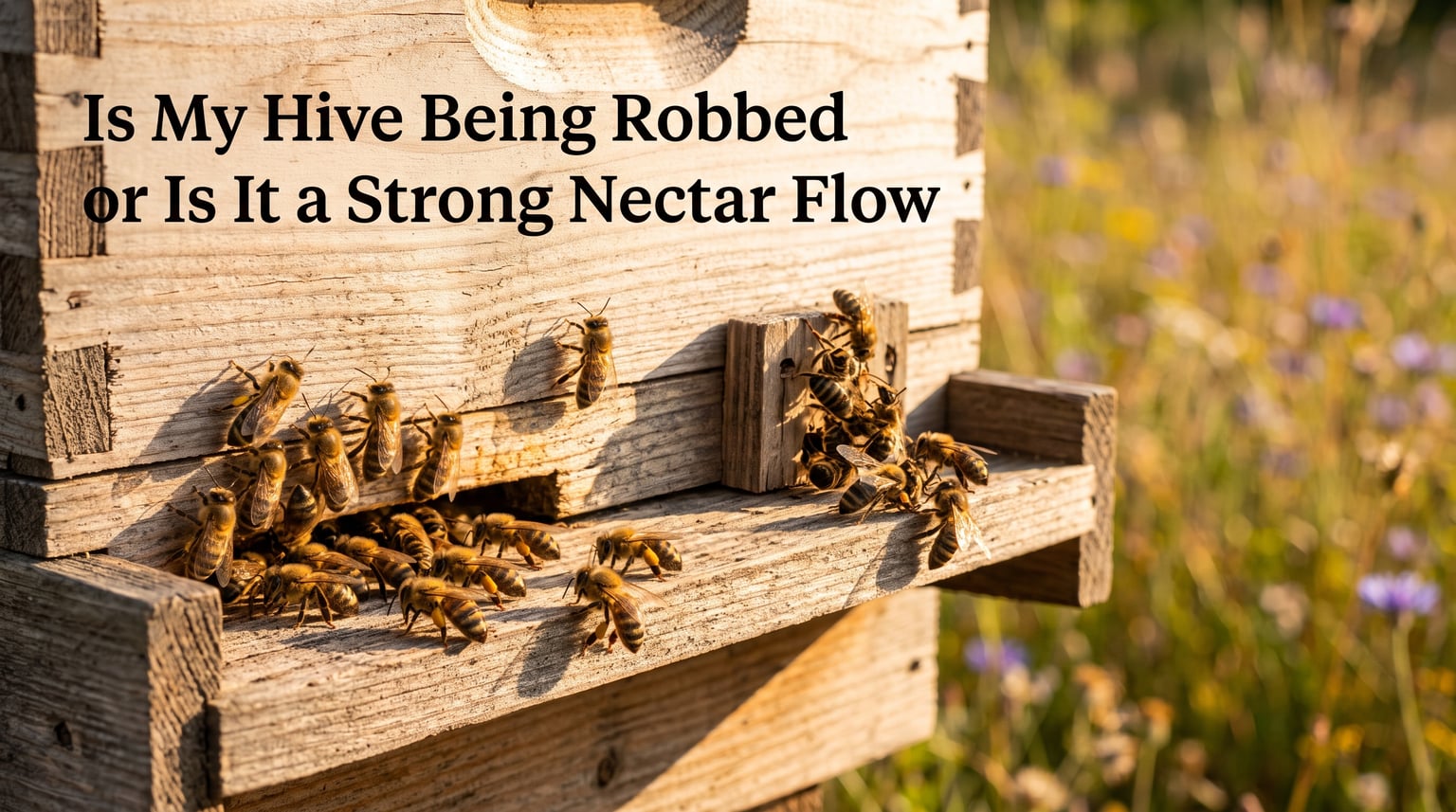
I still remember the first time I ran to my bee yard convinced one of my colonies was being massacred. Bees were everywhere, swirling around the entrance in a way that looked nothing like the calm streaming I’d seen the week before.
It turned out to be a strong nectar flow after a week of dry weather. The hive was bursting with foragers coming and going, but they weren’t fighting.
That moment taught me an important lesson: hive robbing vs nectar flow is one of the most common confusions in beekeeping. The activity at the entrance can look similar from a distance, but the causes, consequences, and responses are completely different.
I’ve kept bees for nine seasons and have watched both behaviors hundreds of times. In this guide I’ll walk you through how to tell what’s actually happening at your hive, what to do if it really is robbing, and how to keep your weak colonies safe.
If you’ve just seen unusual activity and want a fast answer, scroll to the quick recognition signs section first. Then come back for the full breakdown.
Table of Contents
Quick Recognition Signs: Robbing vs Nectar Flow at a Glance
Use this scannable list first, then read the deeper explanation below. It is the fastest way to figure out whether you have a healthy busy hive or a colony under attack.
Robbing is happening when you see
- Bees fighting and wrestling at the entrance, sometimes in pairs rolling on the landing board
- Bees leaving the hive heavily loaded with honey and flying low and straight away from the entrance
- Defensive guard bees clustered thickly at the entrance, often with abdomens raised in alarm posture
- Activity that intensifies through the day, peaking in late afternoon rather than morning
- Wax cappings and shiny honey residue on the landing board and ground in front of the hive
- Bees trying to enter at side cracks, top covers, or anywhere besides the main entrance
- A frantic, swirling, dive-bombing cloud around the hive rather than steady directional flight lines
A strong nectar flow is happening when you see
- Bees leaving the hive light-bodied and climbing upward in a distinctive orientation flight pattern
- Returning foragers arriving heavily loaded, sometimes so heavy they crash-land on the landing board
- Calm, organized traffic at the entrance with bees moving in and out without aggression
- New white wax being drawn on frames, honey being rapidly stored in supers
- Bees returning with full pollen baskets on their legs in addition to nectar
- Activity steady from morning through afternoon with no peak fighting behavior
- A low hum of happy working bees, not an alarmed high-pitched buzz
Save this list on your phone. The next time you walk to your apiary and feel a jolt of panic, you can pull it up and check the entrance in under 60 seconds.
Robbing Is Honey Stealing Between Hives, and It Can Wipe Out a Weak Colony in Hours
Hive robbing happens when bees from one colony invade another hive to steal stored honey. It usually occurs during a nectar dearth, when natural forage is scarce and hungry bees start looking for easier food sources.
The invaders are typically older forager bees from stronger colonies. They are experienced, focused, and aggressive. They zero in on weak colonies, small nucs, or any hive that smells like exposed honey. Once a few scouts find a target, they recruit dozens of sister bees, which can quickly escalate into a full-blown robbing frenzy.
Robbing can devastate a weak colony in 24 to 48 hours. The robbers strip honey stores, kill guard bees, and can even kill the queen. They can also spread diseases and parasites between hives because of the forced contact.
A robbing event is not subtle once you know what to look for. It looks like chaos and sounds like an angry swarm.
A Strong Nectar Flow Means Abundant Forage, and Your Bees Are Loving Life
A nectar flow, sometimes called a honey flow, is a period when blooming plants in your area are producing so much nectar that bees can collect far more than they need for daily survival. Major nectar flows happen during spring and early summer bloom in most temperate regions, though timing varies by climate and flora.
During a strong nectar flow, your bees are essentially working overtime to gather and store as much surplus honey as possible. Foragers leave the hive in waves, fly directly to nectar sources, and return heavily loaded. House bees receive the nectar, evaporate it down, and pack it into cells.
This is the happy version of high entrance activity. Bees are calm, focused, and busy. There is no fighting at the door because no bee has any reason to fight.
A strong nectar flow is also when you’ll see fresh white wax being drawn on foundation, new comb being built, and capped honey appearing in supers within days. These are great signs.
The Visual Signs of Robbing Are Loud, Chaotic, and Frightening Once You Know Them
Robbing has a very specific look. I tell new beekeepers to imagine the difference between commuters calmly walking to work and a riot breaking out at a stadium. Both involve crowds, but only one is dangerous.
Fighting at the entrance
The single most diagnostic sign of robbing is bees fighting at the entrance. Two bees will latch onto each other, fall off the landing board, and roll around on the ground. Sometimes three or four bees gang up on one defender. Dead bees appear in front of the hive within hours.
Guard bees from the defending colony will be clustered thickly at the entrance. They will have their front legs raised and abdomens tilted up in the classic alarm posture. They release alarm pheromone, which smells like banana and attracts more defenders.
Robbers leaving heavily loaded and flying low
Robbers leave the hive with full honey stomachs and fly low, fast, and directly away from the entrance. They are heavy and trying to escape detection. Normal foragers leave lighter and climb steeply upward in a 30 to 60 degree angle to get above obstacles before flying off.
If you watch departing bees for a minute, you should be able to tell the difference. Robbers look like bombers in a hurry. Foragers look like casual commuters.
Wax cappings and honey residue
Robbers rip open capped honey cells. The wax cappings and any spilled honey end up on the landing board and the ground in front of the hive. If you see shiny, sticky residue or bits of white or yellow wax on the ground, that is a serious warning sign.
Bees at unusual entry points
Robbers are looking for any gap. If you see bees investigating the joint between boxes, the back of the hive, the inner cover edge, or any propolis crack, that’s a sign. They are trying to bypass the guard bees at the front door.
Activity that builds late in the day
Robbing usually gets worse as the day warms up and peaks in late afternoon. If you check your hive in the morning and it looks fine, then check again at 3 pm and it’s chaos, that pattern strongly suggests robbing.
An alarming, swirling cloud
Robbing creates a swirling, dive-bombing cloud of bees around the hive. They hover, dart, and crash. Normal flight looks like orderly streams of bees moving in two directions. Robbing looks like a chaotic tornado.
The Visual Signs of a Strong Nectar Flow Are Orderly, Busy, and Almost Cheerful
A nectar flow looks like organized industry. Your bees are working hard, but they are not fighting and they are not stressed.
Heavy returning foragers
Foragers returning from a strong nectar flow are visibly heavier. They sometimes stall in mid-air, crash into the landing board, and crawl into the entrance because they are so loaded they can barely fly. Their abdomens look distended and shiny.
Empty pollen baskets may also appear
Pollen foragers return with full pollen baskets on their hind legs, looking like they are wearing bright orange or yellow saddlebags. During a strong nectar flow, you’ll see both nectar-heavy bees and pollen-laden bees in the same population.
Calm, directional flight lines
Bees leaving the hive during a flow fly upward in a clear orientation flight before heading out. They do not fly low or dart frantically. Bees returning come in on consistent flight paths that look like commuter highways in the sky.
New white wax on frames
When bees are bringing in lots of nectar, they produce wax. Open a hive during a strong flow and you’ll see white wax being drawn on foundation, edges of comb being extended, and cappings freshly laid on honey cells.
Honey appearing in supers within days
If you added a super and within a week it’s being drawn and partly filled, you have a strong flow on your hands. Honey supers fill surprisingly fast during peak bloom.
Activity stays steady all day
Nectar flow activity rises with morning warmth, holds steady through midday, and tapers off in evening. It does not surge and crash. Robbing activity, by contrast, escalates as the day progresses.
Side-by-Side Comparison: Robbing vs Strong Nectar Flow
This is the comparison I wish I’d had during my first season. The featured snippet opportunity here is a clean table, so we have laid out every diagnostic signal I use in the field.
| Signal at the Hive | Strong Nectar Flow | Hive Robbing |
|---|---|---|
| Sound at entrance | Calm, steady hum | Loud, angry, high-pitched buzz |
| Bee behavior | Orderly traffic in and out | Fighting, wrestling, dead bees on ground |
| Departing bees | Light-bodied, climb upward at 30 to 60 degrees | Heavy-bodied, fly low and straight away |
| Returning bees | Heavy with nectar or pollen, sometimes crash-landing | Heavy with stolen honey, darting quickly inside |
| Guard bees | A few at entrance, relaxed posture | Many clustered, raised legs, tilted abdomens, alarm posture |
| Time of day | Steady from morning to evening | Worsens through the day, peaks late afternoon |
| Wax cappings on ground | None | Pieces of wax, sticky honey residue |
| Entry points used | Main entrance only | Cracks, seams, top covers, anywhere they can get in |
| Activity around hive | Organized flight paths | Swirling, dive-bombing cloud |
| Seasonal timing | During bloom of major nectar plants | During nectar dearth, late summer or dry spells |
| Inside the hive | New white wax, honey filling supers, calm bees on frames | Honey stores dropping fast, bees frantically chewing cappings |
| Colony at risk | None, this is healthy activity | Usually a weak, small, or struggling colony |
When Robbing Happens vs When Nectar Flows Happen
One of the simplest ways to tell what you are seeing is the season and the weather.
Strong nectar flows tend to occur in spring and early summer during major bloom periods. In temperate North America, for example, black locust, clover, basswood, and blackberry bloom in succession. In Mediterranean climates, it’s often rosemary, thyme, and lavender. In tropical regions, multiple flows can occur year-round.
Robbing tends to occur during a nectar dearth, when nothing is blooming. Late summer after a dry spell is the classic danger zone. Early fall after the main flow has ended is another. Any time you see plants stop producing nectar, the risk of robbing goes up sharply.
Weather matters too. A long dry spell can shut down nectar production even during a normally productive bloom period. When that happens, healthy foragers suddenly have nothing to do and start looking for easier food sources.
Weak Colonies Get Targeted, Strong Colonies Often Get Away Clean
Robbing is not random. Strong colonies with large guard bee populations can defend themselves effectively. Weak colonies, small nucs, late-season splits, and any hive with compromised defenses are prime targets.
Weak colonies give off stress pheromones and may have difficulty maintaining the colony scent at the entrance. Robber scouts detect this and recruit their sisters to the target.
If you manage multiple hives and one is suddenly being robbed, it’s almost always the smallest or weakest one. Open that hive first to assess stores, queen status, and population.
Strong colonies can also rob during dearth, but they rarely become victims themselves. They have the guard force to repel invaders.
Why Morning vs Evening Observations Matter
Beesource forum veterans recommend inspecting hives early in the morning for a reason. Morning is the safest time to open a hive because foragers are not yet active. If you open a hive during peak activity, you expose honey and feed scents that can trigger robbing.
For diagnosis specifically, you want to observe entrance behavior at multiple times of day. A quick check at 9 am, another at noon, and a third at 3 pm gives you a full picture. If activity is calm in the morning but frantic by mid-afternoon, you are likely seeing robbing escalate. If activity stays consistent, you’re probably seeing a normal flow.
Evening observations also matter because robbers will sometimes continue into dusk while normal foragers go home. If you see bees still working the entrance at sunset during a supposed dearth, that’s a red flag.
How to Stop Robbing When You Catch It Happening
If you’ve confirmed robbing, you need to act quickly but calmly. Here’s the order I follow on my own apiary.
- Reduce the entrance immediately. Install an entrance reducer with the smallest opening, about a single bee width. This gives your guard bees a defensible chokepoint.
- Stop all inspections. Do not open the hive, do not add feed, do not move frames. Every opening releases scent that attracts more robbers.
- Cover the hive with a wet sheet. A damp bed sheet draped over the hive confuses robbers because they orient by sight and smell. The sheet also helps mask the honey scent.
- Remove any open feed sources. If you have open syrup feeders nearby, remove them. Open honey, sugar water, or pollen patties are robber magnets.
- Wait until evening to reassess. Robbing tapers off at dusk. Check again at dawn to see if your intervention worked.
- If the colony is severely weakened, consider combining it with another hive. Sometimes the kindest option is to merge a doomed colony with a stronger one using the newspaper method.
How to Prevent Robbing Before It Starts
Prevention is far easier than intervention. These habits will keep your apiary safe during dearth periods.
- Use entrance reducers year-round on small or weak colonies. Even during a flow, a small colony benefits from a smaller door it can defend.
- Avoid opening hives during dearth periods. Only open them for quick checks when necessary. Save major manipulations for the flow.
- Never leave honey exposed. Cappings, burr comb, and broken frames should be kept inside a sealed bucket or your vehicle, not left sitting in the open.
- Feed inside the hive only. External feeders create robbing stations. If you must feed, use frame feeders, division board feeders, or bag feeders inside the hive.
- Keep colonies strong. Strong colonies with plenty of bees rarely get robbed. Combine weak colonies in late summer if they cannot build up on their own.
- Plant forage to extend your flow. Strategic planting of late-blooming trees, herbs, and cover crops can shorten your dearth period and reduce robbing pressure.
Seasonal Timing Tips That Make Diagnosis Easier
Tracking your local bloom calendar is one of the most underrated skills in beekeeping. Once you know when nectar should be available, you can predict whether a hive’s activity is normal or alarming.
Keep a simple journal with bloom dates for major plants in your area. Note when each major source begins, peaks, and ends. When your bees suddenly intensify activity, cross-reference it against your bloom calendar. If a major nectar source is blooming, you’re seeing a flow. If nothing is blooming and the bees are going crazy, you’re seeing robbing.
Climate and geography matter too. A beekeeper in Florida has very different timing than one in Vermont. Adjust your expectations accordingly.
Common Mistakes New Beekeepers Make When Diagnosing
I made several of these myself in my first two seasons, and I see new beekeepers make them every year.
Mistake 1: Opening the hive to check, which then triggers robbing. If you’re unsure whether something is robbing, do not open the hive to look inside. Your diagnostic work happens at the entrance. Opening the hive releases honey scent and can turn a borderline situation into a full-blown frenzy.
Mistake 2: Confusing orientation flights with robbing. Young bees do orientation flights in the afternoon, hovering in large numbers in front of the hive. This is normal and healthy. Robbing looks similar from inside the apiary but the bees are coming from outside the hive, not from inside.
Mistake 3: Panicking at normal activity. Strong colonies can look alarmingly busy. Trust the diagnostic signs, not your gut.
Mistake 4: Feeding during a dearth. Feeding during a dearth attracts every bee in the apiary to the weakest colony. If you must feed, do it inside the hive in the evening.
A Simple Diagnostic Flowchart You Can Use Today
Walk through these four questions in order.
Question 1: Are bees fighting at the entrance, with dead or wrestling bees on the landing board?
If yes, it’s robbing. Move to action steps immediately.
If no, continue.
Question 2: Are bees leaving the hive heavily loaded and flying low, or returning heavily loaded with calm climbing departures?
Heavy and low and exiting equals robbing. Heavy and arriving equals nectar flow.
If still unclear, continue.
Question 3: Is there wax debris and sticky honey residue on the ground in front of the hive?
If yes, it’s robbing. If no, it’s likely a flow.
If still unclear, continue.
Question 4: Are major nectar sources blooming in your area right now?
If yes, it’s almost certainly a nectar flow. If no, treat it as suspected robbing and observe closely.
Frequently Asked Questions About Robbing vs Nectar Flow
How can I tell if my hive is being robbed?
Look for fighting bees on the landing board, dead bees accumulating, guard bees in alarm posture with raised legs, wax cappings and honey residue on the ground, and activity that intensifies through the day peaking in late afternoon. Departing bees will fly low and straight, while normal foragers climb upward.
What does it look like when bees are robbing a hive?
Robbing looks like chaos around the hive entrance. You’ll see a swirling, dive-bombing cloud of bees, fighting and wrestling on the landing board, and bees trying to enter through any crack or gap. The activity intensifies through the day and wax debris appears on the ground.
Will bees swarm during a nectar flow?
Yes, strong nectar flows often trigger swarming because the colony is crowded with bees and rich in resources. A sudden population boom during a flow is one of the classic warning signs that swarming may be imminent. Manage congestion by adding supers or splitting the colony.
How do I know if my bee hive is being robbed or just busy?
Busy hives have orderly traffic in two clear directions, calm hum, bees leaving light and climbing upward, and steady activity throughout the day. Robbed hives have fighting bees, an angry buzz, bees leaving heavy and low, and escalating activity peaking in late afternoon.
How do I stop a hive from being robbed?
Install an entrance reducer to give guard bees a defensible chokepoint, cover the hive with a wet sheet to mask scent, stop all inspections, remove any open feed sources, and wait until dusk to reassess. Combine severely weakened colonies with stronger ones if intervention fails.
When does robbing usually happen?
Robbing happens during a nectar dearth, typically in late summer or early fall after the main flow has ended, or during extended dry spells when plants stop producing nectar. Weak colonies and small nucs are at highest risk during these periods.
Final Thoughts: Watch the Entrance, Trust the Signs
Distinguishing hive robbing from a strong nectar flow comes down to behavior, not volume. Both create a busy entrance, but only one involves fighting, alarm posture, and chaos.
Build the habit of observing your hives at three times of day, especially during dearth periods. Keep your weak colonies protected with entrance reducers, avoid open feeding, and never open a hive unless you have a good reason.
I’ve watched dozens of new beekeepers panic over a healthy nectar flow and ignore a real robbing event. With the comparison table and diagnostic flowchart above, you don’t have to be one of them.
Save this guide, check your hives this week, and trust the entrance. Your bees will tell you what’s happening if you know how to listen.