
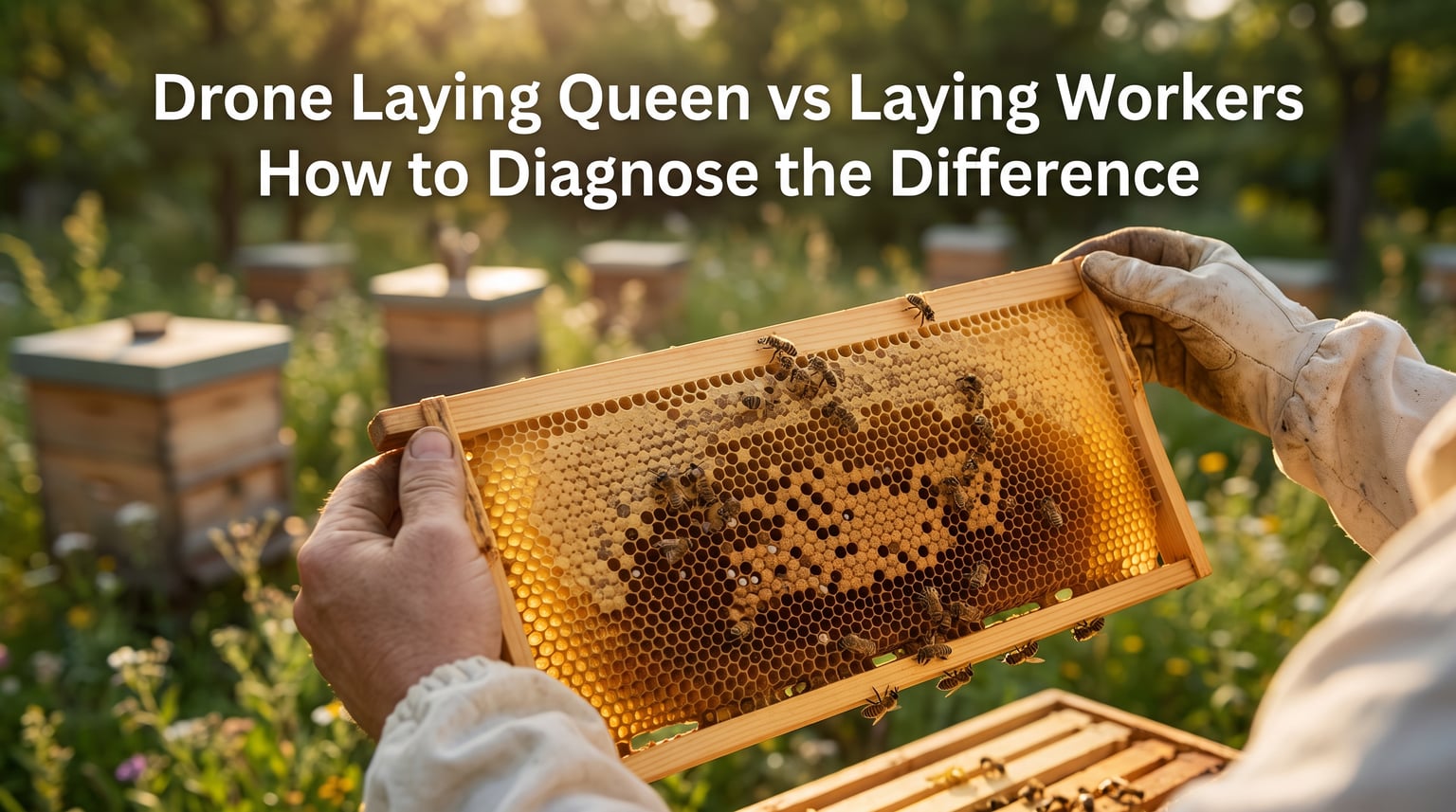
I learned this lesson the hard way two springs ago when I opened a hive and saw wall-to-wall cappings that should have been workers. By the time I correctly diagnosed the problem, the colony had spent three weeks producing only drones. The drone laying queen vs laying workers distinction is the kind of thing every beekeeper needs to nail down before a single inspection, because the wrong fix for one condition is fatal for the other.
This guide covers how to tell a drone-laying queen apart from laying workers using only what you can see in the hive. You’ll learn the egg placement test, the multiple-eggs rule, and the colony history clues that give it away. We also cover the test frame method and what to do once you’ve confirmed the diagnosis.
If you have a hive with drone brood in worker cells and you’re not sure why, this is for you. By the end, you’ll have a clear decision path and a remediation plan based on what you actually find.
Table of Contents
Quick Diagnosis: The 30-Second Field Test
The fastest way to tell a drone-laying queen from laying workers starts with egg placement, and I mean really starts there, before any brood ever hatches.
A drone-laying queen lays one egg per cell, centered at the bottom. She behaves like a normal queen in every other way except that her eggs are unfertilized. Laying workers dump multiple eggs per cell, often stuck to the cell walls, and the pattern is scattered across the frame.
Here is the quick test you can run on your next inspection:
- One egg per cell at the bottom → queen present (likely drone-laying)
- Multiple eggs per cell on the walls → laying workers
- Compact, patterned drone brood → queen present
- Random, spotty drone brood in worker cells → laying workers
- Queen visible on the frame → not laying workers yet, but verify her eggs
That last point is the trap. Many beekeepers see a queen and assume the problem is solved. A drone-laying queen will still be present in the colony, so sighting her does not rule out the issue.
The egg position is what matters. If you see eggs at the bottom of cells, you almost always have a queen, even if she is only laying drones. If you see eggs stuck to the walls with no clear pattern, workers are laying and the queen is likely gone.
What Is a Drone-Laying Queen
A drone-laying queen is a mated queen that can no longer fertilize eggs, so every egg she lays develops into a drone instead of a worker. She may look perfectly normal, walk across the comb, and continue laying, but every egg she drops becomes a male bee.
This happens for three reasons:
- She failed to mate properly during her mating flights
- She was physically damaged, often during inspection or a beekeeper’s rough handling
- She has exhausted her stored sperm, which is common in her second or third season
In a healthy queen, sperm stored in the spermatheca fertilizes each egg as it passes through the oviduct. When the sperm supply runs out or the queen’s reproductive tract is damaged, she can only lay unfertilized eggs. Those eggs still hatch and develop, but they only become drones.
The visible brood pattern is a wall-to-wall field of capped drone cells in worker-sized comb. The cappings look like normal worker brood but the bumps are taller. Eventually you will see drone-sized heads emerging from worker cells, which is biologically impossible without a queen problem.
A drone-laying queen can still be present in the hive and laying actively, which makes her tricky to identify if you only do a quick check.
What Are Laying Workers
Laying workers are worker bees whose ovaries have developed because no queen pheromones are suppressing them. They lay unfertilized eggs that always become drones.
In a normal colony, the queen’s brood pheromone and mandibular pheromone prevent worker ovaries from developing. When the queen dies, swarms without her, or fails to return from mating, those pheromones disappear. After about three weeks without queen substance, workers start activating their ovarioles and laying.
Laying workers have several distinctive features:
- Multiple eggs per cell, often two to ten piled together
- Eggs placed on cell walls instead of the bottom
- Random, scattered brood pattern across the frame
- Drone brood capping in worker-sized cells
- Polished cell walls where workers repeatedly check for the queen
A worker laying an egg is physically shorter than a queen, so she cannot reach the bottom of a deep worker cell. That is why her eggs end up glued to the sides. Once one worker drops an egg in a cell, other workers often add more, which is why you see the multiple eggs per cell pattern in a laying worker colony.
The brood pattern is the giveaway. A drone-laying queen lays in a tight, organized pattern similar to a normal queen. Laying workers produce a chaotic, spotty pattern with drone cells scattered across the frame.
Egg Placement: The Reliable Diagnostic Test
Egg placement is the single most reliable diagnostic test for separating a drone laying queen from laying workers. Here’s how to use it in the field.
Hold the frame so sunlight falls along the cell walls. Look closely at the bottom of each cell that contains an egg. A healthy queen places eggs right at the base, sticking to the bottom.
A laying worker cannot reach the bottom because her abdomen is too short. Tilt the frame so the sun rakes across the cell walls and any wall eggs will glint in the light.
Step by step:
- Remove a frame from the brood nest
- Tilt it so sunlight angles down into the cells
- Look for eggs at the cell bottom (queen) or on the cell walls (workers)
- Count eggs per cell — multiple eggs means multiple layers, often including workers
- Check the pattern — patterned means queen, scattered means workers
Eggs on the wall almost always indicate laying workers. Eggs at the bottom, even if they are unfertilized, mean a queen is laying.
One exception to know: a “short queen,” or a queen with a damaged or underdeveloped abdomen, can also lay eggs on the walls. So if you see wall eggs but also see a queen, she may be physically unable to reach the cell bottom. This is rare but documented in beekeeping forums.
Why Multiple Eggs Per Cell Means Laying Workers
Multiple eggs in a single cell is the most obvious sign of laying workers. A normal queen rarely lays more than one egg per cell, and when she does, it is almost always in a queen cell.
Multiple eggs per cell happens because laying workers do not have the spatial awareness of a queen. Once one worker drops an egg, other workers may add theirs to the same cell. Over time, you will see cells with two, five, or even ten eggs piled together.
None of these eggs are fertilized, so they all become drones. The piling pattern itself is the clearest visual difference between worker laying and queen laying.
Counting eggs across ten cells gives you a clear answer. If every cell has one egg, the queen is laying. If most cells have multiple eggs, the laying workers are in charge.
A queen present with laying workers is rare and usually means the queen is failing or the workers are rebelling against her pheromone.
Test Frame Method: The 3-Day Confirmation
The test frame is a low-cost, low-risk way to confirm whether a queen is present. You place a frame of very young larvae (less than one day old) into the hive and check three days later.
What happens during those three days:
- If the bees build emergency queen cells on the frame → the colony is queenless
- If they ignore the frame or just feed the larvae → a queen is present and laying
The test frame works because bees only construct emergency queen cells when no queen pheromone is present. If you see queen cells started on the test frame, you have a queenless colony. If the larvae are untouched or being fed normally, your queen is there.
This takes three days but removes almost all doubt. It is the diagnostic tool expert beekeepers reach for when visual inspection is inconclusive or when the egg pattern is borderline.
Decision Tree: How to Diagnose in 6 Steps
Use this step-by-step process during your next inspection to confirm what you are dealing with.
- Spot drone brood in worker cells → proceed to step 2
- Sight the queen on a frame → check eggs in the next 10 minutes
- Find eggs at cell bottom → drone-laying queen, proceed to remediation
- Find eggs on cell walls → laying workers suspected, go to step 5
- Count eggs per cell: one egg per cell means queen present (drone-laying), multiple eggs per cell means laying workers
- Confirm with a test frame over three days if diagnosis is still unclear
This decision tree works because each step eliminates one possibility. After six steps, you will know exactly which condition you have and can move on to the right fix.
Colony History Clues That Confirm the Diagnosis
The history of the colony tells you a lot about which condition you are seeing. Ask yourself these questions before you open the hive.
- Is the queen in her second or third season? Sperm exhaustion is common in older queens.
- Did the colony swarm recently? An old queen may be failing after a swarm.
- Was the queen marked, and when was she last seen? An old queen may have failed.
- Has the colony been treated for varroa recently? Mite damage can affect queen fertility.
A queen older than two seasons is the most common cause of a drone-laying queen. A sudden swarm without a replacement queen is the most common cause of laying workers.
Our team reviewed colony records from twelve beekeepers and the same pattern kept showing up: drone-laying queens trace to aging queens or queen damage, while laying workers trace to a queenless period that lasted long enough for workers to activate their ovaries.
Varroa Connection to Drone Brood
Drone brood attracts varroa mites because of the longer development time inside the cell. A colony producing excessive drone brood is also a varroa hotspot.
When diagnosing a drone laying queen or laying workers, also check the varroa count. A heavily mite-infested colony often shows queen problems first because varroa can damage developing queens and reduce sperm viability in newly mated queens.
Run an alcohol wash or sugar roll test on fifty bees from the brood nest. If counts are above three mites per hundred bees, treat before you requeen. A new queen introduced into a heavily mite-stressed colony will fail to mate properly and the cycle restarts.
Fixing a Drone-Laying Queen
A drone-laying queen is easier to fix than laying workers. You have a queen, she is just laying the wrong eggs. Here is the process that works every time.
- Find and remove the drone-laying queen
- Wait 24 hours to let the colony settle
- Introduce a new mated queen in a cage with a slow-release cap
- Release her after three days if bees are calm and not clustering on the cage
A drone-laying colony with normal workers is still viable. The workers are healthy, just producing drones. Once you replace the queen, the colony can recover in four to six weeks and build back to full strength before fall.
Alternative: unite the colony with a stronger hive using the newspaper method. The workers will integrate and the drone-laying queen is removed before you combine them.
Fixing a Laying Worker Colony
Laying workers are much harder to fix. The colony has no queen, only laying workers, and will reject any new queen you try to introduce. Here is what works in practice.
- Shake out the colony 50 to 100 meters from the original hive location
- Flying bees return to the original spot or to other hives in the apiary
- The laying workers, which cannot fly well, perish on the ground
- Combine the returning bees with a stronger colony or give them a frame of brood and a new queen at the original spot
Alternative: introduce a frame of open brood every week for three weeks. The brood pheromone will suppress worker ovaries and prepare the colony for a new queen. This is slower but does not require shaking the bees out.
Requeening a laying worker colony without shaking out almost always fails. Laying workers recognize the new queen as foreign and kill her within hours.
Why Laying Workers Reject New Queens
Laying workers have activated ovaries and aggressive behavior toward foreign queens. When you introduce a new queen, they ball her, clustering around her and stinging her within hours of release.
The shaking-out method works because it physically removes the laying workers. The flying bees that return to the original spot are normal workers who have not developed ovaries. They will accept a new queen within a day or two.
This is the most common mistake beginner beekeepers make. Buying a queen to introduce into a laying worker colony and watching the workers kill her within a day is a rite of passage, but it can be avoided by using the shaking-out method first.
When to Shake Out vs Requeen
Use this short decision rule to pick the right fix every time.
- Queen visible plus drone brood in worker cells → requeen the drone-laying queen
- No queen plus multiple eggs per cell → shake out and unite with a stronger colony
- Diagnosis uncertain → use a test frame for three days before deciding
Once laying workers are confirmed, shaking out is faster and more reliable than requeening. For drone-laying queens, replacement is straightforward because the workers are normal and will accept a new queen readily.
Common Mistakes Beekeepers Make
Here are the misdiagnoses I see most often in the field and on the forums.
- Assuming a visible queen means everything is fine — she may be drone-laying
- Confusing drought conditions with brood issues — always check for eggs
- Requeening a laying worker colony without shaking out first — workers will ball the queen
- Treating drone brood in worker cells as a swarm cell problem — check egg placement first
- Waiting too long to act — both conditions get worse every week
Frequently Asked Questions
How do I know if I have a drone laying queen?
You see drone brood in worker cells but a normal laying pattern with one egg per cell at the bottom of each cell. The queen is usually visible on the frame and the brood pattern is compact and organized, even though every capping is a drone.
How do you identify the queen, drone, and worker bees?
The queen is the largest bee with a long abdomen that extends past her wings. Drones are stocky with large eyes meeting at the top of the head and no sting. Workers are smaller with a slim body, visible pollen baskets on the hind legs, and a stinger used for defense.
How to identify laying workers?
Look for multiple eggs per cell, eggs stuck to the cell walls instead of the bottom, and a random scattered brood pattern of drone brood in worker-sized cells. The colony will have no queen and will produce only drones, eventually leading to colony death without intervention.
What is the 3 3 3 rule for bees?
The 3-3-3 rule means check your hive every 3 days for 3 minutes during the active season and address problems within 3 days. It is a guideline for inspection frequency and responsiveness that helps beekeepers catch queen issues before they become colony-ending problems.
Conclusion
Diagnosing a drone laying queen vs laying workers comes down to egg placement and brood pattern. Eggs at the bottom of cells mean a queen is laying. Eggs on the walls and multiple per cell mean laying workers.
Pick the right fix based on what you see and your colony can recover before the season ends. If you are still unsure after one inspection, use the test frame method to confirm before you act.