
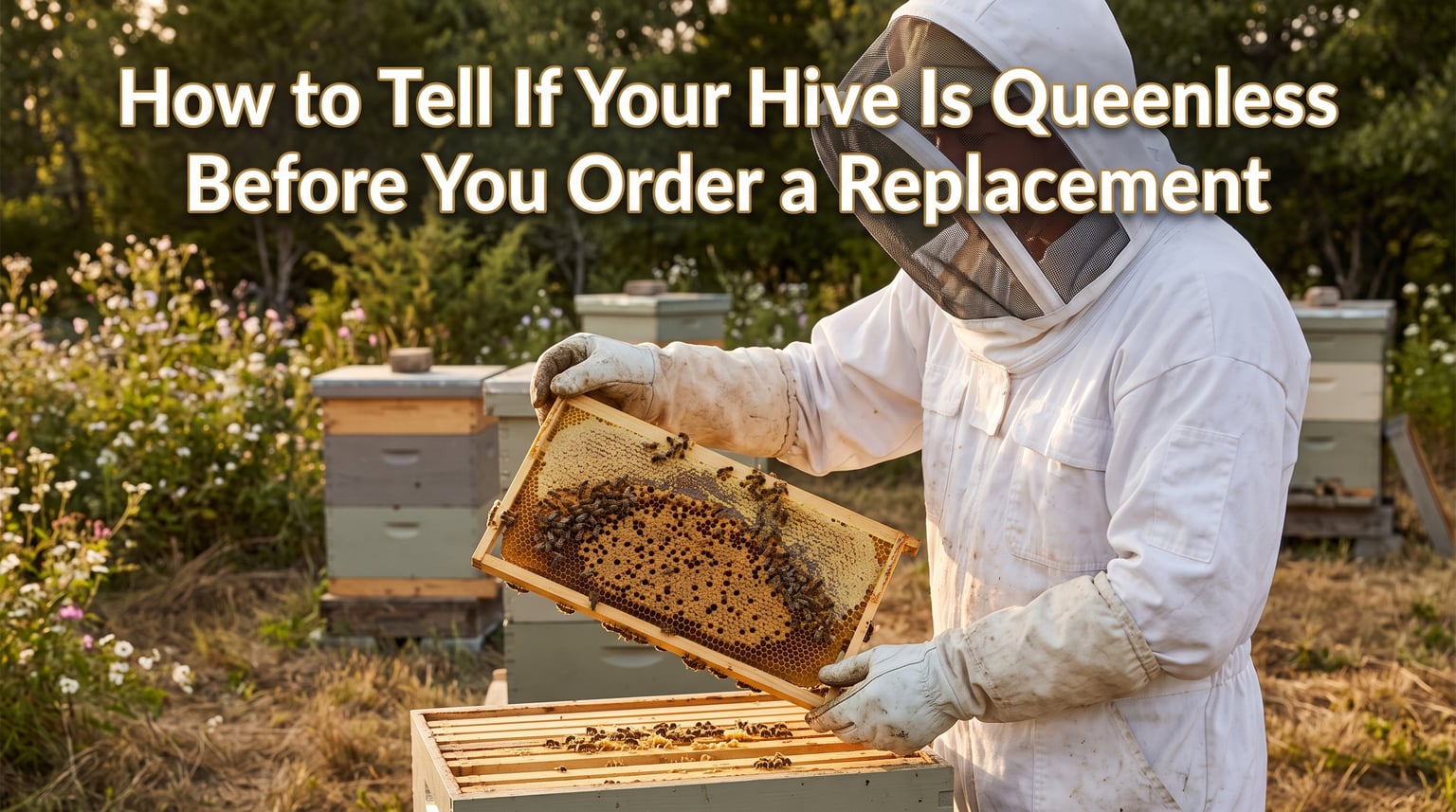
Ordering a replacement queen is a $35 to $50 decision, but ordering one for a hive that still has a queen is a $50 mistake that can cost you the colony. Before you reach for the phone, you need to confirm your hive is actually queenless, because the classic signs of queenlessness overlap with swarming, brood breaks, and even normal seasonal slowdowns.
Every experienced beekeeper has a story about misdiagnosing queenlessness. I once panicked when I could not spot eggs on a cool April inspection and ordered a queen I did not need, only to find fresh larvae three days later when the weather warmed enough for proper egg-laying. The bees knew exactly what they were doing.
This guide walks through the queenless hive signs you can trust, the timeline of how queenlessness develops, and how to confirm your diagnosis before you spend money on a replacement queen you may not need.
Table of Contents
Quick Signs of a Queenless Hive
If you only have time for a quick check, these are the most reliable queenless hive signs, ranked by how early they appear.
No eggs — Single eggs standing at the bottom of cells are the freshest proof of a laying queen. No eggs means no queen has laid in the last three days.
Declining brood pattern — You see capped brood but no open brood, then no brood at all over successive inspections.
Queen cells on the face or bottom of frames — Emergency queen cells built from worker cells signal the bees know their queen is gone.
A loud, restless roar when you open the hive — Queenless colonies often voice their distress.
Cranky, darting bees — A hive that was gentle last week and now greets you with head-butting guards is worth a closer look.
None of these signs alone confirms queenlessness. The strength of your diagnosis comes from seeing several signs together.
The Timeline of Queenlessness
Queenless hive signs do not all appear at once. They unfold over days and weeks, and knowing where your colony sits on this timeline tells you how urgent the situation is.
Within roughly 15 minutes of losing their queen, the colony knows. Worker bees detect the drop in queen mandibular pheromone almost immediately. You will not see any visible change yet, but internally the colony is already in alarm mode.
By day one to three, you stop seeing fresh eggs. Eggs stand upright for the first day after laying, then tilt, then hatch into larvae on day three. If you see only larvae and capped brood with no eggs at all, the queen has been gone at least three days.
By day four to nine, the last of the worker larvae have been capped. The colony has no open brood left, which means no young larvae for the bees to convert into emergency queen cells. This is the window where requeening is still easy.
By day 14 to 21, all the brood has emerged. The hive looks empty of brood and starts showing behavioral changes. Nurse bees have nothing to nurse, so they shift roles.
By week three to four, if the bees have not successfully raised a new queen, worker ovaries begin to activate. This is the danger zone. Once laying workers are established, the colony will resist accepting a new queen.
Without intervention, a queenless colony typically collapses within five to six weeks as the worker population dies off with no replacement.
Outside the Hive: Behavior and Sound
You can pick up some queenless hive signs without ever opening the lid. These are the clues beekeepers learn to read at the entrance.
A Loud, Restless Roar
When you open a queenless colony, the bees often produce a distinctive loud roar that sounds different from the calm hum of a queenright hive. Some beekeepers describe it as a high-pitched whine combined with a deep, anxious hum.
This sound comes from the colony registering the absence of queen pheromone and reacting to the disruption. A queenright hive that is just annoyed at being opened will quiet down quickly. A queenless hive tends to stay loud and restless throughout the inspection.
Cranky, Defensive Bees
Queenless colonies often become noticeably more defensive. Bees that used to ignore you may now head-butt your veil, follow you longer after you close the hive, and sting more readily.
This crankiness has a biological cause. Queen pheromone helps keep a colony calm and cohesive. Without it, the workers feel exposed and act accordingly. A sudden personality change in a previously gentle hive is worth investigating.
Increased Foraging, or Robbing
Some beekeepers report a surge of flight activity at the entrance of a queenless hive. Without brood to care for, more workers become foragers. This can look like a booming, productive hive at first glance.
The trap is confusing this with normal heavy foraging. Look closely. If you see bees fighting at the entrance, bees with shiny, hairless abdomens, and chewed wings, you may be watching robbing rather than foraging. A queenless colony with fewer guard bees is a prime target for robbers from stronger hives.
Inside the Hive: Brood and Eggs
The most reliable queenless hive signs are found on the comb. Brood pattern tells you what the queen has been doing for the last three weeks.
Look for Eggs First
Eggs are your earliest indicator because they tell you what the queen did today. A single egg standing at the bottom of a cell means a queen was laying within the last 24 hours.
Tilt the frame so sunlight hits the cell bottoms. Eggs look like tiny white threads standing on end. If you see one egg per cell, you almost certainly have a queenright colony.
Two or more eggs per cell, or eggs attached to the cell wall instead of the bottom, suggests laying workers rather than a queen. Workers cannot fertilize eggs, and they often lay multiples per cell because they lack the queen’s precise egg-laying behavior.
Read the Brood Pattern
A queenright colony lays a solid, contiguous brood pattern. Worker brood is capped smooth and flat, while drone brood sticks up with bullet-shaped cappings. A healthy queen lays a tight oval of same-age brood, working outward.
A queenless hive shows a spotty brood pattern. You may see patches of capped brood with gaps, then nothing. As brood emerges and the queen is not there to refill cells, the brood nest shrinks week by week.
Tracking the brood pattern over two inspections is more reliable than one. If you see less brood on the second visit than the first, the colony is losing ground.
The Stages of Brood Loss
Queenless hives lose brood in a predictable sequence. First you stop seeing eggs, then open brood disappears, then capped brood emerges and the cells stay empty. By the time the brood nest is bare, you are three weeks into queenlessness.
This progression is why experienced beekeepers say “look for eggs, not the queen.” Finding the queen is hard. Finding evidence of her recent work is easy and tells you the same thing.
Queen Cups vs Queen Cells
One of the most common misdiagnoses comes from confusing queen cups with queen cells. Knowing the difference saves you from ordering a queen you do not need.
Queen cups are small, empty, downward-facing cups built on the face or bottom edge of comb. A queenright colony builds them as a precaution. They are not a problem. Most healthy colonies maintain a few queen cups at all times, like keeping a fire escape ready.
Queen cells are larger, peanut-shaped structures that hang off the comb. An active queen cell has a larva inside and is being fed royal jelly. Once capped, it looks like a peanut shell hanging vertically.
Where the queen cell is located tells you what the bees are doing:
On the bottom edge of frames — Swarm cells. The colony is preparing to swarm, not queenless.
On the face of the comb — Emergency queen cells. The bees lost their queen unexpectedly and are converting worker larvae into queens.
On the face, but few in number — Supersedure cells. The bees are replacing an aging or failing queen while she is still alive.
Emergency queen cells are your confirmation. The bees are telling you they have no queen and are trying to make one themselves.
Laying Workers: The Point of No Return
If a queenless colony cannot raise a new queen and several weeks pass, worker ovaries activate. These laying workers can only lay unfertilized eggs, which all develop into drones. The colony is functionally sterile.
A hive with laying workers is the hardest queenless case to fix. Workers with active ovaries produce pheromones that mimic a queen’s presence, so the colony thinks it is queenright. They will reject and ball any new queen you introduce.
Signs of laying workers include multiple eggs per cell, eggs laid on cell walls instead of the bottom, scattered drone brood in worker cells across the comb, and a hive that increasingly looks drone-heavy with no worker brood anywhere.
Once you see scattered drone brood in worker-sized cells, you are looking at laying workers. Requeening is rarely successful at this stage. The standard advice is to combine the remaining bees with a queenright colony rather than fight a losing requeening battle.
The Test Frame Method
If you cannot confirm queenlessness from the brood pattern alone, use the test frame method. It works because queenless colonies are desperate for young larvae to convert into a queen.
Step 1. Take a frame of freshly laid eggs and very young larvae from a strong, healthy, queenright colony.
Step 2. Brush off all the bees carefully so you do not accidentally transfer the queen.
Step 3. Place the frame in the middle of the suspect hive’s brood nest.
Step 4. Check back in three to five days.
If the suspect colony is queenless, the bees will have built emergency queen cells on the test frame. If the colony still has a queen you missed, they will simply raise the larvae as workers.
The test frame is the single most reliable confirmation method because it lets the bees themselves tell you whether they sense a queen or not. It costs you nothing but a frame of brood and a few days of patience.
Food Storage Patterns
A queenless colony often shows unusual food storage patterns in the brood nest. Without a queen laying, nurse bees that would normally tend larvae have nothing to do.
Foragers keep bringing in nectar and pollen, but there is no brood to feed. The bees start backfilling the brood nest with honey and pollen. You may see pristine white cells packed with nectar or pollen in what should be the brood area.
Backfilling is not always a queenless hive sign. Strong colonies backfill the brood nest before swarming, and any colony that stops brood production for any reason can show this pattern. Treat it as supporting evidence, not proof on its own.
What to Do Once You Confirm Queenlessness
Confirming queenlessness is only half the job. The next decision depends on the time of year, the strength of the colony, and how long it has been queenless.
Option 1: Let Them Raise Their Own
If you catch queenlessness early, the colony still has young larvae, and you are in the active season with drones flying, the bees can raise a new queen from a frame of brood you provide. A virgin queen emerges about 16 days after the egg is laid, then needs another one to two weeks to mate and start laying. Plan on four to six weeks total before you see eggs again.
Option 2: Order a Replacement Queen
If the colony has no suitable larvae, or you want faster results, ordering a mated queen is the standard fix. A mated queen starts laying within a few days of release. Introduce her in her cage, let the colony acclimate for two to three days, and release her when the workers are calm around the cage.
Option 3: Combine with a Queenright Hive
If the queenless colony is weak, late in the season, or you suspect laying workers, combining is the safest move. Use the newspaper method: place a sheet of newspaper between the two hive bodies, poke a few slits, and let the bees chew through and merge gradually over a day or two.
Combining saves the workforce of the queenless hive. Those workers become part of a stronger colony rather than dying off. You can always split the combined hive later once it builds up.
Seasonal Considerations
In late fall and winter, queenlessness is especially dangerous because there are no drones for a new virgin queen to mate with. A colony that goes queenless in October cannot raise a viable queen on its own. Ordering a mated queen or combining is your only realistic option before winter sets in.
How to Tell If Your Hive Is Queenless: A Quick Recap
Trust the bees’ behavior over your assumptions. If you see no eggs across multiple frames, declining brood, a loud roar when you open the hive, and emergency queen cells on the comb face, your colony is almost certainly queenless.
When in doubt, run the test frame method. It removes guesswork and lets the bees confirm or deny what you suspect.
FAQs
How long should a hive be queenless before introducing a new queen?
You can introduce a new queen as soon as you confirm the hive is queenless, typically within a few days. Wait too long and laying workers may develop, making the colony reject the new queen. Aim to requeen within two to three weeks of queen loss for the best acceptance rate.
How long can a hive go queenless?
A queenless hive can survive roughly five to six weeks before colony collapse as the worker population dies off with no replacement. However, the window for easy requeening closes at about three to four weeks when laying workers develop, so action is needed well before the colony dies out.
How long does it take bees to realize they are queenless?
Bees detect queen loss within about 15 minutes through the rapid drop in queen mandibular pheromone. Visible signs take longer to appear, with the absence of fresh eggs becoming noticeable after about three days.
Will a queenless hive make a new queen?
Yes, if the colony has larvae younger than three days old and the season has drones flying for mating. Bees will convert worker larvae into emergency queen cells. A virgin queen emerges about 16 days after the egg was laid, then needs one to two more weeks to mate and begin laying.
Final Thoughts on Confirming Queenlessness
Learning how to tell if your hive is queenless is one of the most valuable skills in beekeeping. Catch it early and a $40 queen or a single frame of brood saves the colony. Catch it late, and you are combining hives or starting over.
Build the habit of looking for eggs every inspection. Once you train your eye to spot that single white thread at the bottom of a cell, you will catch queenlessness long before the population crashes. The bees give you all the signs you need. Your job is to read them before you order that replacement queen.