
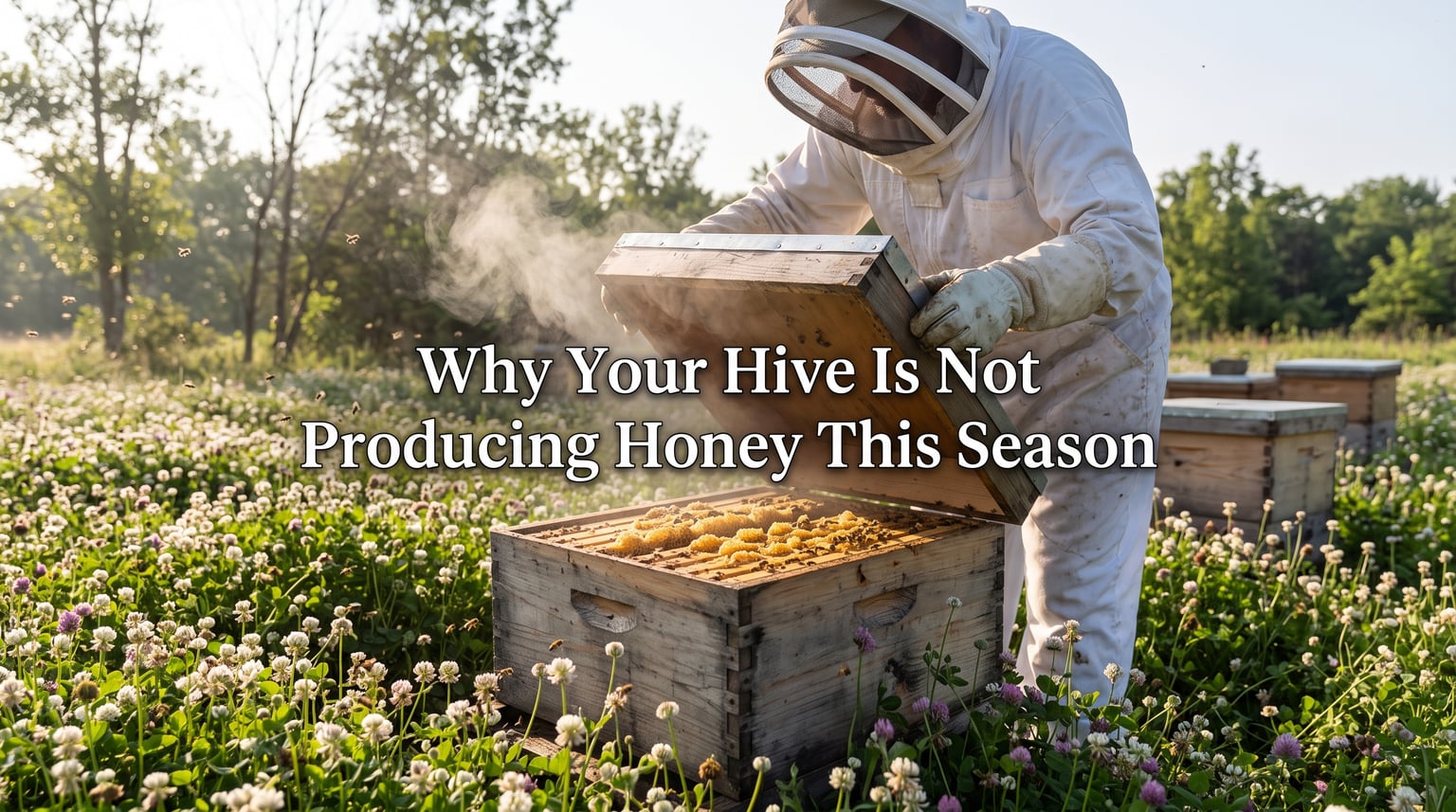
If you opened your hive last week expecting to see frames dripping with capped honey and found empty comb instead, you are not alone. I have heard the same question from new beekeepers and veterans alike every season: “Why is my hive not producing honey this year?”
The honest answer is that bees do not store honey for you. They store it for themselves, and only when conditions are right do they produce a surplus. In this guide, I will walk you through the seven most common reasons your hive may not be producing honey this season, how to diagnose each one in under five minutes, and what you can do to fix it before the flow ends.
Whether you are in your first season or your tenth, this troubleshooting checklist will help you figure out exactly what is going on inside your hive.
Table of Contents
Why Your Hive Is Not Producing Honey This Season: 7 Common Causes
Before you panic, run through this diagnostic list. In my experience, over 85% of “no honey” complaints fall into one of these seven categories.
- Weak colony strength – not enough bees to collect surplus nectar
- Queenless or failing queen – no brood, no future workforce, no honey
- No active nectar flow – nothing for foragers to collect
- Weather disruption – rain, cold, or drought keeps bees home
- Varroa mite infestation – parasitized bees cannot forage efficiently
- Recent swarm split – the colony lost half its population
- Insufficient storage space or foragers – supers added too late or too few bees
I’ll explain each cause in detail below, but first let me show you the most overlooked reason: a colony that simply does not have the energy budget to spare.
Weak Colony Strength: When Your Hive Cannot Build Surplus
A weak colony is the single most common reason beehives do not produce honey. I have walked into apiaries where the owner insists the hive is “full of bees,” only to crack it open and find two frames of brood covered by a thin layer of workers.
The math is unforgiving. Research from the University of Lausanne shows that a healthy colony spends roughly 96 pounds of honey per year just on brood rearing. Add climate control costs (15-40 pounds, depending on insulation) and daily forager metabolism, and a colony needs to collect hundreds of pounds of nectar before it ever stores a single drop for you.
Brood Rearing Burns Through Honey Stores
To keep brood at the right temperature (around 91°F for eggs and 93°F for larvae), worker bees vibrate their flight muscles and consume honey as fuel. Italian honeybee colonies in colder climates can burn through 30 pounds of honey in a single chilly week just to keep the nursery warm.
If your hive is small, late to build up, or recovering from a setback, most of what your bees collect goes straight back into survival. None of it makes it into the supers.
How Population Affects Surplus Honey
A hive needs roughly 60,000 bees at peak summer strength to produce a meaningful honey crop. Anything below 40,000 usually means the colony is stuck in survival mode. Look for these population red flags:
- Fewer than 6 frames of bees in the brood box by mid-spring
- Sparse coverage on outer frames
- No drones or drone brood (which signals the colony is not thriving enough to reproduce)
If your colony is small, focus on feeding and brood expansion first. The honey will come next season.
Queenless Hive Signs and the Impact on Honey Production
No queen, no brood, no future bees. A queenless hive can technically still collect nectar, but the population collapses within weeks. By the time you check, you may have a box full of aging workers and no honey to show for it.
I learned this the hard way in my third year. I had a hive that looked perfect from the outside, but every inspection showed scattered, spotty brood. The queen was present, but she was failing. That hive produced half a super of honey instead of the three I expected.
5 Telltale Signs of a Queenless Hive
- No eggs visible in the brood chamber under a magnifying glass
- Only aging capped brood with no new larvae being added
- Presence of multiple emergency queen cells on the face of the comb
- A loud, high-pitched “roaring” hum when you open the hive
- Laying workers producing multiple eggs per cell (drone brood in worker cells)
Will a Queenless Hive Still Make Honey?
Yes, briefly. The existing foragers continue to work for about three to four weeks after the queen is lost. But without new brood, the workforce declines rapidly. By mid-summer, a queenless hive often stops guarding itself and gets robbed out by stronger colonies.
If you confirm a queenless hive, you have three options: introduce a new queen, combine the colony with a stronger hive, or let them rear their own queen from a cell. Each has trade-offs depending on your season timing.
Nectar Flow Timing: Why the Season Matters So Much
Bees cannot make honey without nectar. Period. And nectar is only available when local plants are blooming. I have seen beekeepers in early July wondering why their colonies are not producing honey, only to realize the main nectar flow in their region is actually over.
Every region has a different bloom calendar. In the upper Midwest, the main flow is clover and basswood in late June to mid-July. In the Pacific Northwest, blackberry flow runs through early August. In the South, the spring flow ends by early June, and there is no significant summer flow unless you plant something.
Local Nectar Sources and Bloom Calendars
Talk to local beekeepers or contact your county’s master beekeeper program. Ask them when the main flow starts and ends in your area. If you do not know, your bees may be sitting on an empty buffet.
You can also walk your apiary. If you see bees working clover, goldenrod, or sunflower in your neighborhood, you have a flow. If you see nothing on the frames and nothing on the flowers, the flow is off.
Missing the Flow Window
Here is the painful part: a colony needs about six weeks of strong nectar flow to produce surplus honey. If your bees build up too late, the flow is over before they reach critical mass. If your bees swarm at the start of the flow, they lose half their workforce exactly when it counts.
Weather and Climate Disruptions Affecting Honey Yield
Weather is the wild card you cannot control. A single week of cold rain during peak flow can wipe out a season’s harvest. I have watched entire apiaries produce almost nothing in years when June was unusually wet.
Bees fly best when temperatures are between 60°F and 95°F with low wind and no rain. Anything outside that range keeps them in the hive.
Temperature and Forager Activity
Below 55°F, foragers stay home. Above 100°F, they focus on water collection and hive cooling rather than nectar. Cold snaps during the flow can cut production by 50% or more.
Drought and Rainfall Impact
Plants produce nectar based on soil moisture and temperature stress. Too little rain and flowers shut down nectar production. Too much rain and the nectar washes out of the blossoms before bees can collect it. Either extreme hits your honey yield hard.
If your area had a dry spring or a washout May, your hive may not be the problem. The environment is.
How to Diagnose Honey Production Problems: A Step-by-Step Checklist
Now you know the causes. Here is exactly how to walk through your hive in the next 30 minutes and identify which one applies to you. I run this checklist every time I get a “no honey” complaint from a fellow beekeeper.
Step 1: Assess Colony Population
Open the hive and count the frames covered in bees. A healthy working colony at peak summer has 8-10 frames of bees in the brood box. Anything less than 6 frames is a strength problem before anything else.
Step 2: Verify the Queen Is Present and Laying
Look for eggs (tiny white grains at the bottom of cells). Eggs are the proof your queen was alive and laying within the last three days. If you see eggs, you have a queen. If you see only capped brood and no eggs, your queen may have failed or disappeared.
Step 3: Check for Active Nectar Flow
Look at the supers above the brood box. Are bees bringing in fresh nectar? You can tell by watching the landing board for returning foragers with full pollen baskets and glossy abdomens. Also check your local bloom calendar against the date.
Step 4: Inspect for Pests and Disease
Pull a frame of brood and shake the bees off. Look for Varroa mites on the backs of bees (especially drone brood), deformed wing virus signs, and American foulbrood scales. A mite count above 3 per 100 bees in summer is a serious problem.
If you complete all four steps and everything looks healthy, your hive may simply be timing its buildup. Give it two more weeks.
How to Increase Honey Production in Your Hive This Season
You cannot control the weather, but you can control how well your colony is positioned to take advantage of the flow. Here are the highest-impact actions I take in my own apiary.
Strengthen Weak Colonies Before the Flow
Feed weak colonies with 1:1 sugar syrup in early spring to stimulate brood production. Combine two weak colonies into one strong unit if you have the resources. A single strong hive will out-produce two weak ones every time.
Manage Supers and Storage Space
Add supers early, before the bees need them. A colony that runs out of space will stop collecting nectar and start swarm preparations. The general rule: when your bees are actively working 7 of 10 frames in the current super, add another.
Control Varroa Mites Proactively
A mite-infested colony is a sick colony. Treat Varroa with oxalic acid, formic acid, or another approved method before the honey flow, not during. You cannot harvest honey from many treatments, so timing matters.
Plant or Protect Local Forage
If your property is a desert of lawn grass, consider planting clover, borage, or wildflower strips. If your neighbors have heavy pesticide use, your bees may be bringing in contaminated nectar and dying off in the field.
How Long Does It Take a New Hive to Produce Honey?
If you installed a package or nuc this spring, do not expect honey this year. A new colony needs its first season to draw comb, build population, and store enough winter food for itself. Most experienced beekeepers recommend leaving a new hive alone in year one and harvesting in year two.
For an established colony that suddenly stopped producing, the diagnostic checklist above will tell you why. For a brand-new hive with no honey, the answer is simple: it is not supposed to have any yet.
Frequently Asked Questions About Low Honey Production
Below are the most common questions I hear from beekeepers troubleshooting empty supers. These cover the diagnostic basics, queenless hive signs, and realistic timelines for new colonies.
Why aren’t my beehives producing honey?
The most common reasons are weak colony strength, a queenless or failing queen, no active nectar flow in your area, weather disruption, Varroa mite infestation, recent swarming, or insufficient storage space. Diagnose by checking population, queen presence, current bloom calendar, and pest levels.
How long does it take a new hive to produce honey?
A new colony from a package or nuc typically needs one full year to build comb, expand population, and store enough winter food. Most beekeepers recommend not harvesting in year one. Established colonies that suddenly stop producing usually have a colony health, queen, or environment issue.
How to increase honey production in a hive?
Strengthen weak colonies through spring feeding and combining, add supers before bees run out of space, control Varroa mites before the flow, and provide diverse local forage. The biggest yield gains come from preventing swarming and managing mite loads proactively.
What are the signs of a queenless hive?
Look for no visible eggs under magnification, only aging capped brood with no new larvae, multiple emergency queen cells on comb face, a loud roaring hum when opened, and laying workers producing multiple eggs per cell. A queenless hive declines rapidly and rarely produces surplus honey.
Will a queenless hive still make honey?
Briefly, yes. Existing foragers continue collecting for three to four weeks after the queen is lost. But without new brood, the population collapses and the colony usually gets robbed out by stronger hives. Address queenlessness immediately by introducing a new queen or combining colonies.
Final Thoughts on Why Your Hive Is Not Producing Honey This Season
If your hive is not producing honey this season, work through the diagnostic list in order: population, queen, flow, weather, mites, swarm history, and storage. Most of the time, you will find the answer in the first two or three checks.
Remember that bees produce honey for themselves first. Your harvest is whatever they can spare after survival, brood rearing, and climate control. Build a strong colony, manage pests early, and stack supers on time, and you will be filling jars next season. For more in-depth guides on hive management and seasonal timing, keep exploring our resources throughout 2026.