
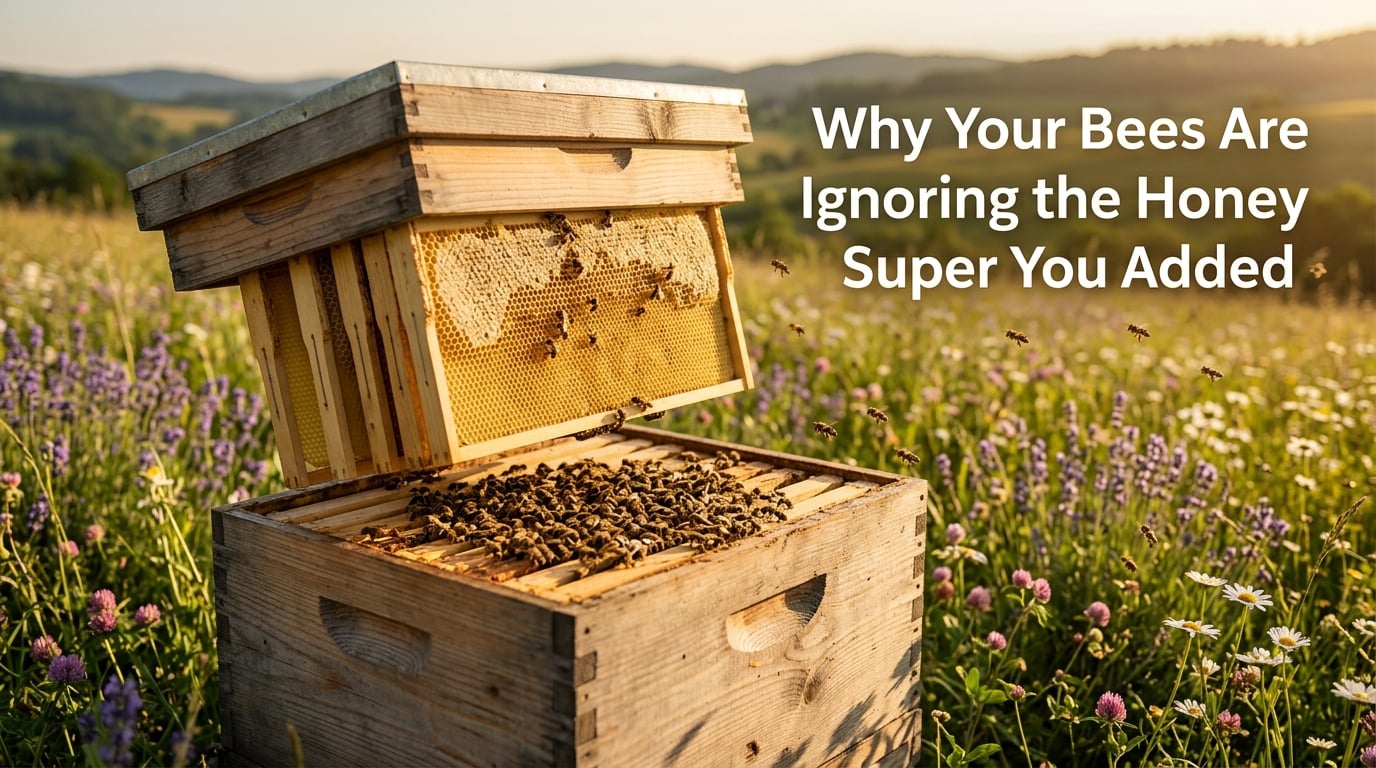
You added a honey super weeks ago, and the frames are still bare. I know how frustrating that feels. After all the work of inspecting the hive, lifting heavy boxes, and hoping for that first golden harvest, an empty super feels like a personal rejection from your colony.
The honest truth is that bees almost never ignore honey supers out of spite. They ignore them because the conditions inside and outside the hive are not right for storing surplus honey. In this guide, I’ll walk you through the seven most common reasons bees ignore the honey super you added, how to diagnose which one is happening in your hive, and exactly what to do to turn that empty box into capped comb.
Table of Contents
Why are my bees ignoring the honey super I added?
Bees ignore honey supers most often because there is no active nectar flow, or because the colony is too small or unprepared to defend and work a new box. Other common reasons include foundation type, super placement, queen excluder use, and a brood nest that is not yet honey bound.
The Short Answer: Why Bees Ignore Honey Supers
Bees ignoring a honey super is almost always about timing and conditions, not about the super itself. If there is no nectar coming in, no strong population to guard and draw new comb, and no congestion in the brood nest, your bees have zero biological reason to move up.
I keep this rule of thumb taped inside my bee truck: no nectar flow, no filled super. Everything else is a distant second.
1. There Is No Active Nectar Flow
The single biggest reason bees ignore honey supers is the absence of a real nectar flow. Bees cannot store what does not exist. If your local flowers have finished blooming, or weather has kept foragers inside for weeks, your colony will conserve energy and leave the super untouched.
How do you know a flow is on? Look for these signs during a normal inspection:
Fresh white wax being drawn on top bars of brood frames
Nectar pooling in cells that were empty the week before
Foragers returning heavy and landing hard at the entrance
A sudden, sweet smell when you crack the inner cover
If none of those are present, you are likely in a dearth. Adding a super during a dearth is like opening a grocery store in the desert. The bees have no reason to shop.
2. Your Colony Is Too Small to Defend the Super
A new honey super is a big empty room from a bee’s perspective. Guarding it costs energy and workers. If your colony is still recovering from a long winter or a split, they will cluster tightly in the brood box and ignore any extra space above.
I learned this the hard way during my second year. I added supers to three small nucs in early spring because I was excited. Two of them drew nothing for six weeks, and one even started backfilling the brood nest because they refused to expand upward.
A practical rule: wait until your bees are covering at least 7 of 10 frames in the top brood box before adding a super. Anything less, and the population simply isn’t there.
3. Foundation Type Is Holding Them Back
Bees have strong opinions about what they build on. New plastic foundation with a thin wax coating is the most common culprit for ignored supers. Some colonies refuse to draw plastic until it has been heavily re-waxed by the cluster, and they will not cross a “honey barrier” of older capped honey to start.
If your super contains plastic foundation and your bees are avoiding it, try this:
Spray the plastic frames with a 1:1 sugar syrup to encourage drawing
Move one or two drawn brood frames up into the super as “bait”
Replace stubborn plastic with wax foundation or foundationless starter strips
Drawn comb is the single best lure you can put in a super. Bees prefer it 10 to 1 over fresh foundation, and they will start work on it the same day you place it.
4. Super Placement: Top vs Bottom
Bees naturally build downward. When you add a super on top of a brood box, you are asking them to work against that instinct. Most of the time it works because the brood nest is expanding upward, but sometimes the cluster simply decides to ignore the new box.
Placing the new super under the brood boxes (between the bottom board and the brood chamber) sounds backward, but it mimics how bees would naturally expand. Several beekeepers on the forums I follow have reported bees moving into a bottom-placed super within 48 hours after weeks of ignoring a top-placed one.
Quick comparison for placement:
Top supering (most common): safer in cold weather, easier to harvest, fits standard beekeeping logic
Bottom supering: better for strong colonies in heavy flow, breaks honey-bound brood nests, faster draw in some cases
If you have tried top placement for 3 or 4 weeks with no progress, swap the order. It costs you one inspection and can save your honey crop.
5. The Queen Excluder Is a Bee Excluder Too
Here is a phrase that has divided beekeepers for over a century: queen excluder. Some keepers swear by them. Others swear at them. The truth is that a queen excluder can absolutely discourage bees from moving up, especially if it has not been well waxed or if the gaps are tight.
If your super sits above an excluder and the bees are ignoring it, try removing the excluder for two weeks. If the bees suddenly start drawing and storing honey, you have your answer. Replace it later, just before adding a queen excluder for honey harvest.
This is one of the most common real experiences new beekeepers share online. They install the excluder and the queen as a package, the bees never quite settle into the super, and harvest drops by half.
6. The Brood Nest Is Not Yet Honey Bound
Honey bound means the brood nest has become surrounded or capped with honey stores. When that happens, the queen has nowhere to lay, the colony feels congested, and a strong nectar flow will push them straight up into the super. No congestion, no upward push.
If your brood frames have open cells in the center and plenty of room on the outer frames, the bees have no reason to abandon the warm brood nest and climb into a cold, empty box above. The solution is either to wait until the brood nest fills, or to feed 1:1 syrup to simulate a flow and trick them into expanding upward.
7. You Added the Super Too Early in 2026
Every season, eager beekeepers add supers before the bees actually need them. An early-season super on a small cluster is one of the most common reasons for an empty box in late spring.
Here is a simple timing checklist that has worked for our team in most temperate climates:
Late winter to early spring: do not add a super yet
Mid spring (when dandelions bloom): only if colony covers 7+ brood frames
Late spring (when blackberries or locust bloom): prime supering time
Summer dearth: leave the super on but expect slow progress
Late summer to fall: remove and extract before treatments
Adjust this calendar 2 to 4 weeks earlier if you live south of the 40th parallel, or 2 to 4 weeks later if you live in a cold foggy zone like the coast of Northern California. Regional timing matters more than any other factor in 2026.
How to Encourage Bees Into the Super
Once you have diagnosed the cause, these are the most reliable ways to get bees working a stubborn super.
Move Drawn Frames Up as Bait
Pull two frames of drawn comb from the brood box and place them in the center of the super. Replace them in the brood box with empty frames or foundation. The drawn comb is a powerful signal that bees respond to almost immediately.
Feed Light Syrup to Start the Flow
A 1:1 sugar syrup feed during a dearth can simulate a flow. It will not make honey, but it will stimulate wax production and get bees moving into the super. Stop feeding the moment they start drawing the foundation.
Reduce the Entry, Reduce the Stress
If your super sits above a small colony, the bees may ignore it because they cannot guard it. Close the top entrance of the super and let them defend only the brood box. Once the population grows, open it back up.
Reassess in 7 to 10 Days
Do not panic and re-arrange the hive every two days. Bees need time to adapt. Give any change at least a full week before judging the result.
Signs Your Colony Is Ready for a Honey Super
Use this checklist before you add another box in 2026. If you can answer yes to at least four, go ahead and super up.
Bees are covering 7 or more frames in the top brood box
You can see fresh white wax on top bars
Foragers are returning heavy with pollen and nectar
The brood nest feels warm and crowded on inspection
There is a visible nectar flow in your area
Outer brood frames are starting to fill with nectar
When our team sees all six at once, we know the super will be drawn within 10 days. Anything less, and we wait another week.
FAQs
How long does it take for bees to fill a honey super?
In a strong nectar flow, a healthy colony can fill a super in 2 to 4 weeks. During a dearth or with a weak colony, it can take 6 weeks to a full season, or the super may never fill until next year.
What happens if you add a honey super too early?
Adding a super too early can chill the brood nest, give pests like small hive beetles extra room to hide, and the bees will simply ignore it. It wastes your equipment and your inspection time.
When should I stop adding honey supers?
Stop adding supers when the main nectar flow ends in your area, when nighttime temperatures start dropping consistently, or when the colony population begins to decline. Most beekeepers stop supering by late summer.
Final Thoughts on Bees Ignoring Your Honey Super
Bees ignoring a honey super is one of the most common puzzles in beekeeping, and the answer is almost always patient observation rather than quick fixes. Check the flow, check the population, check the foundation, and give the colony time to adjust before adding or removing equipment.
Use the checklist in this guide on your next inspection. If your bees are ignoring the honey super you added this season, run through the seven reasons one by one and you will find your answer. Stay curious, keep notes on every hive visit, and your supers will be heavy with capped honey before you know it.