
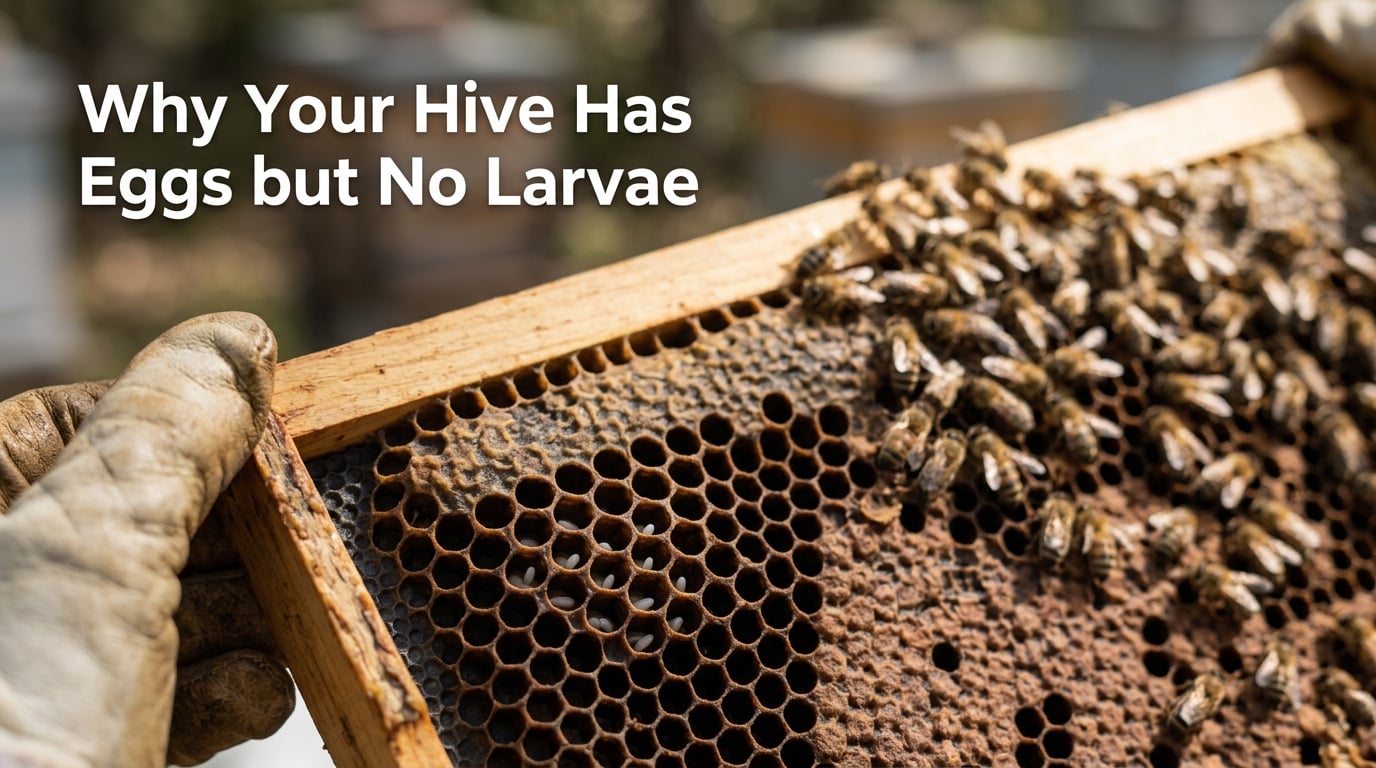
I remember the first time I cracked open a hive and saw eggs but no larvae. My heart sank, because I had no idea what that meant, and the answer turned out to be the most important lesson of my first season.
Why your hive has eggs but no larvae is one of the most common diagnostic puzzles new and experienced beekeepers face, and it almost always points to queenlessness. If you spot this situation during an inspection, this guide will walk you through what is happening, why it is urgent, and exactly what to do about it. We will cover the science, the timeline, and the practical fixes I have used in my own apiary, along with what experienced beekeepers on Beesource and the Beekeeping Forum UK have learned the hard way.
Table of Contents
The Honey Bee Life Cycle: Why Eggs Need to Hatch Quickly
Healthy honey bee eggs hatch into larvae in about 3 days, sometimes stretching to 4 in cooler weather or in weaker colonies. Once an egg becomes a larva, nurse bees start feeding it royal jelly and then a pollen-honey mixture. Without this transition, the brood cycle stalls, and the colony loses its future workforce.
To diagnose your hive properly, you need to understand the three brood stages a worker bee passes through before emerging as an adult:
- Eggs (Days 0-3): Tiny white grains standing upright at the bottom of cells, then tipping over as hatching approaches.
- Open brood or larvae (Days 4-9): White, pearly C-shaped grubs floating in a puddle of brood food. This is what most beekeepers picture when they think of brood.
- Capped brood (Days 10-20+): A tan or brown wax cap seals each cell while the larva pupates and matures into an adult bee.
On a healthy frame, you will see all three stages at once. When I find a frame with eggs but no larvae and no capped brood, my brain immediately shifts into triage mode. The pattern is unstable, and I know the colony has a problem.
If you see eggs alone with no larvae, the question becomes: when were those eggs laid? If they were laid less than 4 days ago, things might still be okay, but if you have been seeing only eggs for a week or more, your queen situation is almost certainly compromised.
A simple way to remember this: any egg more than 4 days old should already be a larva. Honey bee embryology does not pause, so a frame stuck on the egg stage is a frame with a clock that has stopped. Compare what you see today to what you saw on your last inspection. If the same eggs are still eggs, your hive has not been progressing, and you need to find out why.
What Queenlessness Means for Your Colony
Queenlessness means your hive has no laying queen, whether she died, failed, left, or was killed. Without a queen, no new eggs get fertilized, no new workers emerge, and the colony is on a slow countdown to collapse.
A healthy queen lays up to 2,000 eggs per day during peak season. Her pheromone, called Queen Mandibular Pheromone or QMP, also tells workers that a queen is present and suppresses their ovaries. When QMP fades, two things happen: the colony recognizes it is queenless, and laying workers may begin to develop in the background.
Common causes of queenlessness include:
- Natural queen failure: Old queens run out of stored sperm and start laying unfertilized eggs, or stop laying entirely.
- Accidental squashing during inspection: I have done this once and felt sick for a week. Mark your queens so they are easier to see and avoid.
- Disease or pests: Varroa, nosema, chronic bee paralysis virus, and other stressors can weaken and kill queens.
- Colonial rejection: Worker bees sometimes decide to replace or kill a queen they do not accept, especially with newer or older queens.
- Mating flight death: Virgin queens can be eaten by birds, fail to return from their mating flight, or get lost in bad weather.
Whatever the cause, the result is the same: no new fertilized eggs, and within a few weeks, no new bees. That is why seeing eggs but no larvae is such an important clue. The colony is sliding toward a tipping point, and how fast you act determines whether you save the hive or lose it.
Signs of a Queenless Hive You Can Spot in 10 Minutes
You do not need to see the queen to confirm queenlessness. The brood frame tells you almost everything you need to know. Here are the four most reliable signs I check during every inspection, plus the combination cues that make a diagnosis nearly certain.
1. No eggs at all, or only drone eggs. If you find a frame full of capped brood with no fresh eggs, your queen has been gone for at least 3 weeks. If you see only eggs on cell walls or multiple eggs per cell, those are laying worker eggs, not queen eggs. Both situations are bad news.
2. Spotty brood pattern. A queenright hive produces solid, even patches of capped brood. A queenless or failing hive produces spotty patterns with empty cells scattered throughout the brood area. This shows up when nurse bees detect unhealthy larvae and remove them, leaving gaps that signal something is wrong.
3. Queen cells present on the frame. If you see peanut-shaped cells hanging off the bottom of frames or carved into comb, your colony has already tried to raise a new queen. Emergency queen cells mean workers detected queenlessness and attempted a rescue. Swarm cells, by contrast, are built along the bottom edge in swarming season and suggest the colony still has a queen.
4. The queenless roar. Lift a frame and hold it up to your ear. A queenless hive produces an uneven, distressed hum that experienced beekeepers describe as a “queenless roar.” Compare it to the steady, contented hum of a queenright hive and the difference is obvious. The roar happens because workers are signaling distress and searching for the missing queen.
Combining signs raises your confidence. Eggs but no larvae plus no queen cells plus no fresh brood across two inspections in a row is almost always queenlessness. The Beesource forum threads on this exact problem repeat the same story: beekeepers describe finding eggs on visit one, then nothing on visit two, then laying workers by visit three.
If two or more of these signs show up during one inspection, treat it as confirmed queenlessness until proven otherwise.
Understanding Laying Workers: The Colony’s Emergency Response
Laying workers are worker bees whose ovaries activate because the queen’s pheromone is gone or too weak. They cannot mate, so they only lay unfertilized eggs that always develop into drones.
This happens because of two pheromone systems working together. Queen Mandibular Pheromone directly suppresses worker ovaries. Brood pheromone, produced by open larvae, also signals “we have a queen, things are fine.” When brood pheromone disappears with the larvae, and QMP fades with the queen, workers’ ovaries begin to activate.
Michael Bush, one of the most cited voices in modern beekeeping, explains in his laying workers resource that brood pheromone is actually a stronger suppressor than the queen’s own pheromone. That is why many treatments for laying worker colonies rely on introducing open brood from a healthy hive, since the brood pheromone resets the workers’ ovaries back to a non-laying state.
A typical laying worker hive develops 2 to 3 weeks after queenlessness sets in. By that point, hundreds of workers may be laying, each contributing tiny unfertilized eggs to the cells. The colony’s population is now aging out with no replacements, and drone production is ramping up in worker-sized cells, which is a telltale sign.
Once laying workers are active, your hive is in trouble. Drones cannot forage or nurse. A workforce of 1,000 laying workers will produce only a small number of oversized drones in worker cells, none of which will save the colony. This is why the time between detecting queenlessness and acting matters so much.
How to Tell Queen Eggs from Laying Worker Eggs
Eggs are tiny and easy to miss, but the way they sit in a cell tells you almost everything. Here is how I distinguish the two in the field without magnification, using a flashlight and a careful eye.
Queen eggs: A laying queen deposits a single egg per cell, and it is centered at the bottom of the cell. The egg stands upright for 3 days, then tips over to hatch. If you see one egg, perfectly placed, in the center of the cell, your queen was there within the last 3 days.
Laying worker eggs: Workers cannot reach the bottom of the cell, so they lay eggs on the cell walls. You will also often see multiple eggs per cell because many workers compete for the same space. The eggs look scattered, off-center, or stuck to the side wall. Sometimes you will see 2 to 5 eggs piled together or even attached to existing brood.
Another clear sign of laying workers is drones emerging from worker-sized cells. A queen lays fertilized eggs in worker cells, which produce small worker bees. Laying workers produce unfertilized eggs in any cell, including worker cells, which then develop into oversized drones that barely fit. If you see drone-sized caps on a worker brood frame, the colony has laying workers.
A useful trick is to use your phone’s flashlight at a low angle. The eggs cast tiny shadows that make them much easier to see. I use this every inspection. Some beekeepers prefer a magnifying loupe, but a flashlight at the right angle works for almost everyone.
The Critical Timeline: How Long Before Your Hive Dies
Time is your enemy here. A queenless hive does not collapse overnight, but it does collapse on a predictable timeline. Knowing where your hive is on that timeline helps you decide how urgently to act.
Days 0-3: Eggs are still present from the last queen. You may not realize anything is wrong yet, which is why weekly inspections matter so much.
Days 4-10: No new eggs appear. Brood from the last laying cycle is still developing. Workers start fanning, and you may hear the queenless roar when you lift a frame.
Weeks 2-3: Laying workers develop and start producing unfertilized eggs. Drone production begins in worker-sized cells. The colony is now recognizably queenless to anyone inspecting.
Weeks 4-6: The worker population starts dropping because no new bees are emerging. Foragers die off and are not replaced. The colony becomes vulnerable to robbing, wax moth, and small hive beetle, all of which accelerate the collapse.
Weeks 8-12: Total collapse. Without intervention, a queenless hive dies within 2 to 3 months during the active season, faster in winter because the cluster cannot thermoregulate without fresh bees emerging.
I have watched this exact timeline play out in my own apiary. The moment I see eggs without larvae past day 4, I treat it as urgent. Waiting two more weeks to “see what happens” usually means starting over with new bees and lost comb. Forum beekeepers share the same regret, and almost everyone who has survived laying workers will tell you the same thing: act early.
Solutions: How to Fix a Hive with Eggs but No Larvae
If you have confirmed queenlessness, you have four practical options. The best choice depends on how far the problem has progressed, whether laying workers are already active, and whether you want to keep the colony’s genetics.
Option 1: Introduce a new mated queen. This is the fastest fix. Order a marked, mated queen from a reputable breeder. Before introducing her, remove any existing queen cells so workers do not try to replace her immediately. Use a slow-release queen cage with a candy plug so workers acclimate to her pheromone for 3 to 5 days before she is released.
If laying workers are already active, this method has a high failure rate. Workers may kill the new queen because they perceive her as an outsider rather than their own. To improve your odds, brush all bees off the frames before introducing the queen, or shake the bees out 50 yards from the hive so laying workers cannot return.
Option 2: Use the open brood method. This is Michael Bush’s preferred approach for laying worker colonies. The idea is simple: brood pheromone from open larvae suppresses worker ovary development, which gradually shuts down laying. Take 2 to 3 frames of open brood from a healthy donor hive and place them into the queenless hive every 7 days for 3 weeks. After laying workers stop, introduce a new mated queen.
This method requires access to another strong colony. It is the most reliable fix I have used for laying worker situations, and it preserves the colony’s genetics if the donor brood carries similar stock. Beemaster forum users report success rates around 70 percent with this approach, even on colonies that had laying workers for over a month.
Option 3: Shake out and combine. If the colony is weak and laying workers are entrenched, shake all bees off the frames 50 yards from the original hive location. Most laying workers will not return because they have not learned the orientation flights. Foragers and healthy workers will fly back. Add these survivors to a strong queenright hive using the newspaper method.
This is a tough call because you are effectively giving up on the colony, but it preserves the bees that are not laying. In my experience, shakeout works best late in the season when you cannot afford to wait for requeening, or when the colony has been queenless for over 6 weeks and is past saving on its own.
Option 4: Let the colony try to raise its own queen. If you see fresh, viable queen cells on the frame and you trust your queenless colony’s strength, you can leave them alone and let them raise a new queen. This works only if laying workers are not yet active, the queen cells are large and well-formed, and you have plenty of drones in the area for mating. Expect 4 to 6 weeks before new eggs appear.
A simple decision tree: if eggs present and laying workers absent, allow the colony to raise its own queen. If laying workers are present, use the open brood method first, then introduce a mated queen. If the colony is weak and resources are limited, shake out and combine with a strong hive.
Prevention: How to Catch Queenlessness Early
The single best thing you can do is inspect every 7 to 10 days during the active season. That window fits the egg-to-larva-to-capped-brood cycle, so you will always see fresh evidence of your queen if she is laying.
I use what beekeepers call the 3-3-3 rule during inspections: look for eggs in at least 3 frames, confirm larvae in 3 frames, and confirm capped brood in 3 frames. If any of those three checks fail across multiple frames, I start asking why. The 3-3-3 rule gives you a quick mental checklist that catches problems before they become emergencies.
Keep a simple notebook. Note the date, what you saw, and how many frames of brood were present. Patterns show up over time that single inspections miss. A sudden drop in brood frame count is often the earliest warning, and your notes will catch it before your memory does.
Finally, mark your queens. A dot of paint on her thorax means you can find her in 5 seconds instead of 5 minutes, and you will never confuse a new queen with the old one. International beekeeping color codes by year also help you remember the queen’s age at a glance.
Frequently Asked Questions
How long does it take for bee eggs to become larvae?
Bee eggs hatch into larvae in about 3 days, sometimes stretching to 4 days in cooler weather or weaker colonies. After hatching, nurse bees feed the larvae royal jelly and brood food for 6 days before workers cap the cells.
What are the signs of a queenless hive?
The four most reliable signs are no eggs or only drone eggs on the frames, a spotty brood pattern, emergency queen cells hanging from the bottom of frames, and the queenless roar, an uneven distressed hum when you lift a frame. Two or more of these signs usually confirm queenlessness.
What if my hive has no brood at all?
A hive with no brood, no eggs, and no queen cells is almost certainly queenless and may already have laying workers. Inspect every frame, including the edges, since queens sometimes hide in small clusters. If you still cannot find her, treat it as queenless and prepare to requeen.
Can bees raise a queen from larvae?
Yes, but only from very young larvae under 36 hours old. Worker bees select these larvae, draw out an emergency queen cell, and feed the chosen larva royal jelly exclusively. If you spot viable queen cells, the colony has already started this rescue process.
How long can a hive survive queenless?
A queenless hive survives about 2 to 3 months during the active season before collapsing. In winter, the collapse happens much faster, often within 4 to 6 weeks, because the cluster cannot thermoregulate without fresh bees emerging.
Can a laying worker bee make a queen?
No. Laying workers only lay unfertilized eggs that develop into drones. They have never mated and cannot produce a fertilized egg, which is required for a queen. This is why laying worker hives always eventually collapse without intervention.
What to do with a queenless hive with laying workers?
Use the open brood method: bring in 2 to 3 frames of open brood from a healthy donor hive every 7 days for 3 weeks to suppress laying workers with brood pheromone, then introduce a mated queen. Shake out and combine is a faster but harsher option.
How do you tell if you have laying worker bees?
Look for multiple eggs per cell, eggs stuck to the cell walls rather than centered on the bottom, and oversized drones emerging from worker-sized cells. Use a flashlight at a low angle to see the egg shadows clearly.
Conclusion
Why your hive has eggs but no larvae comes down to one urgent question: when was your queen last laying? Healthy eggs hatch in 3 to 4 days, so anything past that window is a serious warning sign. Confirm queenlessness, decide on requeening or rescue, and act quickly.
Inspect every 7 to 10 days, mark your queen, and keep records. Catching this problem early is the difference between a saved colony and a season lost. Your bees are counting on you to read the frames correctly and respond fast.