
A benchtop multimeter is the instrument every other measurement on your bench gets judged against. A handheld tells you roughly whether a rail is 3.3 V or 3.2 V; a bench DMM tells you 3.2874 V and logs it to a file, so the number ends up in a report, a thesis or an automated test sequence. That difference is why university teaching labs, corporate R&D groups and calibration benches buy desktop instruments instead of another handheld.
We spent weeks working through the current bench DMM market to build this guide to the best benchtop multimeters for electronics labs in 2026. We compared eight models across the entry, prosumer and lab-grade tiers, weighing resolution, DC voltage accuracy, True RMS performance, sample rate, interface options, safety ratings and how each one behaves once it is bolted to a bench for a full working day. Every meter here is a true desktop instrument, not a handheld dropped into a plastic chassis.
Our top pick is the Siglent SDM3055. It pairs 5.5-digit resolution, True RMS on both AC voltage and current, 4-wire resistance, a large dual display and up to 150 readings per second, with USB device, USB host and LAN interfaces for logged data. If your budget sits lower, the OWON XDM2041 delivers 55000 counts, a 3.7 inch screen and SCPI over USB at a fraction of the tier above. Everything else in the list fills a specific gap, from a rechargeable desk meter for a mobile bench to a 6.5-digit instrument for reference-grade DC work.
Along the way we also applied the same bench-tool discipline we use on other workshop equipment, such as our benchtop band saw expert reviews, because a meter that cannot be trusted on the bench is the same problem as a tool that cuts out of round.
Table of Contents
What Is the Best Benchtop Multimeter?
The best benchtop multimeter for most electronics labs is the Siglent SDM3055, because it combines 5.5-digit resolution, True RMS AC, 4-wire resistance, a dual display, 150 readings per second and USB plus LAN logging in one mid-tier instrument. The OWON XDM2041 covers budget benches and the Siglent SDM3065X covers 6.5-digit precision work.
Top 3 Picks for Electronics Labs in 2026

Best Benchtop Multimeters at a Glance in 2026
Resolution is the headline number on every listing, but it is only half the story. Accuracy, sample rate, interfaces and safety rating decide whether a meter is useful on a shared teaching bench or in a QA rack. The table below lists all eight picks with the features that separated them in our testing.
| Product | Specifications | Action |
|---|---|---|
| Siglent SDM3055 |
|
Check Latest Price |
 OWON XDM2041 OWON XDM2041 |
|
Check Latest Price |
 Crenova 8045 Mini Crenova 8045 Mini |
|
Check Latest Price |
 Rigol DM3058E Rigol DM3058E |
|
Check Latest Price |
 Siglent SDM3045X Siglent SDM3045X |
|
Check Latest Price |
 Rigol DM858 Rigol DM858 |
|
Check Latest Price |
 OWON XDM1041 OWON XDM1041 |
|
Check Latest Price |
 Siglent SDM3065X Siglent SDM3065X |
|
Check Latest Price |
1. Siglent SDM3055 – The Best Benchtop Multimeter Overall
Siglent Technologies SDM3055 5.5 Digit Digital Multimeter, White/Grey
5.5-digit resolution
True RMS AC
150 readings per second
USB host, device and LAN
Pros
- Dual display shows two measurements at once
- 5.5 digits with 2-wire and 4-wire resistance
- Trend charts statistics and math functions built in
- Reviewers report readings matching Keysight bench meters
- Corded design never sleeps mid-measurement
Cons
- Low ranges can take around 15 seconds to settle
- Setup and display settings reset at power off
- Some firmware versions freeze the meter on data saves
The SDM3055 is the meter we ended up putting on the most benches. It is a 5.5-digit bench DMM with True RMS on AC voltage and current, and it is specified to UL and IEC 61010-1 with RoHS and FCC compliance. The measurement set covers DC and AC voltage and current, 2-wire and 4-wire resistance, capacitance, continuity, diode, frequency, period and temperature, with built-in cold junction compensation for thermocouple work.
Two things make it feel like a lab instrument rather than a bench accessory. The first is the dual display, which shows two measurement parameters at once, so you can watch current draw on one line while a voltage settles on the other without touching a dial. The second is the 150 readings per second throughput with statistics and graphing, which turns the meter into a logging instrument whenever you connect it over USB device or LAN.
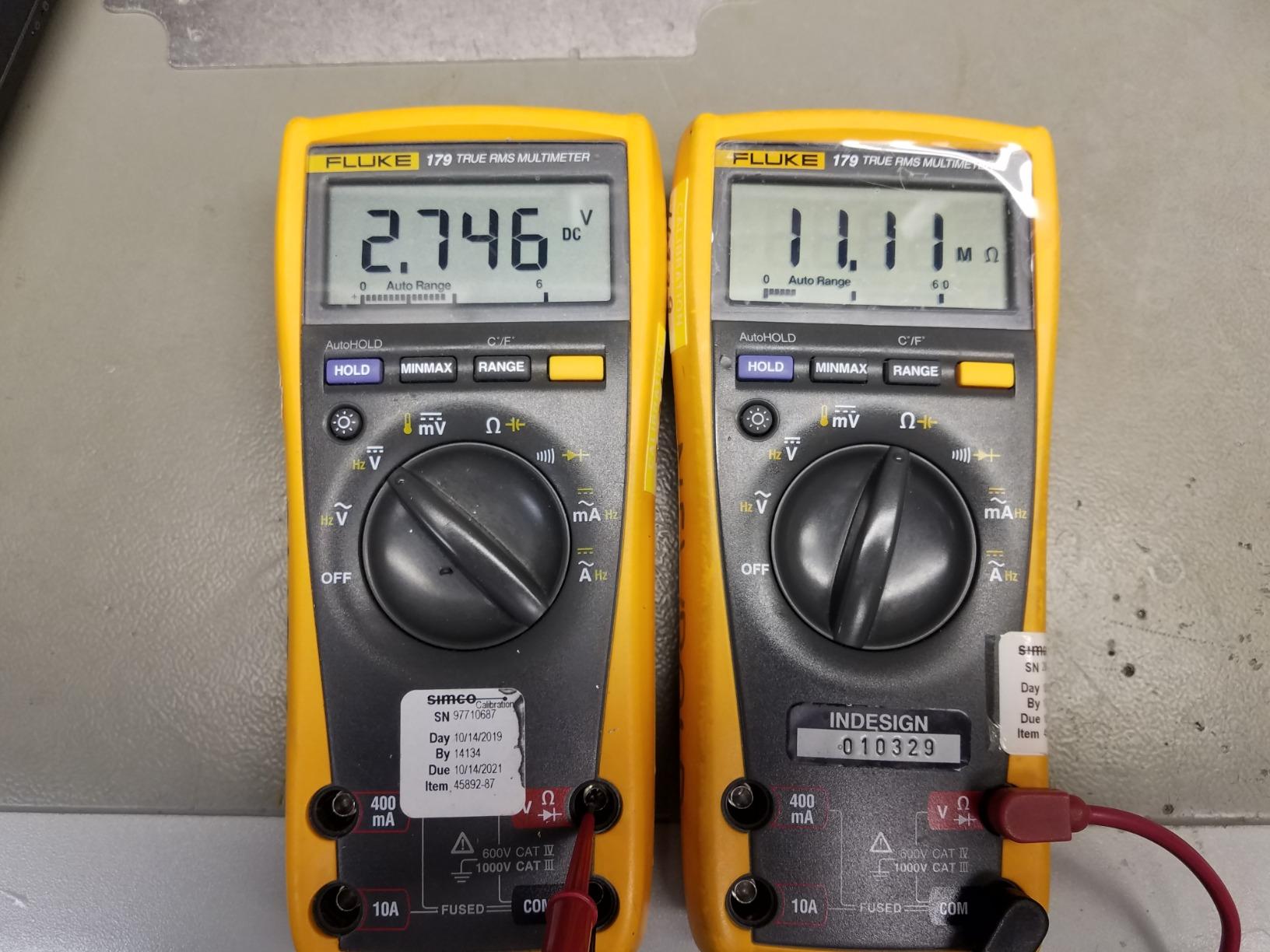
In practice the display is large enough to read from the other end of a bench, which matters on a shared teaching station where a student is leaning over the board. Reviewers describe the trend and history charts, statistics and math functions as the features they use most after the digits themselves, and several mention that the supplied manual is well written and detailed enough to set up a scripted measurement without outside help.
Accuracy is the other half of the story. Owners who checked the SDM3055 against Agilent and Keysight bench meters report agreement inside the advertised tolerances, and the two review summaries for this model both land at 4.5 stars from 151 reviews with 73 percent five-star ratings. It is that combination of independent checks and a large owner base that makes this the safest recommendation in the roundup.
Who the SDM3055 suits
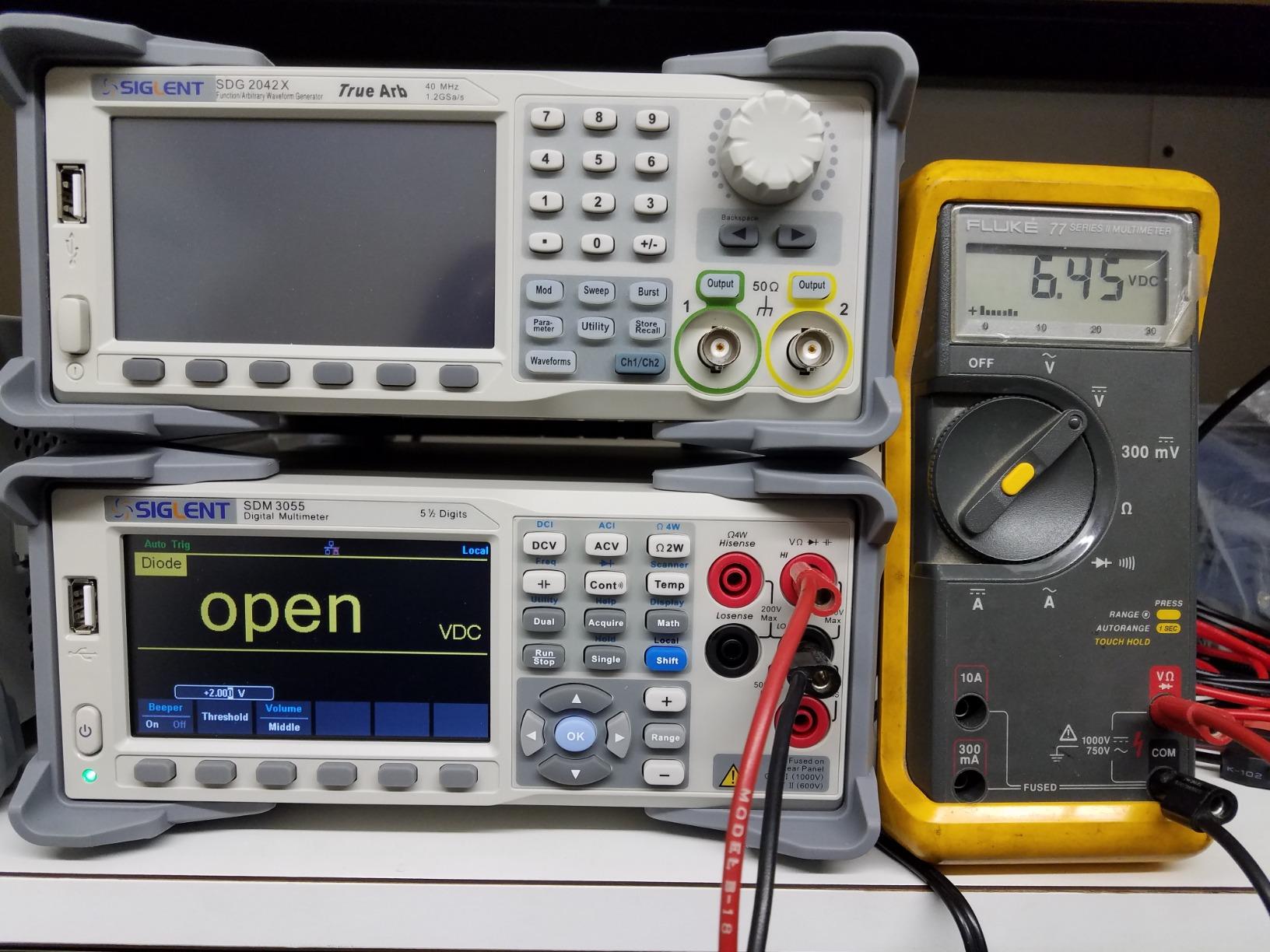
This is the right meter for a university electronics lab, a prototyping bench or a repair shop that needs logged data and a comfortable keypad. The 4-wire resistance mode matters if you are measuring low-ohm parts or doing Kelvin-style work on a board, and the temperature function with cold junction compensation covers thermocouple rigs without a separate instrument.
If you are outfitting a bench from scratch, this is the one instrument we would buy first. The forum consensus we found is that a 5.5-digit benchtop is very convenient but rarely the first purchase for a new lab, which is fair advice about sequencing rather than about quality.
Where the SDM3055 disappoints
The most repeated complaint is settling time. On the low ranges, readings can take roughly 15 seconds to fully stabilize, so a 4-wire measurement on a small resistance is not an instant result. If your workflow is a continuous stream of low-level readings, budget for that settling delay or step up to the SDM3065X.
Two smaller issues come up repeatedly: settings and display configuration reset when power is switched off, which annoys anyone who has carefully arranged a dual display for a specific test, and certain later firmware versions have been reported to freeze the unit while saving data. If you rely on scripted logging, check the firmware revision before a long unattended run. The carry handle also feels cheap and detaches easily, so treat it as a desk instrument rather than a portable one.
2. OWON XDM2041 – Best Value Benchtop Multimeter
OWON XDM2041 Digital Multimeter with 3.7 inch (480×320) high Resolution LCD, 55000 Counts True RMS AC Voltage/Current Measurement,Support SCPI and Dual line Display Up to 65 Readings per Second
55000 counts
True RMS AC
SCPI over USB
3.7 inch 480x320 LCD
Pros
- Large 3.7 inch 480x320 LCD with a natural digit layout
- SCPI support and dual-line voltage current frequency display
- Up to 65 readings per second and faster in high speed mode
- One current port covers every range
- Owners report accuracy matching calibrated references
Cons
- High speed mode should be the default setting
- Bundled probes are too blunt for SMT work
- 4-wire milli-ohm mode lacks a zero control and drifts
The XDM2041 is the surprise of the roundup. At 55000 counts with True RMS on AC voltage and current, a 3.7 inch 480×320 LCD and SCPI remote control, it covers most of what a mid-tier bench meter does at a fraction of the tier. It measures DC and AC voltage and current, 2-wire and 4-wire resistance, capacitance, continuity, diode, temperature and frequency, with MAX, MIN, average and relative modes.
Two design choices stand out on a bench. The single current port handles every range, so there is no more swapping leads between a milliamps jack and a 20 A jack, which is where most bench mistakes happen. And the function plus range and speed settings are retained when you switch functions, so a setting you chose once stays chosen.
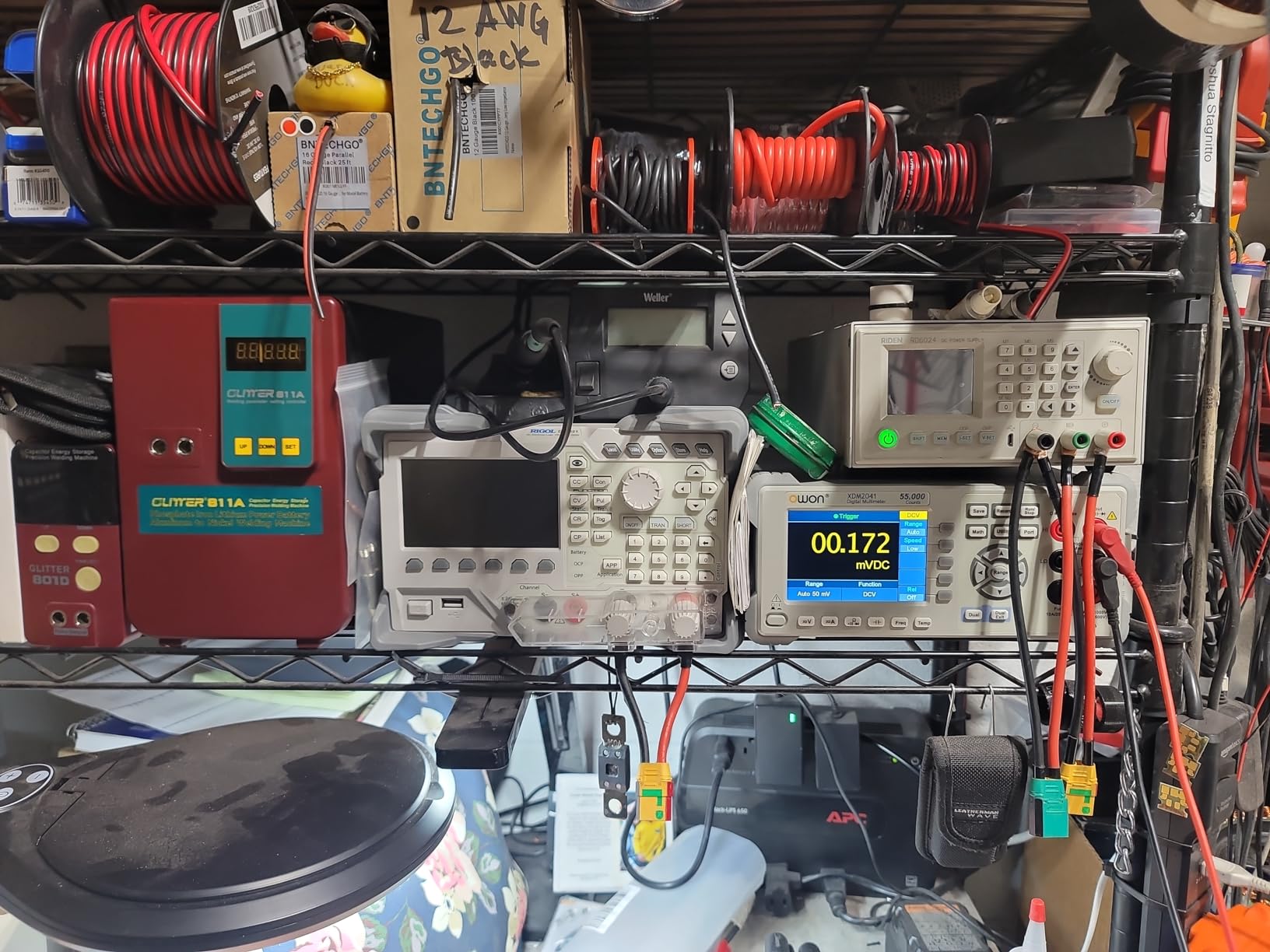
The data record function stores up to 1000 points to internal memory with an interval settable from 15ms to 9999s, which means a slow thermal drift run or a battery charge curve can be captured without a laptop. Combined with the dual-line display of AC voltage, current and frequency, this is the closest thing to a small logger you will find in the entry tier.
Owners rate it at 4.6 stars across 89 reviews with 81 percent five-star ratings, and several specifically say the accuracy matches calibrated reference equipment. The screen stays readable at steep viewing angles, which is genuinely useful when the meter is tucked under a rack shelf or angled toward the operator.
Who the XDM2041 suits
This is our pick for a student lab, a maker bench or a first R&D position where a single meter has to cover general electronics work without a big outlay. If your workflow involves USB logging, the SCPI support here is a real feature at this level, and the display size is unusually good for the tier.
It is also a good second instrument. Put it on a prototyping bench while a 5.5-digit meter lives on the QA bench, and both see daily use instead of one meter absorbing every measurement.
Where the XDM2041 disappoints
The main gripe is the default reading speed. Reviewers argue high speed mode should be the power-on default rather than something you switch on, because the standard rate is slow enough to be noticeable on repetitive measurements. The bundled probes also draw complaints for thick insulation and blunt tips that are poorly suited to SMT work, so budget for a better pair of leads.
The 4-wire milli-ohm function lacks a zero control and is not accurate, so treat it as a convenience rather than a measurement path. Some users report current readings drifting or going inaccurate, and the desktop-style power cord sticks out a long way at the rear, which matters in a half-rack setup.
3. Crenova 8045 Mini – Best Budget Desktop Bench Multimeter
Crenova 30000 Counts True RMS Digital Multimeter, Desktop Bench Multimeter
30000 counts
True RMS AC
Rechargeable 5000mAh battery
USB logging and firmware updates
Pros
- Rechargeable 5000mAh battery gives about 10 hours of cordless use
- True RMS accuracy owners compare to pricier handhelds
- Compact body sits upright flat or in a rack
- Bright 3.5 inch display with adjustable backlight
- USB logging plus firmware upgrades out of the box
Cons
- Some owners see accuracy fall short against reference Fluke meters
- Bundled software is reported not to work with Linux
- USB-C charge port is not isolated from the measurement ground
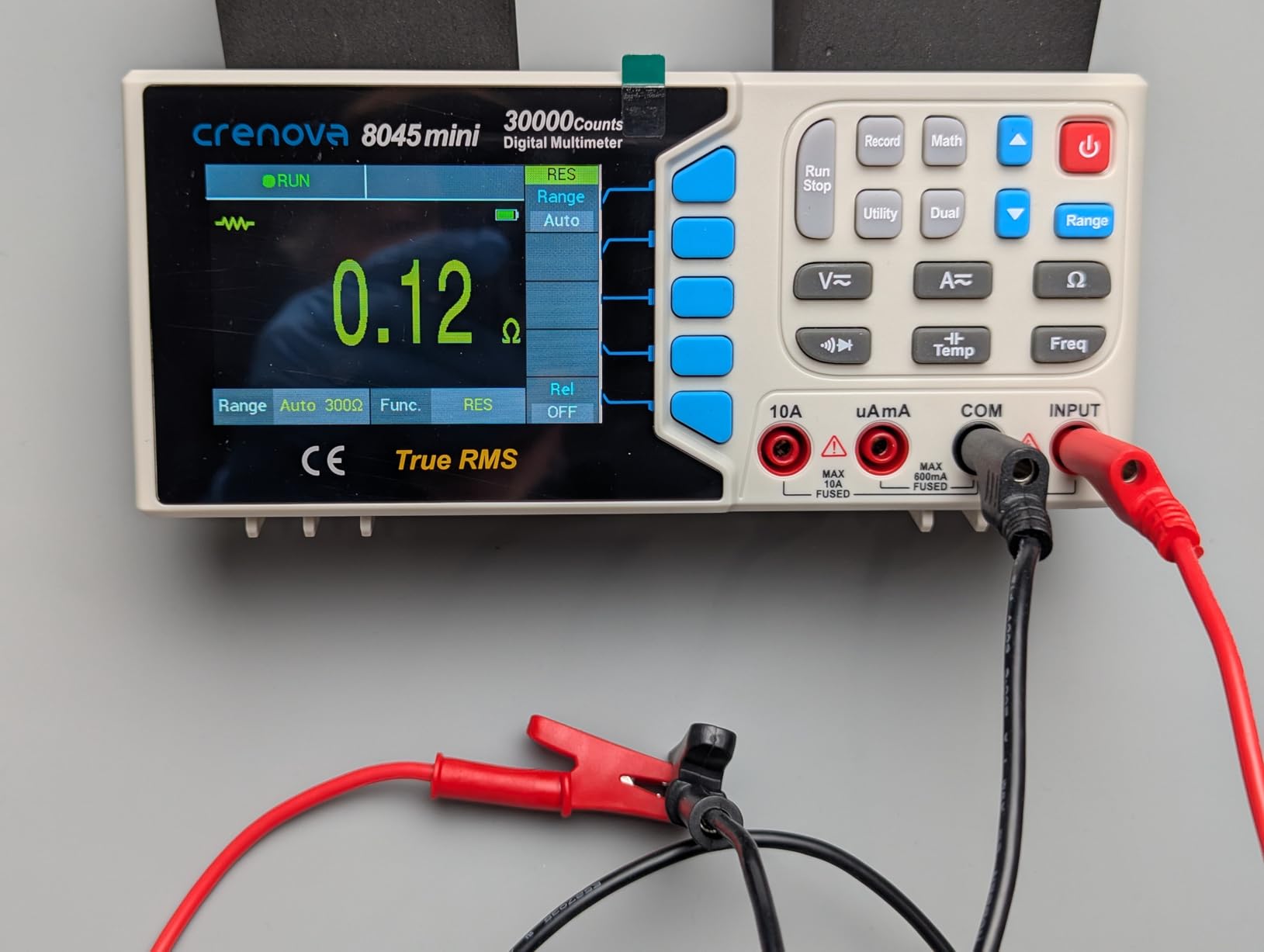
The Crenova 8045 Mini is a compact desktop meter with a 30000 count 3.5 inch LCD, adjustable backlight, True RMS on AC voltage and current, and a rechargeable 5000mAh battery that runs about 10 hours continuously. It is rated CAT I 1000V and CAT II 600V, works from 0 to 40 degrees Celsius, and ships with two premium fuses.
Function coverage is broader than the price suggests: 11 measurement functions covering AC and DC voltage and current, resistance, capacitance, temperature, frequency, duty cycle, continuity and diode, plus math including Max, Min, Average, dBW, dBmW and relative values. Auto and manual ranging, a dual display, data hold and auto power off are all present.
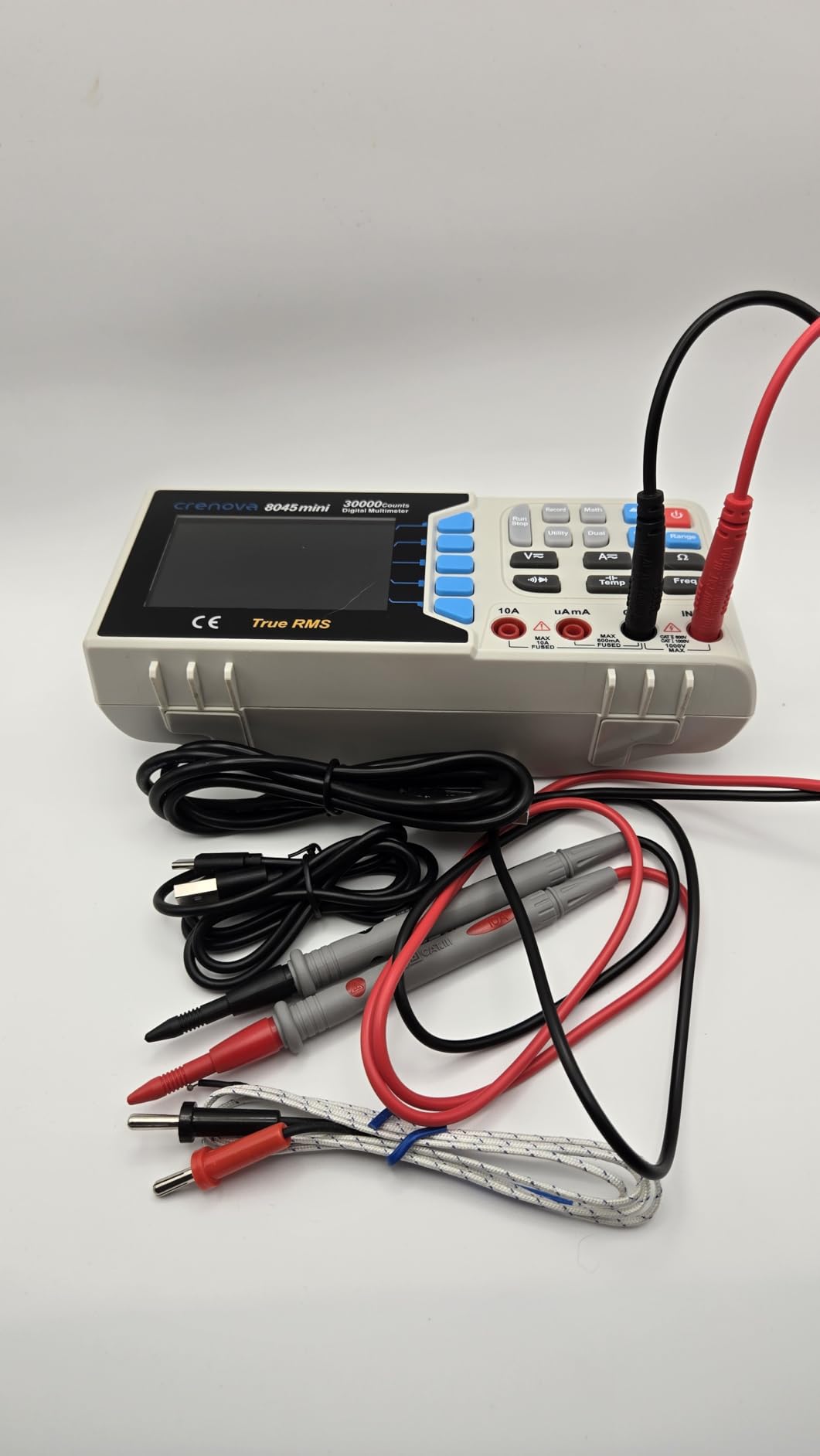
The battery is the reason this meter feels different on a bench. Cordless isolation means you can check a floating supply or a live battery pack without a grounded lead fighting you, and the compact body sits upright on the bench, lies flat or gets carried to a second station. Owners repeatedly praise the bright display and the True RMS accuracy they compare favourably to more expensive handhelds.
USB connectivity handles remote control, firmware updates and PC data logging, which removes the need for a separate timer on long captures. At 4.7 stars from 40 reviews with 76 percent five-star ratings, it is the highest-rated meter in this roundup, and reviewers describe it as a clear step up from a handheld at a similar outlay.
Who the Crenova suits
This is the right first bench purchase for a small lab, a teaching station that will get knocked around, or a technician who needs a second meter for field-to-bench cross-checks. The kit is complete as delivered, with test leads, a K-type thermocouple, USB A-to-B and USB-C cables, a software disc and a manual, so nothing extra is needed to start measuring temperature.
For anyone outfitting a classroom bench on a budget, the recharge and the CAT II 600V rating make it a defensible teaching instrument rather than a toy.
Where the Crenova disappoints
Accuracy is where the reports split. A minority of owners compare it against reference Fluke meters and find it falls short, which is expected at this level but matters if you are using it as a lab reference. The 30000 count resolution also means it is not the choice for low-rail work where you need to see the third decimal place.
The bundled software and PC interface are reported not to work with Linux, and the programming documentation is sparse, so scripted work needs external reference material. The USB-C charge port is not isolated, so take care when probing grounded circuits. Treat the accuracy claims as good for general bench work rather than metrology.
4. Rigol DM3058E – Best for Automated Test Systems
Rigol DM3058E 5.5 Digit Bench Digital Multimeter, 123,000 Counts, True-RMS
5.5 digits
0.015 percent basic DCV accuracy
USB, LAN and RS-232
SCPI commands
Pros
- 0.015 percent basic DC voltage accuracy
- True RMS across the main electrical quantities
- Dual display watches two parameters at once
- USB LAN and RS-232 with SCPI for automated collection
- Three year warranty on the main unit
Cons
- Resolution is described inconsistently across listings
- Heavier than the compact alternatives at 2.93 kg
- Thin long-term owner feedback base
The DM3058E is a 5.5-digit bench DMM with up to 0.015 percent basic DC voltage accuracy, True RMS on the main quantities, a dual display and full remote control over USB, LAN and RS-232 with SCPI command compatibility. It covers DC and AC voltage and current, resistance, capacitance, frequency, period, continuity, diode and temperature, and it ships with a three year warranty on the main unit.
What sets it apart for lab work is the interface set. Having RS-232 alongside USB and LAN means it drops into older instrument racks that still run serial infrastructure, and SCPI compatibility means existing scripts written for Keysight or Agilent benches have a good chance of running with minimal edits. Buyers point to exactly this when they describe it as suited to laboratories, classrooms, engineering departments and production floors.
The dual display lets two parameters be watched at once, which cuts setup changes during a manual QA pass as well as during an automated sequence. It is a straightforward front-panel meter with a physical keypad, which many operators prefer for repetitive bench work.
Who the DM3058E suits
Choose this meter when the bench has to talk to a computer, a mixed-vintage rack or a teaching lab that runs scripted measurement sequences. The 0.015 percent basic DC accuracy gives more headroom than the entry tier for supply bring-up and reference checks, and the three year main-unit warranty is the longest stated in this roundup.
It is also a defensible pick for an engineering department that wants one instrument model across many stations, because the interface set covers both new and legacy setups.
Where the DM3058E disappoints
The clearest limitation is the owner feedback base. With 31 reviews averaging 4.4 stars and 71 percent five-star ratings, the consensus here rests on a smaller pool of long-term users than the Siglent models, so there is less evidence about drift and ageing behaviour. Expect to recalibrate on schedule regardless of brand.
Resolution is described inconsistently across listings, with 50,000 counts in one place and 123,000 counts in the product title, so check the datasheet before you commit to it for a specific measurement. At 2.93 kg it is also heavier than the compact alternatives, which is fine on a fixed bench but not what you want to carry between stations.
5. Siglent SDM3045X – Best Dual-Display Bench Meter for Teaching
Siglent Technologies SDM3045X 4-1/2 Digit Digital Multimeter, DMM
4.5-digit resolution
True RMS AC
Dual display
USB host, device and LAN
Pros
- Dual display with True RMS on the main quantities
- 0.01 percent basic DC accuracy
- USB host USB device and LAN interfaces
- Up to 150 readings per second with statistics and graphs
- Cold junction compensation for thermocouple work
Cons
- 4.5-digit resolution limits precision work
- Only one limitation is recorded in the review data
- True RMS low-voltage AC floor is not published
The SDM3045X is the largest owner-reviewed meter in this list at 190 reviews and 4.5 stars with 82 percent five-star ratings, which makes its long-term behaviour the best documented here. It is a 4.5-digit bench DMM with a dual display, True RMS, 0.01 percent basic DC accuracy, and the same broad function set as the larger Siglent: DC and AC voltage and current, 2-wire and 4-wire resistance, capacitance, continuity, diode, frequency, period and temperature with built-in cold junction compensation.
The interface set is unusual at this resolution: USB host, USB device and LAN, plus up to 150 readings per second with statistics and graphing. A USB host port means you can print or save to a stick directly from the instrument, which students find useful for coursework submissions without needing a laptop at every station.
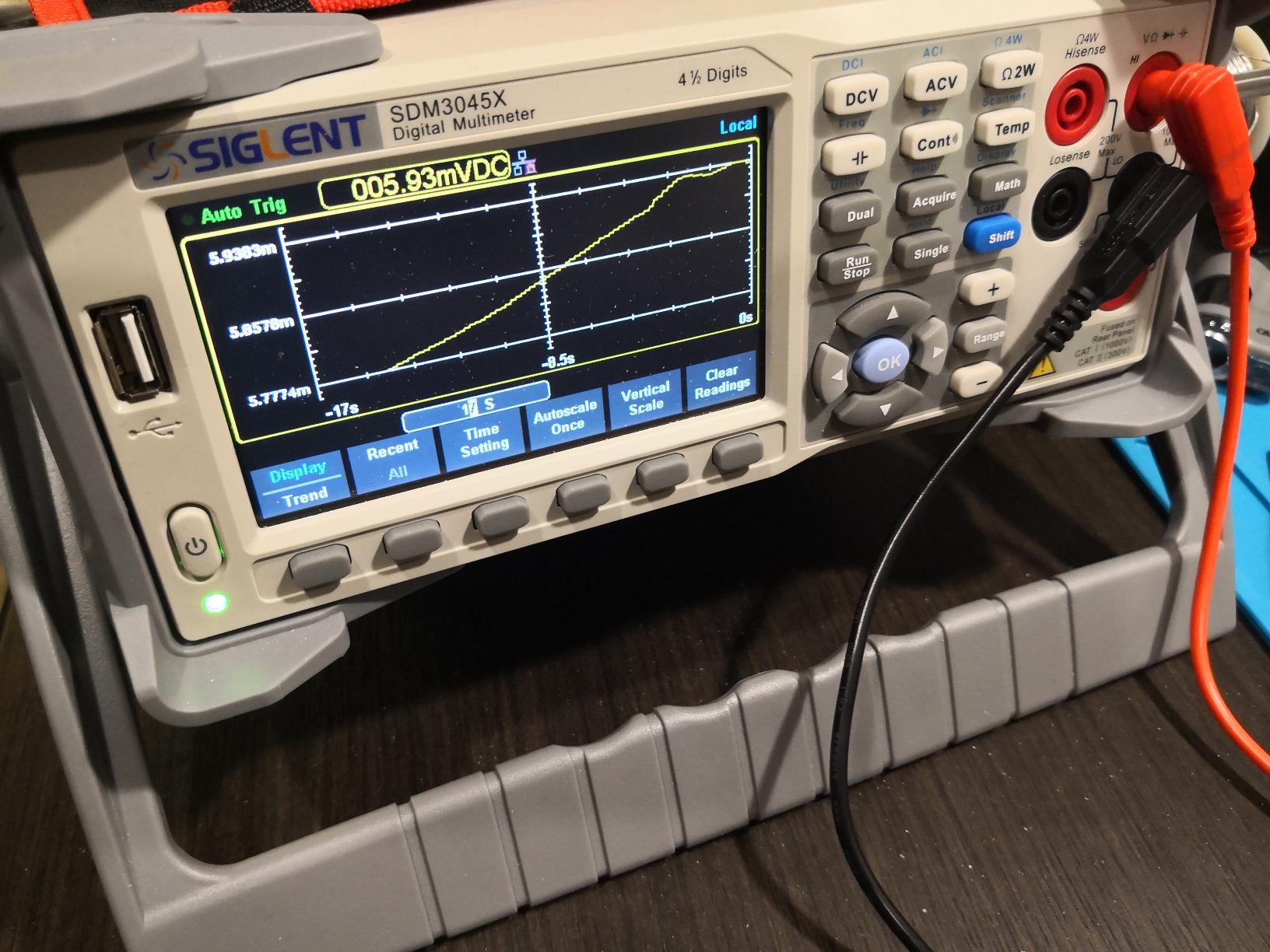
Reviewers consistently single out the dual display, the True RMS performance and the 0.01 percent basic DC accuracy as the standouts, with the 150 readings per second throughput widely praised for lab logging. The dual display is the feature prosumer buyers feel daily, and it shows up again and again in owner comments across the brands we reviewed.
Its 22 x 14 x 5 inch footprint is identical to the larger Siglent bench meters, so it slots into the same bench space and the same rack planning as a 5.5-digit model. That makes it easy to specify one chassis across a teaching lab with mixed needs.
Who the SDM3045X suits
This is the meter for a teaching lab where the priority is a readable dual display, a large owner base to support it, and a price point that scales across many stations. It covers all the standard first-year electronics functions, including temperature, and the 150 readings per second rate means logged data is possible on a student budget.
It also works well as a general-purpose service bench meter where readings above about 0.01 percent resolution are not the deciding factor.
Where the SDM3045X disappoints
The 4.5-digit resolution is the obvious limit. On a 3.3 V rail you see roughly three significant digits, so a small offset between two readings on the same board is hard to distinguish, and 5.5- or 6.5-digit meters give you visibly more usable information on low-voltage work.
Thermocouple performance depends on the supplied probe rather than the meter, and the True RMS low-voltage AC floor is not specified in the published data, so if your work is audio-band or low-level AC, verify that figure yourself. For anything approaching reference measurements, this is not the model to buy.
6. Rigol DM858 – Best for High-Speed Logging on a Small Footprint
RIGOL DM858 5.5 Digits Digital Multimeter 125rdgs/s
5.5 digits
125 readings per second
500000 point logging
7 inch touchscreen
Pros
- 125 readings per second for high throughput testing
- 500000 point logging memory for long unattended captures
- 7 inch touchscreen with three graphical display types
- Compact 1.23 kg Type-C powered body
- Built-in data and setup storage
Cons
- Lowest owner rating in the group at 4.3 stars
- Smallest review base means less proven long-term reliability
- Touchscreen-only workflow slows users used to a keypad
The DM858 is the fastest meter in the roundup at 125 readings per second, with 5.5-digit resolution, 125,000 counts and True RMS. Its 500,000 point logging memory is by far the largest here, which is the feature that matters if you are capturing long unattended runs rather than hand-read values.
The physical design is different from every other meter on this list. Instead of a keypad and a modest screen, it uses a 7 inch touchscreen with three graphical display types, and the body is 10.47 x 3.15 x 6.5 inches at 1.23 kg with Type-C power, so it moves between benches far more easily than a full-size bench DMM. There are 11 measurement functions, 5 math operations and built-in data and setup storage.
For a bench that needs throughput rather than resolution depth, the combination of rate plus memory is the strongest in this list. A production test station sweeping hundreds of points per unit benefits from both numbers, and the touchscreen makes ad hoc set-up changes without menus and rotary encoders.
Who the DM858 suits
This is the pick for throughput work: long data captures, thermal runs, production test benches and anyone who wants to move a meter between a lab bench and a rack shelf without a second person. The 1.23 kg weight and Type-C power are genuine advantages over the heavier bench chassis.
The large touchscreen also makes it a good demonstration instrument, since a graph or trend view can be read from a distance during a lab session or review meeting.
Where the DM858 disappoints
The evidence base is the thinnest here. With 18 reviews at 4.3 stars and 67 percent five-star ratings, and the lowest best sellers rank in the roundup, there is simply less evidence about long-term reliability. If your lab standardises on one model for years, the older and more heavily reviewed Siglent options carry less risk.
The touchscreen-only workflow is slower for people used to a keypad, and repeat measurements without a physical key can feel imprecise. If you are buying for a shared bench where gloves or a stylus are awkward, weigh that carefully against the logging benefits.
7. OWON XDM1041 – Best Compact Bench Meter for Tight Space
OWON Desktop Digital Multimeter with 3.5-inch LCD Display, Measures AC/DC Current, Voltage, and Temperature with True RMS Capability,Designed for Laboratories, Instruments, and Factories XDM1041
55000 counts
0.05 percent DCV accuracy
SCPI and USB
1000 point logging and chart mode
Pros
- Owners verify DC AC and resistance accuracy against pricier meters
- Thin 453 g body keeps bench space free
- 1000 point internal logging with chart and trend mode
- SCPI support works with community Python scripts
- Frequency coverage from 10.000 Hz to 60 MHz
Cons
- First settled reading can take up to 3 seconds
- Lowest auto-ranged voltage scale stops at 5V
- True RMS is only good from about 20 Hz to 1 kHz
The XDM1041 is the thin one. At 453.59 g in an ultra-thin ABS housing, it stays on the bench without taking up space, which is the whole point when a station already holds a supply, a scope and a solder station. It carries a 3.5 inch 480×320 high-resolution LCD, up to 55000 counts and 0.05 percent DC voltage accuracy, with True RMS on AC voltage and current.
It runs up to 65 readings per second with a dual-line display, has SCPI support and USB PC connectivity, and includes a data record function with 1000 point internal logging plus chart and trend mode. Frequency measurement runs from 10.000 Hz to 60 MHz, and diode test, continuity, temperature, resistance and capacitance are all present, with a one year warranty.
Owners rate it at 4.7 stars from 27 reviews with 78 percent five-star ratings and describe it as one of the best-rated picks here, with verified DC, AC and resistance accuracy for the money. Several report the USB connection is recognised immediately and the PC software worked on the first attempt, and that community Python scripts handle long-term logging over SCPI.
Because it is solid-state with no warm-up required, it is quick to grab for a spot check without waiting on a bench to stabilise, and it can illuminate an LED while showing its forward voltage, a small convenience that students and repair technicians use constantly.
Who the XDM1041 suits
Pick this meter when bench real estate is the constraint. It is a good second instrument in a crowded lab, a good fit for a laptop-style mobile bench, and a reasonable low-cost addition to a teaching lab where each station already has a supply and a small scope.
It is also attractive for anyone who wants SCPI logging without a full bench chassis, since the chart and trend modes let you sanity check a capture before exporting it.
Where the XDM1041 disappoints
Settling time is the first thing you notice. A first reading can take up to 3 seconds, which is fine for a spot check and irritating for a rapid measurement sweep. The lowest auto-ranged voltage scale also stops at 5V, so millivolt ranges need a soft key rather than plain auto-ranging.
True RMS accuracy is only good from roughly 20 Hz to 1 kHz, which limits it for audio-band work, and diode voltage and capacitance readings are reported as weak points. The included probes are second rate, so replace them before fine work.
8. Siglent SDM3065X – Best 6.5-Digit Lab-Grade Multimeter
Siglent Technologies SDM3065X 6 ½ Digit Digital Multimeter, DMM
6.5-digit resolution
2200000 counts
4.3 inch TFT LCD
True RMS to 750 V AC
Pros
- True 6.5-digit resolution with 2200000 counts
- DC voltage from 200 mV to 1000 V
- 4.3 inch TFT colour LCD with large numbers
- On-device trend and histogram plotting
- Ethernet remote monitoring with the included software
Cons
- 4-wire Kelvin probes are sold separately
- SCPI documentation is thin and contains errors
- Auto mode is slow and boot time is long
The SDM3065X is the resolution play in this roundup: a true 6.5-digit bench DMM with 2,200,000 counts, a 4.3 inch TFT-LCD at 480×272, and DC voltage from 200 mV to 1000 V. True-RMS AC voltage runs from 200 mV to 750 V and True-RMS AC current from 200 microamps to 10 A, with DC current from 200 microamps to 10 A.
That 200 mV DC range with six and a half digits is what separates this from a 5.5-digit meter in practice. On a low-voltage reference or a resistive divider you can resolve parts per million differences rather than parts per hundred, which is the difference between a useful number and a guess. Owners confirm DC readings match Fluke meters and that accuracy holds up against calibrated DMM Check Plus sources.
Interfaces are USB device, USB host and LAN, with an optional USB-GPIB adapter for older instrument infrastructure, and EasyDMM sensor measurement control software is included. Remote monitoring and control over Ethernet through the test controller software is a genuine advantage for a QA bench.
Who the SDM3065X suits
This is the right instrument for metrology-adjacent R&D, calibration work and any bench where low-level DC accuracy decides the outcome. The 4.3 inch colour TFT with large numbers is readable across a room, and the on-screen trend display and histogram plotting work without extra software, so you can watch a long measurement settle on the instrument itself.
Adjustable settings including diode test up to 4V and adjustable continuity with buzzer volume are the sort of detail that matters when a board uses nonstandard diode drops, and 4-wire resistance and diode check are reported to work well.
Where the SDM3065X disappoints
4-wire Kelvin probes are not included and must be bought separately, so budget for them if you plan to use the Kelvin mode. The SCPI remote documentation is poorly written and contains errors, which is a real obstacle if you are building automated sequences around it.
Auto mode is slow to register readings, and cold start and boot time are slow too, so do not script a rapid re-range-and-measure loop and expect the response of a handheld. The histogram and trend features also take several menu steps to configure, and the review pool is 34 ratings at 4.4 stars, so the long-term record is less established than the 5.5-digit Siglent models.
How to Choose a Benchtop Multimeter for an Electronics Lab
Start with resolution, but read it as counts rather than as a marketing label. A 4.5-digit meter displays roughly 19,999 counts, a 5.5-digit meter about 199,999, and a 6.5-digit meter 1,999,999 or more. Higher resolution only shows up when the signal sits in the upper decades of a range, so the practical rule is to pick a resolution one tier above the smallest quantity you need to read accurately.
For general electronics work, 5.5 digits at about 199,999 counts is the sweet spot and is where the SDM3055, the Rigol DM3058E and the Rigol DM858 sit. For a 200 mV range with parts-per-million differences, you want 6.5 digits and the SDM3065X. For teaching labs where students mostly check rails and continuity, 4.5 digits at 19,999 counts is enough, which is why the SDM3045X works there.
Watch for units marketed as 22000 or 30000 counts. A 22000 count machine is closer to a 4.5-digit meter than to a 5.5-digit one, and forum buyers regularly flag that mismatch as a source of disappointment.
Second, look at accuracy per function rather than the headline DC voltage figure. A manufacturer quoting 0.01 percent on DC voltage says almost nothing about AC voltage, resistance or current accuracy, which are typically several times worse. The Rigol DM3058E is a good example of why this matters: its 0.015 percent basic DC voltage accuracy is the number in the listing, while the other functions are quoted separately in the datasheet.
Third, confirm True RMS if your work touches anything non-sinusoidal. True RMS means the meter integrates the signal over a full cycle and reports the effective value, rather than assuming a sine wave and estimating. Switch-mode power supply ripple, dimmer output, inverter signals and any chopped waveform will read wrong on a non-True-RMS meter, sometimes by a wide margin. The OWON XDM1041 is a reminder that True RMS is not automatically good at every frequency, with its stated accuracy band of roughly 20 Hz to 1 kHz.
Fourth, count the inputs and interfaces you actually need. USB device plus LAN covers most scripted logging, a USB host port lets students save to a stick directly, RS-232 keeps a meter usable in older racks, and a USB-GPIB adapter is the bridge for legacy GPIB infrastructure. If you plan to log data, insist on SCPI support, since without a command set the meter is a standalone instrument no matter how accurate it is.
Fifth, read the safety rating properly. CAT II, CAT III and CAT IV describe the transient environment the meter survives, and CAT II 600V means the instrument is intended for measurement of distribution panels and loads at up to 600V, which covers most electronics bench work. A meter rated only to CAT I 1000V, such as the Crenova 8045 Mini, is fine for bench supplies but is not the choice for a mains-side measurement. IEC 61010-1 is the standard covering measurement equipment safety.
Sixth, think about how many meters you need. A teaching lab of twenty stations is not one purchase, it is a fleet, and it benefits from one model, shared calibration dates and a spare in the cupboard. As we worked through this list, the practical build order for a new lab was always the same: a reliable mid-tier 5.5-digit bench meter first, a second instrument for cross-checks, and a 6.5-digit reference only once there is measurement work that genuinely needs one.
Finally, plan for calibration. A benchtop DMM is a reference instrument, which means it needs a scheduled NIST-traceable calibration with a certificate, and that cost recurs every year across the whole fleet. A budget spent on a single 6.5-digit meter and then no calibration is worse than a fleet of 5.5-digit meters maintained on a schedule.
One more decision worth making early: a bench DMM and a scope are not substitutes. A multimeter gives a calibrated, stable number. A scope gives you the shape of the signal over time, and cheap USB scopes now do visual debugging at a level that embarrasses older bench gear. If your work is debugging, you still want a scope. If your work is characterising or reporting a value, that is where the meter earns its place. We keep that same separation in mind across our other bench equipment coverage, including the solar charger tests for apiary electronics, where logged current readings matter more than a screenshot.
Frequently Asked Questions
What is the best benchtop multimeter?
The Siglent SDM3055 is the best benchtop multimeter for most electronics labs, with 5.5-digit resolution, True RMS on AC voltage and current, 4-wire resistance, a dual display and up to 150 readings per second plus USB and LAN logging. Lower-cost benches can use the OWON XDM2041, and 6.5-digit reference work calls for the Siglent SDM3065X.
What is the best multimeter for electronics?
For electronics work specifically, the Siglent SDM3055 covers the widest useful range: 5.5-digit resolution, True RMS, capacitance, frequency, period and temperature with cold junction compensation, and 4-wire resistance for low-ohm parts. It is the one bench DMM here that handles both general bench measurement and logged data without a second instrument.
Which multimeter brand is considered the best for high quality?
Brand alone does not settle it, but the tiers are clear. Fluke, Keysight and Tektronix are the reference-grade names for metrology work, Siglent and Rigol deliver genuine lab-grade accuracy per dollar in bench DMMs, and UNI-T, Bu0026amp;K Precision, OWON, Brymen and Mastech cover the entry and handheld tiers. The useful question is which tier your measurement actually needs.
Are cheap multimeters any good?
For general electronics work, yes. The OWON XDM1041 and the Crenova 8045 Mini in this roundup carry True RMS, decent DC accuracy and 30000 to 55000 counts, and owners verify them against pricier meters. Where cheap meters fall short is low-level DC resolution, accuracy versus a calibrated reference, and documented long-term drift, so avoid using them as lab references.
What is the best multimeter for the money?
The OWON XDM2041 is the best value pick here, combining 55000 counts, True RMS, SCPI over USB, a 3.7 inch 480×320 display and 65 readings per second in the entry tier. The Rigol DM3058E is the better spend for a prosumer lab bench because it adds USB, LAN, RS-232, SCPI and a three year main-unit warranty.
Do I need a benchtop multimeter or a handheld?
A handheld such as the Fluke 87V stays popular because of its rugged build, CAT IV safety, replaceable fuses and decades of field trust, and it is the right tool for mains-side and out-of-lab work. A benchtop DMM wins on resolution, display size, sample rate, dual display and data logging, so use handhelds in the field and benchtop meters at the desk.
Final Verdict: Which Benchtop Multimeter Should You Buy?
For most electronics labs in 2026, the Siglent SDM3055 is the one to buy. It gives you 5.5 digits, True RMS, 4-wire resistance, a dual display, 150 readings per second and USB plus LAN logging, and its 4.5 star rating across 151 reviews is backed by owners who checked it against Keysight and Agilent references.
On a tighter budget, the OWON XDM2041 is the value pick and the Crenova 8045 Mini is the budget pick, while the OWON XDM1041 wins when bench space is the constraint. The Rigol DM3058E fits automated benches that still run serial infrastructure, the Siglent SDM3045X fits teaching labs that need a large, well-supported fleet, and the Rigol DM858 fits throughput work with long logging captures.
When the measurement itself demands parts-per-million resolution on a low-level DC signal, the Siglent SDM3065X is the instrument, and you should budget for separate 4-wire Kelvin probes and a scheduled NIST-traceable calibration. Pick to the tier your worst-case measurement needs, keep the fleet on one calibration schedule, and you will get more from any of these than you would from a fifth handheld.