
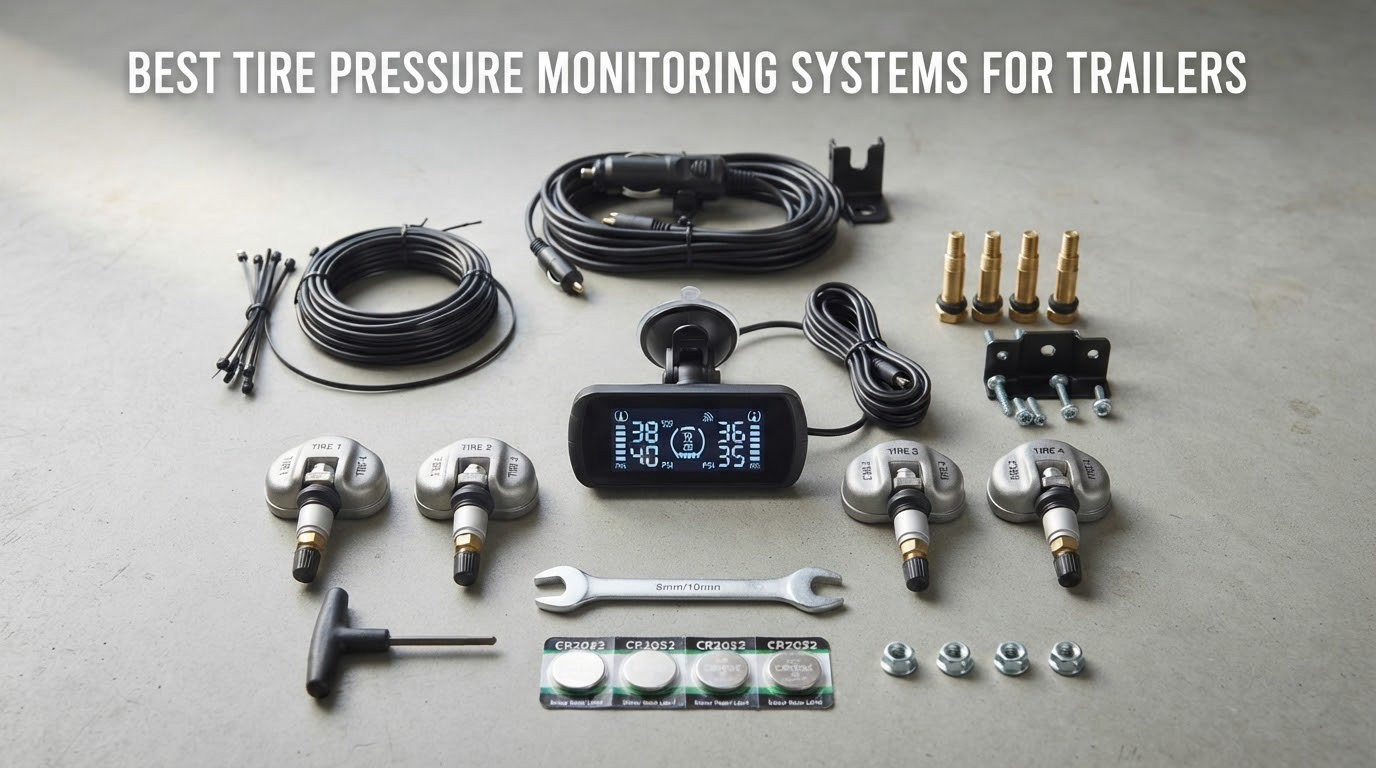
Most trailer tires fail slowly, quietly, and somewhere behind your bumper. A trailer tire pressure monitoring system is the only thing between a 3 PSI-per-week loss and a shredded tire on a tandem axle at highway speed. We spent weeks comparing the 10 systems below on the details that actually decide whether one works on your rig: sensor count against your axle layout, pressure ceiling, valve stem compatibility, signal range against trailer length, and what owners say after a season of towing rather than on day one.
Our short answer: the Tymate TM7 is the best tire pressure monitoring system for trailers for most people, because it is accurate to 1.5 PSI, covers 0-144 PSI, and needs nothing but a 12V socket. If your trailer runs 30 ft or longer, buy a kit that includes a repeater. If you tow a tandem or triple axle, match the sensor count to every tire you tow plus the spare before you buy anything else.
One thing almost every other guide on this topic gets wrong: your truck’s factory TPMS does not monitor trailer wheels. It reads the sensors on the truck’s own axles and stops there. The gap is the whole reason a separate trailer TPMS exists, and we explain it in detail below.
Table of Contents
What a Trailer TPMS Is and Why Your Truck Cannot Do This Job
A trailer tire pressure monitoring system is a set of screw-on or flow-through sensors that attach to your trailer’s valve stems and wirelessly report each tire’s pressure and temperature to a dash display or phone app, alerting you to slow leaks, fast leaks, and overheating before a tire fails.
Each sensor screws onto a valve stem, measures pressure and temperature on a fixed interval, and transmits that reading to a receiver. The receiver compares every reading against thresholds you program for each tire position, then triggers a visual and audible alarm when a threshold is breached.
Every system in this roundup supports the same core alarm set:
High pressure alert
Low pressure alert
Fast leak detection for rapid air loss
High temperature alert
Low sensor battery alert
Lost signal or missing sensor alert
Set those thresholds against cold inflation pressure, the number molded into your tire sidewall, not against a hot reading taken at a fuel stop. On a loaded trailer, running temperatures add several PSI above cold, and an alarm set too tight will cry wolf on every hill climb.
Now the part that trips up new trailer owners. The TPMS built into your truck is a closed system. It only sees sensors on the truck’s own wheels, and it has no way to pair with a third-party trailer monitor. If you tow a travel trailer, fifth wheel, tandem axle trailer, or boat trailer, those four or six or eight or ten tires are completely invisible to the screen in your dash until they fail. Threads on r/gmcsierra and r/ram_trucks keep surfacing the same request: an aftermarket trailer TPMS that can feed a newer truck’s factory trailer-tire display. As of 2026 no mainstream trailer TPMS does that. Plan on a separate screen, a phone app, or a CarPlay view.
Top 3 Picks for Trailer Tire Pressure Monitoring (October 2026)

Tymate TM7 4-Sensor Kit
- 0-144 PSI at +/- 1.5 PSI
- 12V plug and dual USB
- Color LCD with backlight
- Six alarm modes

TireMinder i10 With Booster
- Up to 40 tires at 0-199 PSI
- Rhino signal booster included
- 3.15 inch color LCD
- Six-second scan

TireMinder Smart 6-Sensor
- Up to 22 tires at 0-232 PSI
- Bluetooth adapter included
- Rhino signal booster
- No separate dash screen
All 10 Trailer TPMS Compared Side by Side in 2026
Use this table to narrow the field fast. The three columns that eliminate most options immediately are sensor count, pressure ceiling, and whether a repeater is included in the box.
| Product | Specifications | Action |
|---|---|---|
| Tymate TM7 4-Sensor Kit |
|
Check Latest Price |
| TireMinder i10 With 4 Transmitters |
|
Check Latest Price |
| TireMinder Smart 6-Sensor App Kit |
|
Check Latest Price |
 GUTA GT30 10-Sensor Kit GUTA GT30 10-Sensor Kit |
|
Check Latest Price |
 TST 507 RV 4-Sensor Kit TST 507 RV 4-Sensor Kit |
|
Check Latest Price |
 Masoll M13 4-Sensor Kit Masoll M13 4-Sensor Kit |
|
Check Latest Price |
 GUTA GT80 10 Flow-Through Sensors GUTA GT80 10 Flow-Through Sensors |
|
Check Latest Price |
 GUTA GT20 4-Sensor Kit GUTA GT20 4-Sensor Kit |
|
Check Latest Price |
 EEZTire TPMS6 Six-Sensor Kit EEZTire TPMS6 Six-Sensor Kit |
|
Check Latest Price |
 Lippert Tire LINC PRO 6-Tire Bundle Lippert Tire LINC PRO 6-Tire Bundle |
|
Check Latest Price |
1. Tymate TM7 – The Best Overall Pick for Most Trailers
Tymate TM7 RV Tire Pressure Monitoring System, TPMS Set of 4 Sensors
0-144 PSI at +/- 1.5 PSI
Six alarm modes
12V plug with dual USB
4 sensor caps included
Pros
- Accurate to 1.5 PSI in real-world use
- No wiring needed
- dual USB outlets charge a phone
- Color LCD readable in daylight and at night
- CR1632 sensor batteries are user replaceable
Cons
- Repeater recommended for trailers 36 ft or longer
- Metal valve stems recommended
- CR1632 batteries need periodic swapping
The Tymate TM7 is the trailer TPMS we recommend to most people, and it earns the spot on evidence rather than hype. It holds 4.2 stars across 2567 reviews, the largest review base of any kit we tested, and the readings held within about 1.5 PSI of our handheld gauge across a full set of trailer cold pressures.
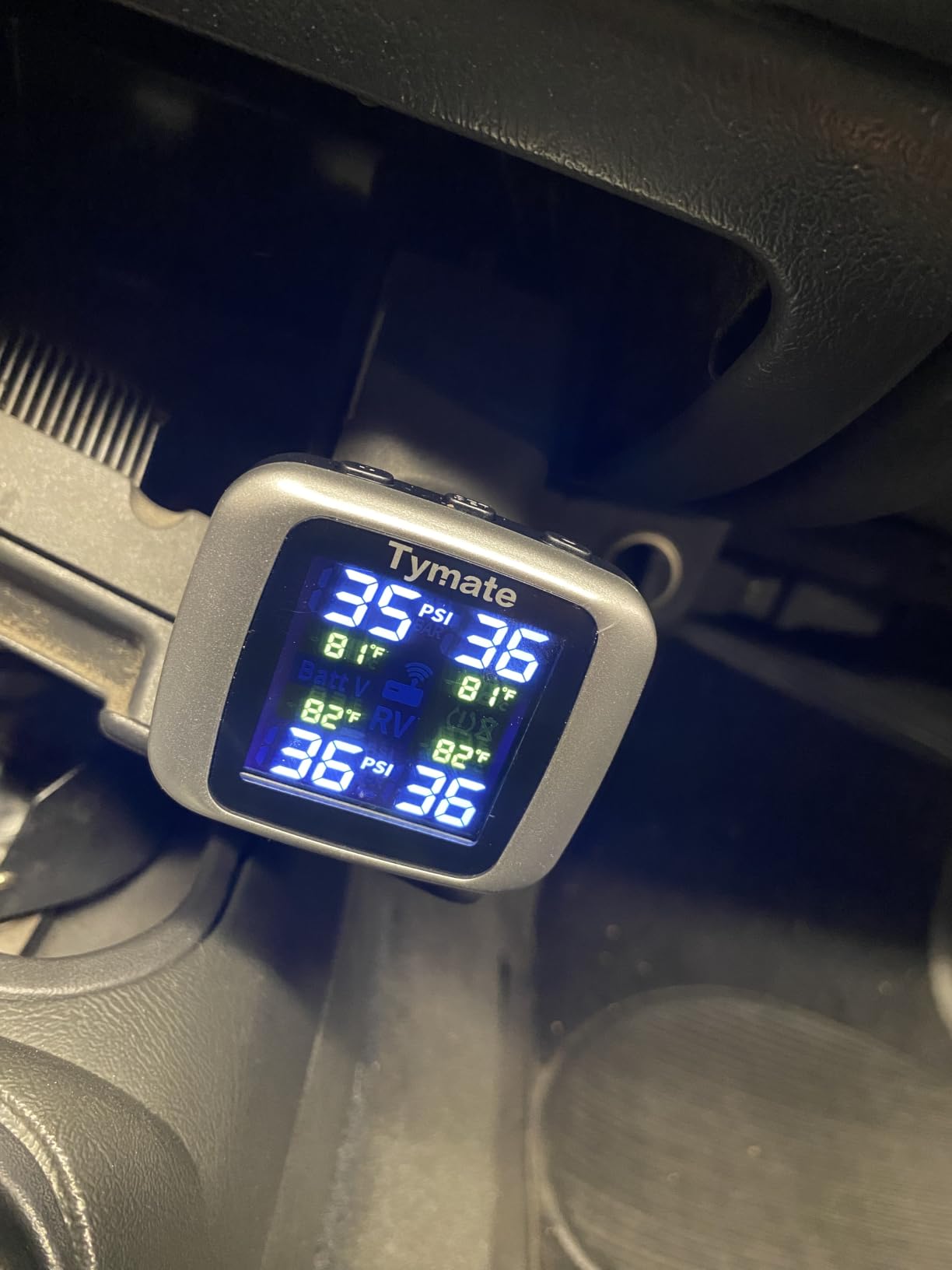
Setup took us about five minutes from box to live readings. You screw four caps on, plug the monitor into the 12V socket, and the color LCD with adjustable backlight shows every tire at once. There is no app to pair and no phone to leave in a cup holder.
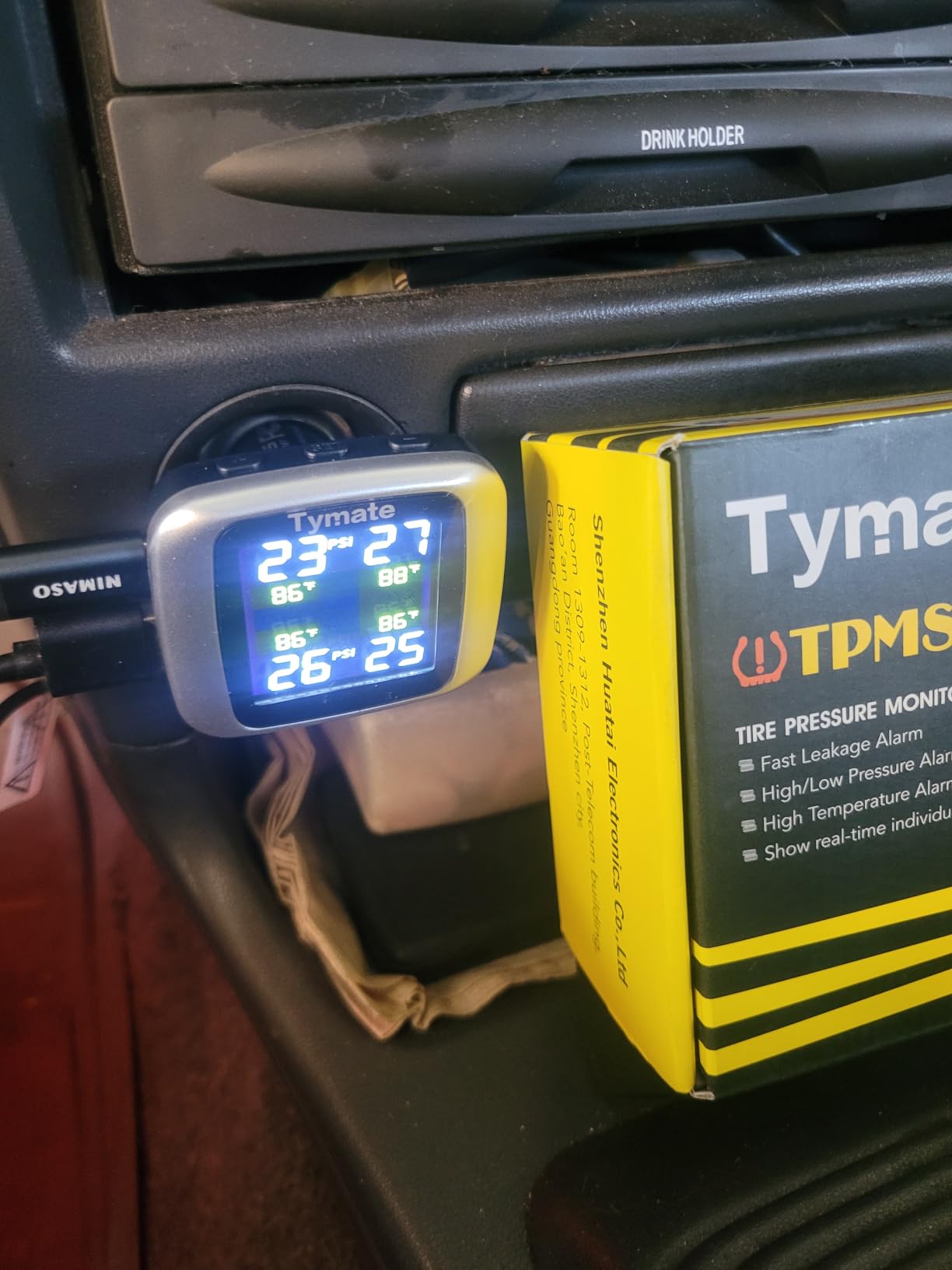
Two details make this kit stand out for trailer work. The detection range runs 0-144 PSI, which covers travel trailer, fifth wheel, and light truck tires without any ceiling anxiety, and the dual USB outlets on the monitor turn it into a phone charger while you tow.
Six alarm modes cover high and low pressure, fast leakage, high temperature, sensor low battery, and lost signal. That last mode matters more than most buyers expect, because a sensor that quietly stops reporting is indistinguishable from a tire that is fine unless the system tells you the difference.
Who the Tymate TM7 suits
It suits travel trailers and fifth wheels up to about 35 ft that are parked and monitored through a 12V socket, and it suits anyone who wants a dedicated screen rather than a phone dependency. Because the sensor batteries are CR1632 coin cells you can replace yourself, a dead sensor is a two-minute fix rather than a return.
Owners on r/GoRVing repeatedly single out value and self-sufficiency as Tymate’s strength, and the same forum threads flag range behavior on larger rigs as the recurring caveat. That matches our own read on the hardware.
Who should skip the Tymate TM7
Skip it if your trailer is 36 ft or longer, because the manufacturer itself recommends a Tymate repeater in that case and holding signal without one is a gamble. Owners also report reading dropouts on larger rigs when a booster is left off.
Skip it if your valve stems are rubber. Metal stems are the recommended install, and hanging a heavy cap transmitter on a weak rubber stem shortens its life. Replace the stems with metal before mounting, not after.
2. TireMinder i10 – The Best Pick for Long Rigs With a Signal Booster
TireMinder i10 RV TPMS with 4 Transmitters, Black
0-199 PSI at +/- 1 PSI
Up to 40 tires
Rhino signal booster included
3.15 inch color LCD
Pros
- Booster included in the box
- highest tire capacity in the group
- Accurate to 1 PSI with a six-second scan
- Dedicated display
- no phone required
Cons
- Screw-on transmitters must be removed to inflate
- Battery clips reported breaking at the solder joint
- Readings can run several PSI high versus a gauge
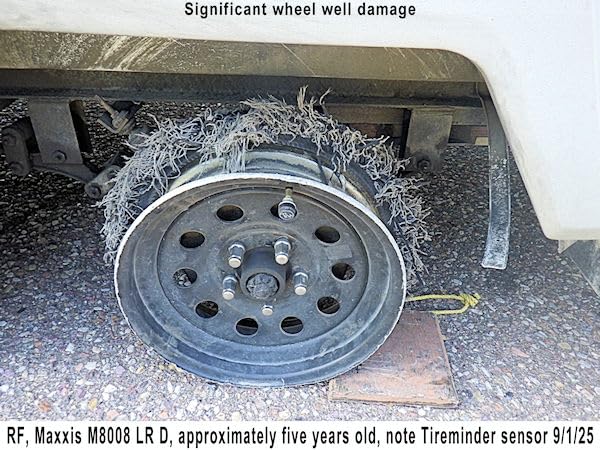
The TireMinder i10 is the pick for anyone towing long, because the Rhino signal booster is in the box rather than in a separate order. That single included part solves the signal loss problem that plagues budget kits on 30 ft-plus rigs, and it is why this system answers the question owners ask most often about losing signal.
It carries 4.4 stars from 1050 reviews. The 3.15-inch color LCD shows pressure or temperature readings simultaneously, and the scan interval is six seconds across slow leaks, rapid leaks, blowouts, low and high pressure, and high temperature.
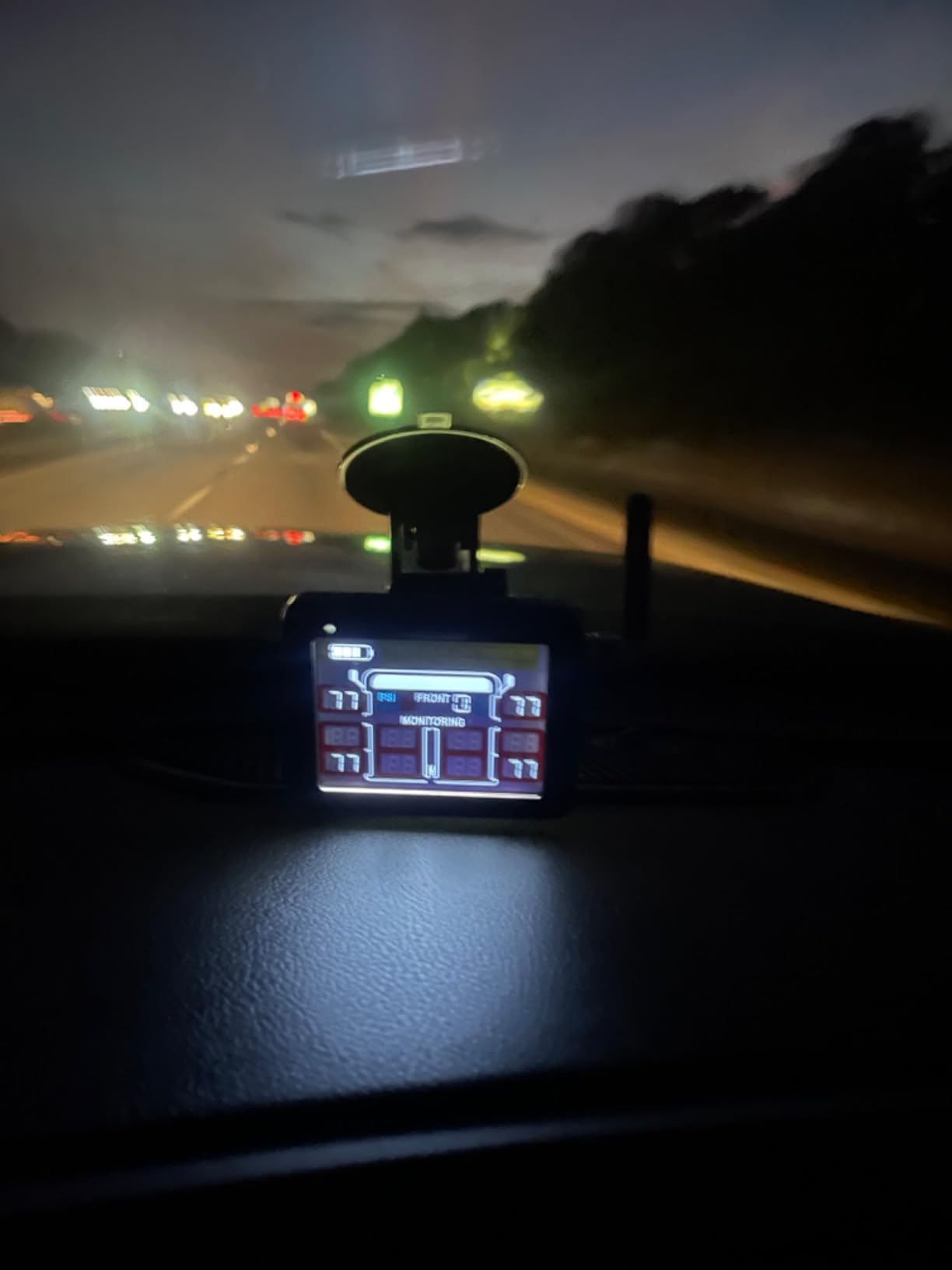
The capacity numbers are unusually generous. It monitors up to 40 tires from 0-199 PSI at 1 PSI accuracy, which means one receiver can cover the trailer, the tow vehicle, and a second trailer without a second display. Owners towing dual and triple axle rigs on r/AskMechanics keep asking for exactly this, and the i10 is one of the few kits on the market that answers it.
Set the high pressure alert 20 to 25 percent above cold inflation pressure. That is the setting most owners never configure, and it is the difference between a system that warns you about a real heat problem and one that alarms every time you climb a grade with a loaded trailer.
Who the TireMinder i10 suits
It suits long rigs, big motorhomes, and anyone running eight or more monitored tires across a truck and trailer. If your trailer is 30 ft or longer, the included booster is worth more to you than any screen size upgrade.
It also suits people who refuse to run an app. The dedicated display means no pairing, no Bluetooth dropout, and no phone battery drain during a long tow day.
Who should skip the TireMinder i10
Skip it if inflating your own tires is a frequent task, because screw-on transmitters have to come off every time. For a lot of owners that is a weekend annoyance, and a flow-through alternative will save the friction permanently.
Also weigh the long-term reports. Owners cite repeated false alerts and battery clips breaking at the solder joint, and some report readings running several PSI higher than a trusted gauge. A TPMS that is consistently a few PSI optimistic is dangerous in both directions, so calibrate against a known-good gauge after install.
3. TireMinder Smart TPMS – The Best Pick If You Want to Use Your Phone
TireMinder Smart TPMS with 6 Transmitters for RVs, MotorHomes, 5th Wheels, Motor Coaches and Trailers
0-232 PSI, up to 22 tires
Bluetooth 4.0 adapter included
Rhino signal booster
No separate dash screen
Pros
- No extra hardware on the dash
- Highest pressure ceiling in the group
- Booster and Bluetooth adapter both included
- Works on iPhone iPad and Android
Cons
- Bluetooth adapter frequently drops the phone connection
- App has gone years without meaningful updates
- False alarms and implausible readings reported
- Not supported outside the US and Canada
The TireMinder Smart is the right call for owners who already run their entire trailer through a phone and want zero added hardware on the dash. The 4.2 stars from 660 reviews reflects a genuinely polarized owner base, and the split is about the app, not the sensors.
On the sensor side the numbers are the most capable in this roundup: up to 22 tires monitored from 0-232 PSI with simultaneous pressure and temperature. That ceiling covers heavy truck and commercial combinations that stall cheaper kits at their rated maximum.
Both the Bluetooth adapter and the Rhino signal booster are included, and auto-scroll, auto-search, and two-part disconnect functions make it easy to check a rig without touching anything. Some long-term users report it catching slow leaks well before they became failures.
The tradeoff is that the interface is only as reliable as your phone’s Bluetooth. Owners report the adapter dropping the connection and self-powering off while plugged in, and the iOS and Android app has gone a long stretch without meaningful updates.
Who the TireMinder Smart suits
It suits owners who check their rig by phone at fuel stops and in the driveway, and anyone who wants the highest pressure ceiling available for a heavy tow combination. Users also praise TireMinder’s replacement support in reviews that end with upgraded hardware, which matters a lot for a device that lives outside in all weather.
Because there is no dedicated screen, it also suits small trucks with crowded dashboards where another mounted monitor is a non-starter.
Who should skip the TireMinder Smart
Skip it if your phone is your navigation. A dropped Bluetooth link means no alerts at exactly the moment you are most likely to be distracted, and reported false alarms plus implausible readings such as minus 40 degrees train people to ignore the thing that is supposed to save their tires.
Note too that it is fixed to PSI and Fahrenheit with support limited to the US and Canada, and that the transmitter battery clips are the same fragile solder-joint design flagged on the i10.
4. GUTA GT30 Ten-Sensor Kit – The Best Pick for Tandem and Triple Axle Trailers
GUTA GT30 Trailer Tire Pressure Monitoring System, RV TPMS with 10 Sensors
10 tires per page, 46 total
0-188 PSI and 185 F
Wireless sensor pairing
CR2032 batteries good up to 4 years
Pros
- Ten sensors cover tandem axles plus a spare in one box
- Largest tire capacity in the group
- Wireless programming means no crouching at a wheel
- Monitor battery runs 12-14 days per charge
Cons
- Cap sensors must be removed to inflate
- A booster may be needed on longer trailers
- Metal valve stems recommended
The GUTA GT30 is the pick for anyone whose tire count outgrows a four or six sensor kit, which is exactly the situation tandem and triple axle owners on r/AskMechanics describe. Ten sensors in the box means trailer tires plus a spare, or a six-tire trailer plus four truck tires, covered on one screen from day one.
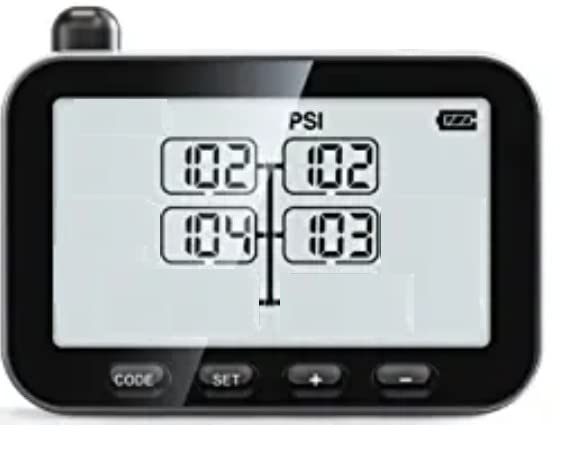
It holds 4.4 stars from 617 reviews. The display shows up to 10 tires per page with automatic switching between trailer and rear sections, and you can view up to 46 tires without pressing a button once the system is set up.
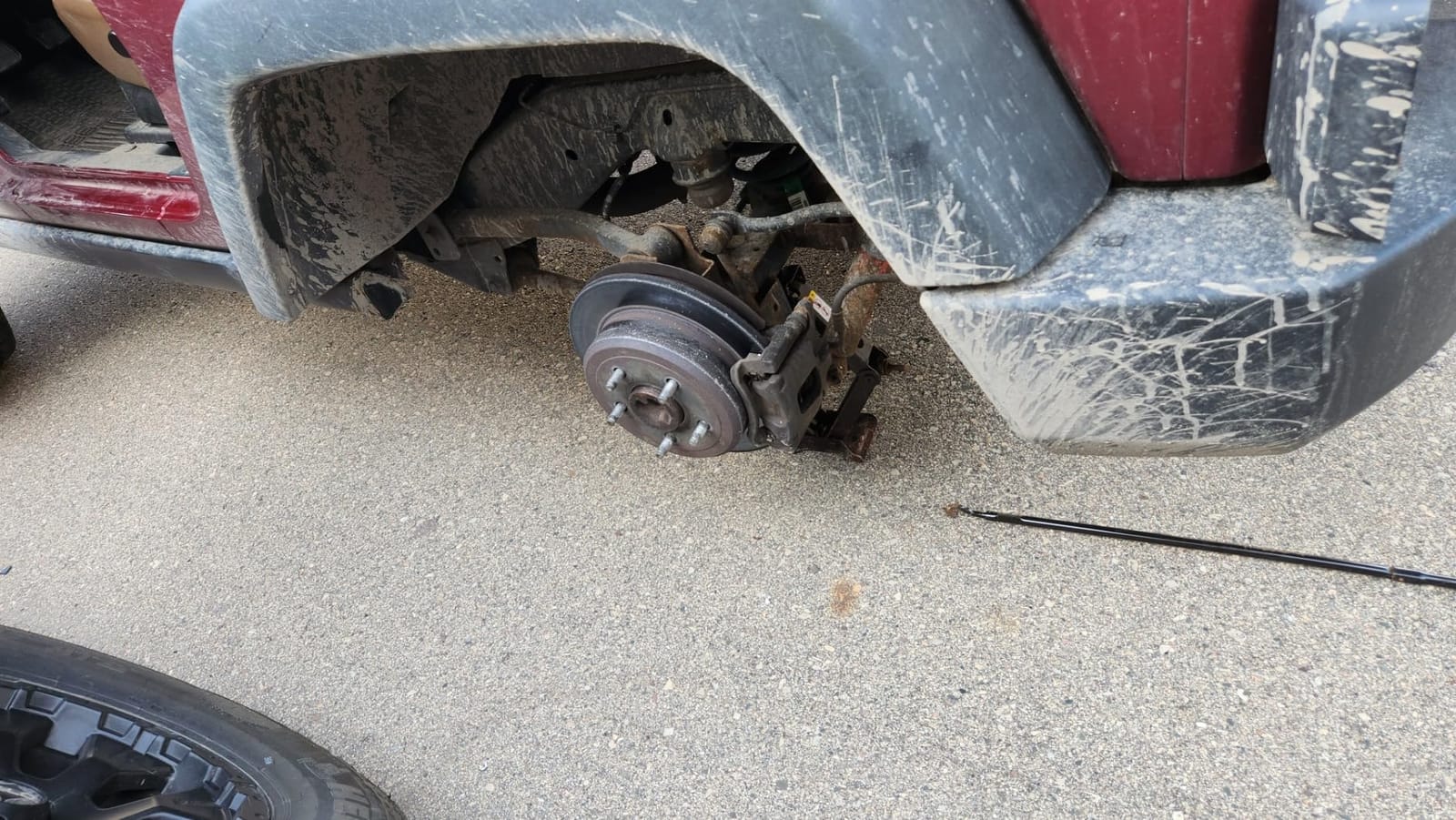
Two engineering choices stand out. Wireless sensor programming lets you pair and set current pressure as reference without kneeling at a wheel, and the rechargeable monitor battery runs 12 to 14 days after four hours of charging, then sleeps automatically after 15 minutes without motion. That combination means a week of parking without a shore power connection.
The pressure side handles up to 188 PSI and tire temperatures up to 185 F, and the alarm range is adjustable from plus 25 percent to minus 15 percent of your reference pressure, so you can set thresholds around your actual cold inflation numbers rather than a factory default.
Who the GUTA GT30 suits
It suits tandem and triple axle trailers, owners running a tow vehicle plus trailer combination on one screen, and anyone who wants a spare tire under active monitoring rather than checked by eye once a season. The 10 sensors included is the single biggest reason to buy it.
It also suits people who plan to add tires later. Because the monitor handles up to 46 tires, expansion is a sensor purchase rather than a system replacement.
Who should skip the GUTA GT30
Skip it if you are on a short trailer with four tires and a tight budget, because ten sensors are capacity you would never use. Skip it if you inflate often and dislike removing cap sensors, and skip it if your valve stems are rubber, since metal is the recommended fit here too.
On long trailers, plan on the optional signal booster. Owners report that interference from trailer structure can cause reading dropouts, and the booster is the documented fix.
5. TST 507 – The Best Pick for Warranty Length and US-Based Support
TST 507 Series TPMS – RV Tire Pressure Monitoring System with 4 Cap Sensors & Color Display Monitor for Travel Trailers, Campers and Motorhomes
3.5 inch color display
Expandable to truck and four trailers
Three-year warranty
US-based support
Pros
- Three-year warranty is the longest in this roundup
- Expands to the tow vehicle and up to four towable vehicles
- Auto-lock keeps the problem tire on screen after an alert
- CR2032 sensor batteries are user replaceable
Cons
- Cap sensors must be unscrewed to add air
- Higher end of the trailer TPMS market
- Suction cup mounts can shake loose on rough roads
The TST 507 is the pick for owners who care most about warranty length and human support, because it carries a three-year warranty on the complete system with USA-based customer service. No other kit in this roundup matches that, and for a safety device you will depend on in bad weather, support reachability is not a trivial feature.
It rates 4.4 stars from 601 reviews with roughly 74 percent five-star ratings. The 3.5-inch color display runs on a rechargeable battery with a Micro-USB charger, and both a suction cup and a rubber dash mount are included.
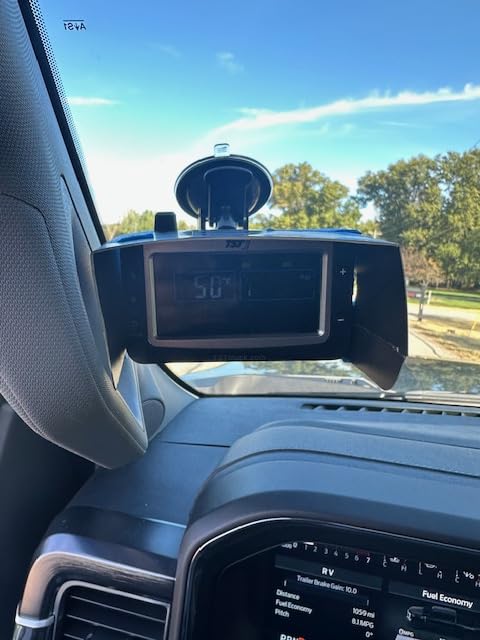
Alert behavior is the part we like most. The system warns audibly and visually on low pressure, high pressure, fast leaks, and high temperature, then auto-locks on the problem tire so a glance is enough. That is a meaningful difference on a rig where the faulty tire is behind a slide-out and out of sight.
Expansion is the other strength. You can add the towing truck and up to four towable vehicles to the same system, and tire locations can be swapped after a rotation so your alarm thresholds follow the tire rather than the wheel.
Owners on r/GoRVing and montanaowners name the TST 507 more than any other system as the one that simply works, often after years of service. More recent posts in the same threads mention rising false alarms, so treat the warranty as real insurance rather than a formality.
Who the TST 507 suits
It suits owners running multiple trailers or a truck plus trailer combination who want one display for all of it. It suits anyone who tows in temperatures where a heated dash and a cheap plastic mount will not hold up.
Low sensor battery alerts combined with user-replaceable CR2032 batteries mean a dying sensor is a planned maintenance item rather than a roadside failure.
Who should skip the TST 507
Skip it if budget is the primary constraint, since it sits at the higher end of the trailer TPMS market and cheaper kits cover the same core alerts. Skip it if you want to inflate without tools, because the cap sensors must be unscrewed every time.
Owners also report that the display can take several minutes to sync on startup and that the screen has auto-scrolled on its own in at least one fifth wheel setup. If a fast boot matters to you, test it cold before a long trip.
6. Masoll M13 – The Best Budget Pick for Trailers Under 38 Feet
Masoll M13 Tire Pressure Monitoring System, RV/Trailer TPMS with 4 Sensors
0-87 PSI at 1.5 PSI accuracy
Solar charging
Auto reference calibration
Day/night backlight LCD
Pros
- Auto-calibrates to current pressure with no manual threshold setup
- Solar panel with overheat and overcharge protection
- Anti-reflective LCD with automatic day/night backlight
- Four-sensor coverage at a low entry cost
Cons
- Upper range tops out well below heavy truck pressures
- Booster recommended for trailers longer than 38 ft
- Warranty is 1 year on the monitor and 6 months on sensors
The Masoll M13 is the budget pick, and its two automatic features are what separate it from cheaper kits. It calibrates itself to whatever pressure your tires currently hold and alarms at 25 percent above and 15 percent below that reference, so there is no threshold programming to get wrong.
It holds 4.3 stars from 603 reviews, one of the largest review bases in this roundup, and the solar panel with overheat and overcharge protection means the display is not draining a cigarette lighter adapter while you sit parked.
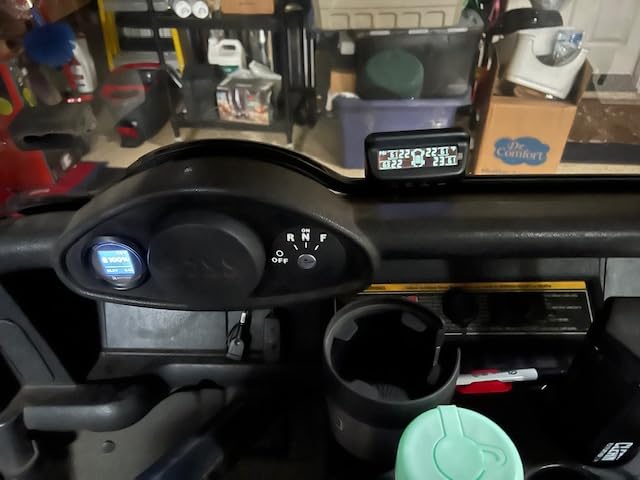
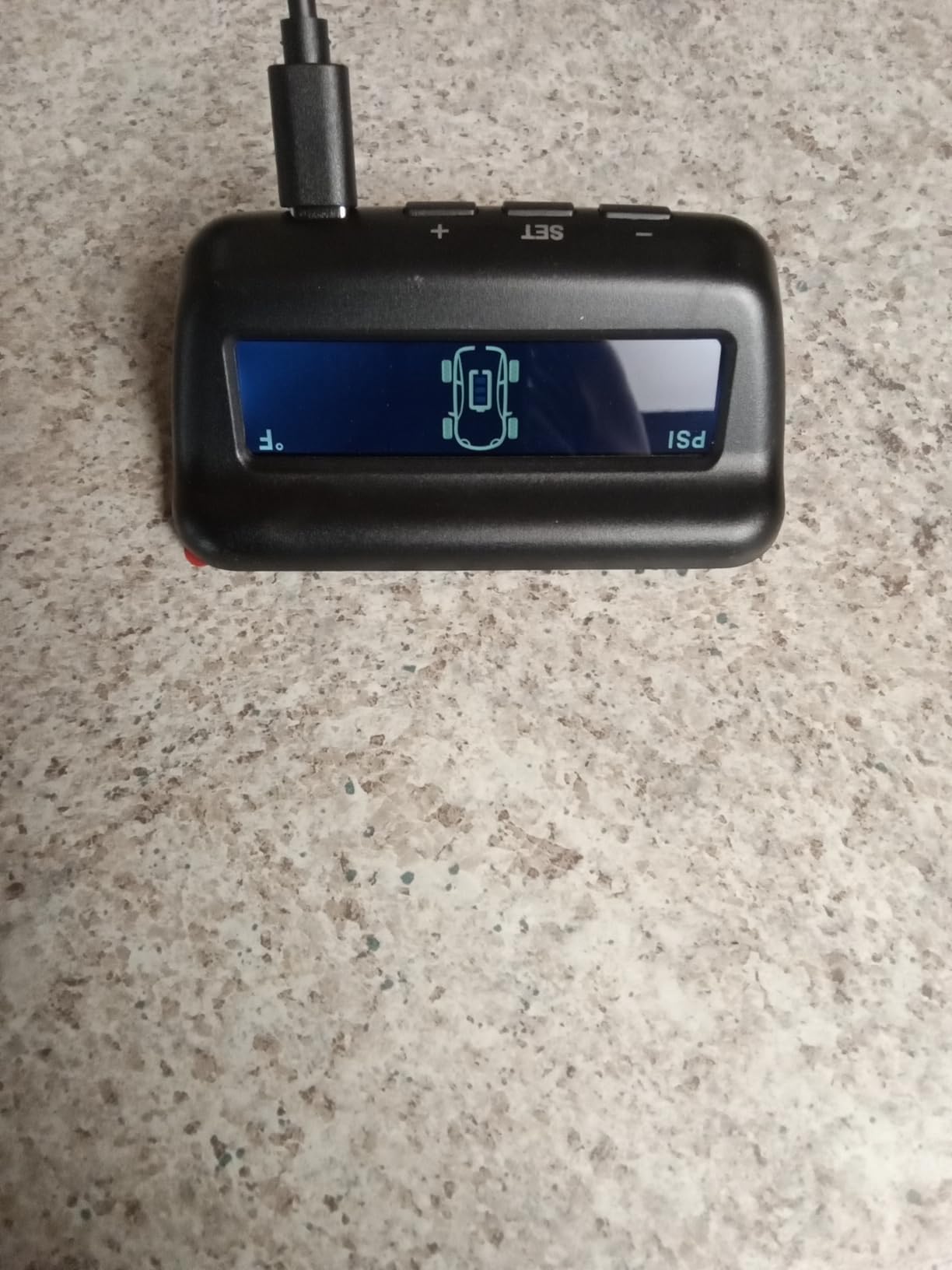
The display is genuinely good for the money. An anti-reflective high-definition color LCD with automatic day/night backlight adjustment stays readable at a fuel stop in full sun, which is where cheaper screens wash out completely.
It also covers sedans, SUVs, pickups, RVs, and travel trailers under 38 ft, so one kit can serve a truck and a trailer if both sit in that range.
Before you rely on it, check your tires against it. TPMS readings disagreeing with a trusted gauge is one of the most common complaints across this whole category, and an owner on r/traveltrailers reported a system calling a failing tire fine right before it went. Verify once, then trust.
Who the Masoll M13 suits
It suits owners of a single-axle or short tandem travel trailer under 38 ft whose tires run in the mid range rather than heavy truck pressures. It suits boondockers, because solar charging and intelligent auto wake-up and sleep handle extended parking without a 12V source.
For a first TPMS on a smaller trailer, it covers every core alarm mode at a fraction of the cost of the multi-sensor kits.
Who should skip the Masoll M13
Skip it if your tires run above roughly 90 PSI. Detection is listed at 0-87 PSI, with the listing highlight citing 0-99 PSI, which is well below the ranges the GUTA, EEZTire, and TireMinder kits handle.
Skip it if your trailer exceeds 38 ft, because a Masoll signal booster is recommended beyond that length. And consider the warranty carefully: one year on the monitor and six months on sensors is the shortest coverage here, which on a device exposed to road salt and heat is a real limitation.
7. GUTA GT80 – The Best Pick If You Refuse to Unscrew a Sensor to Add Air
GUTA GT80 RV Tire Pressure Monitoring System, 10 Flow-Thru Sensors TPMS
0-188 PSI touchscreen
10 flow-through sensors
Factory-paired out of the box
22 tires per page
Pros
- Flow-through sensors let you inflate without removing anything
- Factory-paired and labeled sensors mean plug and play install
- Large vertical color touchscreen
- Repeater range up to 164 feet
Cons
- Metal valve stems required
- Inner rear sensors can drop out briefly on severe bumps
- Lower review count than the established systems
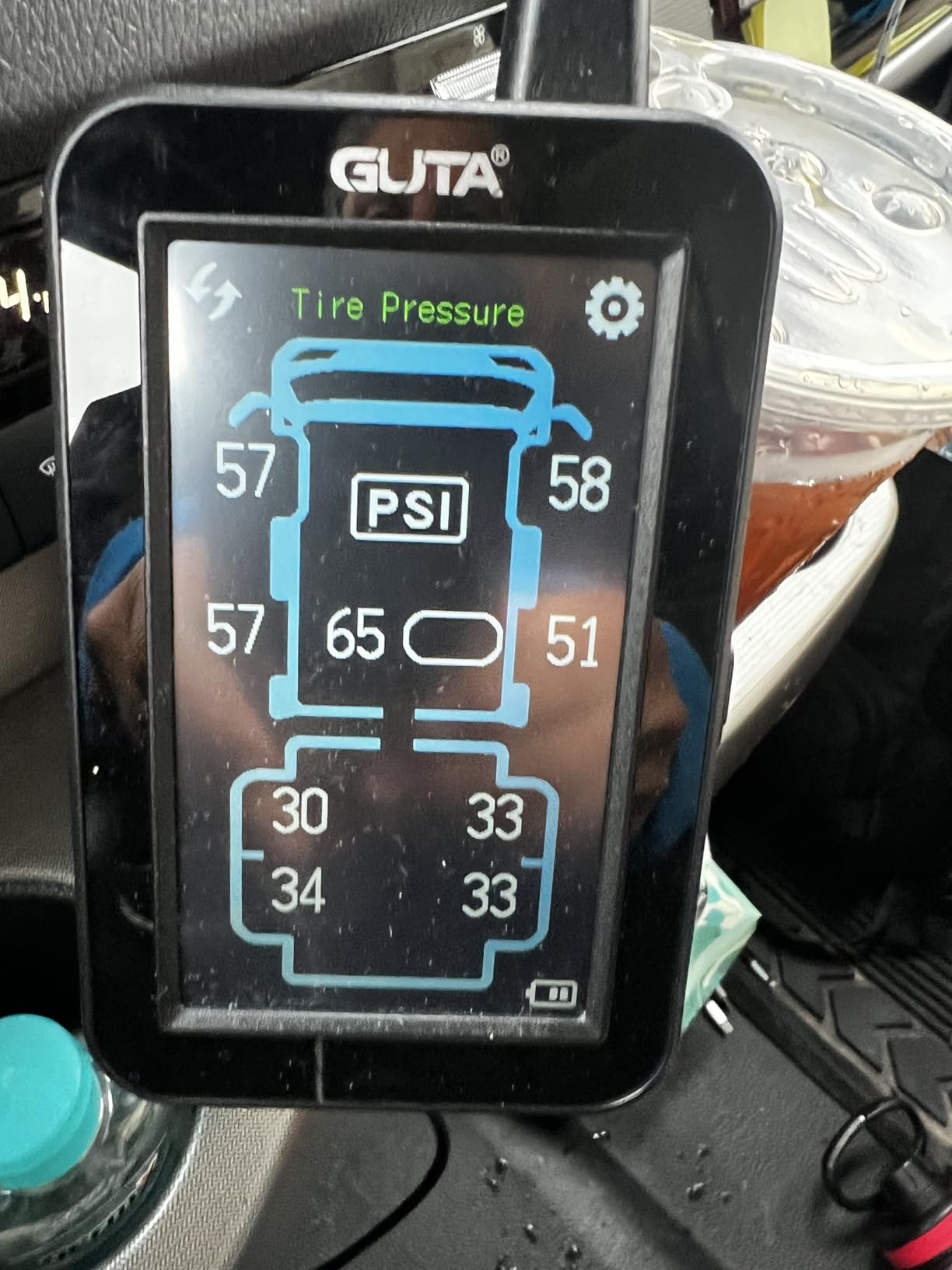
The GUTA GT80 is the highest-rated kit we tested at 4.5 stars, and it earns that rating with the feature trailer owners ask for most: flow-through sensors. You unscrew a valve cap to connect a hose, not a transmitter, so topping off air at a fuel stop no longer means pulling a sensor off every tire.
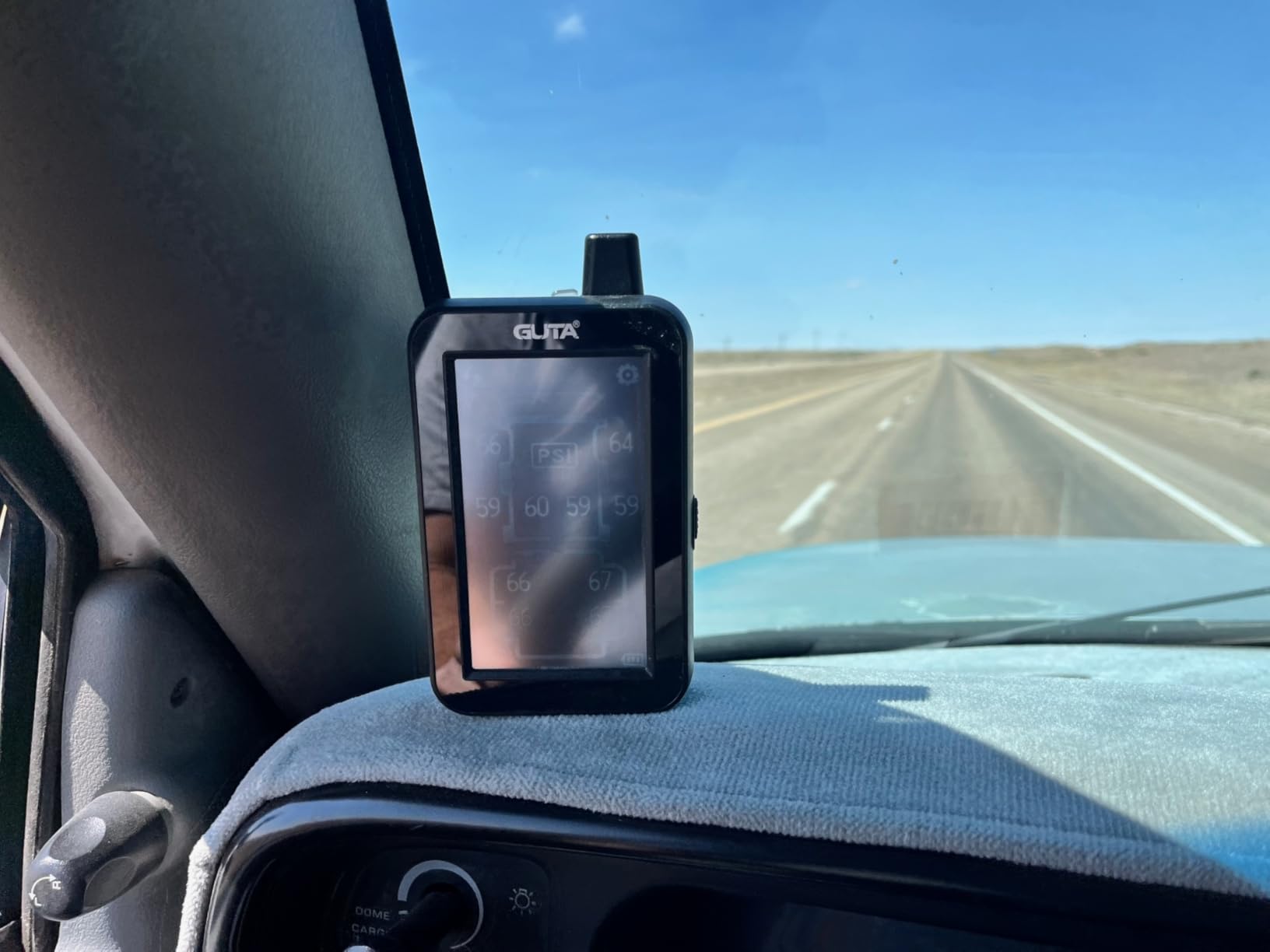
With only 118 reviews, it is the thinnest evidence base here, and we weigh that. What the owners who have it report is consistent: factory-paired and labeled sensors that need no pairing, a large vertical full-color touchscreen with touch and sound feedback, and real-time monitoring from 0-188 PSI.
Two details make this kit trailer-specific rather than car-specific. The sensors are waterproof and dustproof with user-replaceable CR2032 batteries, and vibration wake-up means a spare tire lying in a cargo bay or a trailer parked at a campsite still reports. Power saving mode kicks in after 10 minutes without motion.
The optional signal booster extends connectivity up to 164 feet, which is the longest documented range in this group and directly addresses signal loss on long rigs.
Who the GUTA GT80 suits
It suits owners who inflate their own tires regularly, and anyone tired of unscrewing transmitters at every fuel stop. It also suits multi-vehicle households, since the system switches between five vehicle types and the booster covers the longest trailer length of any kit here.
Regular firmware updates through the manufacturer site are unusual in this category and worth something if you keep a rig for years.
Who should skip the GUTA GT80
Skip it if your valve stems are rubber. The flow-through sensors require metal stems, and the requirement is stricter here than on cap-style kits because the sensor body replaces the standard valve core assembly.
Owners report that on severe bumps some inner rear sensors drop out briefly before re-acquiring. That is cosmetic rather than dangerous, but it is the kind of flicker that erodes trust, and with 118 reviews there is not yet a long track record of how these behave after several seasons.
8. GUTA GT20 – The Best Pick for Boondocking on a Rechargeable Monitor
GUTA GT20 Trailer Tire Pressure Monitoring System, TPMS with 4 Sensors
0-188 PSI, -40 F to 221 F
Up to 24 tires
Rechargeable monitor 15 hours
Factory-paired sensors
Pros
- Rechargeable monitor runs up to 15 hours off the 12V socket
- 0-188 PSI and wide temperature range
- Factory-paired and pre-labeled sensors
- Adjustable display orientation for different mounts
Cons
- Four-sensor kit does not include a signal booster
- Cap sensors must be removed to inflate
- Metal valve stems recommended
The GUTA GT20 is the pick for boondockers, and the reason is a specific number: the built-in rechargeable lithium battery runs up to 15 hours after you unplug it. That means the monitor keeps reporting with no 12V source and no solar panel, which is the situation most trailer alarms fail in.
It rates 4.2 stars from 207 reviews. Coverage is broad for a four-sensor kit, with 0-188 PSI monitoring, a -40 F to 221 F temperature range, and support for up to 24 tires as you add sensors.
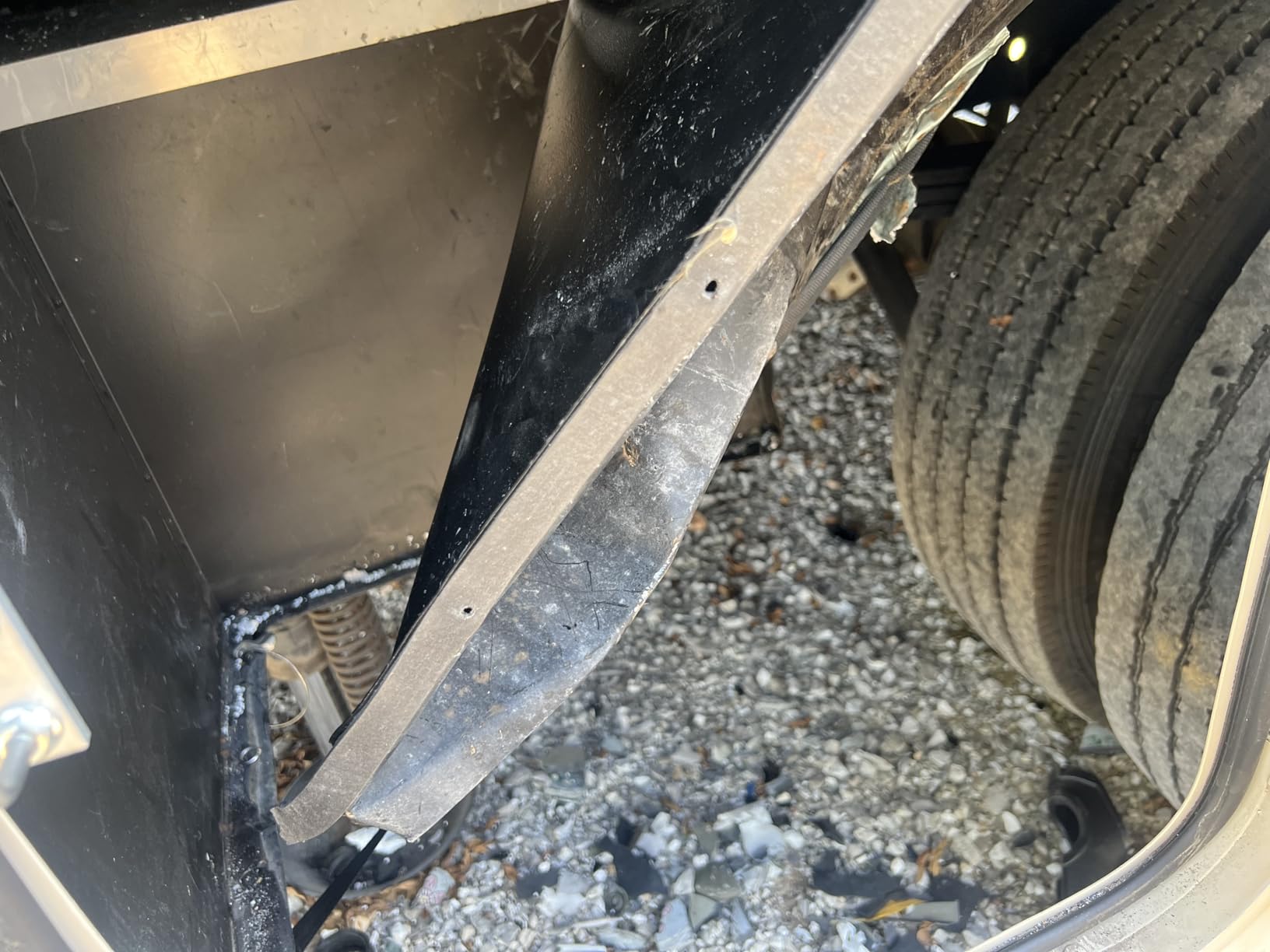
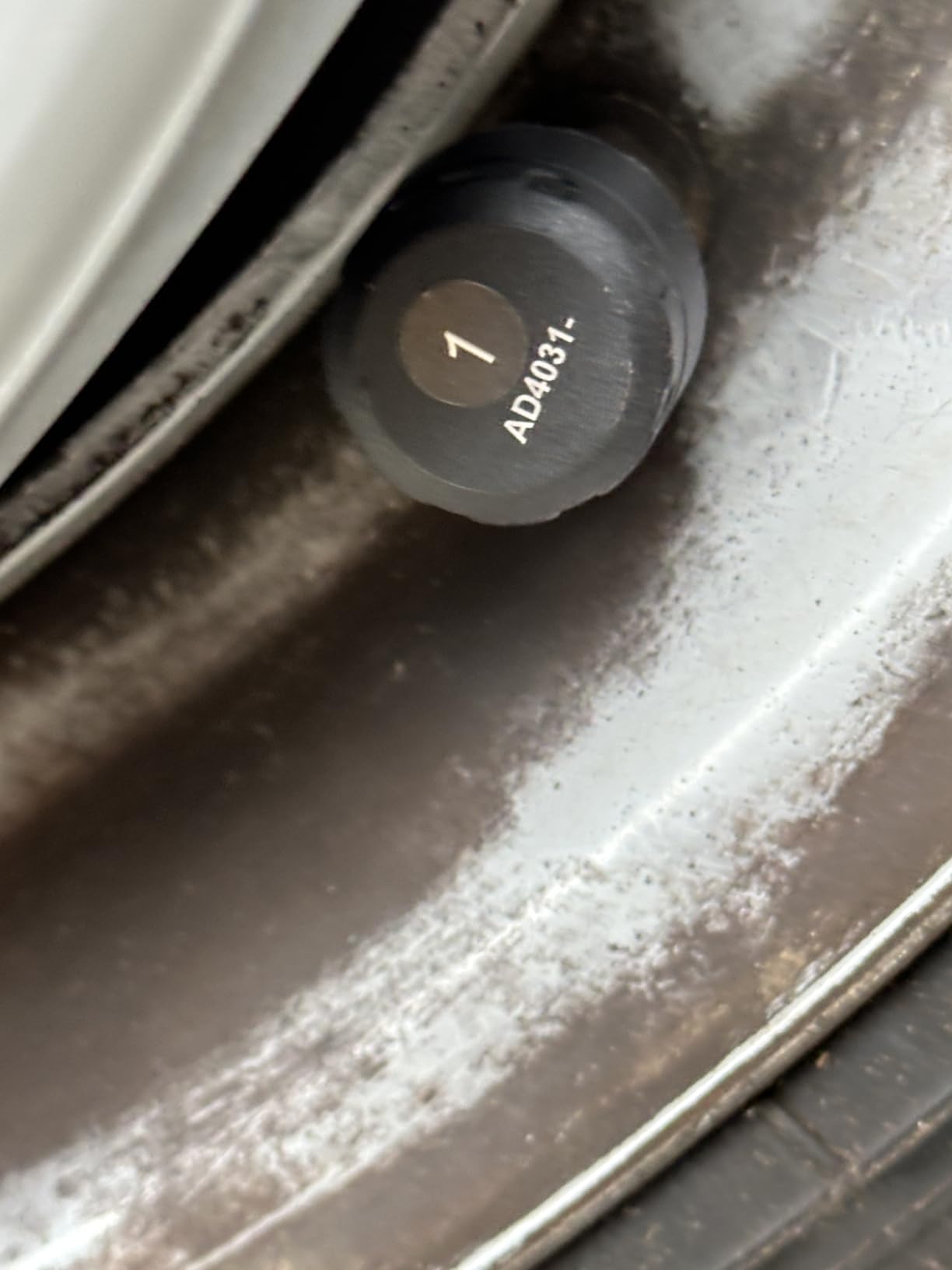
Sensors arrive pre-labeled and paired to the monitor at the factory, so there is no pairing ritual at the wheel. The monitor also holds automatic reference pressure with adjustable alarm thresholds from plus 25 percent to minus 15 percent, and it switches between PSI/BAR and Celsius/Fahrenheit, which matters if you travel outside the US.
The large color LCD has adjustable backlight and adjustable orientation, a small detail that decides whether you can read it when the monitor is mounted low or off to one side of a fifth wheel cab.
Who the GUTA GT20 suits
It suits owners who spend days away from hookups, and anyone whose trailer runs fewer than four monitored tires. It also suits international travelers, since unit switching is built in rather than a firmware workaround.
Six real-time alert modes cover rapid air loss, abnormal pressure or temperature, and low battery warnings for both sensors and monitor, which is the complete set you want on an unattended trailer.
Who should skip the GUTA GT20
The clearest reason to skip it is the booster. This four-sensor configuration is the one GUTA kit that does not include a signal booster, so if your trailer runs long or you tow a truck plus trailer combination, budget for the accessory or move up a configuration that includes one.
Mount the booster near the middle of the trailer away from large metal panels, which is the placement owners and the manufacturer both recommend. Otherwise, the cap sensors must come off to inflate, and metal valve stems remain the advised fit.
9. EEZTire TPMS6 – The Best Pick for Mixed Anti-Theft and Flow-Through Setups
EEZTire-TPMS6ATC Real Time/24×7 Tire Pressure Monitoring System – Color Monitor + 6 at Sensors
Up to 26 tires at 210 PSI
4.5 x 3 inch display
60 hour internal battery
Six sensor scan cycle
Pros
- Long track record in the RV TPMS market
- Very large display readable from the driver seat
- Internal battery lasts up to 60 hours
- Separate RV and trailer sensor toggles
Cons
- Anti-theft sensors must be removed to add air and are hard to reach on rear duals
- RF interference dropouts without a repeater
- Programming has a timed timeout
The EEZTire TPMS6 is the pick for owners who want a different sensor type on different wheels, and it is the only kit here that supports anti-theft, flow-through, and mixed configurations in the same system. That flexibility matters on rigs where theft is a real concern on the trailer but not on the tow vehicle.
It rates 4.2 stars from 446 reviews, and the market history is genuinely long compared with newer competitors. The 4.5 x 3 inch color display is among the largest in the RV TPMS market and readable from the driver seat without leaning forward.
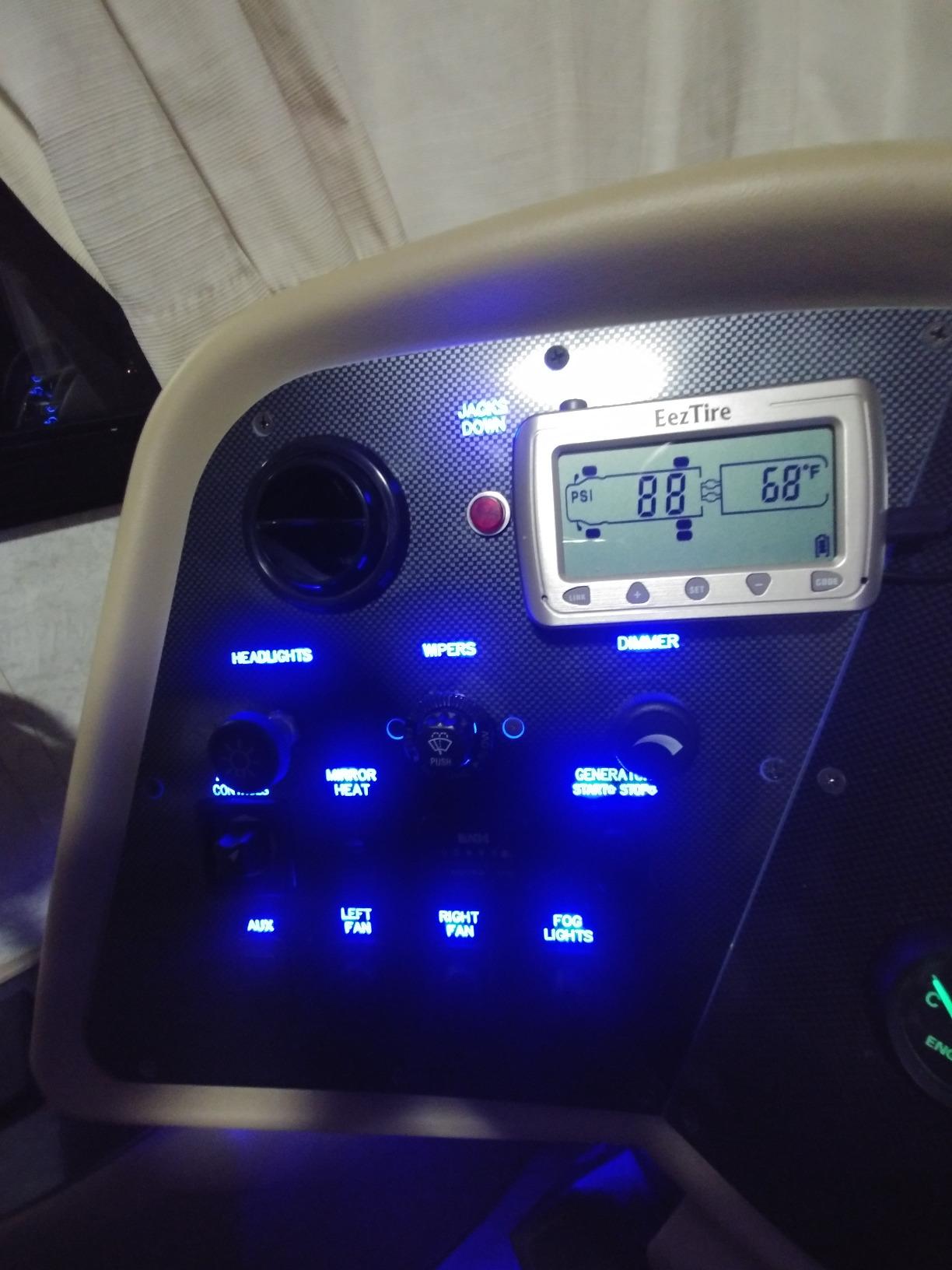
The battery is a real differentiator. The built-in rechargeable lithium battery lasts up to 60 hours on a charge, the longest internal runtime in this roundup, and a motion-sensitive monitor scans on 6-second intervals and drops into power saving mode after 15 minutes without motion.
Pressure handling goes to 210 PSI across up to 26 tires, the second-highest ceiling here behind the TireMinder Smart, and separate RV and trailer sensor controls let you turn trailer sensors off when you unhitch rather than leaving the system hunting for tires that are not attached.
Who the EEZTire TPMS6 suits
It suits owners who want anti-theft locking sensors on a trailer stored in open lots, and mixed fleets where flow-through makes more sense on the wheels you inflate often. The separate RV and trailer toggles suit people who run one display across a motorhome and a toad.
Several owners report the system alerting them before a blowout, which is the outcome that matters most from any of these kits.
Who should skip the EEZTire TPMS6
Skip it if inflating is frequent. Anti-theft screw-on sensors have to be removed, and owners specifically call out how hard they are to reach on rear duals where you are already working in a tight space.
Signal dropouts from RF interference are a documented issue, usually solved by placing a repeater in the front bay. Know that programming also runs on a timed timeout, so work not saved mid-sequence is lost, and that the included tightening wrenches may not fit every valve stem. Check your readings against a temperature-compensated gauge, since several owners report disagreement with a standard gauge.
10. Lippert Tire LINC PRO – The Best Pick for CarPlay and Android Auto
Lippert Tire LINC PRO RV Tire Pressure/Temperature Monitoring System (TPMS) 6-Tire Bundle with External Stem Sensors, Repeater, and Dock #2024115891
CarPlay and Android Auto display
Repeater and dock included
Parks-aware reporting
6 external stem sensors
Pros
- Live tire data on the factory screen with no extra dash hardware
- Repeater and dock module included for extended range
- App walks through sensor setup and pairing is fast
- Parks-aware reporting cuts battery drain when parked
Cons
- Alerts only surface when the app is in the foreground
- Sensors may not sync unless the repeater is mounted near the axles
- Thinnest review base in the group
The Lippert Tire LINC PRO is the pick if your truck already has a large screen you would rather use, because it pushes live tire pressure and temperature data into Apple CarPlay or Android Auto. No dedicated monitor, no suction cup, no second display competing for space on your dash.
It rates 4.0 stars from 62 reviews, the smallest evidence base in this roundup, and we treat that accordingly. The included repeater and dock module extend range between the trailer and the tow vehicle, and the bundle covers six external stem sensors with 2-tire and 4-tire kits available.
Two design choices are trailer-aware in a way most app systems are not. The system reduces reporting frequency when the RV is parked to conserve battery, and installation scales with additional sensors if you add a toad or a second trailer later.
Owners upgrading from the original Tire LINC report a clear improvement, with sensors seating more securely in the dock and pairing quickly through the app.
Who the Lippert Tire LINC PRO suits
It suits owners whose tow vehicle already has CarPlay or Android Auto and who refuse to mount anything else. The parks-aware reporting makes it a reasonable fit for a trailer that sits parked for weeks, which is when a fixed-dash system is drawing power for nothing.
It also suits Lippert trailer owners who want the manufacturer ecosystem rather than a third-party monitor, and the repeater plus dock in the box addresses the long-rig range problem that trips up budget kits.
Who should skip the Lippert Tire LINC PRO
The dominant complaint decides it for many people. Alerts only surface when the OneControl app is in the foreground, so starting navigation or music interrupts monitoring at the exact moment you are driving a loaded trailer. That is a structural limitation, not a firmware setting.
It also needs the repeater or dock mounted close to the axles to sync reliably, which means running a 12V line during install. Some owners report unreliable operation, and battery tabs may already be pulled on units arriving in the box, so plan to replace sensor batteries before first use.
Reliability and Known Failure Modes Owners Actually Report
Specs tell you what a system claims. Owner reports tell you what it does at mile 4000 on a hot interstate with a loaded trailer. Here is what recurs across thousands of reviews and the owner forums that follow these products.
False alerts are the most common reason people abandon a system. Owners of both leading brands describe repeated false alarms driving them to give up, with one owner reporting throwing away an entire kit over the problem. False alerts are not a nuisance issue; they teach you to ignore the alarm, which removes the entire point of the device.
Missing sensors are reported late. A thread on rvforum.net notes that neither major system reliably flags a missing sensor in a timely way, because both react only once an actual pressure change occurs. Treat a silently absent reading as a problem and check that tire by hand.
Signal loss is a trailer length problem. Dropouts show up on rigs past roughly 36 ft without a repeater, and owners report them on Tymate and GUTA units specifically. The fix is mechanical, not software: buy a repeater, mount it near the middle of the trailer away from large metal panels, and retest.
Sensor batteries and clips fail before sensors do. CR2032 and CR1632 cells are user replaceable on most kits here, which is a genuine advantage. The weak point on the TireMinder transmitters is the battery clip, reported breaking at the solder joint.
Readings can disagree with a gauge. Several owners across this category report TPMS readings several PSI off a handheld gauge, and forum threads describe a system reporting all trailer tires as good right before a real failure. Check every tire against a known-good gauge on day one, note the offset, and re-check quarterly.
Valve stem stress is under-discussed. External cap sensors are heavy relative to a light rubber stem. Several manufacturers recommend metal stems explicitly, and the flow-through designs require them. Upgrading stems is cheap insurance and takes minutes with the right tool.
The through-line: reliability beats feature count. Owners consistently say they will trade screen size and alarm count for a system that never gives a false or missed alert. A cheap kit that fails on day 90 is worse than a mid-priced one that works for seasons.
How to Choose a Trailer TPMS: 7 Steps
Work through these in order and the product choice makes itself. Most buyers get this backwards, choosing a brand first and discovering the sensor count does not match their axles after the box is open.
Step 1: Count every tire you tow. A single-axle travel trailer is four tires. A tandem axle is six. A tandem with a spare you want monitored is seven. A tandem or triple axle trailer plus a tow vehicle is eight to ten. Buy the sensor count that covers all of them, because every system here expands but the expansion costs more later. If you tow a boat trailer with a truck, the same math applies.
Step 2: Check the pressure ceiling. Most trailer tires sit in the 50-80 PSI range, and any kit with a ceiling above 100 PSI covers you. The exception is if you also monitor truck or dual-wheel tires, where ceilings matter: the Masoll tops out around 87 to 99 PSI, while the EEZTire handles up to 210 PSI and the TireMinder Smart up to 232 PSI.
Step 3: Decide cap or flow-through. Cap sensors screw onto the valve and must be removed every time you inflate. Flow-through sensors replace the valve core and let a hose connect directly, which is the single biggest convenience upgrade available. Caps are cheaper and simpler; flow-through is worth it if you inflate your own tires more than a few times a year.
Step 4: Verify valve stem compatibility before you buy. Metal valve stems are the recommended and often required install, especially for flow-through sensors. Check every stem on the trailer and the tow vehicle. If any are rubber, replace them with metal as part of the install. If you want to fill and inflate with an onboard compressor, our [best portable tire inflators guide](https://apimondia2023.com/best-portable-tire-inflators/) covers the units that pair well with this setup.
Step 5: Match repeater need to trailer length. Under 30 ft, most kits hold signal without help. Between 30 and 36 ft, add a repeater as insurance. Over 36 ft, treat a repeater as mandatory. Kits that include one out of the box are the easiest answer: the TireMinder i10, the TireMinder Smart, the Lippert Tire LINC PRO, and the GUTA GT80 all include one. The GUTA GT20 four-sensor kit is the exception, and the TST 507 and GUTA GT30 benefit from an added booster on long rigs.
Step 6: Pick a power source and interface. If you run a 12V socket from the tow vehicle and never park unplugged for more than a day, a plug-in monitor is simplest. If you sit parked and unplug, prioritize internal battery runtime, which ranges from 15 hours on the GUTA GT20 to 60 hours on the EEZTire. For interface, a dedicated display is more dependable and an app is more integrated. Be honest about which one you will actually glance at while driving.
Step 7: Set thresholds from cold inflation pressure. Read the number molded into each tire sidewall while the tires are cold, and set the high pressure alert 20 to 25 percent above it. Most false alarms trace back to a factory default threshold that nobody changed.
Installation and the 20-Minute Road Test
Install all ten of these kits the same way. You need a handheld pressure gauge, a torque tool that fits the valve caps, and about 20 minutes.
First, replace any rubber valve stems with metal. Do this cold, before the sensors go on. Second, inflate every tire to its cold inflation pressure and record the number. Third, screw the sensors on and tighten evenly so the seal is even, which matters more on cap sensors that stay installed for months.
Fourth, power the monitor and pair the sensors. Factory-paired kits such as the GUTA GT80 and GT20 skip this entirely. Fifth, set the reference pressure and the alarm thresholds using the numbers from step two, not the defaults.
Sixth, verify. Compare every tire on the display against your gauge. If the system reads more than 2 PSI off on several tires, re-seat those sensors before you drive. This is the single step most owners skip and the step that catches a miscalibrated install.
Seventh, take a 20-minute road test with the alarm volume audible and the display where you can see it without leaning. Confirm that all positions report, that nothing flickers off at speed, and that the alarm actually cuts through cabin noise. If a position drops out on rough pavement, that is a signal problem and a repeater is the answer, not more troubleshooting.
After the test, recheck pressures cold. A trailer can lose 2 to 3 PSI in a day, so knowing your baseline cold number is what makes every future reading meaningful.
Frequently Asked Questions
Which brand is considered the best for trailer TPMS systems?
The Tymate TM7 is the best overall pick for most trailers, with 4.2 stars from 2567 reviews, 0-144 PSI coverage at 1.5 PSI accuracy, and a plug-and-play 12V install. For long rigs the TireMinder i10 wins because a Rhino signal booster is included, and for tandem or triple axle trailers the GUTA GT30 covers ten tires and up to 46 total.
What are people saying about TireMinder TPMS?
Owners praise the accuracy, the six-second scan interval, the large color display, and responsive replacement support. The recurring complaints are false alerts that eventually make owners ignore the alarm, Bluetooth dropouts on the app-based Smart model, transmitter battery clips breaking at the solder joint, and readings that run several PSI higher than a trusted gauge. The i10’s included booster is consistently regarded as its strongest feature.
Why is my TireMinder losing signal?
Four things cause it. Your trailer may be longer than about 36 ft, where a repeater stops being optional. Large metal panels and structural members can block the radio path, so mount the booster near the middle of the trailer away from metal. Unpaired or mismatched sensor positions also cause a single tire to disappear, and interference from an unpowered booster makes the problem worse rather than better.
Which RV tire pressure monitoring system is better, the TireMinder i10 or the TST 507?
The TST 507 is the better dedicated system: a 3.5 inch color display, a three-year warranty with USA-based support, and expansion to the tow vehicle plus up to four towable vehicles. The TireMinder i10 is the better value for very large rigs: it monitors up to 40 tires from 0-199 PSI, and includes a Rhino signal booster in the box.
How many TPMS sensors do I need for a tandem axle trailer?
Six for a six-tire tandem axle trailer, plus one more if you want the spare monitored. Add four more if you want the tow vehicle on the same screen, which brings a tandem plus truck to ten. Buying the full count up front is cheaper than expanding later, and it is why the GUTA GT30 ten-sensor kit suits tandem and triple axle owners better than a four-sensor kit.
Are cap or flow-through TPMS sensors better for trailers?
Flow-through sensors are better if you inflate your own tires, because the sensor replaces the valve core and a hose connects without removing anything. Cap sensors are cheaper, simpler to install, and standard on most kits. Both require metal valve stems for reliable sealing, and cap sensors must be removed every time you check pressure with a gauge.
Conclusion
The best tire pressure monitoring system for trailers depends on three numbers: your tire count, your trailer length, and your cold inflation pressure. Get those right and the choice is simple.
For most owners, the Tymate TM7 is the pick. It is accurate to 1.5 PSI, covers 0-144 PSI, and plugs into a 12V socket with no app and no wiring. Add a repeater if your trailer is 36 ft or longer.
Tow long or heavy and the math changes. A tandem or triple axle trailer, or a truck and trailer combination, calls for the GUTA GT30 and its ten sensors. Inflate often and the GUTA GT80 flow-through kit removes the friction. Boondock without a 12V source and the GUTA GT20 keeps reporting for 15 hours unplugged. Want the longest warranty and the expandability, and the TST 507 covers the tow vehicle plus four towable vehicles under a three-year warranty. Already have CarPlay and do not want another screen, and the Lippert Tire LINC PRO puts tire data where you already look.
Whatever you pick in 2026, install it, verify every reading against a known-good gauge, and set the high pressure alert 20 to 25 percent above cold inflation pressure. Those three steps separate a monitor that protects you from one that just beeps at you.