
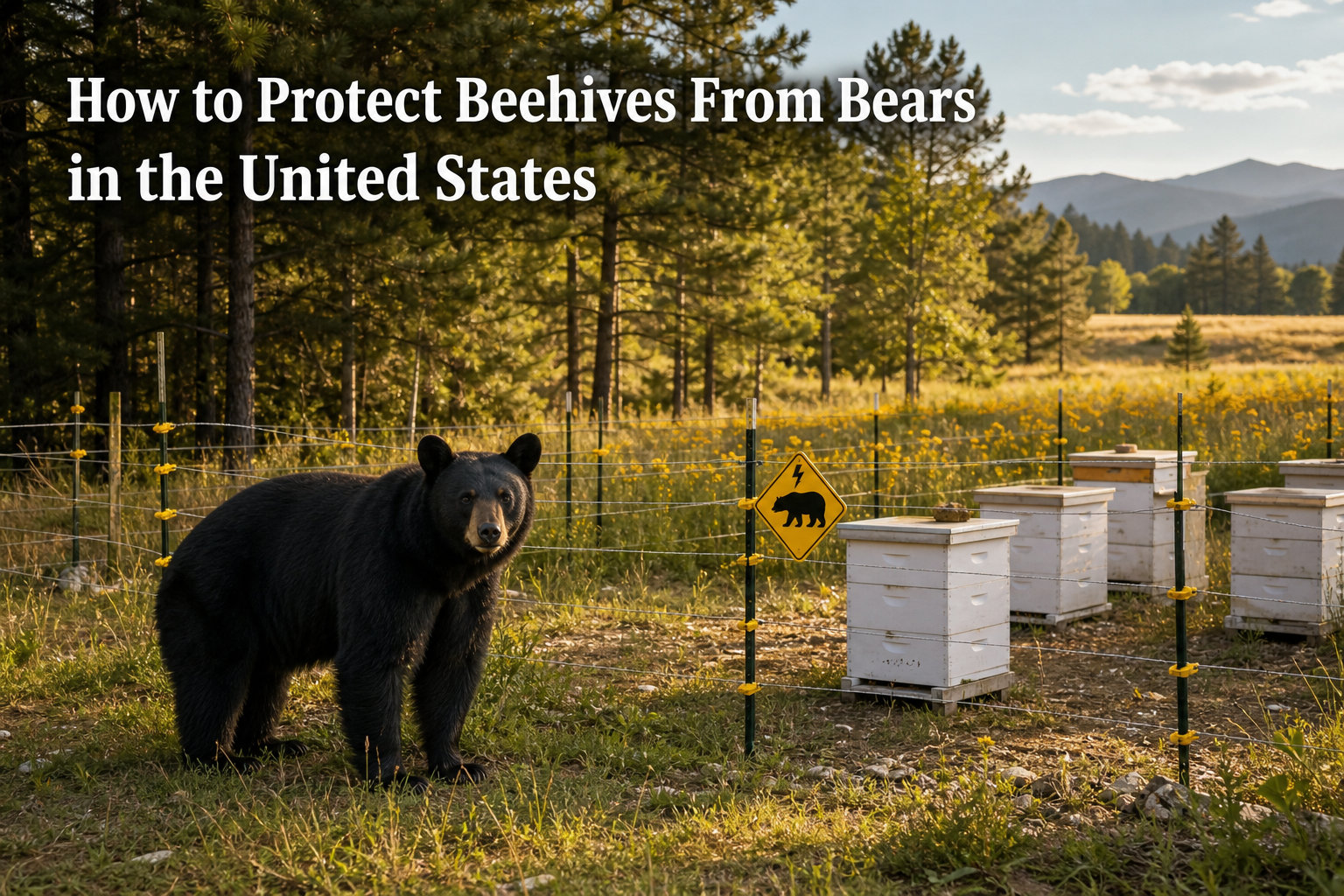
Bears can destroy an entire apiary in a single night, and once a bear learns where your hives sit, it will keep coming back. Electric fencing is the most effective method to protect beehives from bears, with a near 100% success rate when the system delivers at least 0.7 Joules of stored energy and 7,000 volts across 5 wires standing 48 inches tall. I have helped beekeepers across the Southeast and Pacific Northwest recover from bear raids, and the same lesson keeps repeating: prevention always beats reaction.
This guide covers everything you need to keep your colonies safe, including fence specifications, baiting techniques, maintenance routines, hive placement, alternative methods, and state-specific resources. Whether you run a hobby yard with two hives or a commercial operation with hundreds of colonies, the strategies below will help you protect beehives from bears in the United States.
Table of Contents
Why Bears Target Beehives
Black bears raid hives for three high-value foods: honey, bee brood (larvae), and adult bees themselves. A single mature hive can contain 30,000 to 60,000 bees along with several pounds of honey and protein-rich larvae, making it one of the most calorie-dense meals a bear can find in the wild.
Bears can smell a beehive from up to a mile away under the right wind and weather conditions. They use their noses the way we use our eyes, and the scent of beeswax, honey, and pheromones carries far across forests, meadows, and creek bottoms. If your hives sit within a mile of active bear habitat, you should assume a bear knows they are there.
Once a bear gets a meal from a hive, the problem multiplies fast. Bears have excellent memory and will return to the same food source repeatedly. A bear that destroys one hive and finds no consequence will teach its cubs to do the same, and it will recruit other bears in the area. I have seen single bear families destroy 12 hives in one yard within a week.
What Bears Eat From a Hive
Honey – The carbohydrate layer bears crave most during fall hyperphagia.
Bee larvae and pupae – A protein-rich food source critical for bear growth and cub development.
Adult bees – Eaten as a supplemental protein, though bears dislike getting stung.
Beeswax and propolis – Consumed incidentally; bears do not get sick from these materials.
Understanding what bears want from your hives helps you understand why detractors like ammonia-soaked rags work only briefly. The reward is too high, so the deterrent must be stronger than the temptation.
How to Protect Beehives From Bears With Electric Fencing
Electric fencing is the gold standard bear protection method, recommended by every state wildlife agency I have researched, including North Carolina, Michigan, Maine, and Colorado. The fence works by delivering a memorable shock that teaches bears to avoid the area entirely, so well-installed systems can protect beehives from bears for years without a single breach.
The fence must be installed BEFORE bears find your hives. Once a bear has fed successfully, no fence will stop it without significant reinforcement. Our team has watched hobby beekeepers lose colonies one by one because they waited to install fencing until “next season.” By then, the bear had already learned the address.
Why Electric Fencing Works
An electric fence creates a psychological barrier, not a physical one. Bears learn quickly that touching the wire causes a sharp shock, and they avoid the area after one or two encounters. This is why even a four-wire fence that meets the energy spec can perform as well as a heavier barrier with inadequate power.
Reddit user bjm63c runs a solar-powered electric fence inside a regular perimeter fence in North Carolina and reports zero bear losses across five seasons. His setup is similar to what most successful beekeepers describe: layered defense with strong energizer performance.
Fence Specifications and Setup
To protect beehives from bears effectively, your electric fence must meet specific technical requirements. Cut any of these corners and the bear will test the weakest point first.
Energizer Requirements
Minimum output: 0.7 stored Joules (1.0+ Joules recommended for persistent bears).
Minimum voltage: 7,000 volts at the fence line.
Power source: 110V AC plug-in, 12V battery, or solar-charged system for remote locations.
Brand considerations: Brands like Parmak, Zareba, and Stafix are commonly used across commercial beekeeping operations.
Choose a fence energizer rated for the length of your fence line. Longer fences and heavy vegetation growth drain the system, so oversize your energizer by 20% to keep voltage high under real-world conditions.
Wire Layout and Height
The recommended setup is a 5-wire fence standing 48 inches tall with the bottom wire 8 inches above the ground. This configuration prevents bears from going under, through, or over the barrier.
Wire spacing from bottom to top: 8, 16, 26, 36, and 48 inches. Place high-visibility flags or fabric strips on each wire during the first month so bears see the fence before they touch it. Bears are far more cautious when they can see the barrier.
Grounding System
A proper grounding system is just as important as the fence itself. Without good grounding, the shock power never completes the circuit and bears feel nothing. Drive at least three 6-foot galvanized grounding rods into moist soil, spaced 10 feet apart, and connect them with heavy-gauge wire to the energizer’s ground terminal.
Dry, sandy, or rocky soil drains the system and reduces effectiveness. In poor soil conditions, install more grounding rods or use a “hot ground” system that electrifies the ground wire opposite a charged wire.
Baiting Your Electric Fence
Baiting trains bears to touch the fence with their sensitive nose or mouth before they ever reach your hives. The goal is to deliver a strong shock during the curious sniffing phase, not when the bear is already committed to climbing the fence.
When to Bait
Bait your fence for the first 4 to 6 weeks after installation, then discontinue once bears have learned to avoid the area. Re-bait immediately if you see new bear activity, fresh tracks near the hive, or claw marks on nearby trees.
What to Use as Bait
Peanut butter – Smear a tablespoon on a small piece of aluminum foil and hang it on the second wire from the top.
Bacon grease – Wrap a strip of bacon around the wire at nose height (about 26 inches).
Marshmallows – Spear a marshmallow on the wire; bears find them irresistible.
Sardines or fish oil – Use sparingly; the smell carries far and may attract more bears than you want.
Check your bait every 2 to 3 days and replace it as it dries out or gets eaten. The NC Wildlife Resources Commission specifically recommends bacon and peanut butter for black bear training, and our team has seen consistent results with this approach.
Fence Maintenance Checklist
A neglected electric fence is worse than no fence at all, because it gives you a false sense of security. Bears learn within minutes that the fence is off, and that knowledge spreads across the local bear population faster than you might expect.
Weekly Tasks
Walk the fence line and check for broken wires, fallen branches, and vegetation touching the charged wires.
Test the voltage at multiple points using a digital fence voltmeter. Minimum 7,000 volts is required.
Inspect the energizer for error codes or low-battery warnings.
Check posts, insulators, and gate connections for damage.
Monthly Tasks
Clear vegetation within 12 inches of the fence line to prevent power drain.
Test battery voltage on solar or 12V systems; recharge or replace as needed.
Inspect grounding rods for corrosion and ensure solid connections.
Verify solar panels are clean and angled correctly for your latitude.
Reddit user bearproof_hive_setup combined an outer garden fence with an inner electric fence in North Carolina and credits the maintenance routine, not just the equipment, for keeping bears out six years running. The lesson: a fence is only as good as the time you spend on it.
Hive Placement Strategies
Where you place your hives makes a real difference in how often bears visit your apiary. Smart placement reduces bear pressure and gives your electric fence more time to work before a bear reaches the hives.
Buffer Zones
Place hives at least 50 yards from heavy cover, such as thick timber, dense brush, or creek bottoms. Bears use these as travel routes and hiding spots, and hives placed near cover are discovered within days. Open meadows with clear sight lines give bears no cover to approach from and make them more cautious.
Avoid Bear Travel Routes
Identify game trails, creek crossings, and ridgelines before you set up your yard. Bears follow predictable paths between feeding areas, and hives placed in these corridors are found immediately. Walk your property in early morning and look for tracks, scat, and claw marks on trees.
Distance From Nectar Sources
Place hives near major nectar flows during peak season, but avoid putting them in the middle of prime bear foraging habitat. A clover field at the edge of a forest is far safer than one deep inside the woods. The closer you are to bear food, the more risk you accept.
Alternative Methods to Protect Beehives From Bears
Electric fencing is the most reliable option, but several alternatives can supplement or, in low-pressure areas, replace it. These methods work best when combined with other strategies.
Bear-Resistant Hives
Products like Bee Fortress and UDAP bear-resistant hive enclosures use reinforced steel and latches to physically prevent bears from reaching the comb. They cost more than electric fencing but require no power source and provide constant protection. For hobby beekeepers with one or two hives, these can be a practical alternative.
Elevated Platforms
Build a 6-foot elevated platform on a single greased pole. Bears can climb the pole, but the grease prevents them from reaching the platform. The platform needs a ladder for inspections, and you must wear a fall restraint. This is a common Reddit suggestion but a high-maintenance option in most settings.
Natural Deterrents
Smells bears hate include ammonia, pine-based cleaners, and predator urine. These work briefly but lose effectiveness as bears habituate. Use them as a temporary bridge until you install a proper fence, not as a permanent solution.
Bear Hound Deterrents
Some beekeepers use trained bear hounds that patrol the perimeter. The dogs do not fight bears but bark and chase, which discourages bears from approaching. This works on larger ranches but is impractical for most hobby and small commercial operations.
State-by-State Bear Pressure and Resources
Bear populations and pressure vary significantly across the United States. Knowing your region’s bear density helps you choose the right level of protection.
High Bear Pressure States
California, Oregon, Washington – Dense black bear populations in forested regions; electric fencing strongly recommended.
Colorado, Montana, Wyoming – Mountain bears with active foraging patterns; permanent fencing is the standard.
Pennsylvania, New York, Maine – Growing bear populations in the Northeast; pressure has increased dramatically over the past decade.
North Carolina, Tennessee, Virginia – Southern Appalachia has some of the highest bear densities in the country.
State Wildlife Agency Resources
State wildlife agencies offer free technical guidance for beekeepers managing bear issues. The NC Wildlife Resources Commission, Colorado Parks and Wildlife, and Michigan Department of Natural Resources all publish detailed bear-fence construction PDFs you can download. Contact your state agency before setting up a new apiary in bear country.
Insurance and Compensation Programs
Some states offer compensation for bear damage to agricultural assets, including hives. Check with your state Department of Agriculture or USDA Wildlife Services to see if a program covers your area. Even with compensation, prevention is cheaper and easier than rebuilding after a raid.
What to Do If a Bear Already Found Your Hives
If a bear has already destroyed hives, respond immediately. Remove all comb, wax, and honey debris from the site, because the smell will keep drawing bears back. Repair or replace damaged boxes, then install electric fencing before restocking with bees.
Do not attempt to bait or trap the bear yourself. Contact your state wildlife agency to report the incident and ask about relocation options in your area. In most states, black bears are protected and cannot be harmed without a permit.
Once you install electric fencing, bait the wires heavily for the first month. The bear will return, and you need a strong shock on the first encounter to break the habit. Without that shock, the bear will test every defense until one fails.
FAQs
How to keep bears away from bee hives?
Install a 5-wire electric fence around your apiary with 0.7 Joules of stored energy and at least 7,000 volts at the fence line. Bait the wires with peanut butter or bacon for 4 to 6 weeks so bears get a strong shock during their first curious contact. Place hives at least 50 yards from heavy cover and game trails.
What smell do bears hate the most?
Bears dislike ammonia, pine-based cleaners, and predator urine, but these deterrents work only briefly because bears habituate quickly. The most reliable deterrent is the shock from an electric fence, which creates a lasting negative memory rather than a temporary smell aversion.
How far away can a bear smell a beehive?
Under good wind and weather conditions, a bear can smell a beehive from up to a mile away. The scent of honey, beeswax, and bee pheromones travels far across forests, fields, and water. If your hives sit within a mile of active bear habitat, assume a bear already knows they are there.
Is electric fencing enough to protect beehives from bears?
Yes, a properly installed electric fence with at least 0.7 Joules, 7,000 volts, and 5 wires reaching 48 inches high protects beehives from bears with near 100% effectiveness. The key is correct installation, regular maintenance, and baiting the wires during the training period. A neglected or underpowered fence will fail.
What should I do if a bear already destroyed my hives?
Remove all wax, comb, and honey debris from the site to stop attracting bears back. Contact your state wildlife agency to report the damage and ask about local bear-pressure information. Install a properly powered electric fence and bait it heavily before restocking with bees, so the returning bear gets a strong shock on its first encounter.
Final Thoughts on Protecting Beehives From Bears
The single most important step to protect beehives from bears is installing electric fencing before a bear ever finds your yard. Bears that have fed once will return dozens of times, and recovering from a bear-educated bear is far harder than preventing the first visit.
Invest in a quality energizer rated above 0.7 Joules, build a 5-wire fence to 48 inches, bait the wires for the first month, and walk the fence line weekly. Combined with smart hive placement away from cover and travel routes, this approach consistently protects beehives from bears across every bear-populated region of the United States.
If you are starting a new apiary in bear country in 2026, install the fence before your bees arrive. Your future self will thank you when the alternative is replacing every frame, box, and colony after a single overnight raid.