
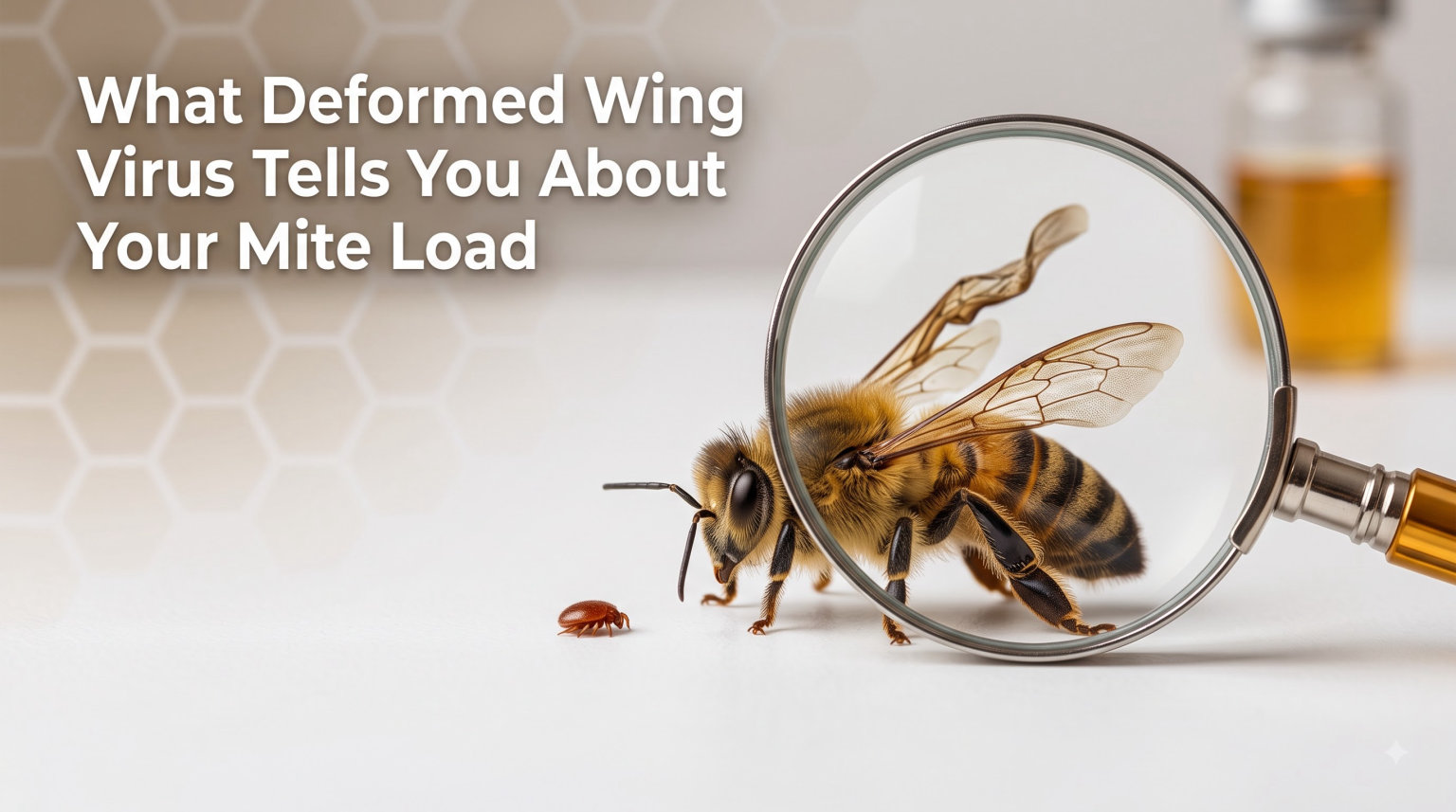
You walk up to your hive on a warm afternoon and notice a bee dragging itself across the landing board with wings that look like crumpled paper. That single sighting is rarely a coincidence. When I see bees with deformed wings in my own apiary, I know the colony has been telling me something for weeks, and I missed it. Deformed wing virus is the loudest warning sign your hive can give you about an out of control deformed wing virus mite load.
Most beekeepers treat DWV as a disease to cure. I treat it as a diagnostic. The virus itself is hard to remove, but the mites that spread it are not. Once you understand what DWV tells you about your mite load, you can read your hives like a book instead of hoping for the best. This guide breaks down the science, the symptoms, and the specific thresholds that should trigger action in 2026.
Table of Contents
What Is Deformed Wing Virus (DWV)?
Deformed wing virus is a single stranded RNA virus that infects honey bees and replicates inside their tissues. It is one of the most common viruses found in Apis mellifera colonies worldwide, and in many apiaries it sits dormant at low levels for years. The problem starts when something gives the virus a fast lane to multiply.
DWV belongs to the Iflaviridae family and has at least two major strains that matter to beekeepers. DWV-A is the original, well studied variant. DWV-B, sometimes called Varroa destructor virus 1, has become more prevalent in recent years and tends to be more virulent. Researchers also identify DWV-C as a minor recombinant variant that appears when A and B strains co-infect the same host.
The defining symptom gives the virus its name. Bees infected during the pupal stage emerge with wings that are crumpled, shortened, or missing entirely. They cannot fly, they cannot forage, and they usually die within a few days of emergence. Younger bees in the hive may carry the virus without showing symptoms, which is why a colony can look fine on the outside while the infection burns underneath.
The DWV-Varroa Mite Connection Explained
Varroa destructor is the reason DWV became a colony killer. Before the mite arrived in Western honey bee populations, DWV circulated at low levels and rarely caused visible disease. The mite changed everything by acting as a biological syringe.
Here is how the transmission cycle works. A female Varroa mite enters a brood cell shortly before it is capped. While the bee larva pupates, the mite feeds on its fat body tissue and injects saliva to keep the wound from healing. If the mite is carrying DWV particles, those particles pass directly into the bee’s hemolymph along with the saliva. This direct injection bypasses the bee’s gut based defenses and floods the pupa with virus.
Once inside, DWV replicates rapidly in the developing bee’s tissues. The bee emerges with a viral load many times higher than what natural feeding or contact exposure could produce. The mite also picks up new virus particles while feeding, meaning a single mite can spread DWV to cell after cell as it moves through the brood nest.
Vertical transmission adds another layer. Drifting bees, shared flowers, and the queen herself can all carry DWV at low levels. Without the mite, these routes keep the virus in a slow circulation that rarely causes harm. Once Varroa enters the picture, the same virus becomes a colony ending epidemic.
This is why so many researchers now say the problem is not really mites. It is the Varroa virus complex. Without the mite acting as a vector, DWV stays in a relatively harmless background state. With the mite, the virus shifts from passenger to driver of colony decline.
Visual Symptoms of DWV Infection
Visible DWV symptoms are dramatic and unmistakable once you know what to look for. The wings are the most obvious clue, but they are not the only one. Subtle signs in adult bees and brood patterns can tip you off before full blown crawling bees appear at the entrance.
The classic wing symptom is a bee that emerges with wings that are stubby, twisted, or curled under the body. Some bees have wings that look like they were folded while still wet. In severe cases, wings are completely missing or reduced to small stubs. These bees cannot fly and they crawl on the ground in front of the hive, often in circles, before dying within a few days.
Other symptoms include a shortened, rounded abdomen that looks bloated compared to a healthy bee. Affected bees may appear darker or greasy because hair loss accompanies the virus infection. You will sometimes see bees trembling on the landing board, unable to coordinate their legs. Because flying is impossible, all of these bees are doomed within days.
It is important to know that DWV can also be covert. A hive can carry high viral loads without producing a single deformed bee. The visible symptoms only show up when infection crosses a threshold during pupal development. Many beekeepers, myself included, have lost colonies that looked healthy the week before collapse. By the time the symptoms appear, the epidemic has been running for weeks.
How DWV Indicates Your Mite Load
Visible DWV is a late stage warning. If you are seeing bees with deformed wings in front of your hive, your mite population has been above the injury threshold for at least one full brood cycle. That is typically 21 to 24 days of unchecked mite reproduction.
The correlation is direct because the virus needs the mite to cause visible damage. A hive with one mite per hundred bees and zero visible DWV is in a very different place than a hive with three mites per hundred bees and a steady crawl of deformed bees at the entrance. The first hive may carry some virus, but the mite population is too low to amplify it. The second hive is feeding an active epidemic.
Practical threshold for alcohol wash or sugar roll mite counts in 2026:
Under 1 mite per 100 bees in spring: healthy, monitor monthly.
1 to 2 mites per 100 bees in summer: treatment threshold for many regions, treat within two weeks.
3 mites per 100 bees: serious infestation, visible DWV likely in the brood nest.
5 or more mites per 100 bees: critical, immediate treatment required to save the colony.
Any visible DWV symptoms: treat now, regardless of your last mite count.
I treat the appearance of any deformed wing bee as a five percent mite equivalent. By the time symptoms are visible at the entrance, more than five percent of bees are usually carrying the virus at high titers, and the mite population driving it is already in the danger zone.
Treatment Thresholds and Action Items
Here is the action plan I follow and recommend to other beekeepers. Run a monthly mite count from early spring through fall using an alcohol wash or sugar shake on 300 bees from the brood nest. Record the number and the date. Three percent is the line that separates safe from risky. Five percent means you are already losing the battle and visible DWV will soon follow.
When you see DWV symptoms, do not waste time on virus treatments. There are no antivirals approved for honey bees. Focus on the vector. Apply an approved miticide immediately, choosing a product that works on phoretic mites as well as mites under cappings. Options include oxalic acid vapor, formic acid pads, and thymol based products, depending on your climate and honey flow status.
Follow up with a second mite count seven to ten days after treatment to confirm the population dropped. If counts remain above three percent, switch to a different active ingredient to avoid resistance. Repeat monitoring monthly until the end of the fall treatment window. A properly timed winter treatment with oxalic acid can knock residual mites down to near zero.
Longer term, consider requeening with stock bred for hygienic behavior or Varroa sensitive hygiene. These bees detect and remove mite infested pupae before the mites can inject more virus. It is not a silver bullet, but combined with monitoring and threshold based treatments, it dramatically reduces how often you see DWV at the entrance.
Monitoring Protocol for the Season
Mite counts are the backbone of every healthy beekeeping operation. Pick one method and stick with it so your numbers are comparable across the season. I use an alcohol wash because it is fast and accurate, but a powdered sugar roll is fine if you want to keep the bees alive.
Sample from the brood nest, not the outer frames, because that is where the mites concentrate. Aim for 300 bees per sample, which is about half a cup of bees. Divide the number of mites recovered by three to get your mites per 100 bees percentage.
Keep a simple notebook or spreadsheet with the date, colony ID, mite count, and any observations like DWV symptoms seen. Over time, patterns will emerge. You will learn which yards spike first, which queens produce colonies that hold mites down, and which treatments work best in your climate. That data is worth more than any single inspection.
Regional and Seasonal Considerations
Mite pressure varies by region, but the pattern is the same. In temperate climates, mite populations explode in late summer as the brood nest contracts. This is why most visible DWV reports cluster in August and September. Tropical and subtropical regions see different timing, with mite spikes often aligning with honey flows and brood buildup.
Northern beekeepers who wrap their hives for winter should finish all mite treatments before the cluster forms. A heavy mite load going into winter is a death sentence, even if you never see a single deformed wing bee. The virus quietly shortens the lifespan of winter bees and the cluster dwindles before spring.
Southern beekeepers managing multiple honey flows should pay close attention to the gap between flows. When the flow stops and the bees pull back on brood rearing, the mites concentrate on fewer cells. That is when DWV can suddenly appear in a colony that looked clean the week before.
FAQs
How to get rid of deformed wing virus?
You cannot get rid of the virus directly because there is no cure for DWV in bees. Instead, control the Varroa mites that amplify it. Run a mite count, apply an approved miticide such as oxalic acid or formic acid, and requeen with hygienic stock to break the cycle. Visible DWV symptoms should disappear within one to two brood cycles after the mite load drops below the treatment threshold.
What is an acceptable mite count?
An acceptable mite count is below 1 mite per 100 bees in spring, and below 2 mites per 100 bees during the summer honey flow. Anything above 3 mites per 100 bees is a treatment threshold, and 5 or more mites per 100 bees means the colony is in crisis and immediate action is required.
Can a hive survive deformed wing virus?
A hive can survive DWV if the beekeeper acts quickly to reduce the mite load. The colony needs treatment within days, requeening if the queen is failing, and supportive feeding if the population is collapsing. Without intervention, visible DWV almost always leads to colony death within weeks to a few months.
What does deformed wing virus do to bees?
Deformed wing virus attacks the developing bee’s wing and nervous tissue, causing wings to be crumpled, shortened, or missing at emergence. Infected bees cannot fly, crawl in front of the hive, and die within a few days. The virus also shortens the lifespan of apparently healthy bees and reduces overwintering survival of the colony.
Final Thoughts on Reading DWV as a Warning Sign
Deformed wing virus is the most honest signal your bees can give you about an unsafe deformed wing virus mite load. Stop trying to cure the virus and start reading it as a pressure gauge for your mite management. Stay below three percent mites, treat at the first sight of deformed bees, and rebuild with genetics that resist the problem. That is how I keep my colonies going into 2026, and it is the same approach that keeps commercial beekeepers in business year after year.