
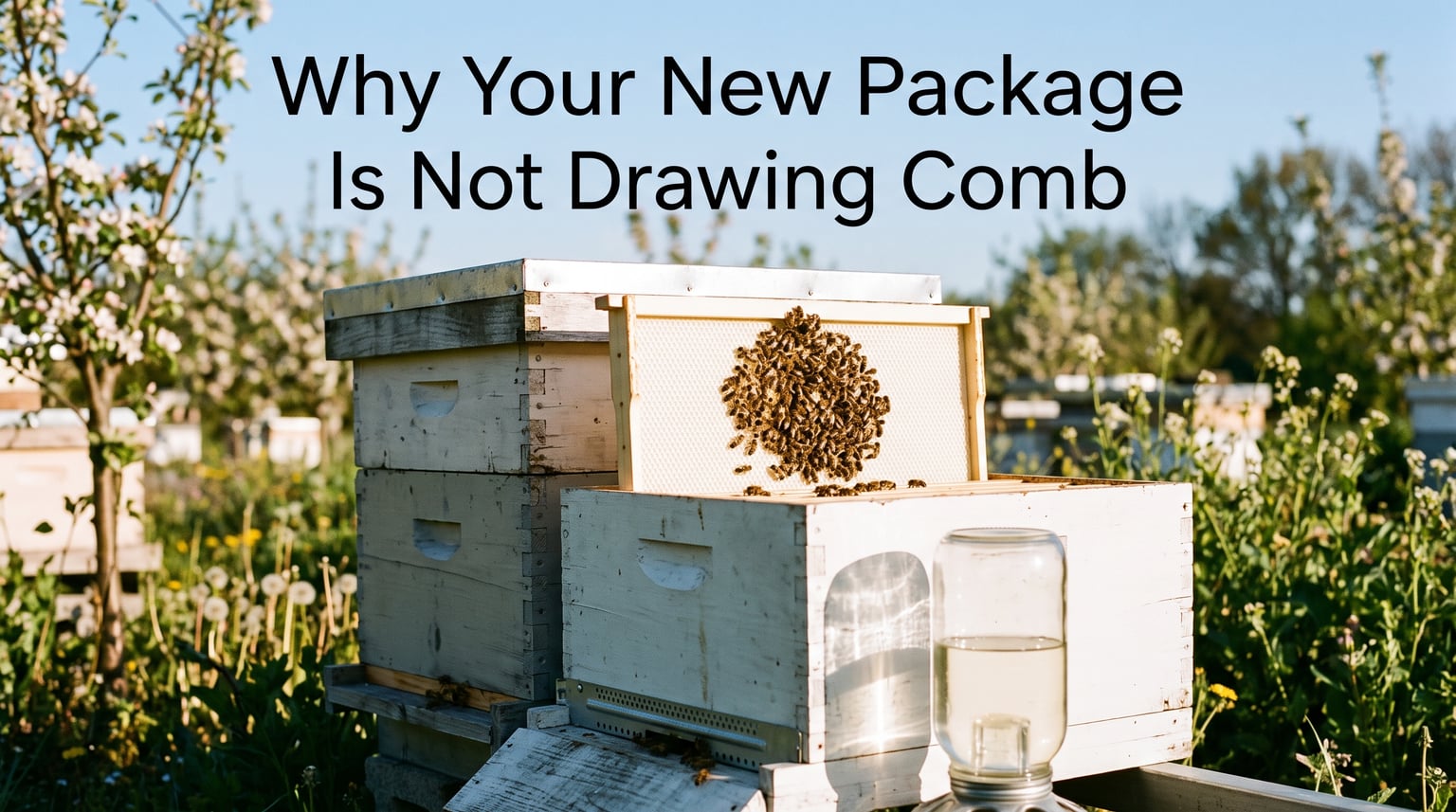
I remember installing my first package of bees on a chilly April afternoon. I gave them sugar syrup, a fresh brood box, and brand new foundation. Then I waited. And waited. By day 10 they had barely touched a single frame. If you are watching your new package bees not drawing comb, I want to save you the weeks of confusion I went through.
This guide pulls together what experienced beekeepers, package producers, and forum regulars have learned about why a freshly installed package sometimes refuses to build wax. We will cover the conditions bees need, the most common failure points, and exactly what to do when your new package seems stuck.
Table of Contents
Why Your New Package Bees Are Not Drawing Comb
Your new package bees are not drawing comb because at least one of the 5 critical conditions for wax production is missing. Most often it is a weak population, no nectar flow, cold nights, an unaccepted queen, or foundation the bees do not recognize as workable. Comb building is a metabolic investment, and a stressed package simply will not spend the energy.
The 5 Conditions Bees Need to Draw Comb
Every successful comb drawing project shares the same 5 conditions. Our team uses this checklist during hive inspections, and it solves roughly 90 percent of stalled-comb situations.
A strong population of young bees. Only workers aged 2 to 3 weeks have fully developed wax glands. Packages ship with mostly older foragers.
An active nectar flow or heavy syrup feeding. Bees need roughly 10 pounds of honey or syrup to produce 1 pound of wax.
Warm cluster temperatures near 95 degrees F. Wax softens and shapes correctly only inside a warm brood nest.
A laying, accepted queen. Without brood pheromone, the colony has no biological reason to expand.
Fresh, properly waxed foundation. Dusty, old, or contaminated plastic foundation often gets ignored.
If even one of these conditions is off, comb building slows or stops entirely. New packages fail at this list more than any other group of hives, because they start with almost nothing.
Reason 1: Insufficient Bee Population and Hive Strength
A standard 3 lb package contains roughly 10,000 bees. That sounds like a lot, but it is a small colony. It takes about 21 days for the first round of new bees to emerge from the queen’s eggs, so your package must survive that gap with the workers you installed.
I have watched two hives in the same apiary behave completely differently. One drew 5 frames in two weeks. The other barely touched the foundation. The only difference I could find was the second package had a noticeably smaller cluster after installation. Population drift to nearby hives made the gap worse.
How to confirm this is your problem:
Count frames covered by bees during the day. A struggling package often shows 3 to 4 frames of coverage, not the 6 to 8 you expected.
Check for drifting. If you have multiple hives, install new packages in the late afternoon so bees orient to the right home before sunrise.
Avoid opening the hive more than once a week. Each inspection costs you bee numbers and heat.
Reason 2: No Nectar Flow and Lack of Feeding
Comb is expensive. Bees must consume roughly 8 to 10 pounds of honey or syrup to secrete 1 pound of wax scales. If your local nectar flow is weak or your feeder is empty, your package will conserve resources rather than build.
Forum users regularly report feeding syrup for two weeks with no visible comb. The fix is usually volume, not just presence. A small package can take a quart of 1:1 syrup per day during peak drawing season.
Use a 1:1 sugar-to-water syrup by weight for comb drawing. The thin consistency mimics a real nectar flow and stimulates wax glands. Switch to 2:1 syrup only in fall when you want them to store food rather than draw new comb.
Reason 3: Temperature Too Low for Wax Production
Wax scales become pliable around 95 degrees F. A package installed in early spring often clusters tightly to keep the queen and brood warm, leaving no energy for wax secretion. This is the most common cold-climate complaint we hear.
If your nights are still dropping below 50 degrees F, your bees are likely in survival mode. I have seen packages installed in March sit on foundation for over a month because the cluster simply could not afford to spread out.
To help with temperature:
Use an entrance reducer to shrink the opening. Smaller entrances are easier to defend and retain heat.
Add a follower board or dummy frame to reduce the space the bees must warm.
Avoid placing the hive in a windy corner. Wind strips heat faster than cold air alone.
Reason 4: Queen Problems or Queenlessness
A new package queen can fail for several reasons. She may have died in transit, been rejected by the workers, or simply not start laying. Without a laying queen, brood pheromone drops and the colony has no biological driver to expand the nest.
How to check the queen situation:
Look for eggs on day 5 to 7 after installation. Eggs look like tiny grains of rice standing upright in cell bottoms.
If you only see polished empty cells after 10 days, your queen may be gone or not mated.
Listen for the “queenless roar” – a continuous low hum that sounds different from normal fanning.
Most queen acceptance failures happen in the first 7 days. If your package has been installed for more than two weeks with no eggs, consider ordering a replacement queen from your supplier.
Reason 5: Foundation Issues and Comb Acceptance
Bees are picky about where they build. Plastic foundation that has been stored in a dusty shed for a year is a common culprit. The bees detect old wax residues, propolis, or chemical smells and refuse to draw on the surface.
I have personally recoated plastic foundation with melted beeswax using a foam roller. The difference was dramatic – the same package that ignored bare plastic built comb on waxed frames within 48 hours.
Quick foundation checklist:
Brush off any dust or cobwebs before installation.
Lightly coat plastic foundation with beeswax using a roller or brush.
Consider drawn comb from a healthy donor hive if available. Bees always prefer real comb.
Make sure frames are tight in the frame rests. Bees propolize gaps and avoid drawing warped frames.
How Long It Takes a New Package to Draw Comb
A healthy 3 lb package in good spring conditions should draw 6 to 8 deep frames of foundation in 3 to 4 weeks. By week 4, the queen should have a solid brood pattern and the colony should be ready for additional space. If you see less than 3 frames drawn after a month, something is off and you should run through the 5 conditions above.
Typical Timeline for a 3 lb Package
Here is a realistic week-by-week expectation based on reports from beekeeping forums and our own experience with package installations in temperate climates.
Days 1 to 3: Cluster settles, bees orient to the hive, queen begins laying if accepted.
Days 4 to 10: First small patches of comb appear on the center frames, often capped sugar syrup or pollen.
Days 11 to 21: First brood emerges, population starts climbing, comb drawing accelerates.
Days 22 to 30: A strong package fills 6 to 8 frames and may need a second deep box.
When to Worry About Slow Comb Drawing
I do not worry until day 14. Some packages spend the first two weeks clustering on the queen cage and ignoring everything else. That is normal.
I start worrying at day 21 if less than 3 frames show any comb. At this point, open the hive on a warm day and run through the 5-condition checklist. Most slow packages have a population problem, a feeding problem, or a queen problem.
One Reddit user described two hives behaving completely differently despite identical treatment. The slow hive had drifted heavily into the other hive. After swapping locations, the slow hive picked up within a week. Population balance matters more than people realize.
How to Encourage Your New Package to Draw Comb Faster
To encourage your new package to draw comb faster, feed 1:1 sugar syrup continuously, use freshly waxed or drawn comb, restrict the space to what the cluster can defend, and confirm the queen is laying. Each of these four levers directly targets one of the conditions in the checklist above.
Feeding 1:1 vs 2:1 Sugar Syrup
Use 1:1 syrup for comb drawing. The thinner ratio stimulates wax glands and mimics an active spring nectar flow. Use 2:1 syrup only when you want bees to fill existing comb for winter stores.
A package that has filled cells with syrup instead of drawing new comb is a common forum complaint. The fix is to add empty foundation frames between drawn frames and reduce the syrup temporarily until they start building again.
Preparing the Foundation
Bees prefer fresh, wax-coated foundation. If you are using plastic foundation, roll a thin layer of melted beeswax over the cells before installation. If you are using wax foundation, store it in plastic bags away from dust and mouse damage.
One user on Beesource reported 15 full frames plus 5 partial frames drawn in 3 weeks using dipped wax plastic foundation. That same package had struggled on bare plastic the year before.
Adding Frames at the Right Time
Do not add a second deep box until the package has drawn 6 to 8 frames in the first box. Adding too much space spreads the cluster too thin and the bees cannot warm the empty frames.
The classic mistake is the overconfident beekeeper who installs a deep and a medium at the same time. The cluster ends up covering 3 frames in the deep and ignoring the medium entirely.
Managing Temperature and Cluster Size
Keep the cluster dense and warm. Use an entrance reducer, a follower board, and a windbreak if needed. A small cluster that is too cold will sit on the queen and ignore foundation rather than expand into a cold box.
Once night temperatures stay above 55 degrees F consistently and the colony covers 6 frames, you can open the entrance wider and start thinking about a second box.
Understanding the 3-3-3 Rule for New Package Bees
The 3-3-3 rule for bees is a quick way to remember the early stages of a new package. It refers to 3 pounds of bees, 3 pounds of sugar syrup per week, and 3 weeks before the first new bees emerge. Following this rule gives the package its best chance to draw comb, accept the queen, and build a stable brood nest before the original cluster ages out.
It is not a magic formula, but it is a great benchmark. If your package is below 3 pounds, feed more than 3 pounds of syrup per week, or you are checking on day 10 expecting brood, the 3-3-3 rule helps you reset your expectations.
Signs Your New Package Is Thriving vs Failing
A thriving package draws comb on the inner 4 frames within 7 to 10 days, accepts the queen within 5 days, has foragers bringing in pollen by day 7, and shows eggs and larvae by day 14. A failing package ignores foundation, clusters tightly on the queen cage, shows no pollen coming in, and has no eggs after 14 days. Run through the 5-condition checklist the moment you notice the second pattern.
Foragers carrying bright orange or yellow pollen on their legs is one of the best early signs of health. Pollen means they have found brood to feed and they are oriented to the hive. No pollen at all by day 7 often means the queen is not laying or has been rejected.
FAQs
Why are my new package bees not drawing comb?
New package bees are not drawing comb because one or more of the 5 conditions for wax production is missing. The most common causes are a weak population, no nectar flow or feeding, low cluster temperature, an unaccepted queen, or foundation that is old or dusty. Run through each condition in order and fix the first one you find.
How long does it take a new package to draw comb?
A healthy 3 lb package in good spring conditions draws 6 to 8 deep frames in 3 to 4 weeks. Slower than that usually points to a population, feeding, or queen problem. By week 4, the queen should have a solid brood pattern and the colony should be ready for additional space.
How can I get bees to draw comb faster?
Feed 1:1 sugar syrup continuously, use fresh waxed foundation or drawn comb, restrict the space to what the cluster can defend, and confirm the queen is laying. Avoid adding extra boxes too early, since a small cluster cannot warm a large hive.
Will bees draw comb with 2:1 sugar syrup?
Bees can draw comb with 2:1 syrup but it is not ideal. The thicker ratio is designed for fall feeding to build winter stores, not stimulate wax glands. Use 1:1 syrup during spring and summer when your goal is comb drawing.
What is the 3-3-3 rule for bees?
The 3-3-3 rule means 3 pounds of bees in the package, 3 pounds of sugar syrup per week, and 3 weeks before the first new bees emerge from the queen’s eggs. It is a quick benchmark for new package care during the critical first month.
Final Thoughts on New Package Bees Not Drawing Comb
If your new package is not drawing comb, work through the 5 conditions one at a time: population, nectar flow, temperature, queen, and foundation. Each one is a checkable item during a quick inspection, and the fix for each is straightforward. Most stalled packages are missing just one of these, and that is the fastest path back to a thriving colony.
Give your new package time, keep the syrup coming, and resist the urge to over-manage. Bees know how to build comb – your job is to give them the conditions to do it.