
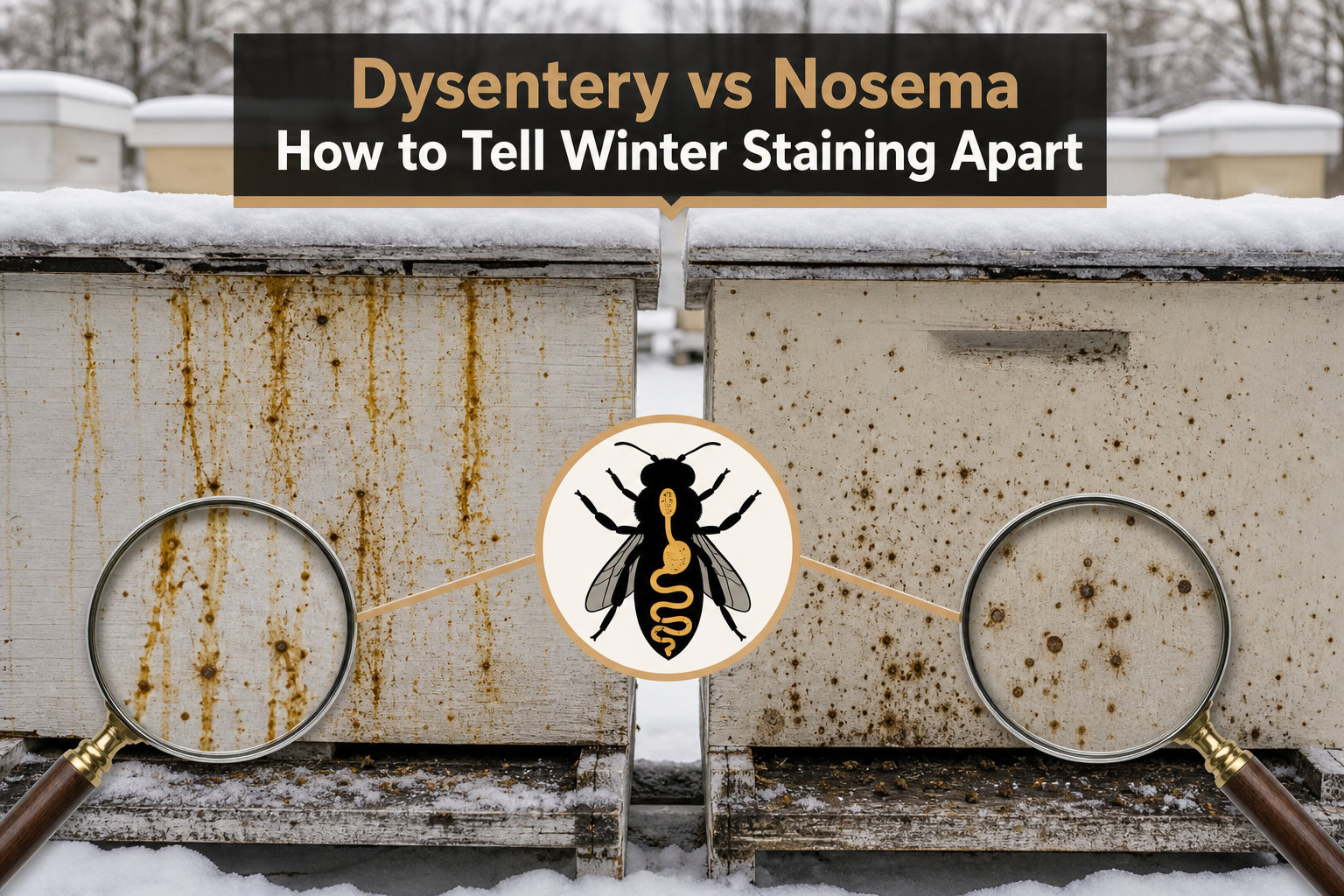
Last February, I opened one of my hives and found dark brown streaks running down the top bars. There were smears on the inner cover and golden splatters on the landing board.
My first thought was nosema. I had heard the warning for years: brown stains in winter mean nosema.
After I sent a few bees to my local bee lab, the results came back negative. The culprit was dysentery, not nosema.
That single inspection pushed me to dig into the science. What I learned reshaped how I read every hive I open.
If you are trying to figure out whether your staining is dysentery vs nosema, you are not alone. The two are the most commonly confused conditions in winter beekeeping.
This guide walks through what each one actually is. It covers how to tell them apart visually, why they so often overlap, and when to reach for a microscope instead of guessing.
I have spent three winters side by side with experienced mentors and bee inspectors. I will share what I have picked up along the way.
Table of Contents
What Is Honey Bee Dysentery and Why Does It Happen
Honey bee dysentery is a condition, not a disease. It happens when a bee’s rectum fills past its capacity.
The bee cannot hold the waste any longer while confined inside the hive. Fecal matter ends up on frames, the inner cover, top bars, and the front of the hive.
Healthy winter bees normally take short cleansing flights on mild days to empty their rectums. When cold weather keeps them inside for weeks, that stored waste keeps accumulating.
The rectum can stretch to hold about 30 to 40 percent of a bee’s body weight. Past that point, the bee loses voluntary control and defecates inside the hive.
The drivers behind dysentery come down to what is in the gut. Three things tend to overload a winter bee’s digestive tract:
- High moisture in late-season feed, especially sugar syrup fed too late in fall
- Honeydew-contaminated stores, which contain sugars the bee cannot fully digest
- Excess pollen or poor-quality pollen, which ferments and adds bulk
Randy Oliver of Scientific Beekeeping has spent years documenting these triggers. His research shows that moisture content in stored food is the biggest predictor of winter dysentery.
In his microscopy work, dysentery often involves yeast overgrowth and microbial imbalance. It is rarely caused by a single pathogen.
I have seen hives run on sugar syrup into November develop dysentery by January. I have also seen hives fed dry sugar or fondant in the same yard stay clean.
The feed type matters more than most beekeepers realize. This single change can prevent most winter dysentery cases I see.
What Is Nosema and How Does It Differ
Nosema is a fungal parasite, not a digestive accident. It is a microsporidian that invades the epithelial cells lining a bee’s midgut.
The two species that matter for beekeepers are Nosema apis and Nosema ceranae. Both target the same gut tissue but behave differently.
Once inside the gut wall, the spores reproduce rapidly. They consume the cells from within and disrupt the bee’s ability to digest pollen.
Infected bees lose nutrition and age faster. They often show a swollen abdomen and trembling wings.
In heavy infections, bees can defecate inside the hive. The droppings look surprisingly similar to dysentery stains.
Nosema apis was the original species identified in European honey bees. It tends to peak in spring and produces classic brown or yellow staining.
Nosema ceranae jumped from Asian honey bees and is now more common in many regions. It can be present year-round, often without obvious staining.
Ceranae tends to weaken colonies quietly rather than producing dramatic outbreaks. That difference is a key part of the dysentery vs nosema conversation.
Nosema ceranae infections often look clean on the outside while still hurting the colony. Dysentery, by contrast, is messy and obvious but does not always come with a parasitic infection.
Dysentery vs Nosema: Side-by-Side Comparison
The fastest way to keep these two straight is to compare them across the categories that matter in the bee yard. Here is the side-by-side breakdown I share with new beekeepers every winter.
| Feature | Dysentery | Nosema (apis or ceranae) |
|---|---|---|
| What it is | A digestive condition from overfilled rectum | A microsporidian fungal infection |
| Primary cause | Excess moisture, honeydew, late liquid feed | Spore ingestion from contaminated food, water, or feces |
| Is it contagious | No, dysentery itself is not contagious | Yes, spores spread between bees and colonies |
| Typical staining color | Yellow to dark brown, often watery | Yellow to brown, can be more granular |
| Where staining appears | Outside hive front, top bars, inner cover | Often on hive exterior, frames, and combs |
| Season | Late winter through early spring | Year-round; apis peaks in spring, ceranae variable |
| Other signs | Bees with full rectums, mild colony stress | Swollen abdomen, trembling wings, dwindling cluster |
| Diagnosis | Visual inspection usually enough | Microscope spore count or lab test required |
| Treatment focus | Improve feed, ventilation, cleansing flights | Improve nutrition, replace comb, consider fumagillin where legal |
| Prevention | Dry winter feed, hive ventilation, strong stores | Hygiene, comb rotation, queen sourcing, robbing prevention |
This table is the one I wish someone had handed me on day one. Keep it on your phone during winter inspections.
Visual Signs of Winter Staining on Your Hive
Reading staining patterns is one of the most practical skills in winter beekeeping. The location, color, and pattern of fecal matter tell you where to look next.
Staining on the Outside of the Hive
Yellow or golden streaks running down the front of the hive are classic dysentery. They often splash the landing board too.
Bees hold their waste as long as possible, then finally relieve themselves during a brief flight on a cold but sunny day. The splash pattern is wide and wet-looking because the feces are liquid.
Staining on the Inner Cover and Top Bars
When you lift the inner cover and find dark brown smears, that points toward dysentery that has been happening for a while. Bees cannot leave the hive for cleansing flights and eventually lose control inside.
You may also see streaks running down the face of the top bars and along the frame rests. This pattern is rarely nosema on its own.
Staining on Frames and Comb
Fecal matter directly on the comb surface can be either condition. With dysentery, it tends to be larger, wetter, and concentrated near the cluster.
With nosema, the spotting may be smaller, more scattered, and accompanied by a generally weakened cluster. You may also see a greasy-looking sheen on the bees themselves.
What Staining Color Tells You
Bright yellow stains usually mean fresh, recently voided feces, often from dysentery. Dark brown to black stains have been there longer and can come from either condition.
Pale or whitish streaks are not fecal matter at all. They are often wax cappings, propolis runs, or crystallized honey. I learned this the hard way my second winter.
Why Beekeepers Confuse Dysentery With Nosema
The confusion between dysentery and nosema comes down to correlation versus causation. The two conditions often appear in the same hive at the same time of year.
One does not cause the other. They share a season, not a cause.
Rusty Burlew of Honey Bee Suite uses a useful analogy. Eating ice cream does not cause homicide, even if ice cream sales rise in summer alongside homicide rates.
The two correlate because of the season, not because of a direct link. In bees, winter confinement correlates with both dysentery and nosema for the same reason.
Bees are stuck inside with stored food and limited flight time. That shared stress shows up as staining.
Here is the actual chain of events. A bee with dysentery voids inside the hive. If that same hive also happens to carry nosema spores, the spores are present in the fresh feces.
A healthy bee cleaning the cell can ingest those spores. Now the dysentery event has spread nosema.
So dysentery can be a vector for nosema without causing it directly. This is the relationship many beekeepers misunderstand.
This is why many old beekeeping manuals list nosema as a cause of dysentery. They were looking at the same relationship through the wrong end of the telescope.
Modern research, including Randy Oliver’s microscopy work, has corrected that view. Dysentery and nosema are separate problems that can co-occur.
When Each Condition Appears: Seasonal Timing
Seasonal timing is one of the most useful diagnostic clues for dysentery vs nosema, although it is not foolproof.
Dysentery tends to peak in late winter and early spring, from January through March in most temperate climates.
The cause is simple. Bees have been confined for two to three months, their rectums are full, and the first warm spell triggers a mass cleansing flight.
If you see staining appear suddenly during a warm spell after a long cold stretch, dysentery is the leading suspect.
Nosema apis follows a similar spring pattern but can also flare in fall. Bees infected in late summer go into winter with spores already in their gut.
The stress of confinement allows infection to grow. Spring then amplifies the load right when the colony needs to build up.
Nosema ceranae is the trickier one. It can be present at any time of year without obvious signs.
Beekeepers in warmer climates sometimes find ceranae infections during summer dearths when forage is poor. The lack of visible staining is exactly why testing matters.
In my own yards, I plan my nosema sampling for early spring and early fall. Those windows catch the highest spore loads.
A microscope count of one million spores per bee or higher generally flags a problem worth addressing. Below that, I focus on nutrition and stress reduction.
How to Properly Diagnose: Microscopy and Lab Testing
Visual inspection is necessary but never sufficient for diagnosing nosema. The gold standard is a microscope spore count from a sample of live bees.
The basic procedure is straightforward. Collect about 50 to 100 older bees from the brood nest or near the entrance.
Mash them in a small amount of water, filter through a fine cloth, and place a drop on a hemocytometer or counting slide. Under 400x magnification, nosema spores appear as bright oval shapes.
Spores are roughly 4 to 6 microns long. Compare what you see against known images or reference photos.
Beginners often mistake yeast cells for nosema spores. Yeasts are generally rounder, larger, and may show budding.
Nosema spores are uniformly oval and refract light brightly at the edges. This is one of the most common misidentifications in beekeeper-led diagnosis.
If you do not have a microscope, your state bee inspector or local university lab usually offers nosema testing for a small fee.
Many regional beekeeping associations also run testing events in spring. I send samples to my state lab once a year as a baseline, even when my bees look healthy.
What Spore Counts Mean
There is no single universal threshold, but here is the rough guide most researchers use:
- Under 1 million spores per bee: low level, monitor
- 1 to 5 million spores per bee: moderate, consider management changes
- Over 5 million spores per bee: high, intervention worth considering
These numbers are guidelines, not verdicts. Strong colonies can handle a moderate spore load without collapsing. Weak ones cannot.
Prevention and Management Strategies
Both dysentery and nosema respond well to the same broad management principles. Dry hives, good ventilation, clean equipment, and strong genetics matter most.
The specifics differ a little. Let me walk through what I have found works in my own operation.
Feed Choices That Reduce Dysentery Risk
If you feed liquid sugar syrup, finish before mid-October in most climates so bees can ripen and cap it. Late-season feeding of 2:1 syrup is one of the strongest predictors of dysentery I have seen.
Switch to fondant, sugar cakes, or dry sugar for winter top-ups. Dark honey is fine for winter feed, but make sure it is your own honey or a trusted source.
Honeydew-laden honey can trigger dysentery. If you are buying winter feed, ask the seller what the bees were foraging on in late summer.
Hive Ventilation and Moisture Control
Moisture is the hidden driver of winter dysentery. A screened bottom board, an upper entrance, or a quilt box can all help.
I run upper entrances on every hive. I also add a small notch in the inner cover to let moist air escape.
The cluster stays drier and the rectum stays more manageable. This is the single cheapest intervention I make every fall.
Comb Rotation for Nosema Prevention
Nosema spores can persist on comb for months. Rotating out old brood comb every three to four years is one of the simplest ways to keep spore loads low.
Some beekeepers also irradiate comb if they have access to a facility. Rotation alone makes a measurable difference in my experience.
Hive Hygiene After an Outbreak
If you have confirmed nosema in a colony, scrape and clean all interior surfaces. Replace heavily soiled comb and never transfer frames between hives without checking them.
For dysentery, the cleanup is similar but less urgent. Bees with dysentery can clean up frames on their own once they get a cleansing flight.
The frames usually recover without replacement. I only rotate comb after a nosema confirmation, not a dysentery event.
Queen Sourcing and Robbing Prevention
Purchased queens from reputable breeders are generally low-risk for nosema. Stress during introduction, however, can flare a latent infection.
Combine a new queen with robbing prevention. A weak, queenless hive is an easy target for robbers who can bring spores from neighboring yards.
I use entrance reducers on any hive that has just been requeened. It cuts down on robbing pressure dramatically.
Frequently Asked Questions
What does bee dysentery look like?
Bee dysentery looks like yellow, brown, or dark streaks and splashes on the hive exterior, inner cover, top bars, and frame rests. The feces are usually wet and watery because they contain excess moisture from late-season liquid feed, honeydew, or fermentation in the gut.
Why do honey bees get dysentery in winter?
Honey bees get dysentery in winter because they cannot take regular cleansing flights to empty their rectums. Moisture-rich food, late-season sugar syrup, honeydew contamination, and excess pollen all add bulk to the rectum. When it fills past capacity, bees lose control and defecate inside the hive.
What time of year is nosema most common?
Nosema apis is most common in late winter and early spring, with a smaller fall peak. Nosema ceranae can be present year-round and often shows no obvious seasonal pattern. Both species flare during periods of confinement, poor nutrition, or colony stress.
How do I tell if my bees have dysentery or nosema?
You cannot tell for certain from visual inspection alone. Dysentery shows up as wet staining concentrated where the cluster sits and on the hive exterior after a warm spell. Nosema staining looks similar but is usually accompanied by a dwindling cluster, swollen abdomens, and trembling wings. Microscopy is the only reliable way to confirm nosema.
Is dysentery in bees contagious?
Dysentery itself is not contagious. It is a digestive condition, not an infection. However, if a hive also carries nosema spores, fresh dysentery feces can spread those spores to other bees cleaning the hive. This is one reason the two are so often linked.
Can you treat nosema with sugar water?
Sugar water alone does not treat nosema. Improving nutrition can help bees tolerate a low spore load, but heavy infections need stronger intervention. Options include comb replacement, thymol-based products where labeled, and fumagillin in regions where it remains legal. Always confirm with a spore count first.
Final Thoughts on Telling Dysentery vs Nosema Apart
The simplest way to remember the difference is this. Dysentery is what happens when a bee cannot hold its waste any longer.
Nosema is a parasite that damages the gut wall. The staining can look similar, but the cause, contagiousness, and treatment are completely different.
Use staining patterns and timing to narrow down what you are seeing. Use a microscope or a lab test to confirm nosema.
Use feed, ventilation, and comb rotation to keep both conditions in check. If you take one thing into this winter, let it be this.
See staining, do not panic, and confirm before you treat. That habit alone will save you money and unnecessary treatments.
Our team at Apimondia has been refining these diagnostic habits for years. The beekeepers who follow them tend to lose fewer colonies each winter.
The goal is not to eliminate every spore. It is to keep your bees strong enough that a few spores do not matter.
This guide is current as of 2026. Beekeeping research continues to evolve, especially around Nosema ceranae. Check back annually for updated guidance as new findings emerge.