
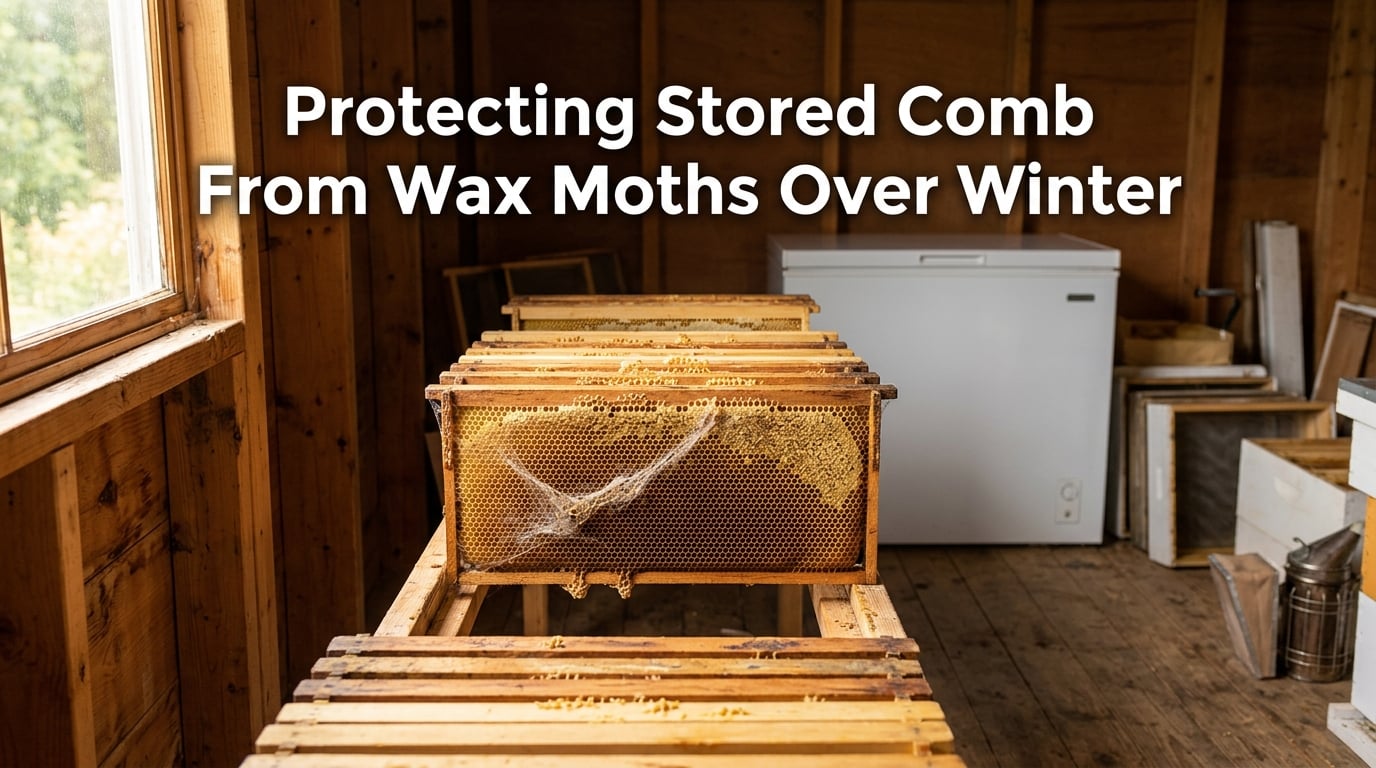
Drawn comb is one of the most valuable assets a beekeeper owns. Bees must consume roughly 8 pounds of honey to produce a single pound of wax. When that comb sits in storage over winter, wax moths see an all-you-can-eat buffet with no guard bees to stop them.
Protecting stored comb from wax moths over winter comes down to understanding how these pests operate and choosing the right defense method before damage starts. One infestation can destroy years of comb-building in a matter of weeks, leaving frames webbed together and useless.
In this guide, I cover every method that actually works: freezing, chemical treatment with Paramoth, biological control with Bacillus thuringiensis, light exposure, and heat treatment. I also walk through how to identify an infestation early and what to do with comb that is already damaged. By the end, you will have a clear plan for protecting your stored equipment from 2026 through spring.
Table of Contents
Why Wax Moths Threaten Stored Comb
Wax moths are nature’s recyclers. In the wild, they break down abandoned comb from dead colonies. In your storage shed, that same behavior destroys equipment you spent seasons building.
Two species cause problems for beekeepers. The greater wax moth (Galleria mellonella) is the more destructive of the pair. Its larvae are larger, eat more aggressively, and tunnel deeper into comb and even into woodenware. The lesser wax moth (Achroia grisella) is smaller and tends to be a secondary invader, moving in after greater wax moths have already started damage.
Both species target comb that contains pollen, honey residue, or brood cocoon silk. Clean, newly drawn white comb is far less attractive than dark brood comb packed with protein-rich debris. This is why brood frames are the most vulnerable during winter storage.
Here is why this matters so much. Each pound of drawn comb your bees produce represents about 8 pounds of honey converted into wax. Lose a box of 10 brood frames to wax moths, and you are not just losing wood and foundation. You are losing the energy equivalent of dozens of pounds of honey that your bees must spend again next season to rebuild from scratch.
Understanding the Wax Moth Lifecycle
To protect comb effectively, you need to know what you are fighting at each stage. Wax moths pass through four life stages: egg, larva, pupa, and adult moth.
Adult female moths slip into hives or storage areas at night and lay eggs in cracks, crevices, and along the edges of comb. A single female can lay 300 to 600 eggs during her lifespan. These eggs are tiny, pearly white, and nearly impossible to spot with the naked eye.
Eggs hatch in 3 to 5 days during warm weather, releasing the larvae that do all the real damage. The larvae immediately begin tunneling through comb, feeding on wax, pollen, honey, and cast larval skins. As they eat, they leave behind silken webbing that binds comb together and makes cleanup difficult.
After feeding for 19 to 34 days depending on temperature, larvae spin tough silken cocoons and pupate. They often chew into wooden frame parts to create a protected pupation chamber. This is why you find grooves and damage in the wood itself, not just the comb.
The full lifecycle from egg to adult can complete in as little as 6 weeks in warm conditions. In colder temperatures, development slows dramatically. Adult moths generally live for 3 to 4 weeks during the active season.
Can wax moths survive winter? Yes, but not as active adults in cold climates. Wax moths survive winter most commonly as pupae nestled inside their cocoons within stored equipment. Larvae can also survive in a slowed state if temperatures remain above freezing. This is why comb stored in a cool but not freezing shed can still develop an infestation by early spring.
Signs of a Wax Moth Infestation
Catching an infestation early can mean the difference between salvaging your comb and throwing it out. Here is what to look for when you inspect stored frames.
The most obvious sign is silken webbing stretched across comb surfaces and between frames. This webbing looks like spider silk but is denser and follows the tunnels the larvae have chewed. Once webbing covers a frame, the comb underneath is usually damaged beyond use.
Tunnels and galleries through the comb are another clear indicator. Larvae eat winding paths through the wax, and you will see these as darkened, jagged channels. Heavy infestations can reduce an entire frame of comb to a webbed mass of debris and frass.
Look for cocoons attached to frame tops, bottom bars, and the inside corners of boxes. These tough, brownish tubes are where larvae pupate. Check the wooden parts of frames for chewed grooves where larvae bored in to pupate.
Dark fecal pellets, called frass, accumulate on bottom boards and in box corners. If you see small dark specks gathering under stored equipment, larvae are actively feeding above.
In an active hive, a symptom called bald brood can indicate wax moth presence. Larvae tunnel under the cappings of worker brood cells, causing the bees to uncap those cells and leave pupae exposed. You will see patches of open cells with white pupae visible inside.
Protecting Stored Comb From Wax Moths Over Winter: Freezing Method
Freezing is the most reliable, chemical-free method for protecting stored comb from wax moths over winter. It kills eggs, larvae, and pupae at every stage without leaving any residue behind.
Step-by-Step Freezing Process
Start by inspecting each frame for visible signs of infestation. Remove any heavily webbed frames and set them aside for disposal or rendering. You want to freeze clean or lightly affected comb before moths can spread further.
Place frames into your freezer so that cold air can circulate around them. Do not stack frames tightly together, as the center frames may not reach a lethal temperature. If your freezer is small, process frames in batches.
Freeze the frames for a minimum of 24 hours. For thorough results, especially with deep brood comb, extend to 48 hours. The goal is to ensure the core temperature of every frame drops below the lethal threshold.
After freezing, let the frames warm back to room temperature gradually to avoid condensation buildup. Moisture trapped in sealed storage can lead to mold, which creates a separate problem.
Once dry and at room temperature, place the frames in airtight storage such as sealed plastic bags or tightly stacked boxes with no gaps. This prevents new moths from laying eggs on the now-clean comb.
Freezing Temperature and Time Guide
What temperature kills wax moths? The answer depends on the stage, but here are the proven thresholds:
At 20 degrees Fahrenheit (-6 degrees Celsius), freeze frames for at least 4 to 5 hours to kill all stages. Most standard chest freezers and upright freezers maintain 0 degrees Fahrenheit (-18 degrees Celsius) or colder, which makes the process faster.
At 0 degrees Fahrenheit (-18 degrees Celsius), 24 hours is sufficient to kill eggs, larvae, and pupae. If you want to be thorough or are dealing with thick, dark brood comb, extend to 48 hours for complete confidence.
At 10 degrees Fahrenheit (-12 degrees Celsius), aim for 24 to 48 hours. The denser the comb and the more material it contains, the longer it takes for the cold to penetrate to the core.
One important note: freezing kills whatever is in the comb at the time. It does not protect against future infestations. Once frames come out of the freezer, they are immediately vulnerable again unless sealed or treated with another method.
Using Paramoth (PDB) for Chemical Control
Paramoth, also called paradichlorobenzene or PDB, is a chemical treatment that has protected stored comb for generations. It works by sublimating from a solid crystal into a gas that penetrates stored equipment and kills wax moth eggs and larvae.
First, let me clear up a common and dangerous confusion. Paramoth (paradichlorobenzene) is not the same thing as mothballs (naphthalene). Mothballs contain naphthalene, which leaves residues in wax that can contaminate honey and harm bees. Never use naphthalene mothballs on beekeeping equipment. Always verify the active ingredient on the label is paradichlorobenzene before applying it to stored comb.
Here is how to apply Paramoth correctly. Stack your supers or boxes of frames in a tight column with no gaps between boxes. Place 3 tablespoons of Paramoth crystals on a piece of cardboard or a small paper plate on top of the uppermost box. Cover the entire stack with a telescoping cover or tarp to trap the gas inside.
The crystals sublimate into a gas heavier than air that sinks through the stack, penetrating the comb. Check the stack every 2 to 3 weeks and replenish the crystals as they disappear. In warm storage areas, crystals sublimate faster and need more frequent replenishment.
Paramoth kills eggs and young larvae but does not kill large larvae or pupae already inside cocoons. For this reason, freeze the comb first if you suspect an active infestation, then use Paramoth as an ongoing preventive during storage.
Before returning treated comb to live colonies, air it out for 24 to 48 hours. The PDB gas dissipates completely when the comb is ventilated. Always store treated equipment away from living colonies and never treat comb that still contains bees or honey intended for harvest.
Do not use Paramoth on honey supers that will hold extractable honey. While the gas dissipates, the safest practice is to reserve this treatment for brood comb and empty drawn comb in storage only.
Bacillus thuringiensis (BT) Biological Control
Bacillus thuringiensis, commonly called BT, is a naturally occurring soil bacterium that offers a biological approach to wax moth control. Products sold for beekeepers under names like B401 and Certan contain a specific strain of BT that targets wax moth larvae.
BT works differently from chemical treatments. When a wax moth larva ingests BT spores on the comb, the bacteria produce proteins that are toxic to the larva’s digestive system. The larva stops feeding within hours and dies within a few days. Importantly, BT is harmless to bees, humans, and other mammals.
To apply BT, dilute the liquid concentrate with water according to the product label, then spray it evenly over both sides of every frame. Make sure to coat the comb surface completely, paying attention to corners and edges where eggs are typically laid. The treatment must be applied to comb before storage.
BT is best used as a preventive measure on clean comb that is about to go into storage. It is not effective against larvae already deep inside tunnels or pupae inside cocoons, so combine it with freezing if you are unsure about existing infestation levels.
One advantage of BT over chemical treatments is that treated comb can go directly back onto hives without an airing-out period. There are no chemical residues to worry about. The main limitation is availability, since BT products for beekeeping are not always easy to find in every region.
The protective effect of BT lasts for several months, making it well suited for comb stored over winter. However, it does degrade over time, so reapply if comb remains in storage through a full year or longer.
Light and Ventilation as Natural Deterrents
Wax moths prefer dark, undisturbed environments. You can use their biology against them by storing comb in conditions that make it difficult for them to thrive.
The light exposure method works on a simple principle: adult moths avoid bright light, and larvae develop more slowly in well-lit conditions. To use this method, stack your stored supers with gaps between boxes so that light and air can enter from multiple directions.
Stack frames in a crisscross or diagonal pattern rather than aligning them all in the same direction. This creates openings where light and airflow can pass through. Many beekeepers store supers outdoors under a covered porch or in a well-ventilated shed using this technique.
Be aware that light exposure alone is not a complete solution. It works best as a supplementary measure alongside freezing or chemical treatment. In warm southern climates, moths can still lay eggs and damage comb even in well-lit storage if temperatures stay high enough for active development.
Good ventilation serves double duty by keeping stored comb dry and less attractive to moths. Moisture in stored equipment promotes mold growth and creates conditions that wax moths find appealing. Store comb in dry locations with air circulation to minimize both problems.
Heat Treatment as an Alternative
If freezing is not practical, heat treatment offers another way to kill wax moths at all stages. The key is reaching temperatures high enough to be lethal without melting the wax itself.
Wax moth eggs, larvae, and pupae die at sustained temperatures of 115 degrees Fahrenheit (46 degrees Celsius) for 80 minutes or more. Since beeswax melts at approximately 145 degrees Fahrenheit (63 degrees Celsius), there is a workable margin, but you must monitor temperature carefully.
Heat treatment is less common than freezing because it requires precise temperature control. A small greenhouse, a vehicle parked in direct sun on a hot day, or a temperature-controlled oven can work for small batches. Use a thermometer to monitor the comb temperature and never exceed 120 degrees Fahrenheit to avoid wax damage.
This method is best suited for beekeepers in hot climates during summer. It is harder to control during winter storage, which is why most beekeepers rely on freezing or chemical methods for their cold-season comb protection.
Prevention Through Strong Colonies
The best defense against wax moths in active hives is a strong, populous colony. Bees naturally patrol comb and remove wax moth eggs and young larvae. A colony with enough bees to cover every frame leaves no unprotected comb for moths to exploit.
Wax moth problems in living hives almost always signal an underlying issue: a weak colony, a queenless hive, or a colony that has died out. Before storing comb from a colony, assess whether that colony was strong enough to have kept moths at bay.
When pulling supers for winter storage, do it promptly. Comb sitting on a weak or shrinking colony in late fall is an open invitation for moths. Remove surplus supers as the colony contracts for winter and move them straight into your chosen protection method.
Never leave drawn comb on a dead or dying colony. Within days, wax moths can move in and destroy comb that could have been saved. Inspect your apiary regularly in fall and pull equipment from any colony that is not going to survive winter.
Dealing With Already Infested Comb
Sometimes you discover damage after the fact. What you do next depends on how bad the infestation is and what type of comb is affected.
For lightly infested comb with minimal webbing and a few tunnels, freeze the frames for 48 hours to kill all live moths. Place the cleaned frames back on a strong colony in spring, and the bees will often repair the damage within a day or two. Bees are excellent at cleaning up wax moth damage when given the chance.
Moderately damaged comb with significant webbing but intact comb structure can sometimes be salvaged. Freeze first, then scrape away the worst webbing before returning frames to bees. The colony will chew out remaining debris and redraw damaged areas.
Severely damaged comb with extensive tunnels, thick webbing, and cocoons embedded in the wood should be destroyed. Remove the comb entirely, melt out any remaining wax for rendering, and replace the foundation. Comb this far gone is not worth the risk of reintroducing pests to your colonies.
If woodenware itself has been chewed by pupating larvae, scrape the grooves clean and consider replacing badly damaged frame parts. Cocoons left in wood can survive freezing and chemical treatment, so thorough cleaning is essential.
FAQs
Can wax moths survive winter?
Wax moths survive winter most commonly as pupae inside their silken cocoons within stored equipment. Larvae can also survive in a slowed state if temperatures stay above freezing. Freezing comb at 0 degrees Fahrenheit for 24 to 48 hours kills all stages and prevents survival through winter storage.
What temperature kills wax moths?
Freezing at 0 degrees Fahrenheit (-18 degrees Celsius) for 24 hours kills wax moth eggs, larvae, and pupae. At 20 degrees Fahrenheit (-6 degrees Celsius), you need 4 to 5 hours. For thorough results with dark brood comb, extend freezing to 48 hours. Heat treatment at 115 degrees Fahrenheit (46 degrees Celsius) for 80 minutes also kills all stages.
What to do with wax moth infested comb?
Freeze infested comb for 48 hours to kill all live moths, then return lightly to moderately damaged frames to a strong colony in spring. Bees can clean and repair minor damage within 24 to 48 hours. Severely damaged comb with heavy webbing and cocoons in the wood should be destroyed and replaced with new foundation.
What repels wax moths?
Bright light, good ventilation, and airtight storage after freezing all help repel wax moths. Adult moths avoid well-lit areas, so stacking stored supers diagonally with light gaps between boxes discourages egg-laying. Paramoth (paradichlorobenzene) gas and Bacillus thuringiensis spray also effectively repel and kill wax moths on stored comb.
Can wax moths damage stored beeswax?
Yes, wax moth larvae feed on beeswax along with pollen, honey residue, and brood cocoon silk. They tunnel through comb leaving silken webbing and can destroy entire frames of stored comb within weeks. Dark brood comb is especially vulnerable because it contains the protein-rich material larvae prefer.
Is Paramoth the same as mothballs?
No. Paramoth contains paradichlorobenzene (PDB) which is safe for treating stored beekeeping comb. Mothballs contain naphthalene, which leaves toxic residues in wax that can contaminate honey and harm bees. Never use naphthalene mothballs on any beekeeping equipment. Always check the active ingredient on the label before use.
Conclusion
Protecting stored comb from wax moths over winter comes down to three proven strategies: freeze your comb before storage, protect it with Paramoth or BT during storage, and store it in well-ventilated, light-exposed conditions. Inspect your stored equipment monthly through winter, and never hesitate to freeze again if you spot any signs of activity.
Your bees spent the entire season building that comb. Give it the protection it deserves so your colonies start next spring strong and ready to produce.